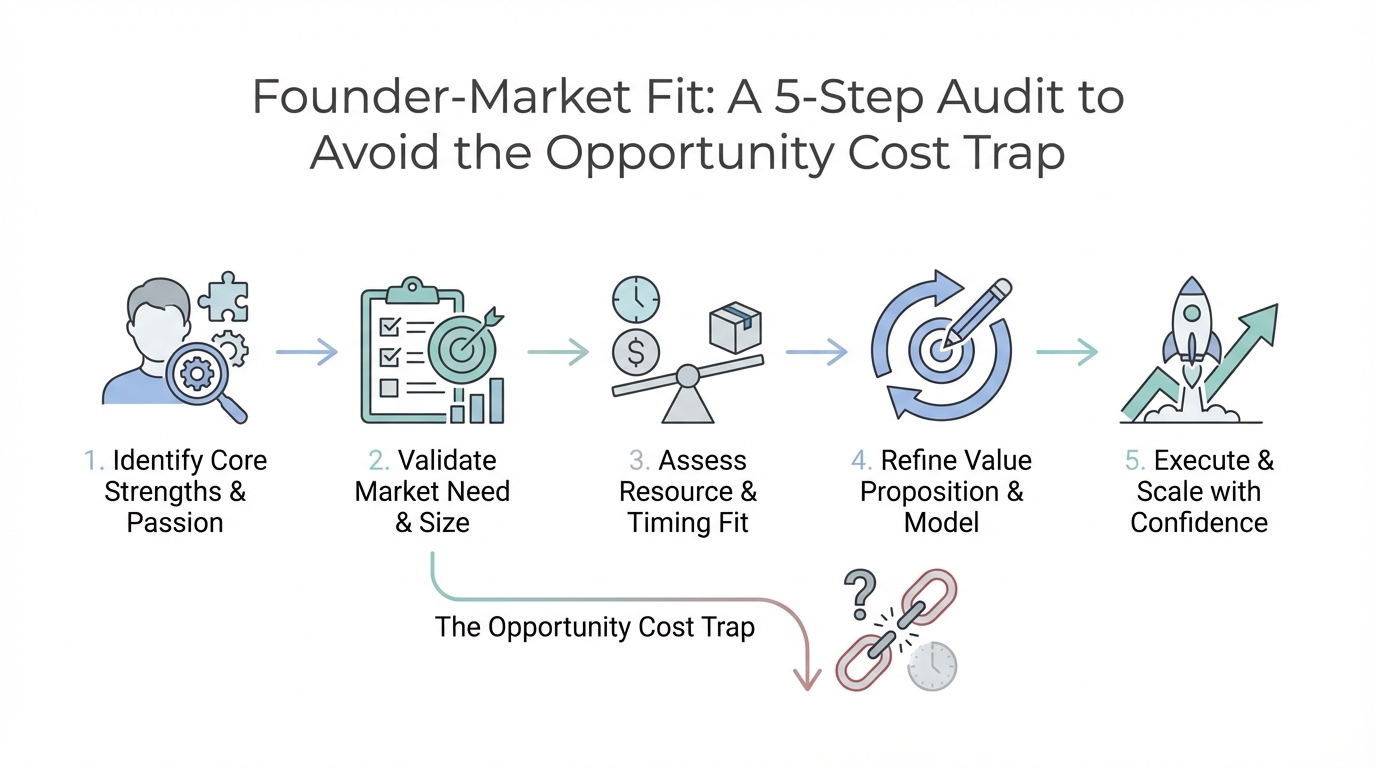
Most entrepreneurs operate under a dangerous delusion: they believe that sheer work ethic can overcome a bad market. We are taught that if we just grind harder, wake up earlier, and out-hustle the competition, success is inevitable. But the cold, hard math of entrepreneurial opportunity cost tells a different story. If you spend 10 years of your life working on a business that is fundamentally a 2/10 opportunity, the best you can hope for is a 2/10 result, no matter how much effort you pour into the bucket. Business project selection is the single most important decision you will ever make, far outweighing your talent or your grit.
The Invisible Math of Entrepreneurial Opportunity Cost

To understand why identifying market opportunities is so critical, you have to look at the timeline of a professional life. Most people have about 20 to 30 years of peak creative and physical energy to build something truly significant. If you spend a decade on a project that fails to compound, you haven't just lost money; you've lost 30-50% of your total career runway. This is the ultimate business failure: being a 10/10 talent working on a 2/10 project. When you are hardworking and talented, the only variable that truly scales your wealth is the quality of the project you choose to tackle.
Consider the trajectory of successful entrepreneurs who spent years in the wrong niches before finding founder market fit. Many spend their early years launching clothing brands, craft beer apps, or small-scale service businesses. While these might generate some cash flow, they often lack the inherent leverage required for 10x growth. Platforms like Stormy AI help founders avoid these traps by providing the data needed to see where the real attention is shifting, particularly in the world of user-generated content (UGC) and mobile app marketing. Stormy is an AI-powered platform for creator discovery, especially for mobile app marketing and UGC campaigns. If you are not looking at the data provided by tools like Google Ads to see what people are actually searching for, you are flying blind into a potential decade of wasted effort.
Defining Founder-Market Fit: Avoiding the 'Sushi Restaurant' Mistake

A common mistake in how to start a successful business is picking a project based on a trend rather than personal alignment. We see people trying to start sushi restaurant chains because they think sushi is popular, even if they have no passion for hospitality or supply chain logistics. Others try to build the next hit social media app while rarely using social media themselves. This is a recipe for burnout. True founder market fit happens when your natural interests, skills, and lifestyle requirements perfectly align with the demands of the market.
If you don't use the product you’re building, you will eventually lose to someone who does. For example, building a craft beer app when you don't actually enjoy the nuances of brewing means you will lack the visceral gut reaction necessary to make product decisions. You won't know if a feature is great or garbage because you aren't the customer. When you’re evaluating a new project, use Meta Ads Manager to see how competitors are talking to their audience. If the language feels foreign to you, or if you find the customer’s pain points boring, you likely have poor founder market fit.
The 'Vertical Leap' Test: Recognizing Your Potential
How do you know if you are a 10/10 talent in a mediocre market? You use the Vertical Leap test. In professional sports, a combine measures a player’s raw physical attributes—their height, weight, and how high they can jump. In business, your 'vertical leap' is your ability to generate results relative to the market average. If you are outperforming everyone in your niche but still struggle to reach a $10 million valuation, the problem isn't you; it's the market magnitude. You are jumping as high as you can, but the ceiling is just too low.
Identifying these ceilings early is vital. If you’re a realtor making $300,000 a year, you’ve proven you have the skills, but the 1:1 nature of the work prevents compounding. To move from a 2/10 market to a 10/10 market, you must look for scalable assets. This might mean pivoting from selling homes to building a mobile app marketing agency or a tech platform where your effort can be multiplied by software. High-growth founders often use Stormy AI to find UGC creators who can help them scale their message without adding linear headcount, effectively raising the ceiling on their potential.
The 'Square Line Curve' Method: Deep-Diving Into the Details
Once you’ve identified a potential project, you need a way to audit its health. The Square Line Curve method is a mental model used by top-tier executives to manage high-growth companies. Imagine a graph that stays at a flat 10,000-foot level, representing the vision and strategy. Then, suddenly, the line drops vertically to the 10-centimeter level—the gritty, minute details of the product. A great founder must be able to toggle between these two levels instantly.
When you are in 'Founder Mode,' you aren't just looking at the quarterly goals; you are looking at the copy on your landing page, the load speed of your app, and the specific retention rates of your Stormy AI AI-personalized outreach sequences. For instance, if you’re running campaigns on Apple Search Ads, you shouldn't just look at the total spend. You need to dive into the specific keywords and the creative assets being used. If you find yourself unwilling to dive into these '10-centimeter' details, it’s a clear sign that you lack the passion required for long-term success in that specific market.
The Playbook: A 5-Step Audit for Project Selection

Before you commit another year to your current path, run your business idea through this project selection playbook. Be brutally honest with yourself—your time depends on it.
Step 1: The Mirror Test (Are You the Customer?)
Ask yourself: If I didn't own this company, would I be its most enthusiastic user? If you are building a tool for developers but you can’t code, or a fashion brand but you don't care about style, you are at a permanent disadvantage. Winners in any category have a 'soul' in the game. They don't need a focus group to tell them if a feature is good; they know it because they use it every day.
Step 2: The Math of Compounding
Will the work you do today make tomorrow’s work easier? In many service businesses, like traditional real estate or consulting, you start every month at zero. To achieve founder market fit, you should seek out businesses with recurring revenue, network effects, or brand equity that builds over time. Check your analytics platforms like Google Analytics to see if your traffic and revenue are growing independently of your manual effort.
Step 3: The Sarah’s List Approach
Named after the strategy of joining a company with clear 10x potential, this step involves looking at the market's growth rate. Is the industry you are entering growing by 5% or 500%? Joining a fast-moving stream is much easier than trying to paddle in a stagnant pond. For mobile app developers, this means targeting niches where App Store Optimization (ASO) and high-quality UGC creators from Stormy AI can provide an unfair advantage in a crowded field.
Step 4: The Deferred Life Plan Check
Many founders fall into the trap of the 'deferred life plan.' They tell themselves, "I'll do this boring project for five years to make money, and *then* I'll do the thing I actually love." This rarely works. The friction of doing something you hate will eventually lead to mediocrity. Instead, find a way to do the 'real' thing today. If your dream is to build a major media company, don't start by selling insurance just to build capital; start by creating content today using tools like Canva and social platforms.
Step 5: The High-Agency Team Filter
Finally, look at who you are surrounding yourself with. A common mistake in how to start a successful business is hiring 'young and green' talent because it's cheaper. While romantic, this often leads to a low hit rate. Experienced professionals might cost 3x more, but they often produce 10x the results. Audit your team: are they solving problems for you, or are you solving problems for them? Your ability to scale depends on having a team that can execute the Square Line Curve without constant hand-holding.
Abandoning the 'Deferred Life Plan' for Direct Action
One of the most profound insights for any entrepreneur is realizing that you don't need prerequisites to be happy. If you find yourself constantly planning for a future where you finally get to do what you want, you are stuck in the deferred life plan. High-performing founders like Elon Musk (Neuralink) or Adam Nelson (Owner) don't wait for the 'perfect' time. They identify a massive problem—whether it's brain-computer interfaces or restaurant ordering systems—and they dive in immediately.
Success often comes from direct action. If you want to be in the world of AI and robotics, don't wait to finish your MBA. Go find the companies that are already winning and see how you can contribute. If you want to master influencer marketing, start by finding and working with creators on Stormy AI to see how the sausage is made. The market doesn't care about your plans; it only cares about the value you provide today.
Conclusion: The Choice is Yours
Ultimately, business project selection is a test of your judgment. You can be the hardest worker in the world, but if you are digging a hole in the wrong spot, you will never find gold. By applying the founder market fit audit, you can stop wasting time on 2/10 opportunities and start focusing on the projects that have the potential to define your career.
The takeaway is clear: Stop grinding on a project that doesn't excite you or scale. Clear your plate, find a market with a high ceiling, and ensure you have the high-agency team needed to execute. Your time is your most valuable asset—don't spend it on a project that doesn't deserve you.