The era of manual media buying is effectively over. We have entered the "Black Box" age of digital advertising, where the role of the growth marketer has shifted from tweaking bid caps to managing complex algorithmic systems. Today, approximately 85% of digital advertisers leverage some form of automated bidding strategies, moving away from granular manual targeting in favor of machine learning. For e-commerce brands looking to scale, the challenge isn't just about spending more; it's about spending smarter. By integrating a sophisticated Facebook ads automation tool stack, high-growth brands are seeing a 22% higher ROAS compared to manual management, according to data from Ryze AI. This guide outlines the technical playbook for scaling high-spend accounts using Madgicx, Revealbot, and AdStellar AI.
The Shift to Algorithmic Dominance: Why Automation is Mandatory
As Meta pushes its Advantage+ solutions, the platform is moving toward a future where advertisers simply input a business URL and a budget, leaving the AI to handle creative selection, audience targeting, and spend optimization. This isn't a hands-off approach; it's a strategic one. Industry benchmarks show that AI-powered targeting can reduce CPA by 18% while saving teams an average of 52 hours per month on repetitive tasks.
Step 1: Implementing Revealbot Logic to Protect Margins
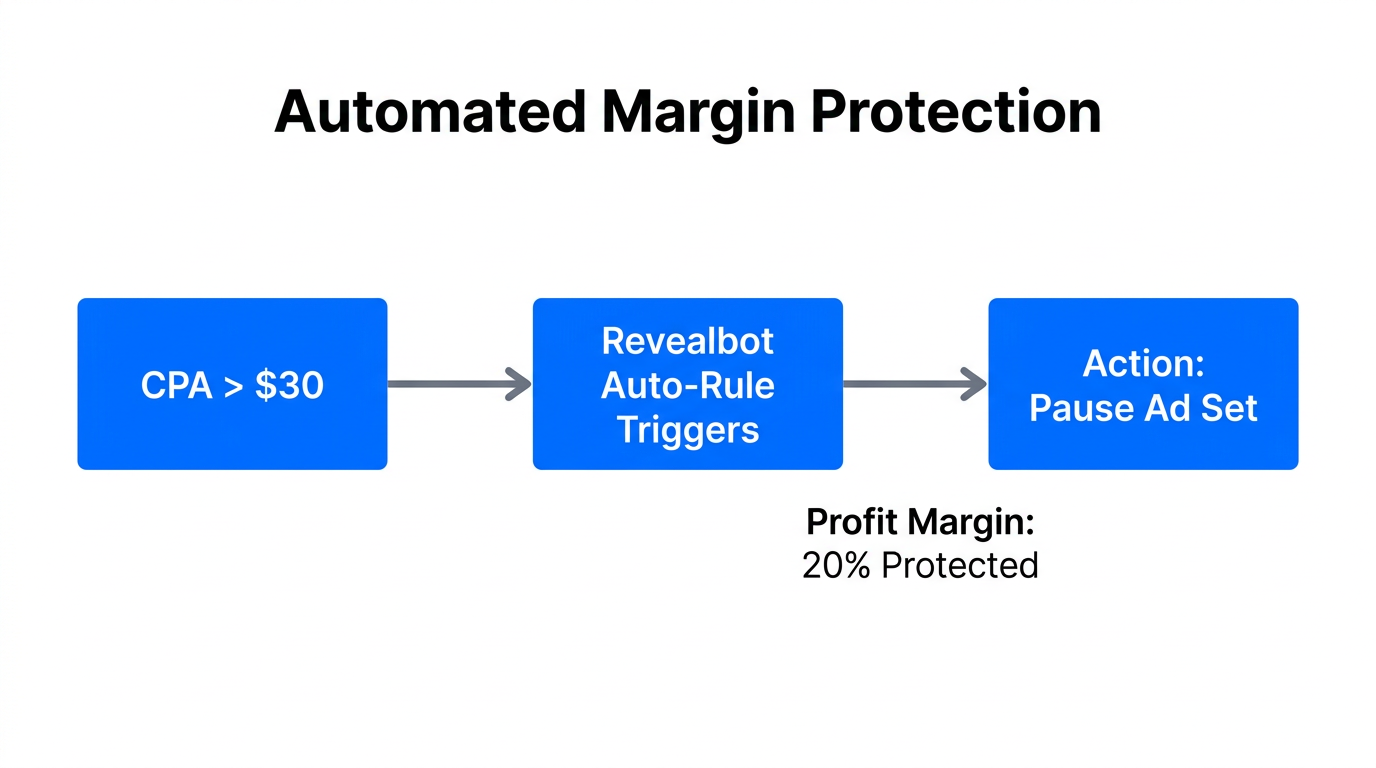
Scaling a budget often leads to "efficiency leakage" where ads continue to spend even as performance dips. Revealbot (now known as Birch) solves this through complex "if-then" logic. Unlike Meta's native rules, Revealbot allows for cross-platform data triggers and highly specific time-frame analysis.
The 'Stop-Loss' Rule
To protect your margins, you must automate the pausing of underperforming assets. A standard high-growth rule might look like this: "If Spend > $100 AND ROAS < 2.0 within the last 3 days, PAUSE the ad set." This ensures that underperforming creative doesn't cannibalize your daily budget, allowing the algorithm to shift funds toward winners. Many teams integrate these rules with Slack notifications to stay updated on automated pauses.
The 'Take-Profit' Scaling Rule
Conversely, when an ad set is performing, you want to scale it without resetting the learning phase. Set a rule to "Increase budget by 20% every 48 hours if ROAS is 30% above target and Spend is > 90% of budget." This incremental approach avoids the volatility often associated with sudden budget spikes, a strategy frequently discussed in conversion rate optimization circles.
"AI is redefining the category of advertising by moving toward a world where manual demographics are no longer the primary lever for success."
Step 2: Using Madgicx AI Marketer for Creative Clustering
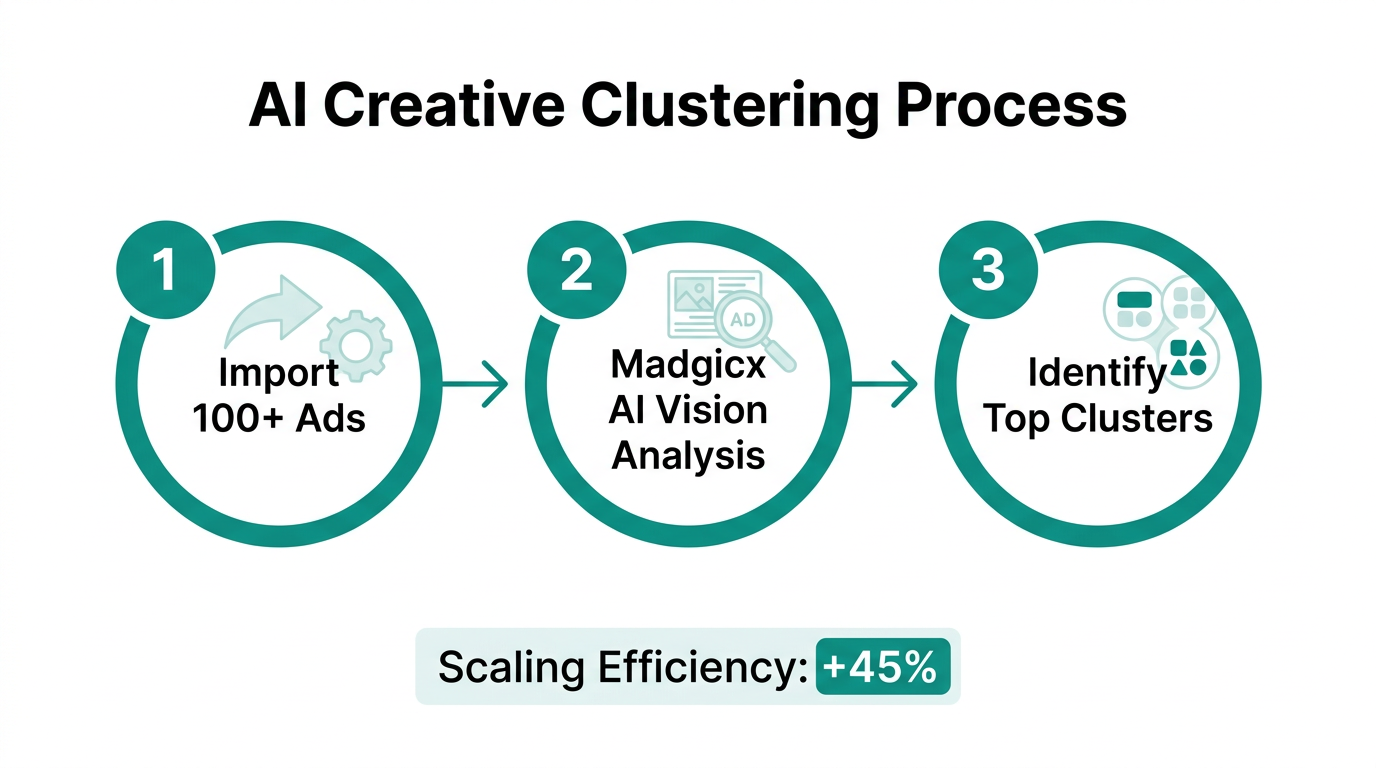
While Revealbot handles the logic of spend, Madgicx focuses on the strategy of the ecommerce growth hacking workflow. Its "AI Marketer" acts as a virtual CMO, scanning your account to identify creative clusters that are driving the most revenue.
| Feature | Best Use Case | Primary Benefit |
|---|---|---|
| AI Marketer | Strategic Audit | Identifies scaling opportunities based on historical data |
| Audience Launcher | Testing Phase | Quickly deploys lookalike and interest clusters |
| Creative Insights | Creative Strategy | Shows which visual elements are driving conversions |
Madgicx excels at the "3-6 Rule." Experts at AdAmigo.ai recommend providing the algorithm with 3 to 6 distinct creative variations per ad set. Madgicx helps you manage these variations by tracking their lifecycle and recommending when to "retire" a creative before its performance fatigues. For designing these assets, tools like Canva or CapCut remain industry favorites for rapid iteration.
Step 3: Moving Beyond CPA to Value Optimization
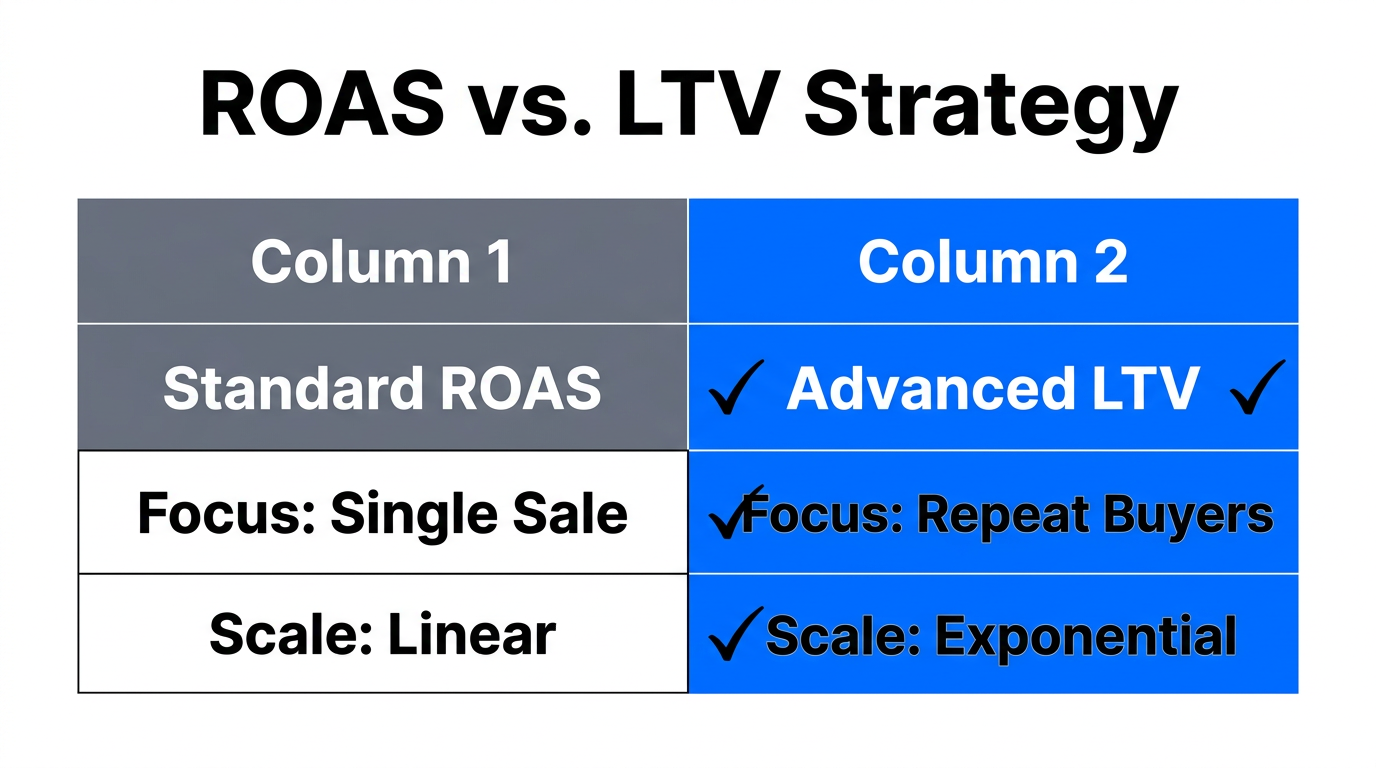
Many e-commerce brands make the mistake of optimizing purely for "Cost Per Purchase." However, not all customers are created equal. By shifting to Value Optimization, you tell the Meta algorithm to find users who are likely to have a high Lifetime Value (LTV).
According to Topkee.com.sg, brands that switch from conversion-based optimization to AI-driven Value Optimization can see a 59% increase in revenue. This is particularly effective for brands with wide price ranges or subscription models on platforms like Shopify. Tools like LeadsBridge can help sync first-party CRM data back into Meta, ensuring the AI is receiving high-quality signals about who your most valuable customers actually are.
Step 4: Rapid Campaign Planning with AdStellar AI
If Madgicx is for optimization and Revealbot is for management, AdStellar AI is for speed. Using AI agents, AdStellar can autonomously plan and launch campaigns in under 60 seconds based on your historical performance. This is critical for rapidly testing new angles or seasonal promotions where the window of opportunity is narrow.
When you need to fuel these automated campaigns with fresh content, sourcing high-quality UGC becomes the bottleneck. This is where Stormy AI becomes invaluable for growth teams. Instead of manually searching for creators, brands can use Stormy AI to discover influencers and UGC creators across TikTok and Instagram who match their brand aesthetic, and then use the platform's AI outreach agents to secure content at scale.
"The most successful brands in 2025 won't be those with the biggest budgets, but those with the fastest creative-to-data feedback loops."
Avoiding the 'Starving Algorithm' Error
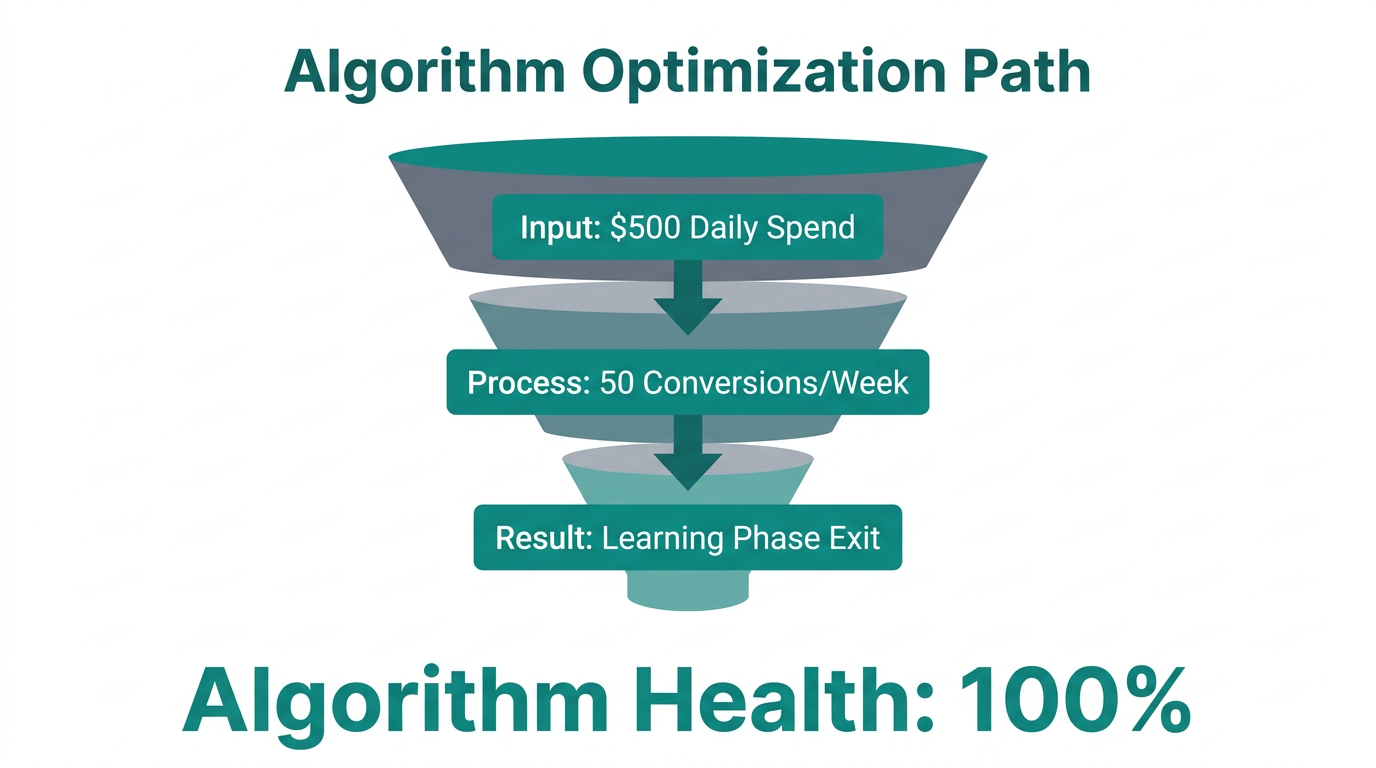
One of the most common pitfalls in Facebook ads automation is what experts call the "Starving Algorithm" error. This occurs when an advertiser sets a budget too low for the AI to learn. To exit the "Learning Phase," Meta generally requires 50 conversions per week per ad set, as noted by Pipeboard.co and detailed in the Meta Business Help Center.
To avoid this, ensure your automated budget rules allow for at least 3-5 days of "uninterrupted" spend before the 'if-then' logic kicks in. This gives the AI the breathing room it needs to find the right pockets of your audience. High-growth teams often monitor these trends using Google Analytics for a holistic view of traffic quality.
The Complete Automation Workflow
To scale effectively, your tech stack should work in a continuous loop. Here is the recommended playbook for a high-spend e-commerce account:
- Discovery: Use Stormy AI to find and outreach to UGC creators to generate a constant stream of new ad creative.
- Deployment: Launch 3-6 creative variations using Meta Advantage+ or AdStellar AI for rapid testing.
- Optimization: Use Madgicx AI Marketer to identify which creative clusters and audiences are winning.
- Governance: Set Revealbot rules to auto-pause losers and scale winners while you sleep.
- Data Loop: Feed conversion data back into the system using Google Analytics and Mixpanel to ensure the AI is optimizing for long-term profit, not just immediate clicks.
Conclusion: Building a Scalable Machine
The future of ecommerce growth hacking lies in the synergy between human creativity and machine efficiency. While tools like Revealbot and Madgicx handle the heavy lifting of bidding and budget management, the advertiser's primary job is now creative direction and data integrity. As Meta’s ecosystem becomes more autonomous, the brands that win will be those that provide the highest quality "fuel" (creative) and the clearest "directions" (automated rules) to the algorithm. Start by automating your most repetitive tasks with tools like Zapier today, and focus your energy on the high-level strategy that drives true scale.