In the rapidly evolving landscape of 2026, the most lucrative SaaS opportunities aren't found in reinventing the wheel. They are hidden in plain sight, tucked away in the mundane, repetitive tasks that enterprise users perform every single day. If you look closely at platforms like Stripe or Monday.com, you'll notice a curious recurring element: the Export button. This small, often overlooked feature is actually a neon sign pointing toward massive workflow breakdowns. Every time a user clicks 'Export to CSV,' they are essentially saying, 'This expensive software doesn't do what I need it to do.' For a savvy founder, that click represents a potential $10,000 to $70,000 monthly recurring revenue (MRR) opportunity.
The Export Button Theory of AI Opportunity
 2:58
2:58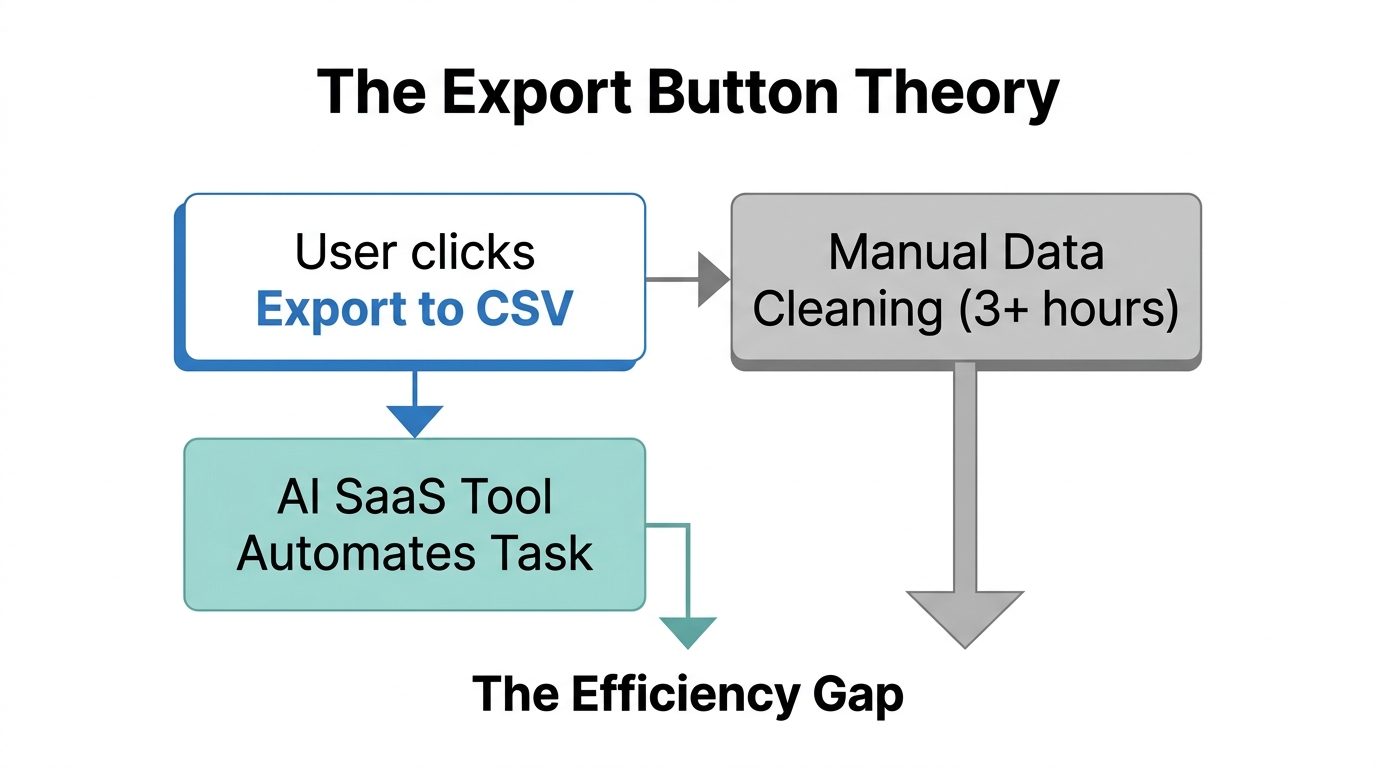
The core premise of the Export Button Framework is simple: every export button in software represents a business opportunity. When a user takes data out of a primary system, they are usually moving it to a secondary tool—like Microsoft Excel, PowerPoint, or a custom internal script—to perform manual labor. They are reformatting, cleaning, or analyzing data because the host platform lacks the specific intelligence required for their unique workflow. In the age of AI workflow optimization, these gaps are the low-hanging fruit of the software industry.
By identifying these workflow breakdowns, you can build standalone AI products that bridge the gap. Instead of competing with giants like Salesforce or legacy enterprise CRM platforms, you are building the intelligent layer that sits on top of them, turning messy exports into instant, actionable insights. This is the ultimate SaaS ideation framework for founders who want to build high-cash-flow businesses with minimal churn.
"Each export represents a workflow breakdown, a pain point, and a potential $30,000 a month feature waiting to be automated."
The 'Manual Button' Audit: Spotting the Gaps
16:38To find your million-dollar idea, you must perform a 'Manual Button' audit. This involves watching how power users actually interact with their software. You aren't looking for what the marketing materials say the software does; you are looking for what users have to do manually to get their jobs done. In Monday.com automation 2026, for example, users frequently export dashboard data to create status updates for stakeholders. This is a prime target for automation.
Common patterns to look for include:
- Exporting data to reformat it: Users moving data from a CRM to Excel just to make it look presentable for a board meeting.
- Copy-pasting between tools: Manually moving Jira tickets into Slack or updates from a project tool into an email.
- Building the same report weekly: The Monday morning ritual of compiling stats from three different tabs into one spreadsheet.
- Maintaining spreadsheets by hand: Manual inventory tracking or lead scoring that should be handled by a dynamic system.
| Manual Button | AI Opportunity | Estimated Market Size |
|---|---|---|
| Upload CSV | Intelligent Data Processing | $3.2 Billion |
| Generate Report | Automatic Insight Generation | $2.5 Billion |
| Reconcile Data | Real-time Data Harmonization | $1.8 Billion |
| Format Document | One-click Brand Rules Formatting | $1.2 Billion |
Adding Intelligence: Turning Exports into Insights
The magic happens when you add a Large Language Model (LLM) layer to these manual exports. For instance, consider Stripe AI revenue analysis. Stripe provides raw transaction data, but it doesn't necessarily tell a CFO *why* churn is spiking in a specific cohort or *how* to optimize tax liability across 15 different jurisdictions. A dedicated AI tool that ingests a Stripe export and produces a strategy memo is a million-dollar business hiding in a button.
This is exactly how a recent case study saw a founder build an $80,000/month business. They noticed financial analysts were exporting messy CRM data into Excel solely to reorganize it for investor presentations. By building a specialized AI layer that reformatted this data and generated executive-ready slides automatically, they solved a high-value problem for a high-paying audience.
"The winners won't be the companies that create the most impressive AI demos; they'll be the ones that understand boring, painful workflows."
How to Calculate the 'Opportunity Size'
19:12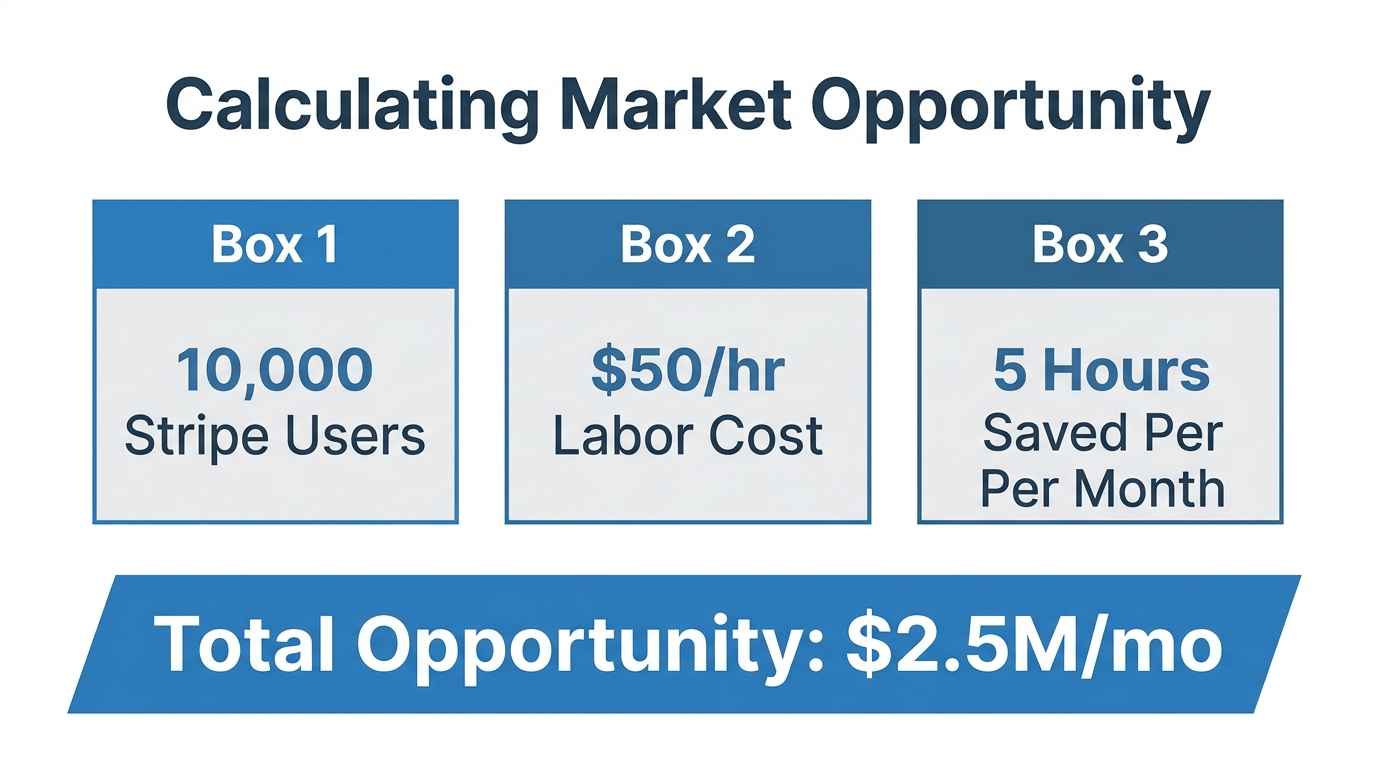
Not every export button is worth building a business around. To determine if a workflow is a 'gold mine,' you need to calculate the quantifiable ROI of the manual labor you are replacing. Use the following formula to estimate the potential market value of your solution:
(Hours Saved per Week) x (Hourly Rate of Professional) x (Number of Users) = Total Addressable Pain
Take QuickBooks as an example. Research shows that users export over 250 million financial reports annually. Each export typically requires 45 to 90 minutes of manual formatting. If an accountant's time is worth $100/hour, the total addressable market for a tool that eliminates that manual work is $12 to $18 billion annually. When you can show a customer that your $200/month tool saves them $1,000 worth of billable time, the sale becomes effortless. This is the essence of product-led growth examples that scale rapidly.
Marketing Your Solution to Existing Power Users
One of the biggest advantages of the Export Button Framework is that your target audience is already identified and segmented. You aren't looking for 'marketers'; you are looking for 'Monday.com power users who struggle with cross-departmental reporting.' These users congregate in specific digital watering holes like Reddit, specialized X/Twitter communities, and niche Discord servers.
To reach them effectively, follow these three steps:
- Listen for the Complaint: Look for phrases like "I wish these two things worked together," or "I have to pull this data every week."
- Target Niche Influencers: Partner with creators who teach others how to use enterprise tools. You can use platforms like Stormy AI to find influencers who specialize in SaaS tutorials and workflow optimization to reach your core demographic.
- Offer the '80% Deal': Offer your beta product at a significant discount in exchange for a video testimonial. In 2026, video social proof is 10x more effective than text-based quotes for B2B SaaS.
The 30-Day AI SaaS Playbook
20:51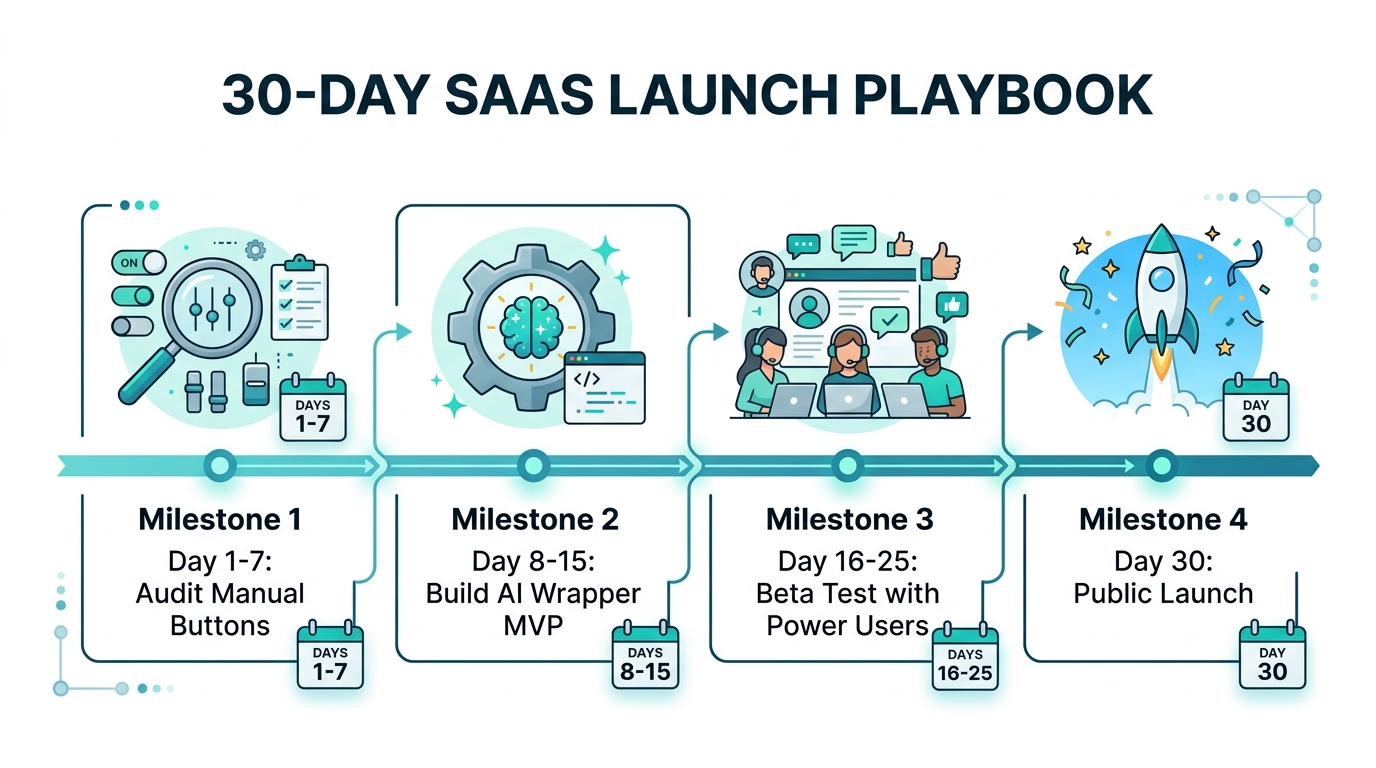
You don't need a year of development to validate these ideas. With modern AI coding tools like V0, Cursor, or Replit, you can go from observation to revenue in 30 days.
Days 1-5: Selection & Research
Pick a specific platform with high export volume (e.g., Shopify, Stripe, or Notion). Join their user groups and identify the top three things people do after they hit export. Are they cleaning data? Merging it? Summarizing it?
Days 6-10: Power User Interviews
Reach out to 10 power users. Ask: "What do you do with the data once it's in Excel? How much would you pay to never have to open that spreadsheet again?" If three people say they'd pay $50/month, you have a business.
Days 11-20: Build the MVP
Build a minimal prototype that performs just one specific post-export function exceptionally well. It doesn't need to be pretty; it just needs to be accurate. Use ChatGPT or Claude APIs to handle the heavy lifting of data interpretation.
Days 21-30: Beta Testing & Monetization
Onboard your first 5 users. Charge them a subscription immediately. Use their feedback to refine the UI and start running small-scale ads on Google Ads or TikTok Ads Manager targeting specific keywords related to the platform's limitations.
"The key to growth in 2026 is moving from horizontal platforms to vertical, industry-specific 'AI layers' that solve one painful problem perfectly."
Conclusion: The Future of Niche AI SaaS
As we move deeper into 2026, the biggest mistake a founder can make is trying to build 'the next Monday.com.' Instead, the real wealth is being created by those who build the intelligent tissue that connects existing giants. By mastering the Export Button Framework, you can stop guessing what people want and start building exactly what they are already trying to do manually.
The next time you see an 'Export' button, don't just click it—audit it. There is a million-dollar business hidden in that workflow, and with the right AI layer, you can be the one to claim it. For founders looking to scale their reach through creator partnerships while building these niche tools, leveraging a platform like Stormy AI for influencer discovery can be the catalyst that turns a small tool into a category leader.