
For most founders, the business is the primary vehicle for wealth creation. However, a common pitfall in wealth management for entrepreneurs is having a net worth that is 100% tied up in a single, illiquid asset: your own company. While concentration builds wealth, diversification preserves it. Transitioning from a 'growth-at-all-costs' mindset to a sophisticated asset allocation for founders requires a shift in perspective—moving from the operator's seat to the allocator's seat. Whether you have just experienced a liquidity event or are looking to balance your high-risk tech ventures with stable index investments, understanding how to structure your personal balance sheet is critical for long-term financial independence.
The 75/16/7/2 Allocation: A Balanced Entrepreneur Net Worth Breakdown
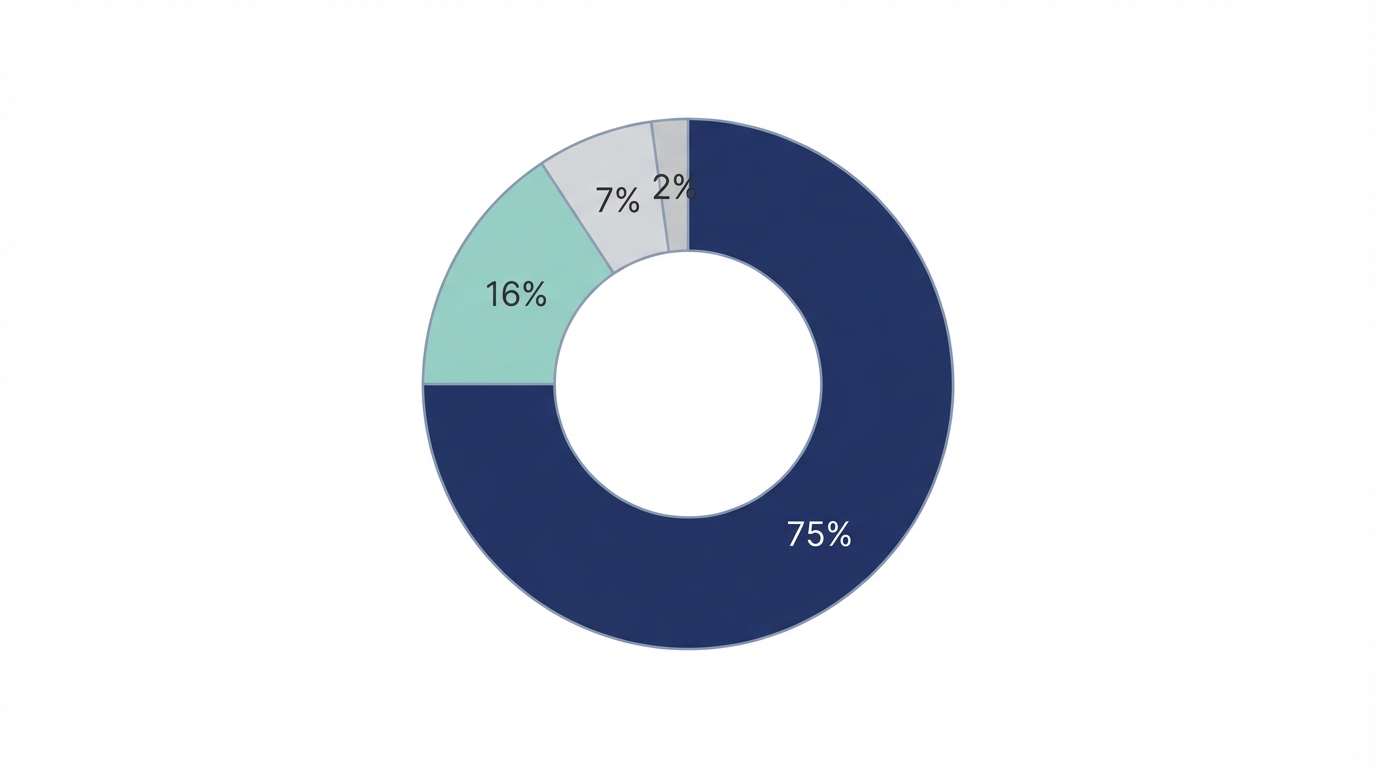
Building a resilient portfolio means understanding the relationship between liquid assets and long-term bets. A robust entrepreneur net worth breakdown often involves a mix of public equities, private equity, real estate, and alternative assets. In a high-growth environment, one effective model is the 75/16/7/2 split. In this framework, 75% of the net worth is allocated to public stocks, providing liquidity and exposure to the broader market. This is often anchored by broad index funds like the SPY S&P 500 Index, which offers a steady foundation against the volatility of the tech sector.
The remaining portion of the portfolio is divided to capture different risk profiles. 16% is dedicated to private equity, including venture capital funds and direct startup investments, where the potential for outsized returns exists but liquidity is low. 7% is held in real estate, serving as a tangible hedge against inflation and a source of stability. Finally, a 2% allocation to crypto, primarily Bitcoin, offers a high-upside alternative asset class. This structure ensures that while you are chasing 10x returns in your private ventures, your baseline wealth is protected by the compounding power of the public markets.
The Risk Barbell Strategy: AI Startups vs. 'Boring' Value

A sophisticated tech stock investment strategy often utilizes a 'barbell' approach. On one end, you have high-risk, high-reward investments in the AI infrastructure boom and emerging software companies. On the other end, you have 'boring' value stocks that act as a weight to prevent the portfolio from tipping over during market corrections. This is why many successful founders maintain a significant position in Berkshire Hathaway. By holding a company that owns everything from insurance to railroads, you offset the inherent risks of the technology sector.
This barbell strategy allows you to be 'right' in two different ways. You benefit from the explosive growth of the AI era while staying anchored by cash-flow-heavy conglomerates. Another example of this 'boring but effective' philosophy is investing in Constellation Software, a Canadian giant known for acquiring vertical SaaS businesses with incredible capital discipline. By balancing these stable performers with high-conviction tech plays, entrepreneurs can withstand the cyclical nature of the tech world without losing sleep over daily market swings.
The Cloud-to-AI Investment Thesis: Identifying High-Growth ETFs
One of the most compelling insights for modern investors is the Cloud-to-AI thesis. The premise is simple: the companies that built the world's cloud infrastructure are the ones best positioned to dominate the AI landscape. This is why many founders look closely at the WCLD cloud computing index as a proxy for AI growth. Cloud companies already possess the data, the distribution, and the compute resources required to deploy large language models at scale. If you are a cloud company, you are inherently an AI company in the making.
This thesis extends to the 'Magnificent Seven' but also includes smaller-cap opportunities. While the S&P 500 has seen historic runs, the IWM Russell 2000 index, which tracks small-cap stocks, has often lagged. For a forward-thinking entrepreneur, this represents a potential rotation opportunity. As interest rates stabilize and AI tools democratize high-level software development, small-cap tech companies may find a new path to profitability that hasn't yet been priced in by the broader market.
Disciplined Rebalancing: Trimming Winners to Maintain Risk Tolerance

Rebalancing is the most difficult part of wealth management for entrepreneurs because it requires selling your winners. When an asset like Bitcoin or a specific tech stock 'rips,' it can quickly become an outsized portion of your portfolio. While it feels counterintuitive to sell an asset that is performing well, failing to rebalance means you are implicitly taking on more risk than your original plan allowed. A disciplined approach involves checking your allocations every three to six months and trimming positions back to their target percentages.
For example, if Bitcoin climbs to a point where it represents 10% of your net worth but your target was 2%, selling into that strength provides the liquidity needed to buy undervalued assets. This systematic 'buy low, sell high' mechanism removes emotion from the process. Many founders find success by following the lead of expert capital allocators like Pershing Square Holdings, where rigorous analysis and disciplined exits are the standard. By maintaining a strict rebalancing schedule, you ensure that a single market crash in one sector won't wipe out years of hard-earned gains.
Preparing for and Managing Wealth After a Company Exit

A liquidity event—whether a full acquisition, a secondary sale, or an IPO—is a life-changing moment that requires immediate strategic shifts. The transition from 'paper wealth' to 'cash wealth' brings new challenges, particularly around tax optimization and legacy building. It is common to see a 38% year-over-year increase in net worth following a successful exit, but that capital must be deployed quickly to avoid 'cash drag.' This is the time to finalize your asset allocation for founders and move money into more stable vehicles.
During this phase, many entrepreneurs reinvest in the ecosystem they know best. This might mean starting a holding company or an agency to incubate new ideas. For instance, Late Checkout Agency focuses on building community-based products and AI interfaces, allowing founders to leverage their expertise while diversifying their income streams. When scaling these new ventures, using AI-powered discovery tools like Stormy AI can help source and manage UGC creators at scale, ensuring that your new marketing efforts are as efficient as your investment portfolio.
Productivity Unlocks: The Psychology of Wealth Management
Managing a portfolio of businesses and investments requires immense mental clarity. Productivity for founders isn't just about doing more; it’s about making better decisions. Many successful investors adopt the 'Friday Afternoon Test': if a big decision still feels right when you are tired and ready for the weekend, it is likely a sound choice. This prevents impulsive 'over-trading' driven by the morning's caffeine or a temporary market spike. Simplification is the ultimate sophistication; switching from complex software to streamlined tools like Apple Notes can often lead to better strategic thinking.
Furthermore, scaling businesses in 2025 requires a deep focus on AI-assisted growth. Tools and services like Boring Marketing use proprietary AI to help companies outrank their competition on Google without the need for massive ad spend. Similarly, for those who do run paid media, Boring Ads provides AI-assisted creative strategies to optimize spend. By automating the 'boring' parts of business growth, entrepreneurs can focus on the high-level capital allocation decisions that actually move the needle on their net worth.
Conclusion: Building Skyscrapers, Not Strip Malls
The ultimate goal for any entrepreneur should be to build 'skyscrapers'—a few deeply valuable, high-impact businesses—rather than a 'strip mall' of dozens of mediocre ones. This same philosophy applies to your investment portfolio. A focused tech stock investment strategy combined with a disciplined private equity vs public stocks balance is the key to generational wealth. Don't be afraid to pay for expert advice; whether it is hiring a personal trainer for mental clarity or paying for 15 minutes of a pro's time on intro.co, the ROI on specialized knowledge is almost always positive.
As you move into your next phase of growth, remember that community is your greatest asset. Joining groups like Startup Empire can provide the connections and tools needed to accelerate your startup ideas. By combining aggressive business building with a conservative, well-rebalanced wealth strategy, you position yourself to win not just for one year, but for the rest of your life.