The modern entrepreneur is often caught in a 'hustle' trap, where 16-hour days and a backlog of 400 unread Slack messages are badges of honor. But if you look at the most successful founders and creators—the ones building legacies that outlive them—you find a surprising paradox. They aren't just working harder; they are aggressively un-busy. They utilize what is known as engineered rest: intentional periods of inactivity designed to solve complex business problems that no amount of 'grinding' can fix.
Whether it is Einstein floating on a motorless boat or Jerry Seinfeld analyzing the mechanics of irritation, the world's highest performers treat leisure as a prerequisite for innovation, not a reward for it. In this playbook, we will break down the strategies used by the founders of 1hourbooks.co to turn 'nothingness' into a high-leverage business growth strategy.
The Science of 'Shower Thoughts' and Low-Stimulation Environments
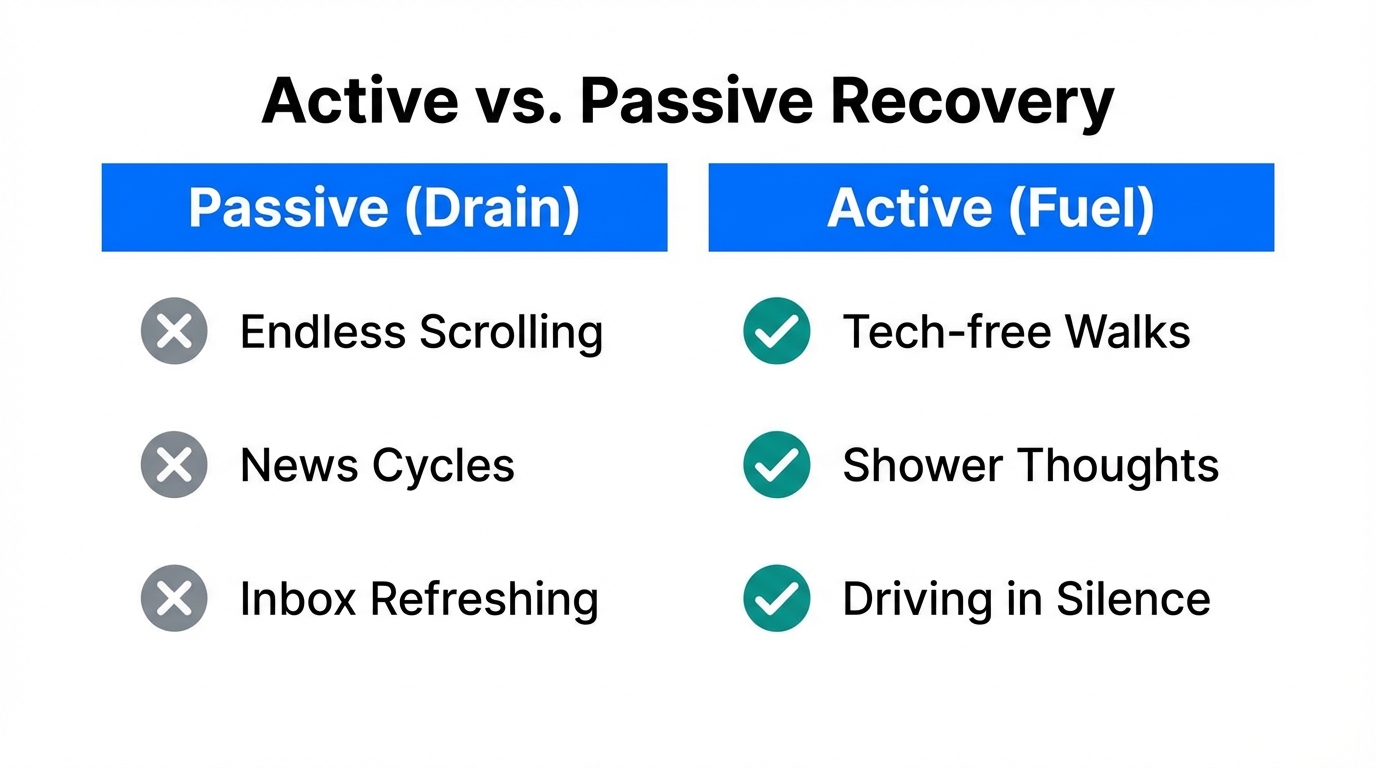
Why is it that our most valuable ideas never seem to arrive when we are staring at a spreadsheet on Google Sheets? There is a biological reason why low-stimulation environments produce high-value ideas. When you remove the constant barrage of notifications from Instagram or LinkedIn, your brain enters a 'default mode network.' This is where non-linear connections are made.
Aaron Sorkin, the legendary screenwriter behind The Social Network, famously takes up to eight showers a day. He isn't obsessed with hygiene; he’s obsessed with breakthroughs. Every time he hits a mental plateau, he resets with warm water and a distraction-free zone. Neuroscientists confirm that we do our best thinking in motion or in water. When the muscles relax and the external noise stops, the brain finally has the 'bandwidth' to process the innovation management challenges you’ve been avoiding.
The Darwinian Walk: Solving 'Four-Stone' Business Problems
Charles Darwin didn't just stumble upon the theory of evolution; he walked his way into it. Darwin had a specific 'thinking path' where he would walk laps whenever he was noodling on a difficult problem. To track his progress, he would set a pile of stones at the starting point and kick one away after every lap.
He categorized his challenges by difficulty: a 'three-stone problem' was relatively easy, while a 'five-stone problem' required miles of walking before a solution emerged. For a founder, this is a masterclass in deep work for founders. Instead of staying stationary and hoping for a creative breakthrough, the Darwinian method uses physical movement to facilitate mental clarity.
"You produce pretty low-quality ideas when you stare at a screen in a stationary position. The great ones measure the difficulty of a problem by how many laps of walking it takes to solve it."If you are struggling with a complex GTM strategy or a product pivot, stop typing. Go for a walk. Don't take a podcast with you. Don't check your TikTok Ads Manager. Just walk until the stones—metaphorical or physical—are gone.
Irritation as Innovation: The 1hourbooks.co Case Study
Innovation often starts with a high degree of annoyance. For the founders of 1hourbooks.co, the irritation was the fluff found in traditional 300-page business books. Most books are long because of the 'relics of the publishing industry'—the need for physical weight to justify a $25 price tag. This realization led to a new category: high-impact books that can be read in a single sitting.
Jerry Seinfeld calls this 'irritation breeding innovation.' He hated the formulaic nature of late-night talk shows, so he created Comedians in Cars Getting Coffee—the exact opposite of the 'cookie-cutter' format. This 'anti-format' thinking is a powerful business growth strategy. By identifying what irritates you in your industry, you find the map to your next product.
| Strategy | Amateur Approach | Professional (Founder) Approach |
|---|---|---|
| Problem Solving | Stare at a screen until exhausted. | Use 'engineered rest' and motion. |
| Product Creation | Follow existing industry templates. | Use irritation as a signal for innovation. |
| Work Schedule | Fill every hour with 'busy work.' | Schedule 'nothing' to allow for reflection. |
| Learning | Passive consumption of content. | Strategic reading to avoid winners' mistakes. |
The ROI of 'Nothing': Why Einstein Floated Away
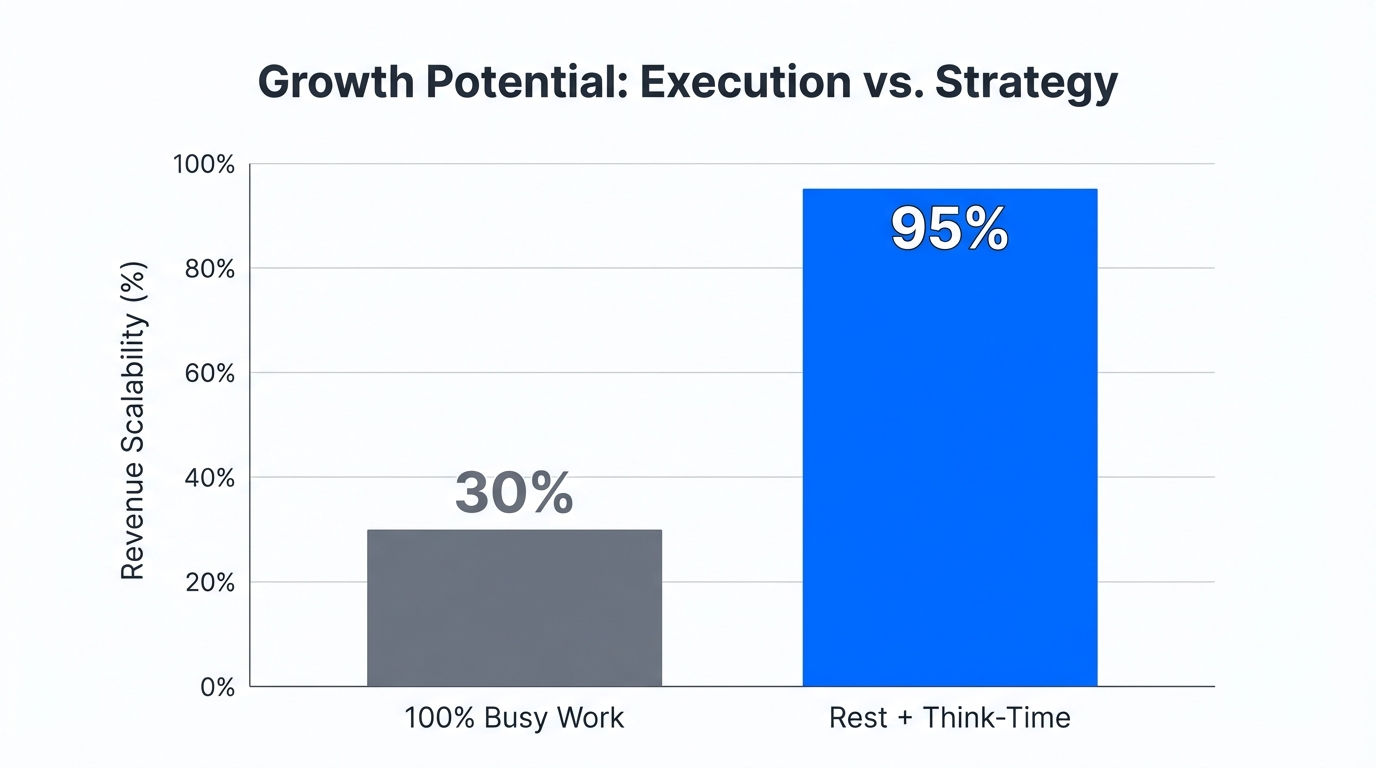
Albert Einstein was a prolific boater, but he was notoriously bad at it. He would float out into the sea in a motorless boat for hours, often requiring the Coast Guard to rescue him. When asked why he took such risks, he explained that the further he floated from shore, the better his quality of thinking became. This aimless idleness was where the theory of relativity found its shape.
For a modern founder, this looks like unproductivity. It looks like being a 'lazy bastard' while your competitors are grinding. However, the ROI of this 'nothingness' is a business growth strategy that actually scales. If you are constantly 'doing,' you never have time to ask if what you are doing is the right thing. Platforms like Stormy AI can help source and manage UGC creators at scale, freeing up your mental calendar for this high-level 'Einstein-style' thinking.
A Step-by-Step Playbook for Your 'Think-Time' Routine
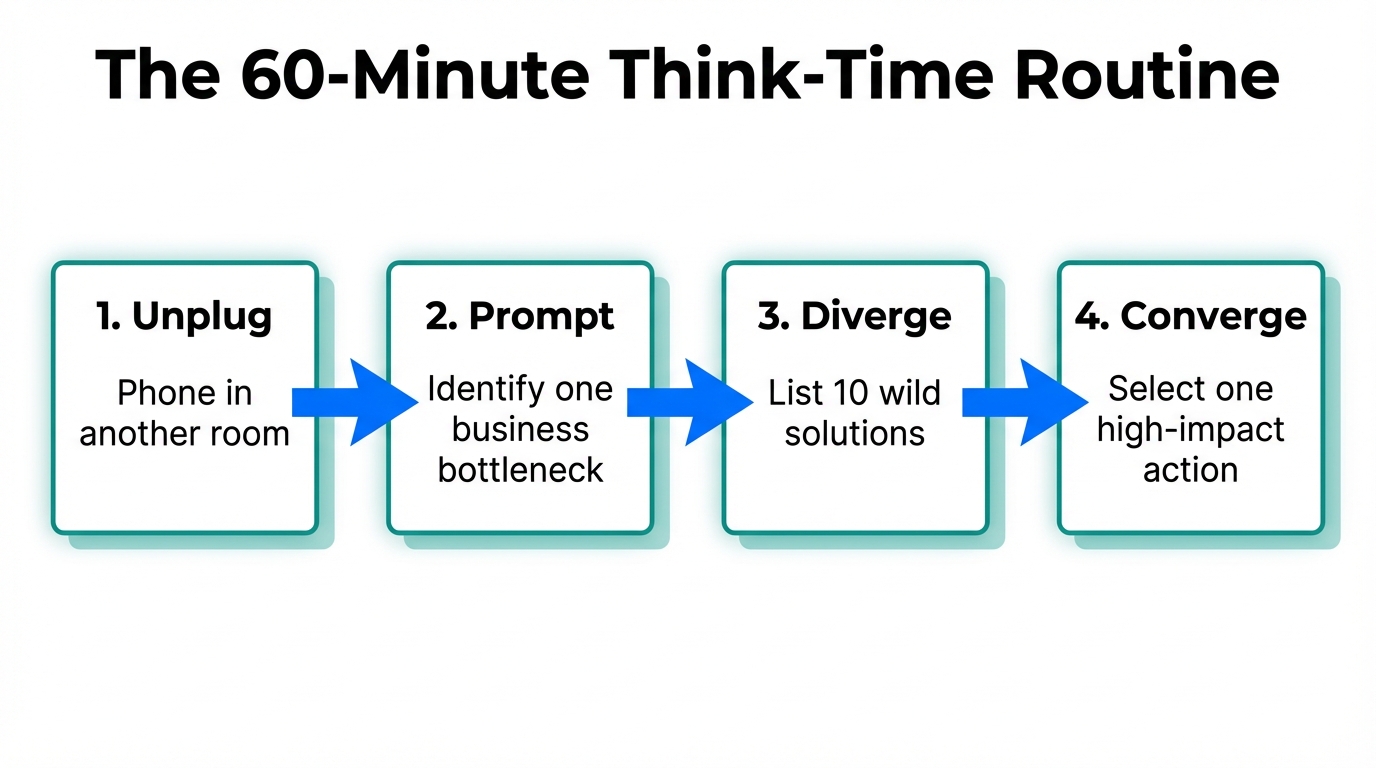
Building a 'think-time' routine is about innovation management. It is a protective barrier against the trivialities of daily operations. Follow these steps to implement your own:
Step 1: The Two-Hour 'Shit-Eating' Window
Shonda Rhimes, the creator of Grey's Anatomy, describes the creative process as running a 5-mile race past brownies and TV shows to get to a 'door' where the good ideas are. Set aside the first two hours of your day for deep work. No email, no CRM updates, and no meetings. You 'eat shit for breakfast' by tackling the hardest, most creative task first.
Step 2: Engineering Motion
Integrate 30 minutes of 'poking around' or 'puttering' in the morning. This isn't a workout; it’s a slow walk with coffee or tea. The goal is to be idle but awake. This is when the 'happy accidents' of thought occur.
Step 3: Agenda-Less Conversations
Schedule 30 minutes a week to talk to someone interesting without an agenda. Don't try to sell them something or hire them. Just riff. Much like the discovery engine on Stormy AI helps you find influencers by typing natural language prompts, these conversations help you find 'market signals' through unstructured dialogue.
"The pros aren't more talented than you. They just sit down more and are able to face their own mediocrity longer than the amateurs."The Procrastination Paradox: Good vs. Bad Inactivity
Paul Graham, the founder of Y Combinator, argues that there are three types of procrastination. The third type—the 'forgetful scientist' type—is actually essential for entrepreneur productivity.
- Type 1: Not doing the things you are supposed to do (Simple laziness).
- Type 2: Doing things that have 'professional-sounding names' but are actually worthless (Research, to-do lists, checking Google Analytics for the 10th time).
- Type 3: Ignoring small tasks to focus on your life's work according to Graham's philosophy.
To be great, you must be willing to piss people off. You might wear the same hoodie every day like Mark Zuckerberg or forget to answer non-essential texts because you are obsessed with a 'five-stone' problem. This is 'good' procrastination. It is the art of ignoring the trivial so you can build what outlives you.
Conclusion: Building What Outlives You
The ultimate goal of business growth strategy isn't just a higher MRR; it is flourishing—an Aristotelian concept of living a harmonious life where work feels like growth rather than pain. By implementing engineered rest, you stop being a reactor to the world’s notifications and start being a creator of its future.
Whether you are building a series of 1hourbooks.co or scaling a travel empire like WeRoad, the principle remains the same: Invest in your thinking time as much as your execution time. Once you have that 'breakthrough' vision, leverage AI-powered tools like Stormy AI to handle the heavy lifting of creator discovery and outreach, so you can stay in your 'Einstein boat' just a little bit longer.