From ROAS to Contribution Margin: The 2026 Unit Economics Blueprint for 7-Figure Brands
Master ecommerce unit economics and contribution margin for ecommerce in 2026. This 7-figure ecommerce growth strategy covers cash flow and scaling secrets.
In the fast-evolving landscape of 2026, the era of 'growth at all costs' has officially been replaced by the era of 'growth with precision.' Scaling an ecommerce business to the 7-figure mark—the elusive $1M+ annual revenue milestone—now requires more than just a clever Meta ad campaign or a viral moment. It demands a fundamental shift from founder-led hustle to a robust, systems-led growth engine. As global ecommerce sales are projected to reach $7.4 trillion by late this year, accounting for nearly 24% of all retail spending according to data from Invesp, the opportunity is massive. However, with professionalization comes increased competition. To survive and thrive, brands must move beyond vanity metrics and master the granular reality of their financial health.
The Death of ROAS: Implementing the Incremental Marginal Return (IMR) Framework
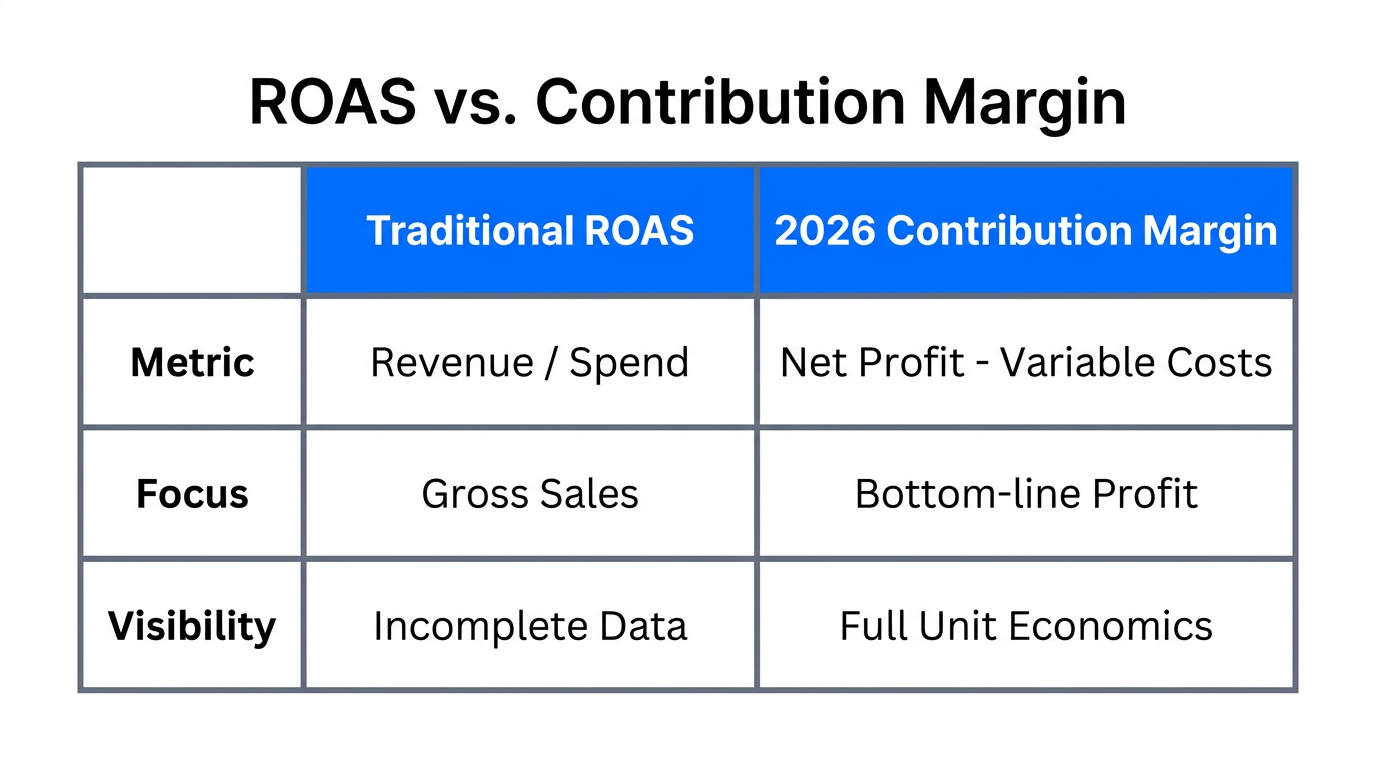
For years, Return on Ad Spend (ROAS) was the North Star for ecommerce marketers. If you put $1 in and got $4 out, you were winning. But in 2026, ROAS is often a deceptive vanity metric. It doesn't account for rising COGS, shipping surcharges, or the platform-specific attribution lag. Modern growth experts, such as those at Common Thread Collective (CTC), argue that brands must pivot toward Incremental Marginal Return (IMR) and contribution margin for ecommerce to truly understand their profitability.
The IMR framework focuses on the next dollar spent. It asks: 'If I spend an additional $1,000 on TikTok Ads today, what is the actual incremental profit—not just revenue—generated?' This requires a deep dive into ecommerce unit economics. You must calculate your Contribution Margin (CM) by taking your Net Sales and subtracting Cost of Goods Sold (COGS), platform transaction fees, shipping costs, and packaging. What remains is the money available to cover your fixed costs (rent, payroll) and marketing. If your marketing spend exceeds your CM, you are effectively paying for the privilege of giving your products away.
| Metric | ROAS Focus (Old School) | Contribution Margin Focus (2026) |
|---|---|---|
| Primary Goal | Top-line Revenue Growth | Net Profitability per Order |
| Variable Costs | Often ignored in daily dashboarding | Mandatory inclusion (COGS, Ship, Pick) |
| Scalability | Likely to break at high spend | Mathematically predictable scaling |
| Long-term Health | High risk of 'the 7-figure gap' | Sustainable cash flow generation |
Solving the '7-Figure Gap' with First-Purchase Profitability
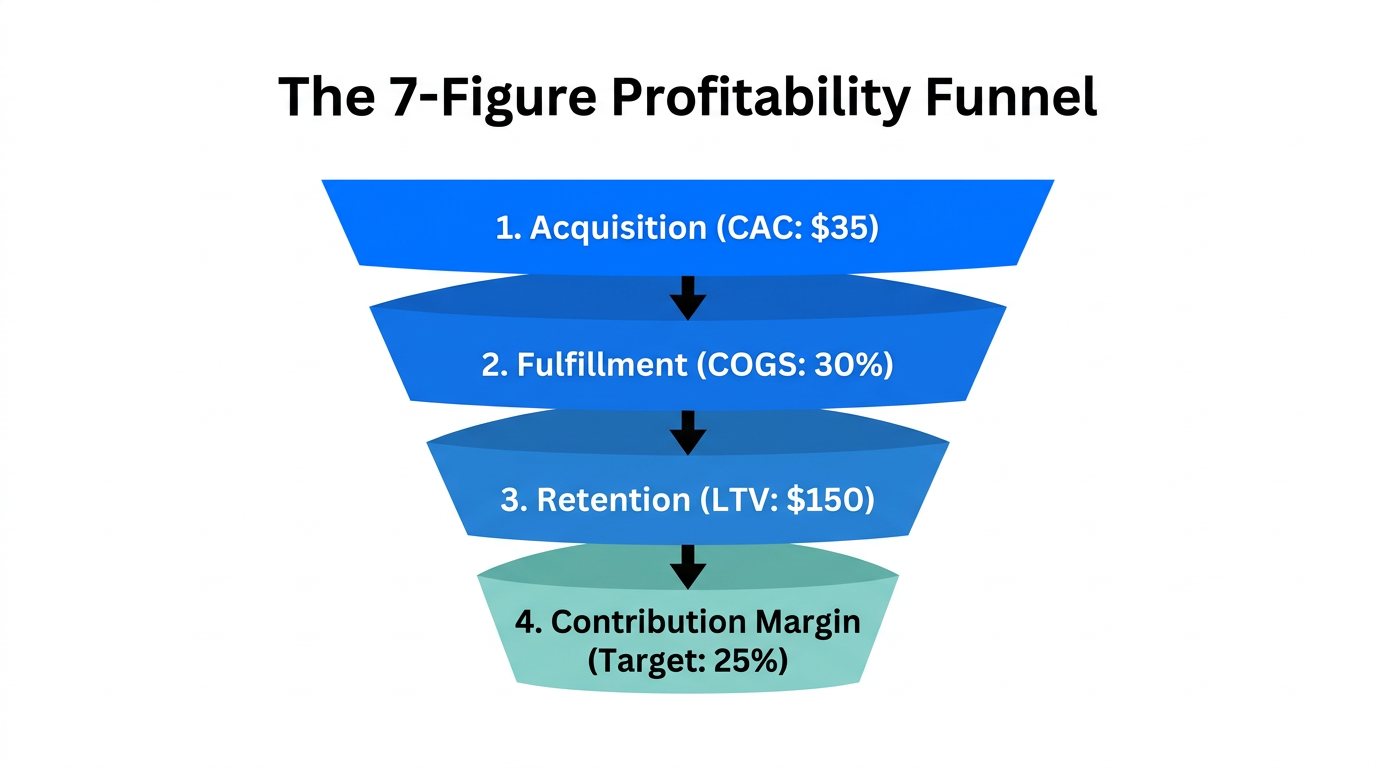
While there are over 28 million ecommerce stores globally, only a tiny fraction—estimated at less than 2%—ever reach the 7-figure mark. This is due to the '7-figure gap,' a phenomenon where the cost to acquire a customer (CAC) begins to exceed the profit from their first purchase as you attempt to scale. According to Shopify, this CAC-LTV gap is the primary barrier to sustainable growth in the mid-market segment. In 2026, relying on a second or third purchase to break even is a high-stakes gamble that most small brands cannot afford.
"The most successful 7-figure brands in 2026 don't just sell products; they engineer Average Order Values (AOV) that force first-purchase profitability."
To bridge this gap, your 7-figure ecommerce growth strategy must prioritize bundling and aggressive upselling. With Meta CPMs remaining volatile, you cannot scale if you lose money on every new customer acquisition. Digital marketing analysts at Digital1010 note that failing to optimize AOV is one of the most common mistakes for scaling brands. By creating 'Hero Bundles'—grouping complementary products together—you can increase your AOV by 30-50%, effectively offsetting the rising costs of traffic on platforms like Meta Ads Manager and TikTok Ads.
Attribution & Analytics: Tracking True Profit-Per-Ad
In the fragmented privacy landscape of 2026, standard pixel tracking is no longer sufficient. To scale, you need a single source of truth that connects your ad spend directly to your bank balance. Professional brands are moving away from the Shopify dashboard as their primary source of truth and toward advanced attribution tools like Triple Whale or Northbeam. These platforms allow you to see 'True Profit' by pulling in real-time data from your marketing channels and your financial stack.
Using these tools is essential for scaling ecommerce profitability 2026 because they provide a 'Blended ROAS' or 'Marketing Efficiency Ratio' (MER). If you are using an omnichannel approach—selling on your own site while leveraging social commerce engines like TikTok Shop—you need to know which channel is actually driving the incremental lift. This is particularly important as social commerce is projected to reach $2.9 trillion globally according to Statista, making it a critical pillar of any modern growth stack.
The 3% Benchmark: A Step-by-Step CRO Audit
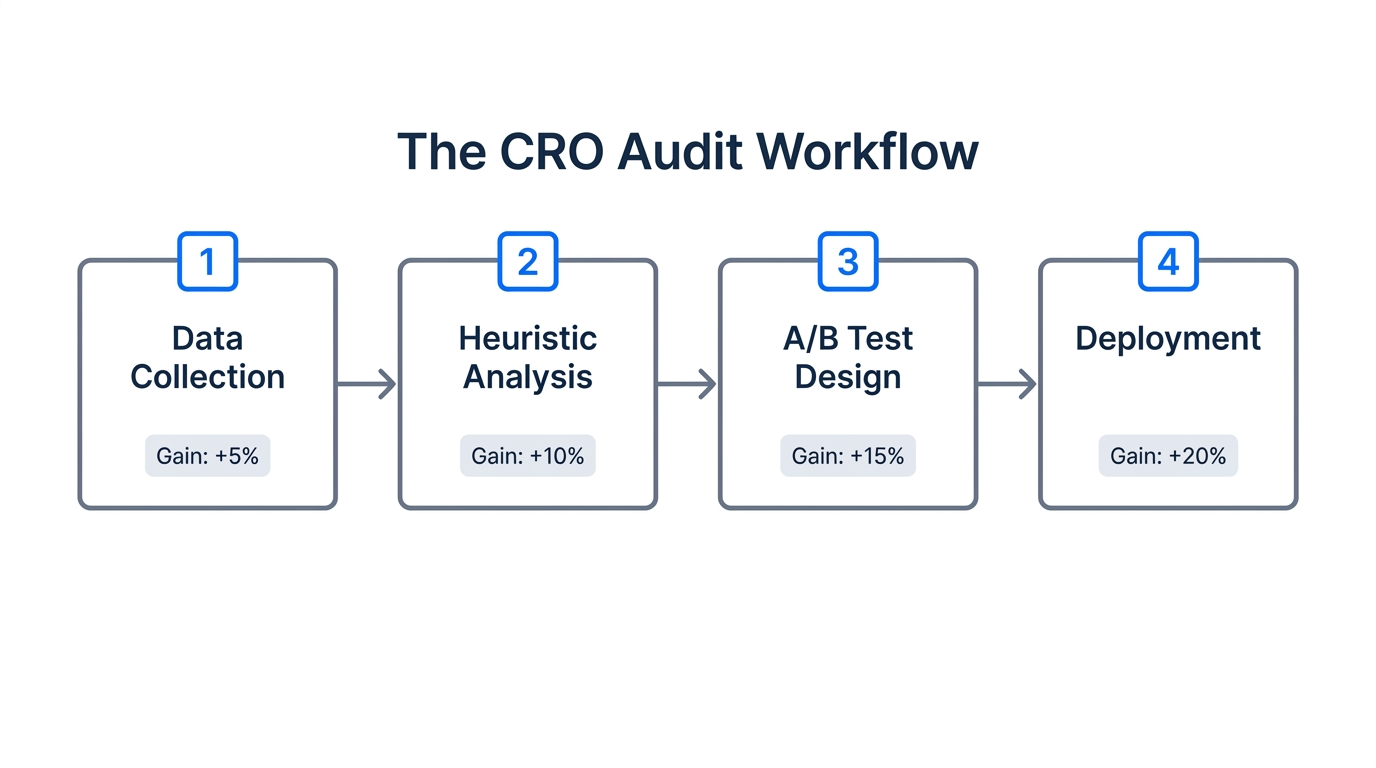
Before you double your ad spend, you must ensure your conversion funnel isn't a leaky bucket. A site that converts at 1.5% vs 3% effectively doubles your CAC. In 2026, a 3% conversion rate is the standard benchmark for a healthy 7-figure brand. To reach this, you need a systematic Conversion Rate Optimization (CRO) audit. Follow this playbook to identify friction points:
- Analyze User Behavior: Use tools like Hotjar to watch session recordings. Look for where users 'rage click' or drop off in the checkout flow.
- Mobile-First Polish: With mCommerce expected to drive 59% of all sales this year per Marketing LTB, your mobile experience must be flawless. Test your site on multiple devices and ensure one-click checkout options like Shop Pay or Stripe are prominent.
- Personalization at Scale: 71% of consumers now expect tailored experiences according to BizHealth. Implement AI-driven product recommendations and dynamic landing pages that match the ad creative.
- High-Quality UGC: The creative is the new targeting. To fuel your conversion engine, you need a constant stream of authentic User Generated Content. Modern platforms like Stormy AI streamline this process by helping you discover and vet creators who fit your niche, ensuring your site is filled with high-converting social proof.
Mastering Cash Flow: The 10-Week Rule
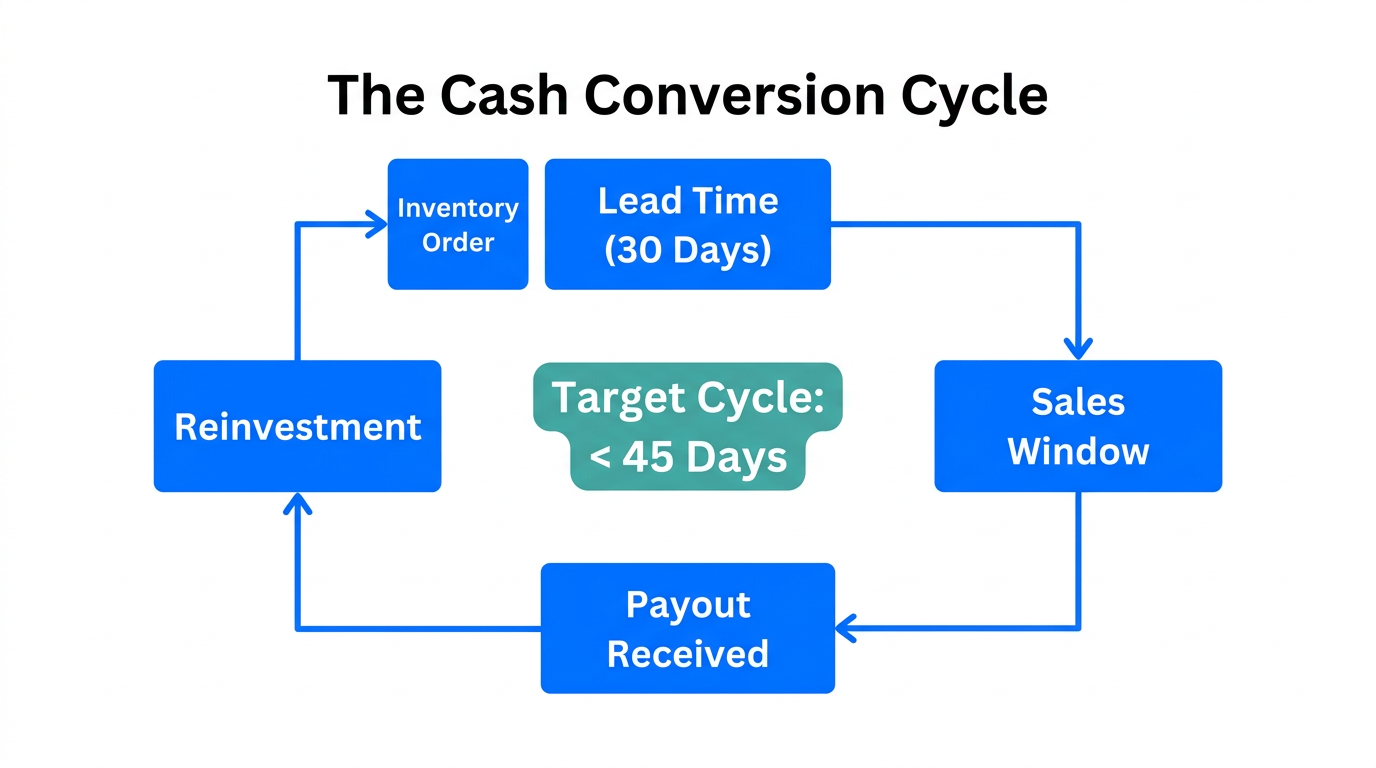
Perhaps the most common reason 7-figure brands fail isn't a lack of sales, but a lack of cash. Ecommerce cash flow management is the silent killer of rapid scaling. Growing businesses often find themselves 'profitable on paper' but with zero cash in the bank because all their capital is tied up in inventory. This is the 'inventory trap.'
Ecommerce advisor Paul Waddy suggests that scaling brands in 2026 must maintain 10 weeks of cash on hand and 12-16 weeks of inventory to survive supply chain volatility and the 'crunch' that occurs during rapid growth phases. Research from Clearco indicates that 82% of small businesses fail due to cash flow issues. To avoid this, utilize modern financial tools like Settle for inventory financing or Wayflyer for revenue-based funding. These tools allow you to bridge the gap between paying your manufacturer and receiving customer revenue.
"Cash is the oxygen of your business. You can survive a few months without profit, but you won't survive a week without cash."
Operational Efficiency: Systems Over Hustle
As you scale, manual processes become bottlenecks. A 7-figure brand cannot rely on the founder packing boxes or manually answering customer emails. You must professionalize your tech stack. This includes moving to Shopify Plus for enterprise-grade stability and integrating a specialized helpdesk like Gorgias to automate customer support. For fulfillment, tools like ShipStation are non-negotiable for multi-carrier automation.
Furthermore, your marketing should be 30-40% automated revenue. This is achieved through lifecycle marketing on platforms like Klaviyo. Your 'Welcome Series,' 'Abandoned Cart,' and 'Post-Purchase' flows should be generating revenue 24/7 without additional ad spend. Brands like Condition 1 have seen massive revenue growth by shifting their focus to aggressive email and SMS segmentation according to Sweatpants Agency.
Conclusion: Your 2026 Growth Roadmap
Success in 2026 requires a disciplined approach to ecommerce unit economics. By moving from ROAS to Contribution Margin, solving the 7-figure gap through first-purchase profitability, and maintaining a strict 10-week cash reserve, you position your brand for sustainable, long-term success. Remember, scaling is not about spending more; it's about being more efficient with every dollar you earn. Utilize AI-powered discovery tools like Stormy AI to find the creators who will lower your CAC, and pair them with a professionalized backend that maximizes every conversion. The brands that win this year will be those that treat their financials as seriously as their creative.