By the start of 2026, the retail landscape has undergone a fundamental transformation. We have officially moved past the era of the "helpful chatbot" into the era of the Digital Sales Consultant. In this new high-stakes environment, the difference between a storefront that merely survives and one that thrives is the shift from reactive support to proactive, intent-based engagement. If your brand is still relying on static FAQ bots, you are likely settling for an industry-standard 3.1% conversion rate, while your competitors are hitting 12.3% or higher.
The goal for 2026 is clear: e-commerce conversion rate optimization is no longer about moving buttons or changing colors; it is about simulating the high-touch experience of a luxury physical boutique at a digital scale. By leveraging advanced tools like Rep AI and Tolstoy, brands are seeing conversion rates increase by up to 4X compared to unassisted shopping experiences. This playbook will detail exactly how to implement these AI shopping assistant strategies to dominate the market this year.
The 2026 Shift: From FAQ Bots to Digital Sales Consultants
For years, chatbots were viewed as a way to deflect tickets and save money on human agents. However, data from Master of Code shows that the global AI chatbot market has surged to $15.12 billion in 2026 because the focus has shifted entirely toward revenue generation. Modern AI agents are no longer just answering "where is my order?"; they are analyzing user behavior to provide predictive e-commerce sales recommendations.
Today’s consumers have higher expectations. According to Zendesk, 56% of shoppers now expect bots to be capable of natural, fluid conversations. This "Agentic" shift means your AI must be able to reason through complex tasks, such as managing multi-item returns across 3PL providers or cross-referencing live inventory data with a shopper's local weather to suggest the perfect outfit.
"The most successful brands in 2026 aren't using AI to hide from their customers; they are using it to be present at every critical moment of the buying journey."
Step-by-Step Implementation of a Rep AI Sales Assistant
A Rep AI sales assistant acts as your best floor manager, identifying which customers are "just looking" and which are ready to buy. Unlike traditional bots that wait for a user to click a bubble, Rep AI uses behavioral triggers to start conversations when they matter most. Here is how to deploy it effectively:
Step 1: Identifying Intent-Based Triggers
Stop sending generic "Can I help you?" messages. Instead, use Rep AI to monitor metrics like scroll depth, time spent on a product page, and mouse movement toward the exit using tools like Hotjar or Microsoft Clarity. If a user spends more than 45 seconds on a sizing chart, the AI should proactively offer to help them find their perfect fit based on their past purchases.
Step 2: Proactive Cart Recovery
One of the most powerful features of predictive e-commerce sales is recovering abandoned carts before the user even leaves the site. According to research from the Baymard Institute, proactive AI chat currently recovers approximately 35% of abandoned carts. When a user shows exit intent with items in their bag, the AI can offer a one-time incentive or answer a final concern about shipping times to close the deal instantly.
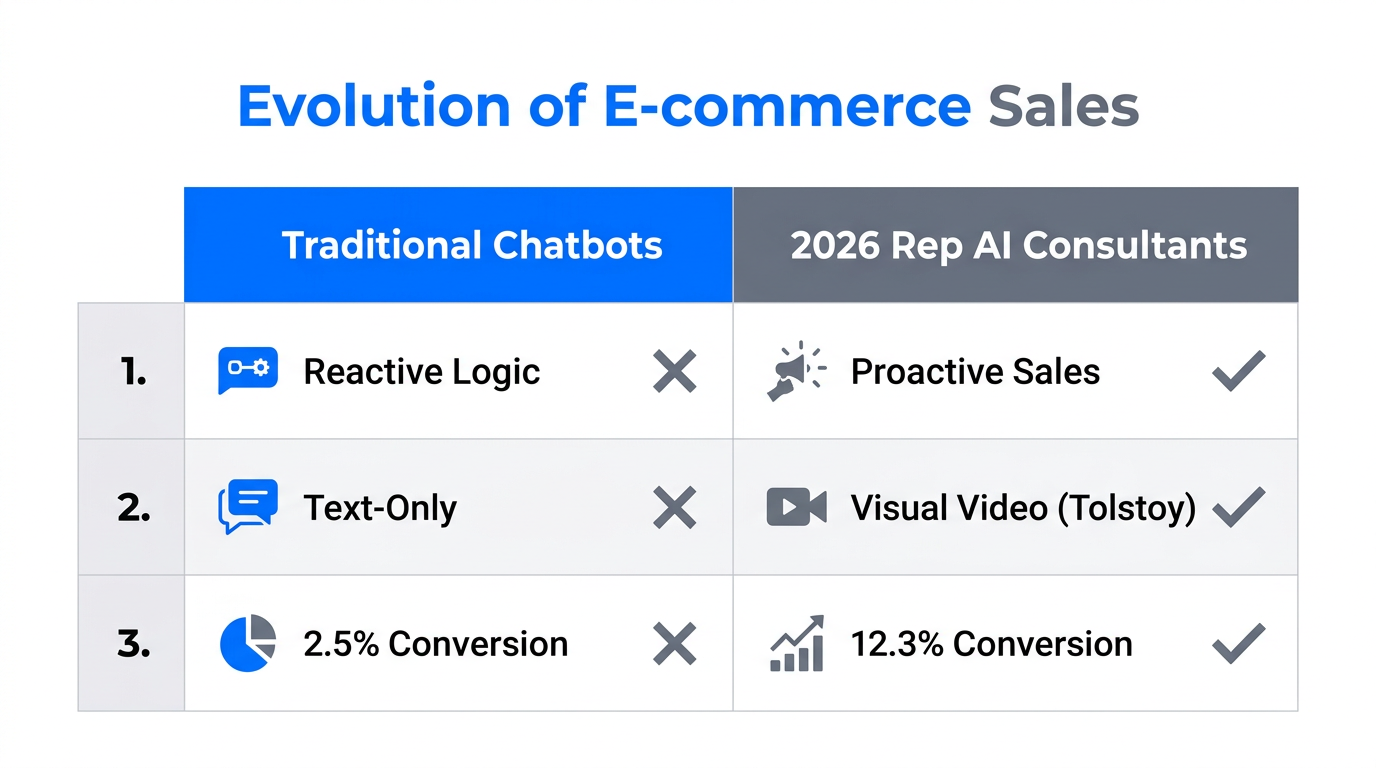
| Feature | Legacy Chatbots | Rep AI (2026 Model) |
|---|---|---|
| Engagement | Reactive (User clicks first) | Proactive (Triggered by behavior) |
| Knowledge Base | Static FAQs | Real-time PIM & Inventory Sync |
| Sales Goal | Ticket Deflection | Conversion & AOV Growth |
| Success Metric | Response Time | Revenue Per Session |
Step 3: Integrating with Your CRM
To provide hyper-personalization, your AI needs to know who it is talking to. By syncing Rep AI with your CRM or marketing automation tools like Klaviyo, the assistant can greet returning customers by name and suggest accessories for a product they bought last month.
Using Tolstoy to Master Visual and Voice Commerce
If Rep AI is the "brain" of your sales operation, Tolstoy visual commerce is the "face." In 2026, text-based commerce is being rapidly eclipsed by visual and voice interactions. Consumers no longer want to read product descriptions; they want to see the product in action through short-form video edited in apps like CapCut or ask questions out loud while they multitask.
A comprehensive Tolstoy visual commerce guide emphasizes the importance of shoppable video. By embedding interactive video snippets on product pages, you allow users to see real people (often sourced through UGC campaigns) using the product. This builds the trust that static images simply cannot provide.
"Visual commerce isn't just about video; it's about making the entire shopping experience 'hands-free' and immersive."
To fuel these visual experiences, many top-tier brands use platforms like Stormy AI to discover and vet the high-quality UGC creators who produce the video content for their Tolstoy carousels. Having the right creator content is the difference between a video that feels like an ad and one that feels like a recommendation from a friend.
Key Visual Strategies for 2026:
- Interactive Quiz Videos: Use Tolstoy or Octane AI to ask customers about their preferences (e.g., skin type, style, or budget) and serve them a personalized product recommendation video immediately.
- Voice-Enabled Search: Allow users to say, "Show me something like this but in blue," and use AI to filter your catalog instantly.
- Image Uploads: Let users upload a photo of a style they like and have the AI find the closest match in your inventory.
Lessons from the Giants: H&M and Sephora’s Digital Stylist Models
We can learn a lot from how global leaders have implemented these AI shopping assistant strategies. H&M, for instance, transitioned their bot into a full-scale digital stylist. By quizzing customers on their style and analyzing their browsing history, they created a recommendation engine that significantly increased Average Order Value (AOV).
Similarly, Sephora's "Virtual Artist" bot provides personalized makeup advice. This isn't just a gimmick; it has led to an 11% improvement in conversion rates. The takeaway for smaller retailers is that you don't need a billion-dollar budget to replicate this. Tools like Rep AI and Tolstoy bring this level of sophisticated interaction to any Shopify or mid-market store.
Actionable Framework: Setting Up Predictive Sales Triggers
To achieve 4X conversions, you must move from *reactive* support to *predictive* sales. This requires a structured framework that connects your user behavior data to your sales logic.
1. The Data Layer
Ensure your AI is integrated with your Product Information Management (PIM), such as Akeneo, and your 3PL logistics platform, such as Zowie. This allows the bot to know exactly what is in stock and when it will arrive at the customer's specific zip code.
2. The Logic Layer
Create "if-this-then-that" scenarios for your AI agent. For example:
- If a user has visited the same high-ticket item three times in 48 hours...
- Then have the Rep AI assistant offer a personalized demo video or a limited-time free shipping code.
3. The Human-in-the-Loop Layer
While AI can handle 93% of queries, the final 7% are often the most valuable or complex. As noted by Yuma AI, the most sustainable model in 2026 is Human-AI Collaboration. Ensure your high-value customers can seamlessly transition from the AI to a human expert when empathy or complex negotiation is required.
"The 'Trust Gap' is real: 71% of retailers think they are great at personalization, but only 34% of customers agree. Closing this gap is the mission for 2026."
Common Pitfalls to Avoid in 2026
Even with the best tools, many brands fail because they treat AI as a gatekeeper rather than an enabler. Avoid these common mistakes discovered in Webless research:
- Treating Bots as Gatekeepers: Don't make it impossible for a customer to find a human. 86% of consumers still prioritize empathy for complex issues.
- Ignoring the CTA: A bot should never just give an answer and stop. Every interaction should lead the customer back to a product page or a checkout link.
- Skipping Quality Control: Launching an LLM-based bot without a "Human-in-the-loop" phase to audit responses can lead to hallucinations that damage brand trust.
Conclusion: The Future of Assisted Shopping
In 2026, e-commerce conversion rate optimization is a battle won through superior customer experience. By transitioning from basic support bots to intelligent digital sales consultants, you are not just saving money on support—you are building a 24/7 revenue engine. Implementing a Rep AI sales assistant for proactive engagement and a Tolstoy visual commerce guide for immersive shopping will put you years ahead of the competition.
Remember, the tech is only as good as the content and data you feed it. Use tools like Stormy AI to ensure you have the right creator partnerships to fuel your visual sales engine, and keep your AI grounded in real-time inventory and customer data. The brands that win this year will be those that make shopping feel less like a transaction and more like a conversation.