Boosting Ecommerce Profitability: The 2026 ROI Guide to AI Demand Forecasting and Demand Sensing
Boost your ecommerce profitability in 2026 with AI demand forecasting. Learn how to reduce inventory by 30% and cut supply chain errors using demand sensing.
In 2026, the retail landscape has reached a definitive turning point. The era of "growth at all costs" is dead, replaced by a ruthless focus on the bottom line. For ecommerce leaders, the most significant shift hasn't occurred in the storefront, but in the warehouse. We have entered the year of the AI reckoning, a period where Forrester predicts CFOs will aggressively pull funding from any technology project that cannot prove a direct, measurable link to the Profit and Loss (P&L) statement. At the heart of this fiscal tightening is AI demand forecasting—the bridge between bloated inventory costs and streamlined, high-margin operations.
The 2026 AI Reckoning: Linking Logistics Directly to the P&L
For years, demand forecasting was the domain of spreadsheets and "last year plus 10%" logic. In 2026, that approach is a liability. The global AI-enabled ecommerce market has surged to nearly $10 billion, and for good reason. Retailers are no longer just looking for "better guesses"; they are seeking autonomous supply chains that can protect margins from the twin killers of ecommerce: stockouts and overstock deep-discounting.
"The 2026 AI reckoning isn't about adoption; it's about the P&L. If your AI doesn't reduce your carry costs or increase your full-price sell-through, it's just expensive overhead."
The investment surge is staggering. US retailers are expected to pour $113 billion into technology budgets this year, according to eMarketer research, with nearly 46% of that specifically allocated to software like AI-enabled forecasting. This isn't just a retail technology trend; it's a fundamental restructuring of how ecommerce profitability is achieved. By automating the prediction of consumer behavior, brands are shifting from a reactive stance to a proactive one, ensuring that capital isn't tied up in dusty boxes in a third-party logistics (3PL) facility.
Beyond History: The Rise of Demand Sensing
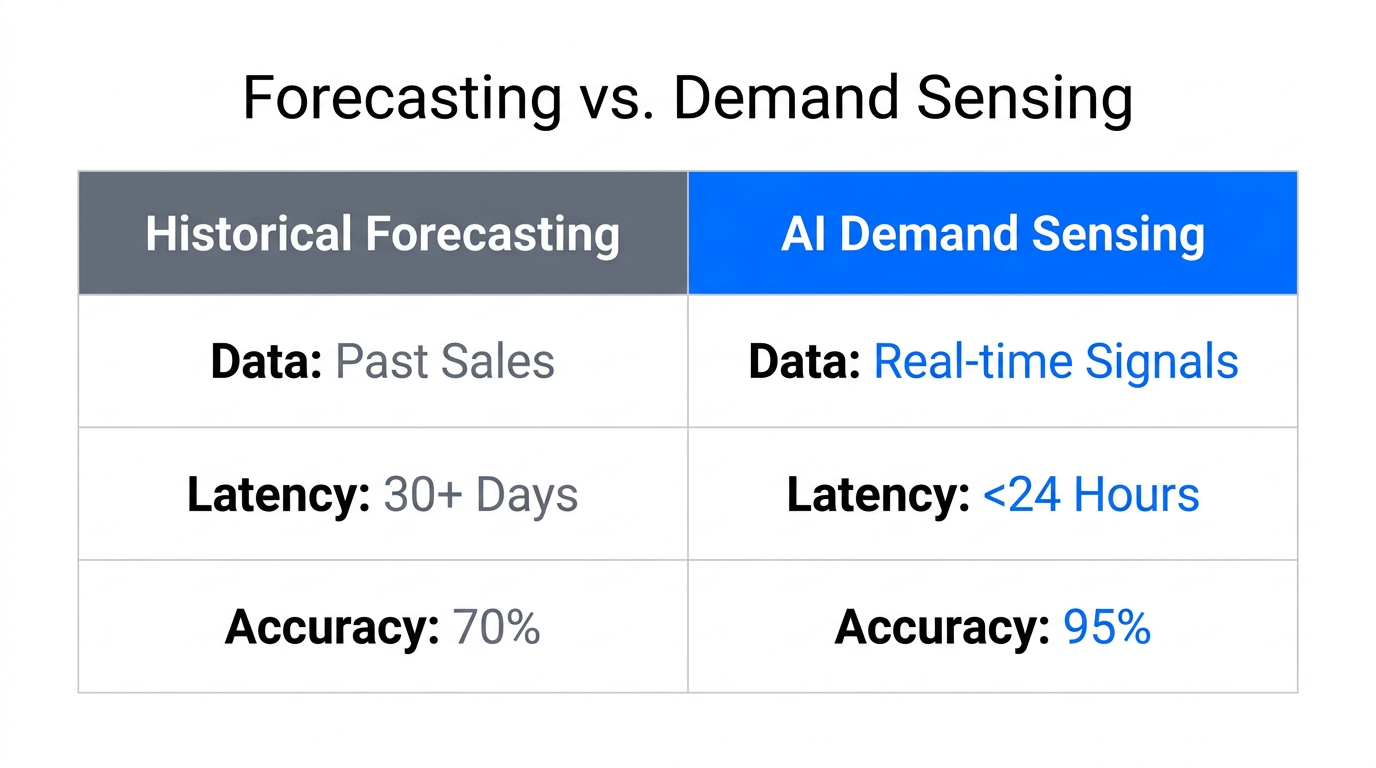
Traditional inventory management software relied almost exclusively on historical data. But in the volatile market of 2026, what happened in 2024 or 2025 is often irrelevant. Enter Demand Sensing. Unlike traditional models, demand sensing uses AI to "sense" real-time market shifts by ingesting a massive array of external signals.
- Social Media Sentiment: Analyzing viral trends on TikTok and Instagram to predict sudden spikes in specific SKUs.
- Weather Patterns: Adjusting inventory for seasonal goods based on hyper-local weather forecasts from services like The Weather Company.
- Local Events: Factoring in concerts, festivals, or local sports wins that drive specific product demand.
- Competitor Pricing: Automatically adjusting demand expectations when a competitor launches a flash sale.
This is where the "Super Agents" come in. Companies like Walmart are now deploying Agentic AI that doesn't just predict demand but automatically negotiates with suppliers or rebalances stock across regional warehouses without human intervention. This real-time agility is what allows modern brands to maintain ecommerce profitability in 2026 despite global supply chain fluctuations.
Statistical Breakdown: Measuring the Supply Chain ROI
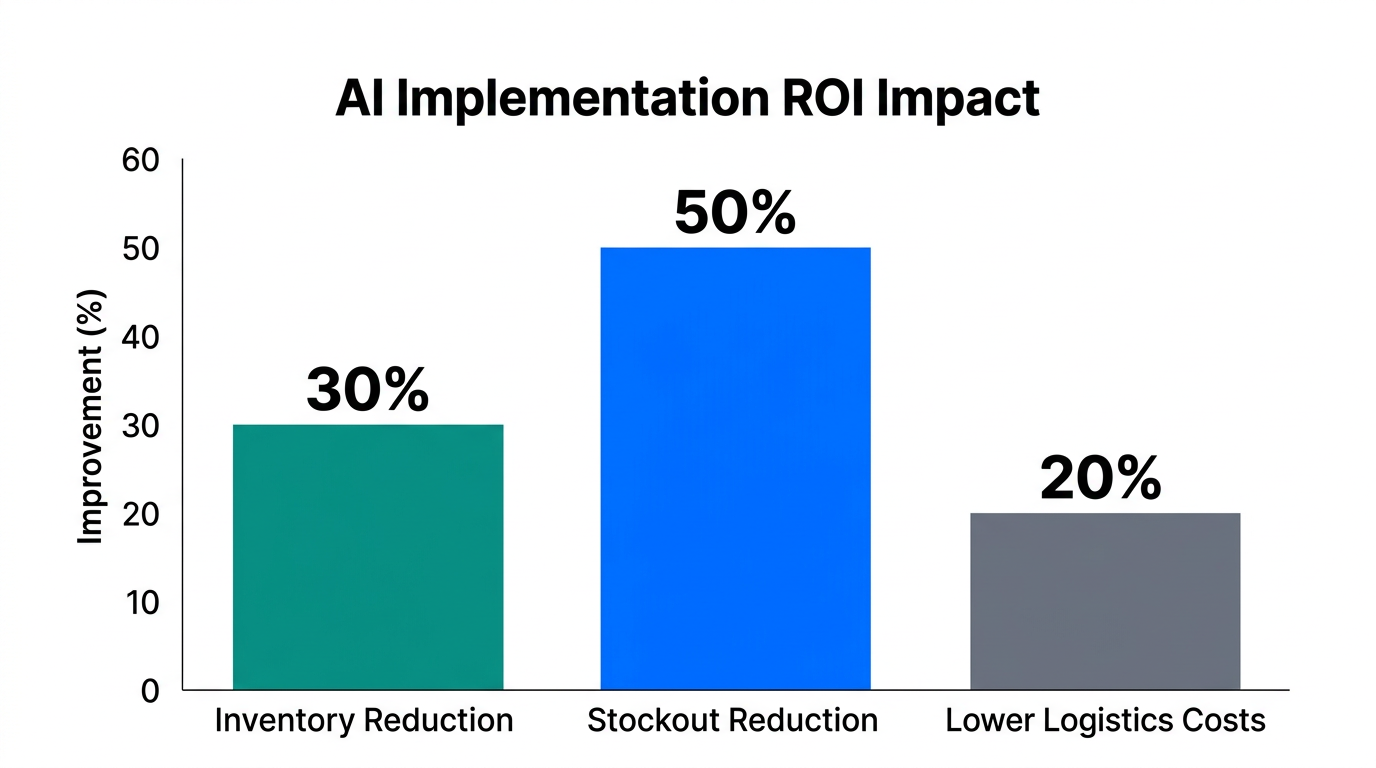
The financial impact of AI on the supply chain is no longer theoretical. The data from the last twelve months shows a clear divide between the "AI-integrated" and the "AI-lagging" retailers. According to McKinsey, AI-driven supply chain systems can reduce inventory holdings by 20% to 30%. For a mid-market ecommerce brand, this translates to millions of dollars in unlocked cash flow.
| Metric | Traditional Model | AI-Enhanced Model (2026) | Impact |
|---|---|---|---|
| Inventory Holdings | Baseline | 20-30% Reduction | Increased Cash Flow |
| Forecasting Errors | Baseline | 30-50% Reduction | Lower Stockouts |
| Logistics Costs | Baseline | 5-20% Savings | Improved Margins |
| Full-Price Sell-Through | 60-70% | 85%+ (e.g., Zara) | P&L Protection |
Furthermore, industry research indicates that AI cuts supply chain errors by up to 50%. When you combine this with logistics savings of up to 20% through better routing and demand prediction—as seen in recent DHL implementations—the supply chain ROI becomes the single most important metric for the operations team.
Hyper-Localization: The Zip-Code Level Revolution
In 2026, we have moved beyond national or even regional forecasting. The leading edge of AI demand forecasting is now hyper-local. Brands are using AI to predict demand at the store or zip-code level. This allows an ecommerce brand with multiple micro-fulfillment centers to stock exactly what a specific neighborhood wants.
For example, if social data suggests a sudden trend in "minimalist tech accessories" in Brooklyn but "boho-chic home decor" in Austin, the AI automatically shifts inventory levels at the respective fulfillment centers. This prevents the costly mistake of shipping items across the country—a move that eats into margins and increases the carbon footprint. By 2027, Gartner predicts a subset of brands will market themselves as "AI-free" for content, but even they will still use these deep-logistics AI systems behind the scenes to survive.
"Forecasting at the zip-code level is the difference between having the right product in the right place and paying $15 in shipping to move a $20 item."
The High-Margin Masters: Zara, Amazon, and H&M
How are the giants using these tools to dominate? Look at Zara. By using AI to analyze real-time sales and social media buzz, they manage to sell 85% of their inventory at full price. In contrast, the industry average still hovers between 60-70%. They don't need broad-market sales because they rarely have the wrong inventory.
Amazon has taken this a step further with Anticipatory Shipping. Their AI predicts what you are likely to buy and initiates shipping to a local warehouse before you even click "Buy." This level of inventory management software sophistication, detailed in Amazon's operations reports, is what sets the standard for consumer expectations in 2026.
Meanwhile, H&M has mastered the use of AI-driven dynamic pricing. Instead of profit-killing deep discounts across the board, they use AI to identify which specific items in which locations need a slight price adjustment to clear. This surgical approach to inventory clearance protects the overall brand value and the P&L.
The 2026 Playbook: Implementing AI Demand Forecasting
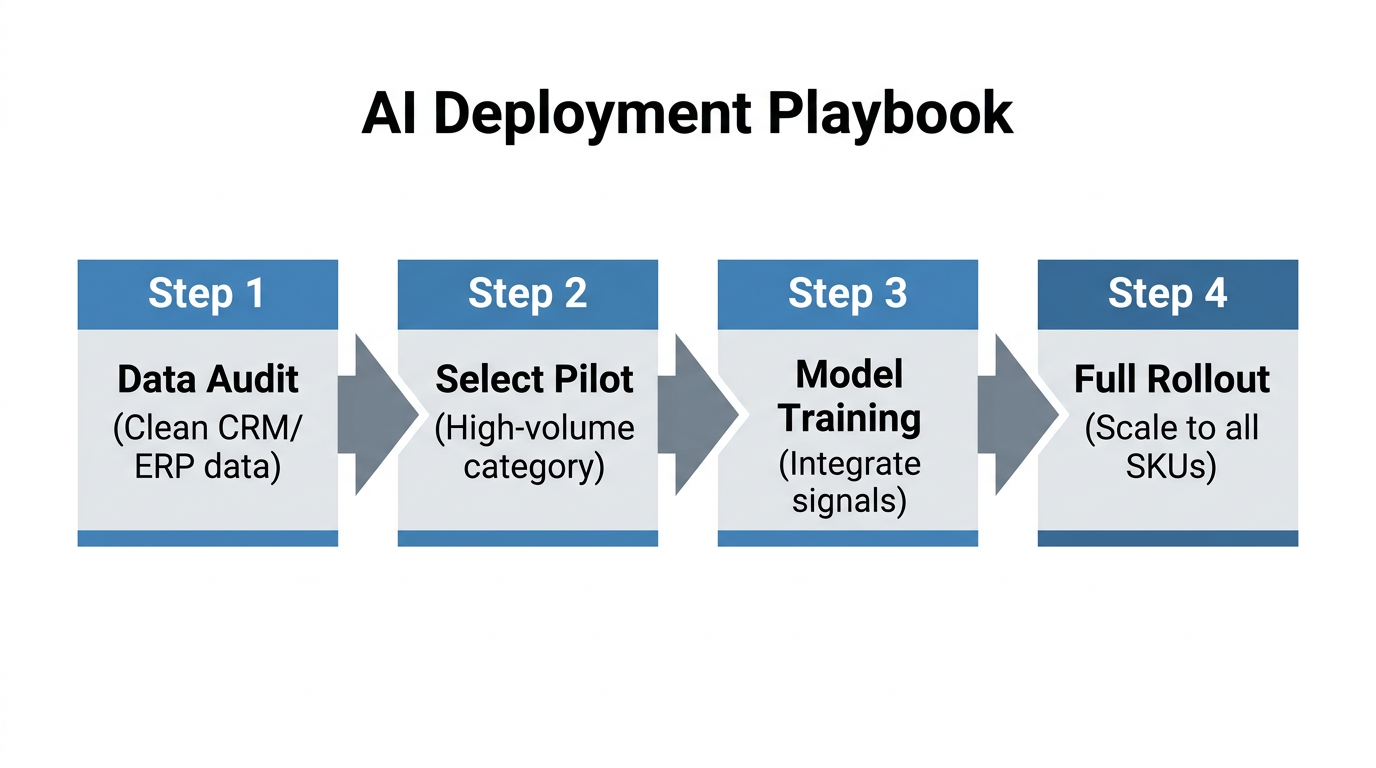
Transitioning to an AI-driven model doesn't happen overnight. To ensure a high supply chain ROI, follow this structured playbook:
Step 1: Consolidate Data Silos
AI is only as good as the data it eats. You must integrate your ERP, Warehouse Management System (WMS), and marketing platforms. Crucially, in 2026, this includes social signals. For instance, brands using Stormy AI to discover and manage UGC creators can feed campaign schedules and creator performance data into their forecasting models to anticipate spikes caused by influencer content.
Step 2: Run a 'Pilot Category'
Do not attempt to roll out AI to 10,000 SKUs at once. Select one high-volatility category—perhaps one prone to seasonal shifts or social media influence—and run the AI model alongside your human planners. Measure the Forecast Accuracy of the AI against the human baseline for 90 days.
Step 3: Layer in Causal Factors
Ensure your model isn't just looking at internal sales. It must ingest "Causal Factors" such as weather forecasts, promotional calendars, and even competitor price changes. This is the essence of demand sensing.
Step 4: The Hybrid Human-in-the-Loop Approach
Use AI for the baseline, but allow human experts to override it for "Black Swan" events. If a global event occurs that the AI hasn't seen in its training data, human intuition is still the final safeguard against supply chain errors.
Common Pitfalls to Avoid in AI Forecasting
Despite the power of these tools, many brands stumble. Avoid these common 2026 mistakes:
- The "Set-it-and-Forget-it" Trap: AI models require continuous learning. They must be retrained at least quarterly to account for shifting consumer preferences.
- Ignoring Promotions: If you don't feed your marketing schedule (e.g., a massive TikTok campaign sourced via Stormy AI) into the model, you will face massive stockouts.
- Model Overfitting: Don't create a model so specific to 2025 that it can't handle the new realities of 2026.
Choosing Your Stack: Top AI Forecasting Tools
Depending on your scale, the right inventory management software will vary. Here are the top performers in 2026:
| Category | Recommended Platforms |
|---|---|
| Enterprise | SAP IBP, C3 AI, Kinaxis Maestro, Oracle Demand Management |
| SMB / Shopify | Shopify native tools, Prediko, Inventory Planner by Sage, Sumtracker |
Conclusion: The Future of Profitability
The transition to AI-powered demand forecasting is no longer a choice—it's a survival mechanism for ecommerce in 2026. By reducing inventory holdings by up to 30% and cutting supply chain errors in half, brands can finally achieve the lean, high-margin operations that the current economic climate demands. Start with a pilot, integrate your social and marketing signals, and move toward a model of demand sensing that protects your P&L from the volatility of the modern market. Ecommerce profitability 2026 isn't about selling more; it's about selling smarter.