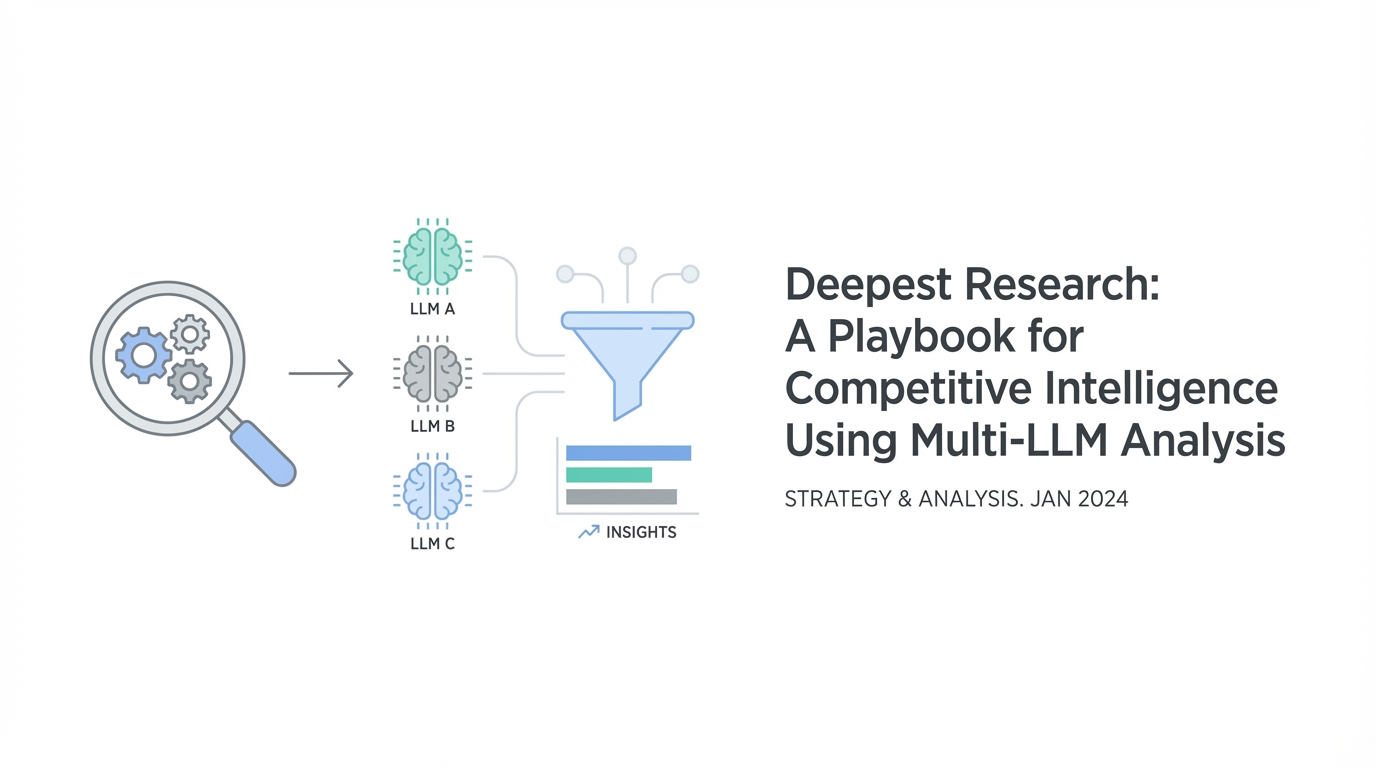
In the high-stakes world of startup growth, information isn't just power—it’s the difference between a successful pivot and a quiet exit. Most founders and marketers have integrated AI into their workflow, but they are often falling into the single-model trap. Relying solely on ChatGPT for market analysis is like looking at a 3D landscape through a keyhole; you get the general idea, but you miss the depth, the shadows, and the critical contradictions. To truly outmaneuver the competition, you need a strategy for AI market research that goes beyond basic prompting. You need what Guillermo Rauch, the founder of Vercel, calls "Deepest Research."
This methodology isn't about asking one AI a question; it's about orchestrating a symphony of Large Language Models (LLMs) to cross-examine data, detect hallucinations, and uncover hidden market gaps. By utilizing a multi-model AI strategy, you can transform business intelligence AI from a simple chatbot into a high-fidelity radar for your industry. This article will walk you through the exact playbook for conducting deep competitive intelligence, leveraging the strengths of different models to build a comprehensive view of your market.
The Hidden Dangers of Single-LLM Research
The primary reason most market analysis for startups fails is a lack of perspective. Every LLM has been "steered" or fine-tuned with specific biases. If you ask a single model to analyze a competitor, you aren't getting the ground truth; you're getting that model's specific interpretation of its training data. This creates critical blind spots. One model might be overly optimistic about a trend, while another might be hallucinating feature sets that don't exist.
Guillermo Rauch highlights that when you really need to study a topic in depth, you shouldn't bank on the viewpoint of a single LLM. As seen in recent industry discussions, models like GPT-4o are excellent for general reasoning, but they may lack the real-time nuance found in platforms like Perplexity. If your strategy relies on a single source, you are inherently vulnerable to model bias, a concept well-documented in Stanford HAI research.
To overcome this, you must adopt a workflow that forces these models to talk to one each other—or at least, for you to triangulate their outputs. This is the foundation of competitive intelligence tools in the AI era: the ability to compare, contrast, and verify.
The Multi-Model Workflow: Building Your Research Stack
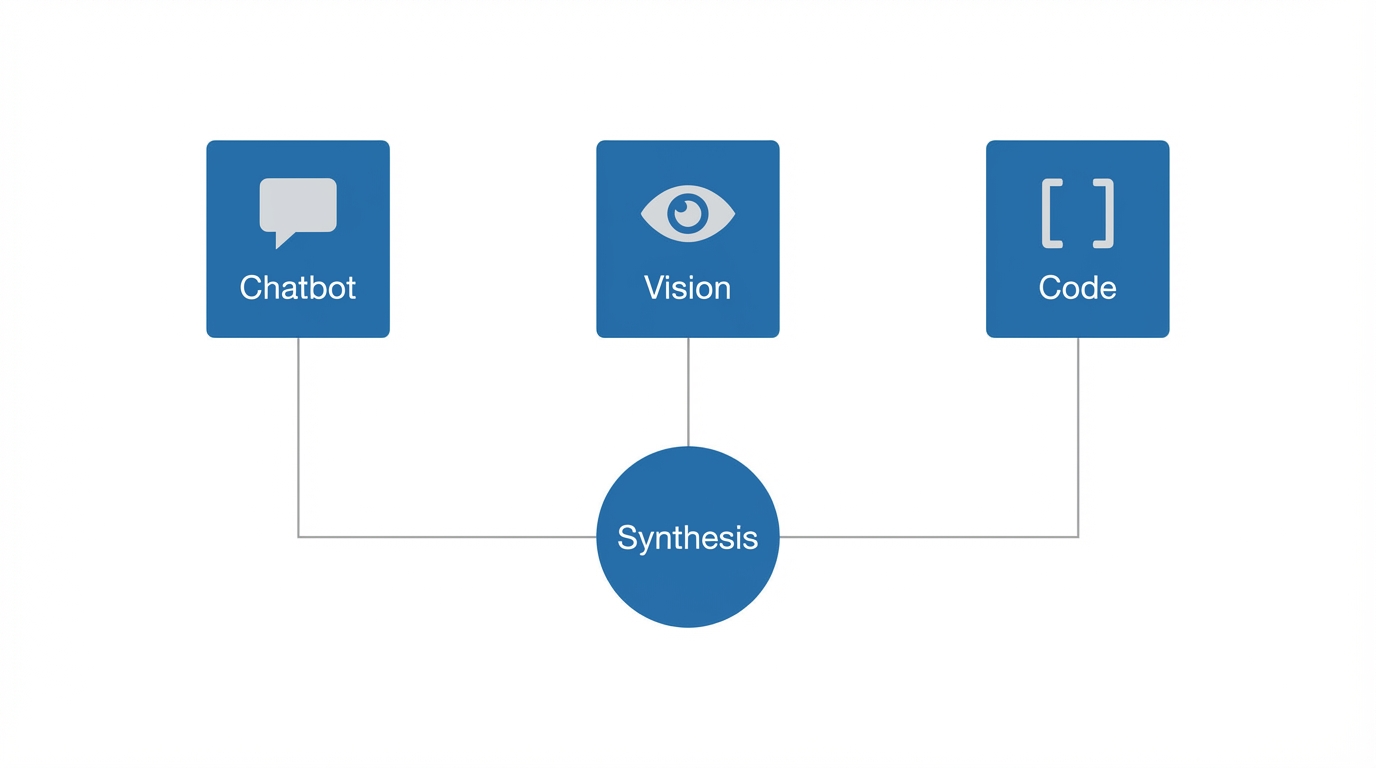
Effective AI market research requires a specialized stack. Each tool in your arsenal should serve a specific purpose in the intelligence-gathering process. Here is how to segment your models for maximum fidelity:
- Real-Time Discovery (Perplexity): Start here to gather the latest news, funding rounds, and product launches. Perplexity acts as your live search engine, providing cited sources that prevent basic hallucinations.
- Analytical Reasoning (GPT-4o): Use this for high-level logic and structuring your research data. It is excellent at taking unstructured notes and turning them into a formal SWOT analysis.
- Nuance and Creative Interpretation (Claude 3.5 Sonnet): Anthropic’s models are often cited for their superior "writing feel" and ability to understand complex, nuanced instructions without sounding robotic. This is where you look for subtle market shifts.
- Speed and Iteration (Groq): When you need to run hundreds of micro-prompts to test different angles, Groq provides the inference speed necessary for real-time "vibe coding" and brainstorming.
By leveraging an AI Gateway—a concept discussed by technical leaders to prevent model lock-in—you can switch between these providers seamlessly. Tools like OpenRouter or Vercel's own AI SDK allow developers and researchers to access the best price and performance for each specific query without being tied to one ecosystem.
Step 1: Prompting for Critical Analysis and Contradictions
To conduct "Deepest Research," you must stop asking for summaries and start asking for critiques. Most users prompt AI to be an assistant; you need to prompt it to be an adversary. This is the "sauce" that separates surface-level skimming from true business intelligence AI.
Instead of asking "What does Competitor X do?", try a multi-stage prompting approach:
- The Data Dump: Feed the AI the latest press releases, blog posts, and reviews for a competitor.
- The Critique Prompt: "Analyze this photo/data and find the flaws. Tell me what is missing from their value proposition that users are complaining about in the shadows of the internet."
- The Contradiction Search: "I have gathered reports from GPT-4 and Claude. GPT-4 says the market is moving toward X, while Claude suggests Y. Analyze the reasoning of both and find the edge cases where both might be wrong."
This method forces the AI to identify subtle details—the kind Guillermo Rauch mentions when discussing how a camera app should not just take a photo, but use AI to critique the lighting and background to create a better output. In the same way, your research AI should critique the market data to find the "bad lighting" in your competitor's strategy.
Step 2: Transitioning from Research to Actionable Sourcing


Once you have identified a market gap or a specific audience niche through your multi-model AI strategy, the next step is finding the right voices to exploit that gap. This is particularly relevant in UGC (User-Generated Content) and influencer marketing, where data-driven discovery is essential.
When you need to find creators who fit the highly specific niches uncovered in your research, tools like Stormy AI can help source and manage UGC creators at scale. Instead of manual searching, you can use natural language prompts—the same kind you used in your research phase—to discover influencers who align with your new market intelligence. For example, if your multi-model research suggests a rising interest in "sustainable tech for digital nomads," you can use Stormy AI's discovery engine to instantly find creators already talking to that specific sub-culture.
This bridge between AI market research and actual execution is where startups win. Research tells you what the opportunity is; AI-powered discovery tools tell you who can help you capture it.
Step 3: Automating the Intelligence Report

The final stage of the Deepest Research playbook is synthesis. You cannot expect stakeholders to read transcripts from four different LLMs. You need to build a single source of truth. This is often achieved through generative UI—a concept where the AI doesn't just give you text, but builds a custom dashboard to represent its findings.
Using platforms like v0.dev, founders can "vibe code" their way to a custom internal dashboard. Imagine a document tool where every block is backed by a prompt. One block might track Google Trends data, while another periodically asks various AIs for their rankings on the "best products in the category" to monitor AI bias over time. If a specific model suddenly starts favoring a competitor, your dashboard should reflect that shift immediately.
This type of business intelligence AI allows you to track how model responses evolve. If Claude or Llama begins citing your startup more frequently, you know your brand awareness strategies are permeating the training sets and RAG (Retrieval-Augmented Generation) pipelines that modern users rely on.
Conclusion: The Future of AI-Native Intelligence
Competitive intelligence is no longer about who has the most data; it's about who has the highest fidelity of interpretation. By moving beyond a single-model approach and adopting the "Deepest Research" playbook, you eliminate the blind spots that plague traditional research. You move from being a passive consumer of AI summaries to an active orchestrator of AI market research.
The takeaway for founders and marketers is simple: delete the complexity. Start with a clear vision, use multiple models to critique that vision, and leverage automated tools to bridge the gap between insight and execution. Whether you are using Stormy AI to find the perfect influencers for your next campaign or building custom research dashboards on Vercel, the goal is the same—to see the market more clearly than anyone else. Stop searching and start researching.