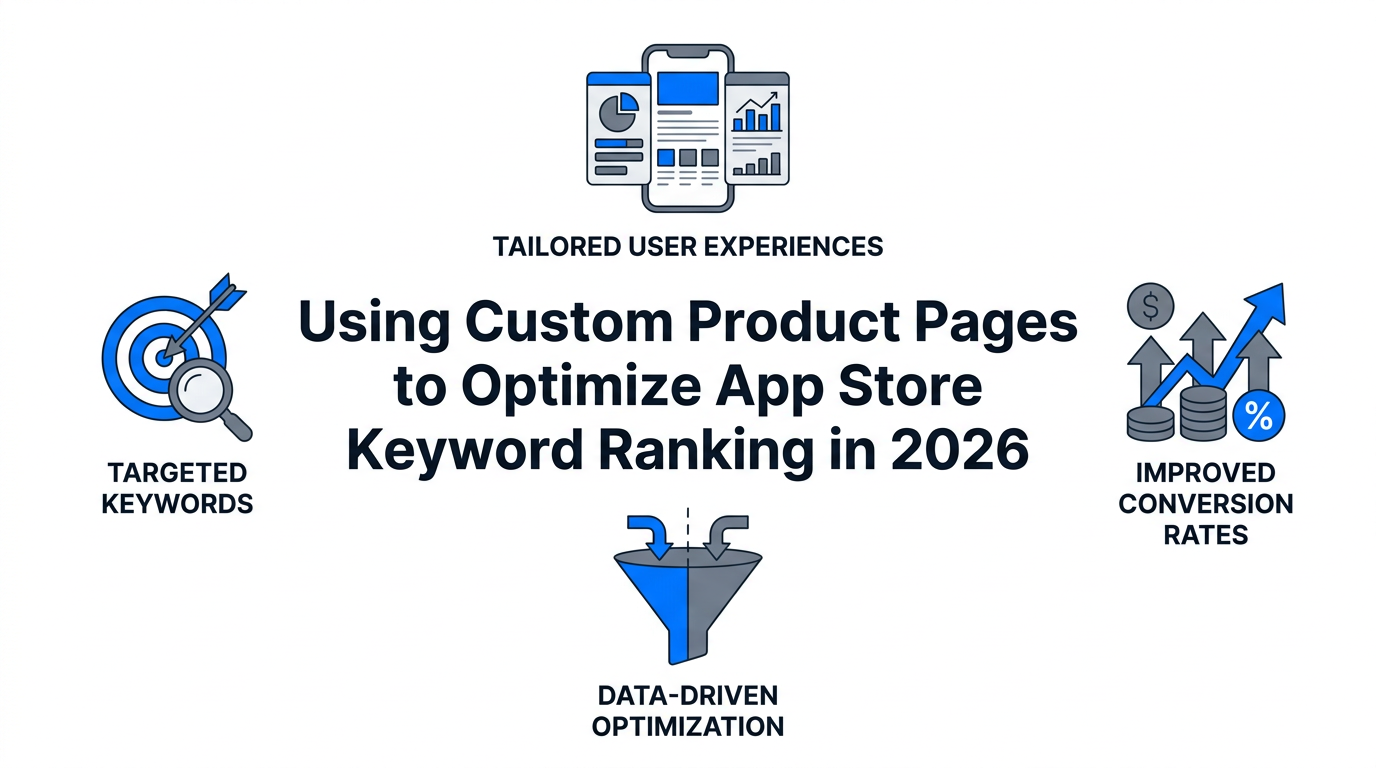
In 2026, the battle for mobile real estate is no longer won through sheer keyword stuffing or brute-force user acquisition. As the Apple App Store and Google Play Store have evolved into sophisticated discovery engines, the focus has shifted toward intent-based semantic search. With approximately 70% of all app installs originating from a search query, mastering app store keyword ranking is the single most critical organic lever for any developer. However, the secret weapon of 2026 is not just the keywords you target, but where you send the users after they click. Custom Product Pages (CPPs) have become the bridge between high-intent search and high-conversion downloads, allowing brands to align specific search terms with tailored visual experiences.
The Semantic Shift: Why Keywords Alone Aren't Enough
The days of "exact-match" lexical search are largely behind us. In the current 2026 landscape, app stores utilize Natural Language Processing (NLP) to understand the intent behind a query. If a user searches for "calorie tracker," the algorithm automatically understands the relevance of "diet log," "macro counter," and "weight loss assistant," even if those terms aren't explicitly in your title. With over 2 million apps on iOS and nearly 4 million on Google Play, standing out requires more than just being indexed; it requires being relevant.
"65% of users download an app immediately after performing a search, highlighting that search traffic has the highest conversion intent of any channel in 2026."
Mapping Intent: Using Up to 70 Custom Product Pages
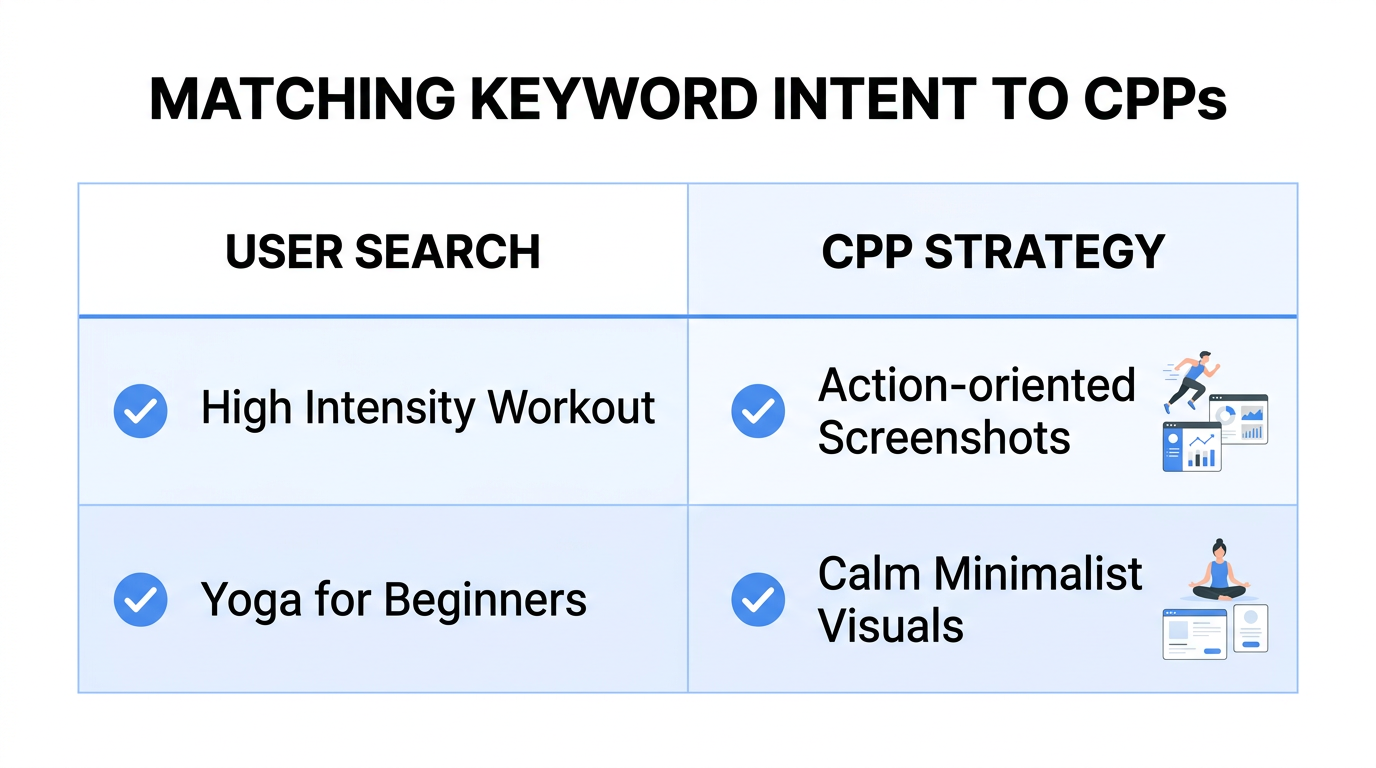
Apple now allows developers to create up to 70 Custom Product Pages, each with its own unique set of screenshots, app previews, and promotional text. This allows for a level of personalization previously reserved for web-based landing pages. For example, a multi-functional fitness app can create one CPP for "Yoga for Beginners" and another for "Bodybuilding Routine." When a user searches for one of those specific terms, the app can present a storefront that mirrors their exact needs.
The User Journey from Search to Install
When you align your Custom Product Pages with high-intent keywords, you create a seamless psychological journey. Tools like Mobile Action help identify which keywords have the highest difficulty and volume, but the real magic happens in the ASO conversion rate optimization. If your search result shows a general fitness app but your competitor shows a dedicated "HIIT Workout" screenshot for the term "HIIT," they will win the download every time. By segmenting your search traffic, you can achieve a 20% to 50% boost in organic downloads.
| Platform Factor | Apple App Store (iOS) | Google Play Store (Android) |
|---|---|---|
| Max CPPs/Variants | 70 Custom Product Pages | Store Listing Experiments (8) |
| Visual Search | OCR-indexed Screenshots | AI "Ask Play" Analysis |
| Keyword Weight | Title > Subtitle > Keyword Field | Title > Short Description > Density |
| Indexing Logic | Semantic & Combinatorial | NLP & Backlink Authority |
OCR and Visual Search: How Screenshots Affect Ranking
A massive change in 2026 is the role of app store visual search. Apple’s algorithm now uses Optical Character Recognition (OCR) to "read" the text inside your screenshots. This means that the keywords you include in your visual assets are now ranking factors themselves. If your primary screenshots contain the text "Personalized Meal Planner," the App Store's algorithm uses that data to reinforce your relevance for those terms in search results.
This shift makes the creative process even more vital. Brands are increasingly moving away from stock imagery toward high-impact User Generated Content (UGC). For instance, sophisticated teams are using Stormy AI to discover and vet creators who can produce authentic video previews that resonate with specific demographics. These UGC assets are then placed into specific CPPs to ensure that the visual "hook" matches the user's search intent perfectly.
"The text in your screenshots is no longer just for the user; it is for the algorithm. OCR indexing has turned visual design into a technical ASO requirement."
The Correlation: Why CVR is the Ultimate Ranking Signal
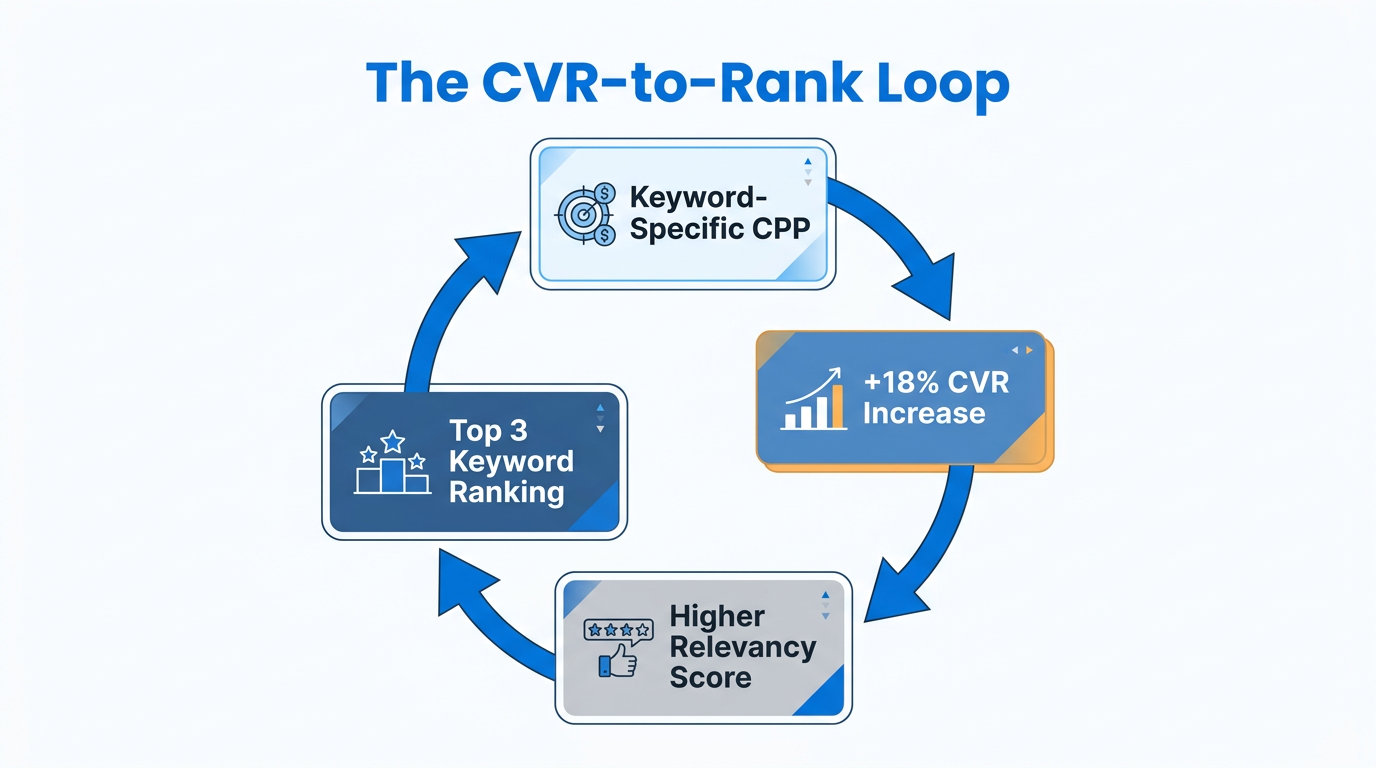
In 2026, the algorithm prioritizes "utility" over "matches." The most important signal of utility is your Conversion Rate (CVR). If 1,000 people search for "meditation," click on your app, and only 10 download it, the App Store will quickly demote you in favor of an app that converts 100 out of 1,000. This is the CVR-Ranking Loop.
- High Relevance: Using a CPP tailored to the keyword "Sleep Sounds" ensures the user sees what they searched for.
- Increased CVR: The user is more likely to install because the visuals match their intent.
- Higher Velocity: More installs in a shorter period signals popularity to the algorithm.
- Improved Ranking: Your app moves up the search results for that keyword, leading to even more organic traffic.
Research from ConsultMyApp suggests that apps utilizing targeted CPPs see significantly better retention in top-3 ranking positions because they maintain a higher-than-average CVR compared to generic listings.
The 2026 ASO Playbook: Setting Up Your CPP Strategy
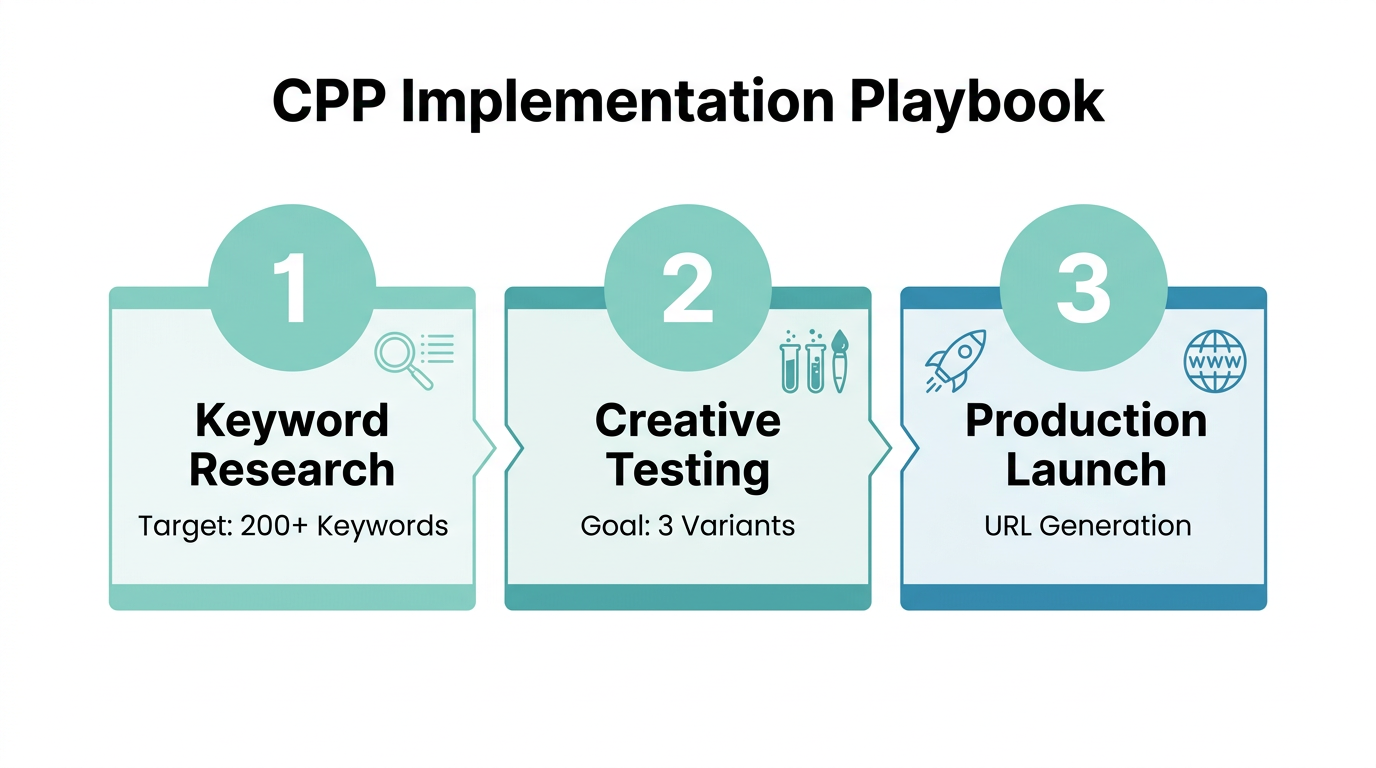
To dominate app store keyword ranking this year, you need a systematic approach to keyword-to-page mapping. Follow these steps to build a high-conversion organic funnel:
Step 1: Identify Your High-Volume Clusters
Use tools like AppTweak to find clusters of semantically related keywords. Instead of targeting 100 random words, group them into 5-10 primary themes (e.g., "Pricing," "Speed," "Specific Feature A," "Specific Feature B").
Step 2: Create Intent-Specific Visuals
For each cluster, design a set of 3-5 primary screenshots that highlight that specific benefit. Ensure the text on these screenshots is OCR-optimized—meaning use clear, high-contrast fonts that the store's AI can easily read. Incorporating UGC creators through Stormy AI can help you generate authentic content for these pages at scale without a massive production budget.
Step 3: Deploy via Apple Search Ads (ASA)
The fastest way to test if a CPP is working is through Apple Search Ads. You can direct ASA traffic to specific Custom Product Pages. This not only gathers data on CVR but also feeds the algorithm's download velocity requirement, helping your organic ranking rise faster.
Step 4: Monitor and Rotate
ASO is not a "set-it-and-forget-it" strategy. Seasonality plays a massive role in 2026. Keywords like "New Year's resolution" or "World Mental Health Day" should be swapped into your CPPs dynamically. Appfigures is excellent for tracking how these creative rotations impact your overall ranking over time.
Case Studies: Real-World Gains from CPP Segmentation
Several major apps have already demonstrated the power of this approach. For example, the travel giant Kiwi.com saw a 31% increase in organic downloads by moving primary keywords to the title and localizing for over 10 markets using region-specific CPPs. Similarly, Headspace utilized seasonality to its advantage, updating metadata for specific awareness days, which resulted in a 40% boost in visibility.
In the fintech space, a US-based news app pivoted from broad terms like "Finance" to long-tail keywords like "crypto tax tracker." By creating a dedicated CPP for this niche intent, they saw a 140% growth in downloads because their conversion rate was nearly double the industry average for that specific sub-niche.
"Winning in ASO isn't about being the biggest app; it's about being the most relevant answer to a user's specific problem."
Conclusion: The Future of Discovery
As we move through 2026, Custom Product Pages are no longer an optional feature—they are the foundation of a modern app store keyword ranking strategy. By aligning semantic keyword clusters with OCR-optimized visuals and high-conversion landing pages, developers can create a feedback loop that the algorithms of Apple and Google simply cannot ignore.
The key to success lies in the intersection of data and creativity. Use platforms like ASOdesk for keyword suggestions, and ensure your creative assets—the literal face of your app—are performing at their peak. In a world of 6 million apps, the one that speaks most directly to the user's immediate need will always win the install.