Crown SP 1500 Harness and Anchorage Bar: The Checks That Come Before Elevation
How operators inspect the full body harness, lanyard, snap hooks, and single-person anchorage bar on Crown SP 1500 Series order pickers daily before platform operation.
STORMY Editorial · · 8 min read
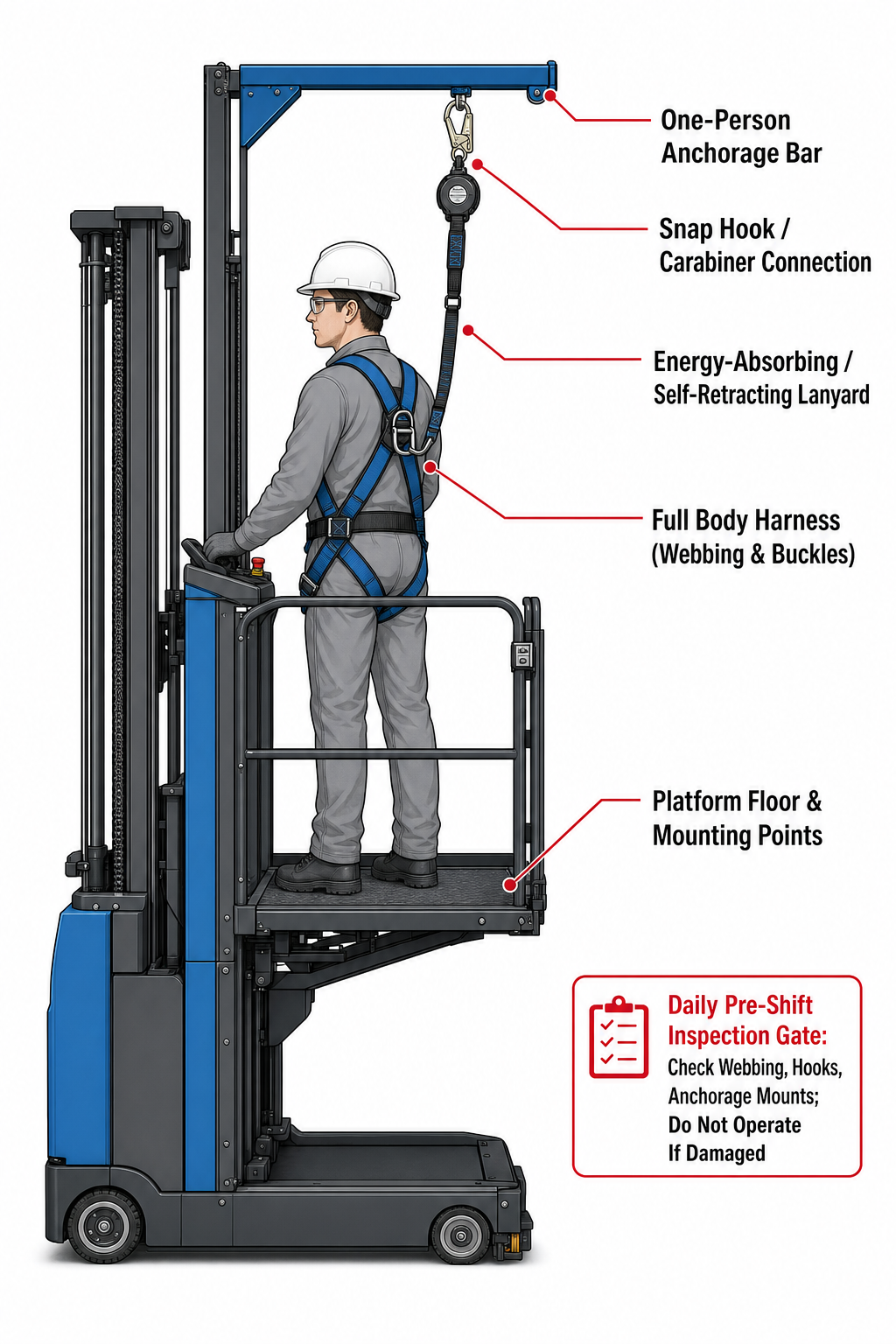
Platform fall protection components on the Crown SP 1500 Series, showing the dedicated one-person anchorage bar, harness, lanyard, snap hooks, and mounting points.
Before operating the platform on a Crown SP 1500 Series man-up order picker, the operator must put on their harness, attach the harness and lanyard to the dedicated anchorage bar, and check the system daily. Crown's operator manual specifies that the anchorage bar is intended for one person and mandates daily inspection of the harness, lanyard, snap hooks, and mounting points for wear or damage. If any part is damaged or not working correctly, the equipment must not be used and the supervisor must be notified.
1
Step 1: Put on the full body harness upon entering the platform
Put on your harness as soon as you get on the platform. Check the harness daily for wear or damage following manufacturer instructions for proper fit, inspection, and maintenance. Note that pregnant women must not use fall protection devices.
2
Step 2: Check lanyard and snap hooks daily for wear or damage
Inspect the lanyard and snap hooks daily for wear or damage following the manufacturer's instructions. Verify that all components of the fall protection system are rated for the operator's weight.
3
Step 3: Inspect the anchorage bar and platform mounting points
Check the overhead anchorage bar and its mounting points daily for wear or damage. Confirm that the anchorage bar is used only for one person.
4
Step 4: Attach to the anchorage bar and verify weight and jurisdictional rules
Attach your harness and lanyard to the anchorage bar. Ensure truck capacity is reduced by operator weight in excess of 100 kg (220 lbs). Verify device selection: energy-absorbing lanyards (max 1.8 m / 6 ft) are prohibited in California by CAL-OSHA, self-retracting lanyards must have a max length of 2.4 m (8 ft), and if operator weight exceeds 181 kg (400 lbs), contact Crown.
Full Body Harness; Energy Absorber (max 1.8 m / 6 ft); Self-Retracting Lanyard (max 2.4 m / 8 ft)
Truck capacity must be reduced by operator weight in excess of 100 kg (220 lbs). Energy absorbing lanyard prohibited by CAL-OSHA in California.
141 kg to 181 kg (311 to 400 lbs)
Full Body Harness; Self-Retracting Lanyard (max 2.4 m / 8 ft)
Truck capacity must be reduced by operator weight in excess of 100 kg (220 lbs). All components must be rated for operator weight.
> 181 kg (> 400 lbs)
Contact Crown
Operator must contact Crown Equipment Corporation for guidance.
Anchorage Occupancy
One Person Only
The anchorage bar is intended for one person. Do not connect multiple persons to the bar.
Daily Harness, Lanyard, and Anchorage Inspection Requirements
Crown Operator Manual 600098-200 Rev. C requires operators to put on their harness as soon as they get on the platform and attach their harness and lanyard to the anchorage bar. The anchorage bar is intended for one person. Operators must check the harness, lanyard, snap hooks, and mounting points daily for wear or damage.
Under OSHA 29 CFR 1910.178(q)(7), industrial trucks must be examined before being placed in service, and must not be placed in service if examination shows any condition adversely affecting vehicle safety. Such examinations must be made at least daily, or after each shift in round-the-clock operations. Following manufacturer instructions for proper fit, inspection, and maintenance ensures the fall protection system is checked before use.
Put on the harness as soon as stepping onto the platform.
Attach the harness and lanyard to the overhead anchorage bar.
Verify the anchorage bar is used for only one person.
Check harness, lanyard, snap hooks, and mounting points daily for wear or damage.
Follow manufacturer instructions for proper fit, inspection, and maintenance.
Operator Weight Limits, Derating, and Jurisdictional Rules
Page 57 of the Crown SP 1500 manual provides a specific Fall Protection / Prevention Selection Chart based on operator weight. All components of the fall protection system must be rated for the operator's weight. When an operator's weight exceeds 100 kg (220 lbs), the truck capacity must be reduced by the weight in excess of 100 kg (220 lbs).
The chart specifies device suitability by operator weight class. For operators under 141 kg (311 lbs), full body harnesses, energy absorbers up to 1.8 m (6 ft), and self-retracting lanyards up to 2.4 m (8 ft) are listed; however, energy-absorbing lanyards are prohibited by CAL-OSHA in the State of California. For operators between 141 kg and 181 kg (311 to 400 lbs), self-retracting lanyards (max 2.4 m / 8 ft) and full body harnesses are specified. If operator weight exceeds 181 kg (400 lbs), the manual directs operators to contact Crown. In addition, pregnant women must not use fall protection devices.
Handling Damaged Components and Supervisor Notification
The Crown SP 1500 manual states plainly: if something is not working correctly or is damaged, do not use it, and notify your supervisor. Daily inspection ensures any wear or damage to the harness, lanyard, snap hooks, or mounting points is identified prior to operation.
This protocol is reinforced by OSHA 29 CFR 1910.178(p)(1), which mandates that if at any time a powered industrial truck is found to be in need of repair, defective, or in any way unsafe, the truck shall be taken out of service until it has been restored to safe operating condition. Any defects found during examination must be immediately reported and corrected under 1910.178(q)(7).
Sources and limits
Crown SP 1500 Series Operator Manual (600098-200 Rev. C)Official Crown operator manual covering operating position, harness and lanyard daily checks, anchorage bar requirements, operator weight chart, and daily safety inspection.
OSHA 29 CFR 1910.178 - Powered Industrial TrucksFederal standard covering daily pre-service vehicle inspection under 1910.178(q)(7) and taking unsafe or defective trucks out of service under 1910.178(p)(1).
Applies strictly to Crown SP 1500 Series order pickers and their designated one-person platform anchorage bars and fall protection systems as documented in Crown Operator Manual 600098-200 Rev. C.