Crown RR 5700 Reduce Lift Height: Read the Fork Zone Before You Raise Again
When the Crown RR 5700 display sounds an alarm and reads REDUCE LIFT HEIGHT, the load is too heavy for the current lift zone. Lower carefully and verify capacity evidence before proceeding.
STORMY Editorial · · 8 min read
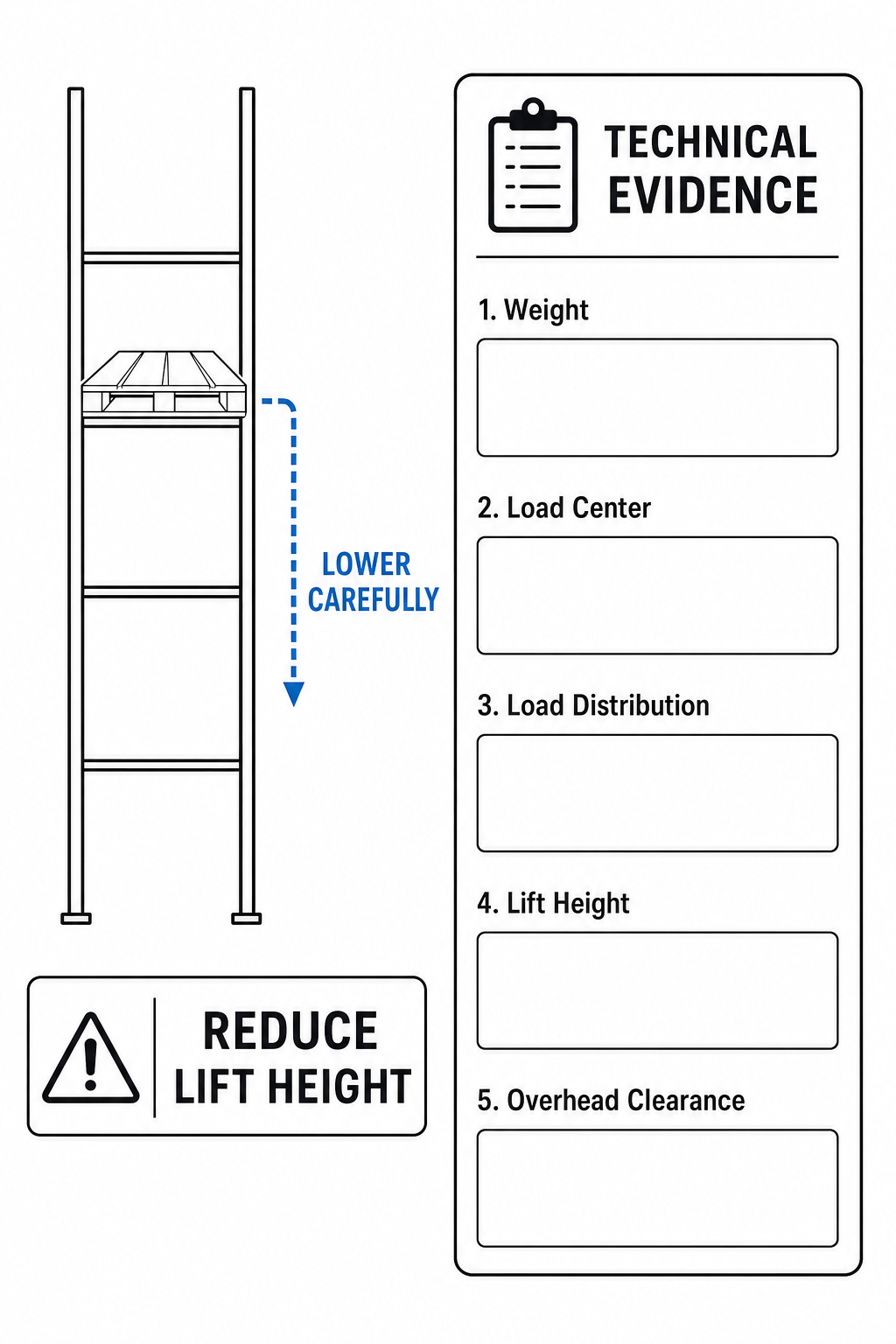
Editorial technical diagram illustrating four-rung lift height zones, the REDUCE LIFT HEIGHT warning, the LOWER CAREFULLY directive, and five blank intake evidence fields.
Operator Manual - RR 5700 Series Rider Reach Truck
Locator
Page 16, Display Panel, Capacity Data Monitor Overload Warning
Manual ID
PF18340-F
On the Crown RR 5700 rider reach truck, an audible alarm accompanied by the display text REDUCE LIFT HEIGHT indicates that the load on the forks is too heavy for the current lift zone. Operators must not attempt to force raising or bypass height limits. The manual directs the operator to lower the load carefully, check the rated capacity on the truck's capacity plate, and record key physical load evidence if the machine requires service evaluation.
1
1. Cease Raising and Lower Load Carefully
When the alarm beeps and REDUCE LIFT HEIGHT appears on the display panel, stop raising immediately. Lower the load carefully and smoothly to reduce elevation, avoiding sudden control movements.
2
2. Check Rated Capacity on the Truck Capacity Plate
Examine the capacity plate located on the operator console. Check the maximum rated capacity for the intended lift height and load center, noting that allowable capacity decreases as lift height increases.
3
3. Inspect Load Center, Packaging, and Distribution
Verify that the load is stable, centered, and evenly distributed on the forks. Ensure the fork tines support at least two-thirds (67%) to three-fourths (75%) of load length and do not protrude beyond the load.
4
4. Record Five-Field Capacity Evidence
Preserve the five physical capacity parameters for service intake and verification: verified load weight, horizontal load center, load distribution, lift zone height, and overhead clearance. If the truck requires evaluation, report these findings alongside the exact display message and truck serial number.
The mast is at its minimum collapsed height (page 16).
Make certain the load will clear overhead obstructions (page 16).
Yellow Fork Height Lights
The load backrest is higher than the collapsed height of the mast (page 16).
Ensure load and backrest clear obstructions; keep travel speed at or below load positioning speed (2.4 km/h / 1.5 MPH).
Green Max Lift Height Lights
Green bars show how high or to which lift zone the load can be raised (page 16).
Do not attempt to raise forks above the indicated lift zone.
Beep Alarm + 'REDUCE LIFT HEIGHT'
Load is too heavy for the lift zone the forks are in (page 16).
Lower load carefully; check load weight and load center against capacity plate.
Service Required Indicator (Wrench)
Service required (page 17).
Contact your supervisor or service department (page 17); remove from service if unsafe.
How Lift Height and Load Center Affect Rated Capacity
On the Crown RR 5700, truck capacity is the maximum load that can be lifted to a given height at a given load center as indicated on the capacity plate. As lift height increases, rated lifting capacity is reduced to maintain stability. Capacity is also reduced when the horizontal load center increases beyond the dimension specified on the plate.
The Capacity Data Monitor assists the operator by indicating current lift zones with yellow fork lights and maximum allowable lift zones with green bars. However, Crown manual PF18340-F cautions that all information displayed by the fork position lights and Capacity Data Monitor is for reference only. The console capacity plate remains the controlling rating for safe operation.
Capacity may be reduced as lift height increases, as shown on the console capacity plate (PF18340-F, page 14).
Capacity is reduced as load center increases; operators may not increase capacity if load center is less than shown (PF18340-F, pages 14-15).
Only loads within the rated capacity of the truck shall be handled (29 CFR 1910.178(o)(2)).
The long or high (including multiple-tiered) loads which may affect capacity shall be adjusted (29 CFR 1910.178(o)(3)).
The Five Essential Capacity Verification Fields
When an overload warning occurs, operators must systematically verify five key physical conditions before attempting to move or store the pallet. First, verify actual load weight against known pallet manifests or scale data. Second, verify the horizontal load center from the vertical face of the forks to the load center of gravity. Third, verify that weight is evenly distributed across both forks.
Fourth, confirm the specific lift zone and target rack elevation against capacity plate limits. Fifth, check total overhead clearance to ensure the mast and load backrest clear building structures. Recording these five blank fields provides the necessary factual record whether adjusting the load or initiating service intake.
Safe Service Intake and Removal from Service
If a load is verified to be within rated capacity on the stamped plate but the truck repeatedly sounds an alarm and displays REDUCE LIFT HEIGHT, the machine may have an underlying sensor or system defect. Operators must not attempt display calibration, sensor bypassing, or mechanical alterations.
Under OSHA 29 CFR 1910.178(p)(1), any powered industrial truck found unsafe or in need of repair must be taken out of service until restored to safe operating condition by authorized personnel. Provide maintenance with the truck serial number, hour meter reading, exact display message, and documented load parameters.
Sources and limits
Crown RR 5700 Series Operator Manual (PF18340-F)Official manufacturer manual covering Display Panel, Capacity Data Monitor, fork height lights, overload warning, and capacity plate rules (pages 12-17).
Applies to the Crown RR 5700 rider reach truck equipped with the standard Display Panel and Capacity Data Monitor. Covers operational response to the REDUCE LIFT HEIGHT overload warning and safe capacity intake verification. Does not cover technician-level sensor calibration or internal repairs.