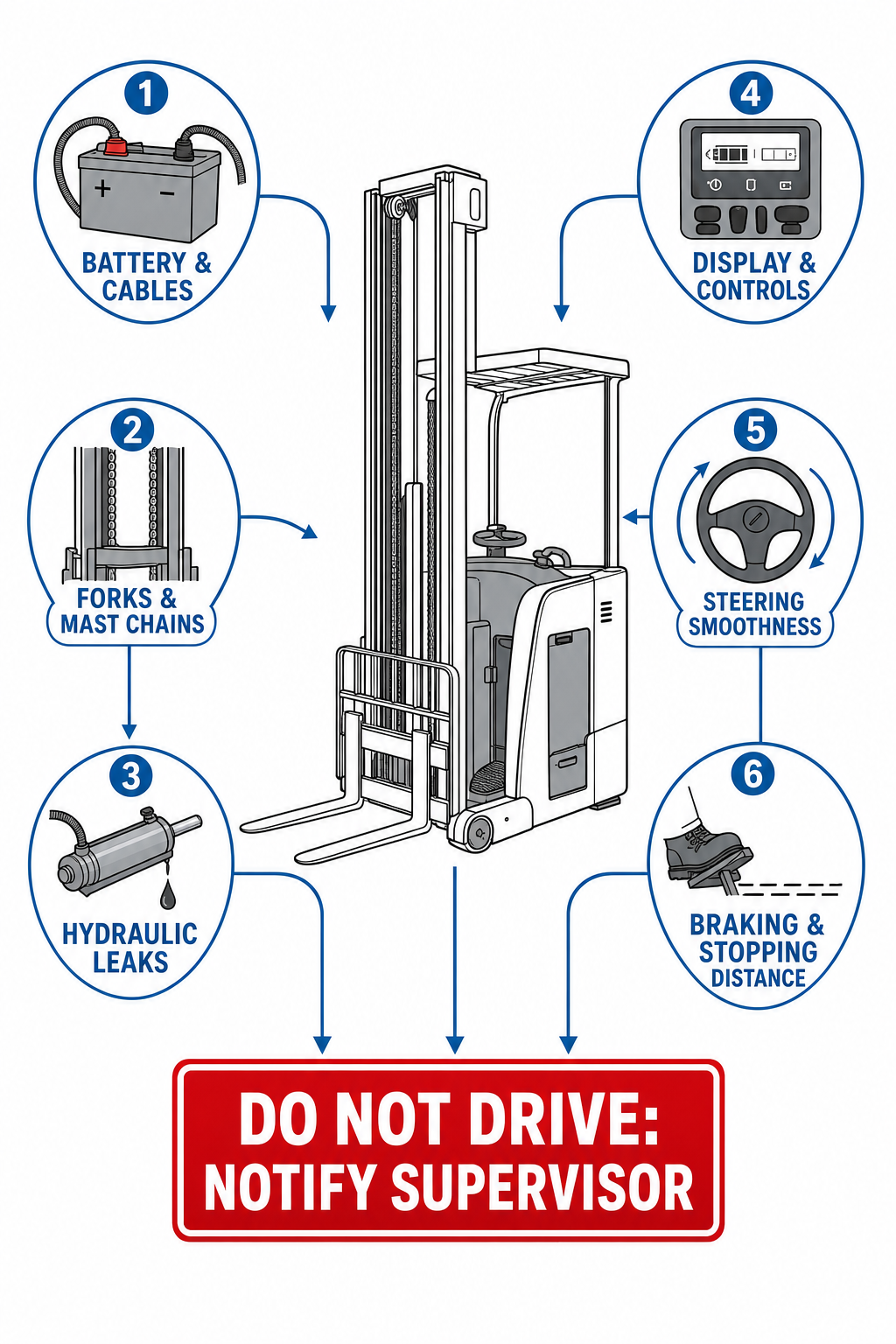
Crown RR 5700 Daily Safety Check: When the Truck Must Not Be Driven
Official Crown manual PF18340-F and OSHA regulations define pre-shift inspection points, stopping-distance failure rules, and mandatory supervisor notification when any component fails.
STORMY Editorial · · 8 min read
Crown RR 5700 pre-shift inspection workflow: visual walkaround and functional operational checks leading to mandatory do-not-drive decision and supervisor notification upon inspection failure.
The Crown RR 5700 Series operator manual specifies a two-stage pre-shift safety check: a visual walkaround inspection followed by an operational test drive in an uncongested area. If braking distance is too long or any component does not look, work, feel, or sound right, the operator must not drive the truck and must immediately notify their supervisor.
1
Perform visual walkaround inspection
Examine battery charge, connectors, terminals, cables, and retainers on both sides. For flooded lead-acid batteries, verify water levels and vent caps, checking for spilled acid without open flames. Inspect wheels, clean safety glass, verify forks are secure and not bent, cracked, or badly worn, inspect lift chains and anchors for damage, corrosion, and lubrication, ensure load backrest and overhead guard are fastened, and check under the truck for hydraulic leaks.
2
Verify static controls and electrical disconnect
Turn the key switch to TEST (yellow dot position) to confirm all display lights illuminate and function. Test the horn, and test the emergency disconnect switch to confirm complete power cut-off before attempting any machine motion.
3
Conduct operational test drive in uncongested area
Operate all hydraulic fork functions (raise, lower, reach, retract, tilt, and any optional sideshift or rack height selection). Check that steering is easy and smooth. Drive slowly in both directions, then test through the full speed range in forward and reverse.
4
Evaluate stopping distance and stop if abnormal
Check braking and plugging distances in both forward and reverse, accounting for floor conditions and load. Know the stopping distance before starting work. If stopping distance is too long, or if anything does not look, work, feel, or sound right, do not drive the truck and notify your supervisor.
Crown RR 5700 Daily Safety Check: Inspection Items vs Safe Condition vs Defect Condition
Inspection Area
Safe Condition (Pass)
Defect / Failure Condition (Do Not Drive)
Braking & Plugging
Truck stops predictably within expected distance across slow and full speed ranges in both directions
Stopping distance is too long, braking is erratic, or plugging fails to decelerate smoothly
Battery & Power Supply
Battery charged, retainers locked on both sides, cables/terminals undamaged, vent caps on, no spilled acid
Spilled acid, damaged cables/terminals, unlatched retainers, or damaged main connector
Forks, Chains & Mast
Forks secure without bends/cracks/excessive wear; lift chains lubricated without damage or corrosion
Bent or cracked forks, worn fork heels, damaged/corroded chain links, or loose chain anchors
Hydraulic System
All lift, lower, reach, retract, and tilt motions respond smoothly; no fluid pooling under chassis
Fluid dripping/puddling under truck, jerky hydraulic movement, or failure to hold lift height
Steering & Controls
Steering wheel moves easily and smoothly; test-dot lights work; horn and emergency disconnect function
Crown Operator Manual PF18340-F establishes that the operator must ensure the truck is safe to use prior to beginning any shift. The protocol divides inspection into two distinct phases: a stationary walkaround examination and a dynamic operational test drive in an open, uncongested area.
The stationary walkaround covers critical structural, electrical, and hydraulic components. Operators inspect battery retention, cable integrity, wheel condition, mast lift chains, fork wear, overhead guard fastening, and under-chassis hydraulic integrity. The static electrical check verifies indicator lights via the key TEST position, horn audibility, and emergency disconnect operation before any motion is initiated.
Static control check: key switch TEST position for display lights, horn operation, and emergency power disconnect functioning.
Dynamic functional check: full-range hydraulic motions, smooth steering response, low-speed and full-speed travel in both directions.
Stopping-distance verification: braking and plugging checks in forward and reverse prior to handling active warehouse loads.
Stopping Distance and Abnormal Condition Thresholds
Dynamic testing requires testing braking and plugging across slow and full speed ranges in both travel directions. Because floor conditions and load weights alter stopping distances, operators must establish that the vehicle stops within safe operating tolerances before entering production aisles.
Crown explicit rule states: if braking distance is too long for the operator, or if anything does not look, work, feel, or sound right, do not drive the truck. This standard prevents operators from compensating for degraded friction surfaces, hydraulic bypass, or electronic control faults during production.
OSHA Compliance, Removal from Service, and Supervisor Notification
Federal regulation 29 CFR 1910.178(q)(7) mandates that industrial trucks be examined before being placed in service, at least daily or after each shift in continuous operations. If examination reveals any condition adversely affecting vehicle safety, the unit cannot be placed in service.
Under 29 CFR 1910.178(p)(1), any powered industrial truck found defective, in need of repair, or unsafe must be immediately removed from service until restored to safe operating condition. Operators must immediately report defects to supervisory personnel and remove the truck from service; only authorized, qualified maintenance technicians may perform adjustments, diagnostic testing, or repairs.
Sources and limits
Crown RR 5700 Series Operator Manual (PF18340-F)Official manufacturer operator manual covering daily safety check procedures, walkaround checklist, test drive requirements, and stopping distance rules on pages 34-35.
OSHA 29 CFR 1910.178 Powered Industrial TrucksFederal safety standards covering vehicle examination before service (1910.178(q)(7)) and mandatory removal from service for defective or unsafe equipment (1910.178(p)(1)).
This guide applies specifically to the Crown RR 5700 Series rider reach truck daily pre-shift inspection and service boundary protocol. It covers operator visual and functional checks as documented in manual PF18340-F and OSHA 1910.178. It does not provide service manual diagnostics, electrical schematics, hydraulic pressure relief settings, or DIY repair instructions, which must be performed only by certified service technicians.