Counter-Positioning for Growth: Why 6-7 Water Outperforms Legacy Brands on Social Media
Discover how 6-7 Water used the 'opposite is stupid' brand positioning framework to crush legacy competitors in social media engagement and community-led growth.
In the crowded 2026 beverage market, a new player has emerged that defies every traditional rule of corporate marketing. While legacy giants like Dasani and Aquafina spend millions on top-down agency campaigns, a startup water brand called 6-7 Water has managed to amass over 150,000 followers and 5x the engagement of its billion-dollar predecessors in just eight weeks. This isn't just a fluke of the algorithm; it is a masterclass in digital-native vertical brands using a specific brand positioning framework called 'counter-positioning.'
By intentionally designing a brand that is 'grown-up proof' and leaning into the chaotic energy of TikTok memes, 6-7 Water has proven that all positioning is actually counter-positioning. If you aren't defining yourself against an incumbent, you aren't really positioned at all. This article explores the strategic playbook used by Dan Porter and high school athlete Taylen Kinney to turn a simple canned water into a cultural movement.
The 'Opposite is Stupid' Framework
Learn why a strategy only counts if its opposite isn't inherently stupid.
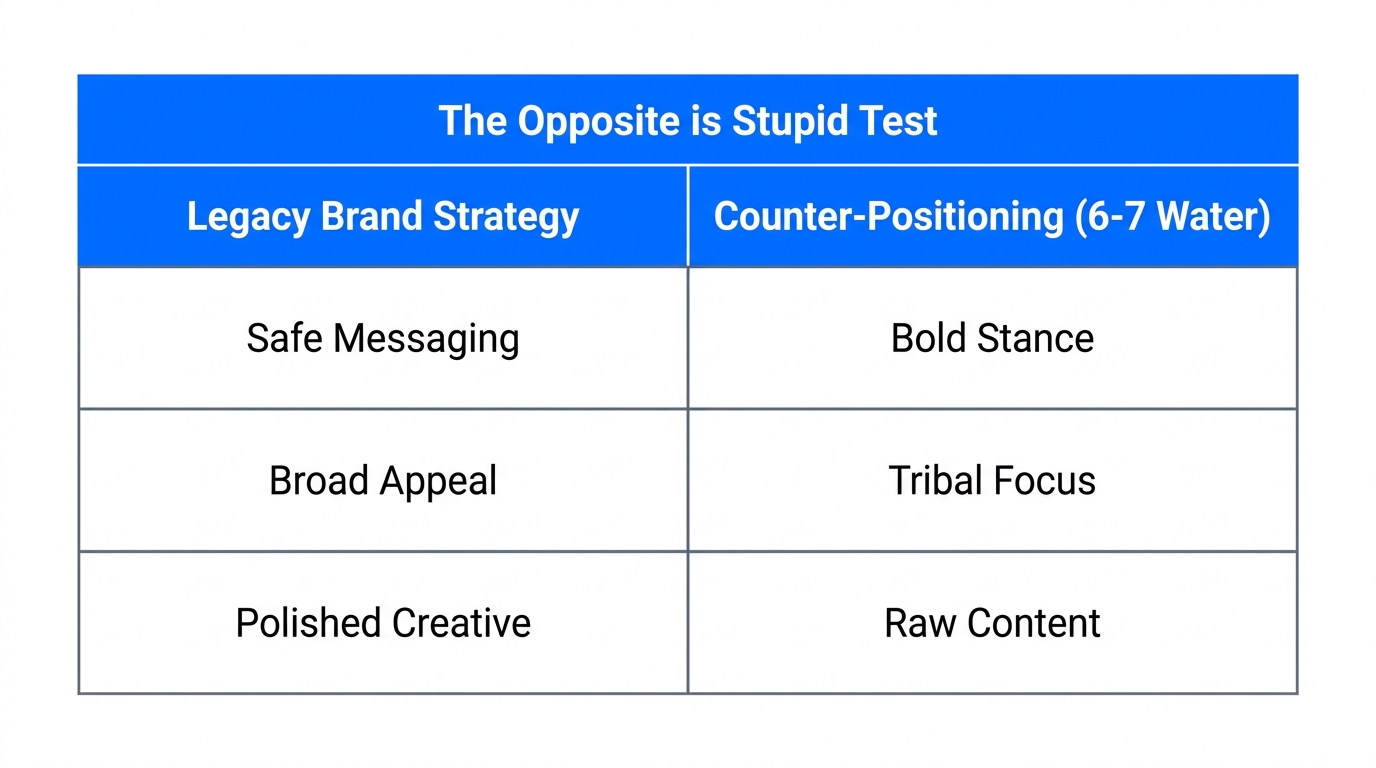
Dan Porter, the mind behind Overtime, posits a simple but brutal test for any community-led growth strategy: If the opposite of your strategy is stupid, then it's not a strategy. Most brands claim they want to 'have the best customer service' or 'make high-quality products.' But since no company would ever claim their strategy is to have bad service or low-quality products, those aren't strategies—they're table stakes.
For 6-7 Water, the strategy was built on an insight that legacy brands couldn't touch. Legacy brands need to appeal to everyone from 8-year-olds to 80-year-olds to maintain their massive scale. This 'general appeal' is their greatest strength, but it is also the box they are trapped in. A brand like Vitamin Water cannot suddenly start using Gen Z slang like 'rizz' or 'liddy' without alienating half their customer base. 6-7 Water, however, can lean entirely into the niche, creating competitive differentiation in 2026 by being hyper-specific and exclusionary.
"If the opposite of your strategy is stupid, then it's not a strategy. If your strategy is 'having great service,' you don't have a strategy at all."
The 'Cereal Aisle' Positioning Map
Dan Porter explains the strategic positioning of cereal brands in the grocery aisle.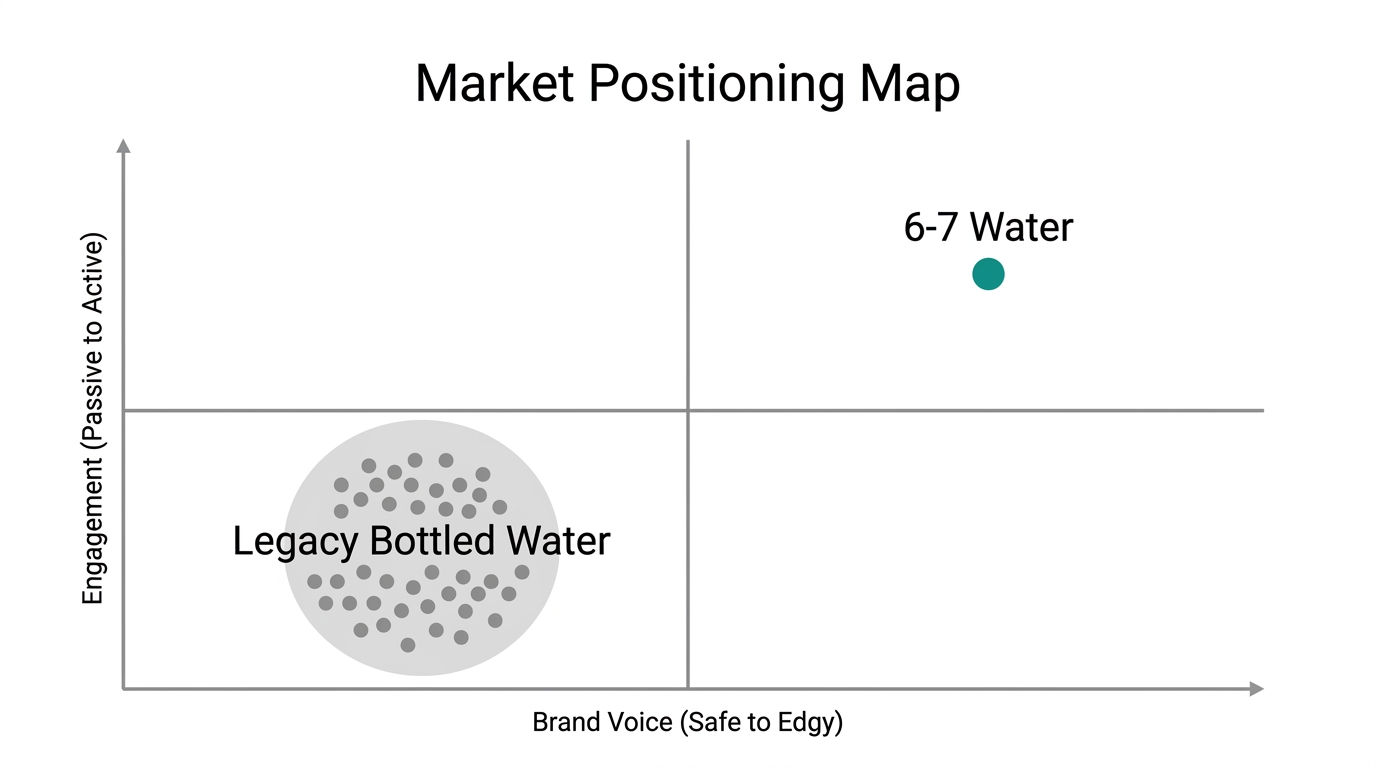
To understand where a brand sits in the mind of a consumer, Porter uses the analogy of the cereal aisle. In a supermarket, cereal is organized on two axes: Health (Left to Right) and Age (Top to Bottom). Sugary cereals for kids are on the bottom at their eye level, while the healthy, boring grains for adults are at the top. Every digital-native brand in 2026 must find its 'white space' on a similar grid according to modern positioning experts.
| Brand Type | Target Demographic | Content Strategy | Engagement Level |
|---|---|---|---|
| Legacy (Dasani/Aquafina) | Mass Market (All ages) | Top-down, polished, corporate | Low |
| Lifestyle (Liquid Death) | Millennial/Gen X | Irony, heavy metal, edgy visuals | Moderate-High |
| Digital-Native (6-7 Water) | Gen Z/Gen Alpha | Bottom-up, meme-driven, UGC-first | Extremely High |
6-7 Water positioned itself in the 'Kid/Social-First' quadrant. By using a meme that only middle schoolers and high schoolers understood—the '6-7' hand motion from a YouTube-famous rap song—they created a natural barrier for adults. When a parent sees the content and says, 'I don't get it,' the brand has succeeded. That confusion is the grown-up proofing that builds tribal loyalty among the youth.
Grown-up Proofing: Why Exclusion is the Ultimate Moat
Discover how intentionally confusing design can build deep tribal loyalty among younger users.The 6-7 Water movement started when a video of 17-year-old basketball player Taylen Kinney went viral. The meme—a specific answer to a question that 'means nothing'—exploded on TikTok. Instead of trying to explain the joke to the masses, the brand leaned into the absurdity. In 2026, social media engagement tactics often fail because they try to be too accessible.
By making the brand hard to understand for anyone over the age of 21, 6-7 Water created a 'secret password' effect. This is similar to the early days of Snapchat, where the UI was intentionally confusing to prevent parents from joining. When a brand is intentionally designed to exclude older demographics, it gives the younger target audience a sense of ownership. They didn't just find a water brand; they found their water brand.
Bottom-up vs. Top-down Culture
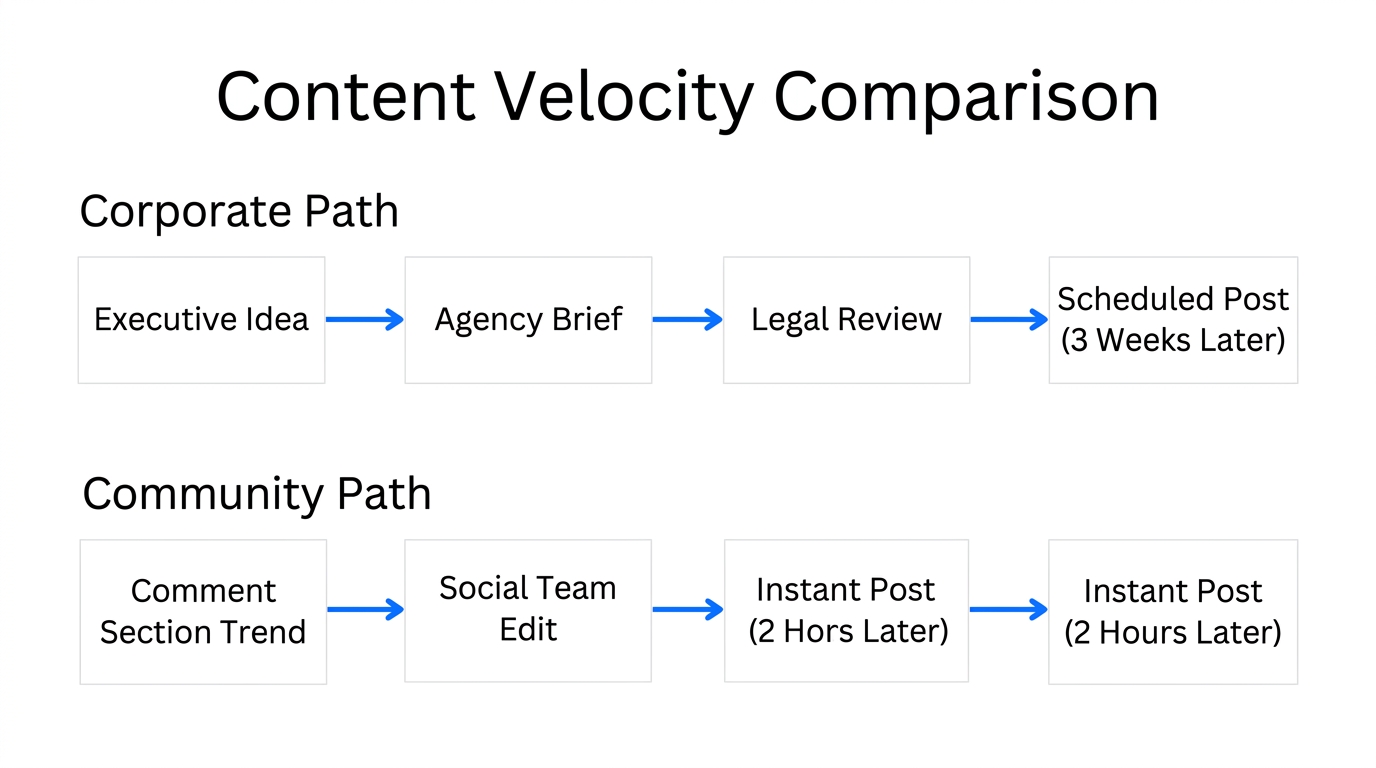
Legacy water brands operate on a top-down culture. They hire expensive agencies to create 15-second spots that run on Google Ads and TV. This is 'broadcast' marketing. 6-7 Water uses bottom-up culture, where the fans create the marketing. Kids are making their own commercials for 6-7 Water, pouring it on each other like holy water, and posting it to their stories.
This bottom-up approach is fueled by the NIL (Name, Image, Likeness) revolution. High school and college athletes are now the most powerful influencers in the world. When a brand like 6-7 Water partners with an athlete like Taylen Kinney, it's not just an endorsement; it's a co-founding partnership. To find these high-engagement creators and manage these relationships at scale, platforms like Stormy AI are becoming essential for brands that want to bypass traditional agencies and work directly with the 'buckets-getters' of the digital world.
"The concert was actually a backdrop for them to create content. Everyone under 30 has the camera pointing at themselves; everyone over 30 has it pointing out."
The 'Reply to Every Comment' Rule
Dan Porter shares why replying to every single comment is a game-changing strategy.One of the most effective social media engagement tactics Porter utilized was the 'Reply to Every Comment' rule. In the early days of Overtime and subsequently 6-7 Water, the team manually responded to hundreds of thousands of comments. They didn't just send emojis; they engaged in 'roasting' culture. If a fan commented, the brand might go to that fan’s profile, find a photo, and roast their 'mom jeans' or their jump shot.
This creates a 'fan for life' model. When a brand with 100k+ followers interacts with a 14-year-old on a personal level, that kid becomes a brand evangelist. In 2026, where ChatGPT and other bots handle most 'interactions,' the human-centric, high-volume manual engagement stands out as a premium experience. It’s a community-led growth strategy that cannot be faked by a legacy corporation.
Using Trade-offs as a Values-Building Tool
A brand's values are meaningless unless there is a trade-off baked into them. Facebook’s 'Move Fast and Break Things' was a true value because it acknowledged that things would break. For 6-7 Water, the trade-off is professional polish for speed and authenticity. They launched the brand in eight weeks without a long-term 'marketing plan,' choosing instead to 'live read' the market.
This speed allowed them to capitalize on a meme while it was still hot. While a company like Pepsi would spend two years in R&D and focus groups, 6-7 Water was already in gas stations. They accepted the risk of not having a perfect distribution deal with Publix or Shopify fully optimized from day one. In the world of digital-native vertical brands, speed is often more valuable than certainty.
Conclusion: The 2026 Branding Playbook
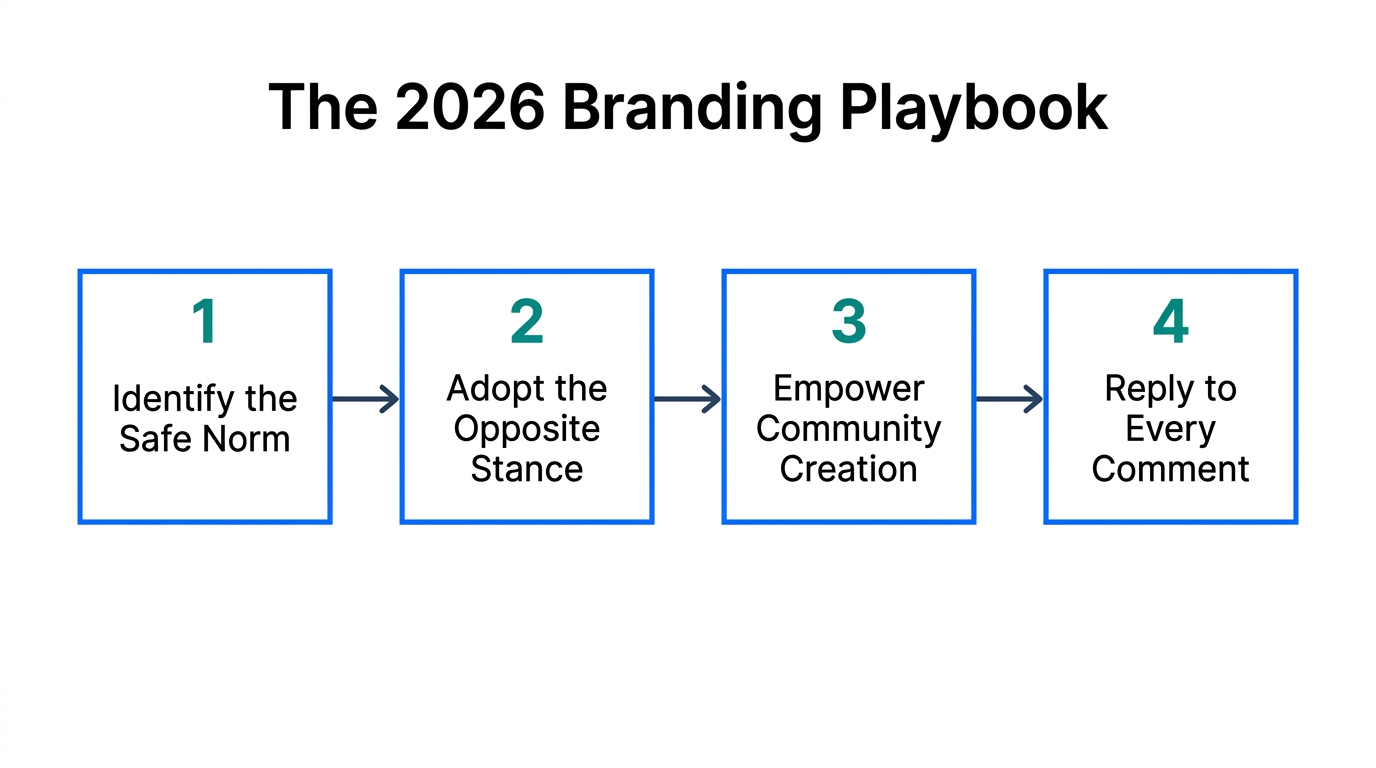
The success of 6-7 Water in 2026 proves that the 'curling' model of business—shaving the ice and smoothing the path for creators—is the future of branding. Legacy incumbents are hindered by their need to be everything to everyone. Small, agile brands can win by being 'nothing' to the masses and 'everything' to a specific tribe.
To implement this in your own growth strategy:
- Identify the 'Blue': See what everyone else is looking at (stats, mass appeal) and look for the 'Red' (niche culture, memes, prodigies).
- Build a Grown-up Proof Moat: Don't be afraid to be misunderstood by people who aren't your target customer.
- Engage Bottom-Up: Use tools like Stormy AI to discover and manage the creators who are actually defining culture, then interact with their fans one-on-one.
- Accept the Trade-off: If your strategy doesn't hurt a little, it's not a strategy.
The era of top-down broadcast marketing is over. Whether you are selling water, software, or sneakers, the only way to the moon is through the community you build in the trenches of the comment section.