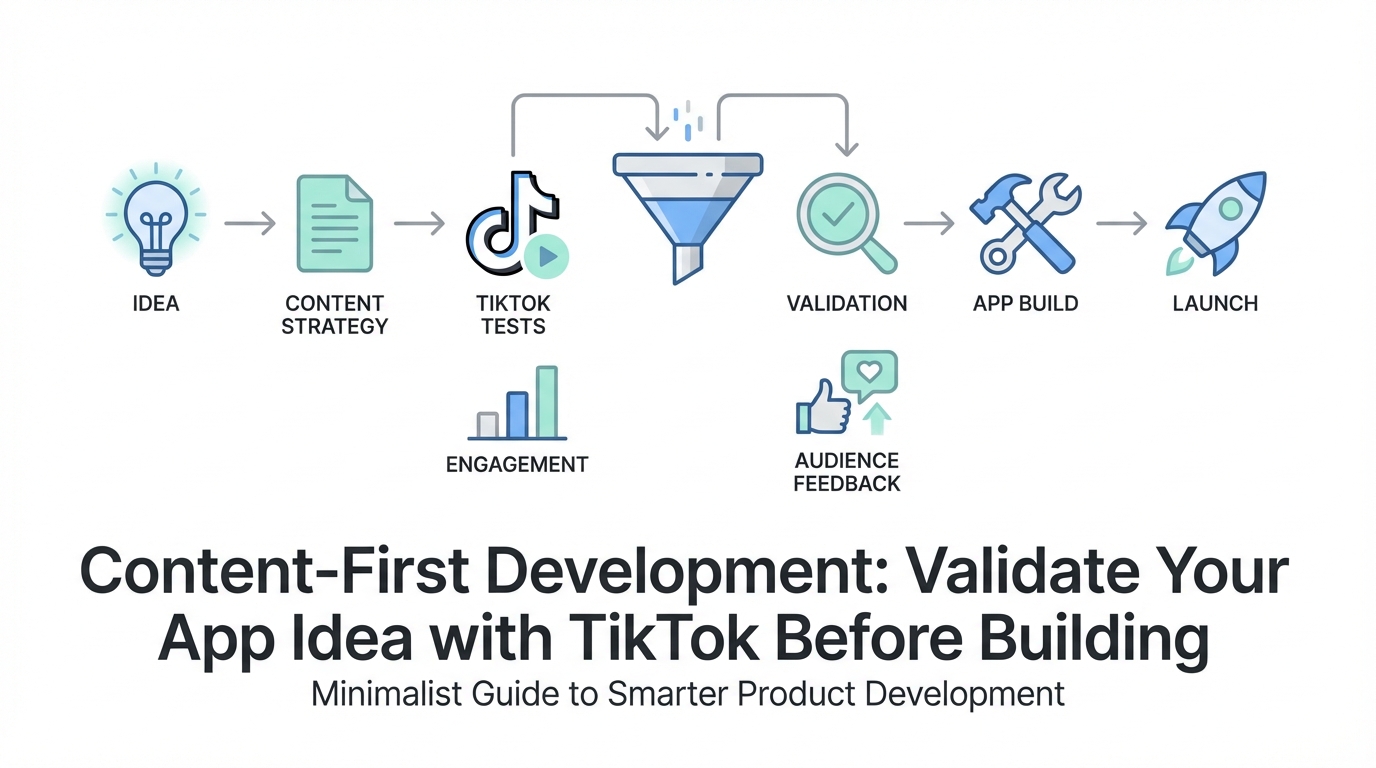
The traditional startup lifecycle is a gamble that most founders lose. You have an idea, you spend six months in a basement writing code, you launch on Product Hunt, and then... silence. You spent thousands of dollars and hundreds of hours building a solution for a problem that might not exist, or worse, for an audience you don't know how to reach. This is why content-first development is becoming the gold standard for modern developers. Instead of building a product and then looking for an audience, smart founders are using app idea validation through social media to prove demand before a single line of code is written. By flipping the script, you ensure that distribution is baked into the product from day one.
The Distribution Hurdle: Why Build-First is a Trap
In the current software ecosystem, building the app is actually the easy part. With the rise of no-code tools and AI-assisted coding, the barrier to entry for creating software has never been lower. However, the barrier to distribution has never been higher. Most founders fail because they ignore how they will actually get their app in front of users until after the version 1.0 is finished. This lack of a product market fit strategy leads to the "ghost town" effect where a technically perfect app has zero active users.
As we see in the success stories of modern mobile apps, the most successful products are those that solve a visible, visceral problem that can be demonstrated in seconds. When you focus on distribution first, you aren't just looking for users; you are performing app idea validation in the most rigorous way possible: by seeing if strangers on the internet actually care enough to stop scrolling. If you cannot capture attention with a video of the concept, you likely won't capture it with the finished product either.
The 'Fake Demo' Method: Visualizing the Value
How do you show off an app that doesn't exist? This is where the "Fake Demo" method comes into play. You don't need a functioning backend to prove a concept. You need to visualize the value your app provides. For example, if you are building a fitness app, you don't need a workout tracker; you need a video that shows the result of using that tracker. This approach allows you to test how to validate a startup idea without the overhead of technical development.
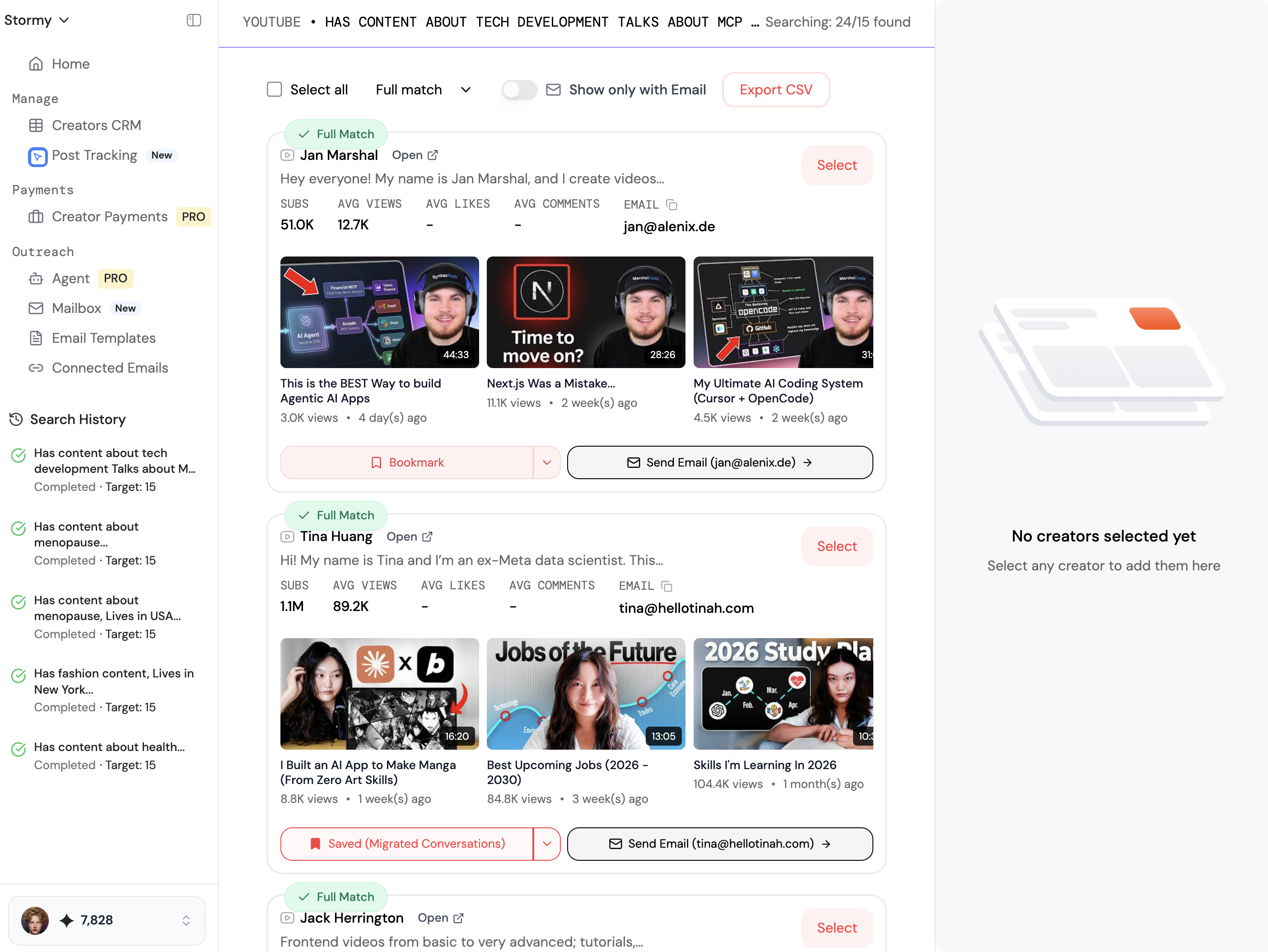
To create a high-fidelity fake demo, founders are increasingly using a mix of AI-generated clips, stock footage, and simple UI overlays. The goal is to bridge the "curiosity gap." You want to present a scenario where a user has a problem and your "app" solves it instantly. Platforms like Meta Ads Manager and TikTok have shown that users respond more to the outcome than the interface. If you can visualize the problem-solution loop, you have a winning validation asset. This is where tools like Stormy AI become invaluable for research, helping you use AI search to see what kind of user-generated content (UGC) is already trending in your specific niche before you even start filming.
Case Study: How Push Scroll Validated a $30k/Month Idea
Take the example of Alejandro and Mario, the founders of Push Scroll. They identified a massive problem: doom scrolling. Their solution was novel—an app that blocks social media until you perform physical exercises like push-ups. But they didn't start with an IDE. They started with a video. Alejandro created a video using fake footage and a simple concept: "What if you had to do 20 push-ups to unlock TikTok?"
The results were staggering. That single video, which featured AI push-up detection footage found on the internet and simple transitions, garnered 80,000 views and over 500 comments from people begging for the app to be built. This wasn't just a "like"; it was a product market fit strategy in action. They had 300,000 downloads within months and are now generating over $30,000 in monthly recurring revenue (MRR) according to Indie Hackers reports. By using content-first development, they transformed a hypothetical idea into a validated business with a hungry waitlist before they even wrote their first screen in Jetpack Compose.
The 6-Step Content-First Playbook
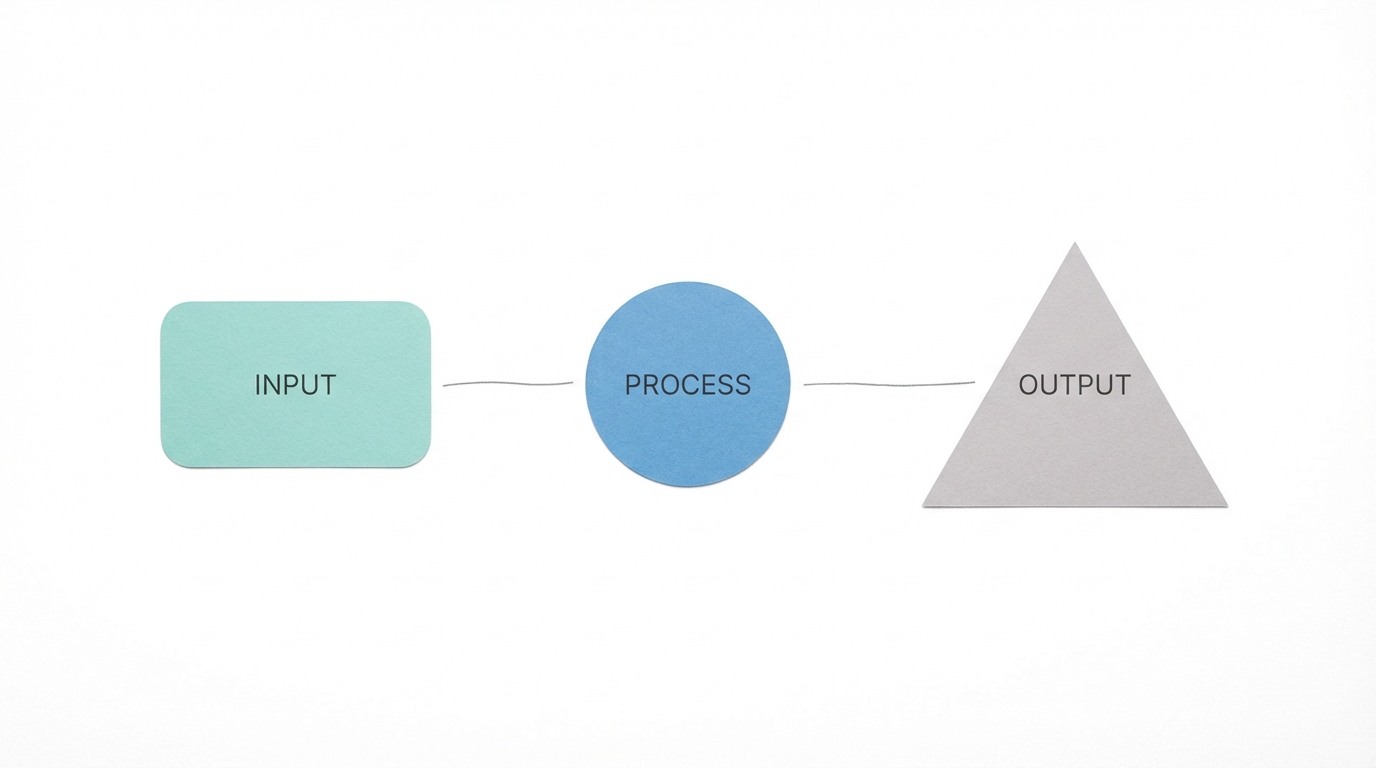
If you want to replicate this success, you need a structured approach to how to validate a startup idea. Here is the playbook used by top-tier indie hackers to move from zero to a validated MVP.
Step 1: Niche Immersion and Account Warm-up
Before you post, you must consume. You need to create a dedicated TikTok or Instagram account and "train" the algorithm. Spend a week interacting with content in your target niche—whether that's productivity, fitness, or SaaS. Comment, share, and save videos that are already going viral. This signals to the platform that you are a real user and not a bot, preventing the dreaded shadowban. It also allows you to perform deep market research. You can even use Stormy AI to discover creators who are already dominating that space and get an AI-powered quality report to analyze their audience demographics and detect fake followers.
Step 2: Ideation for Virality
Your app idea must be "visuably heavy." If it takes ten minutes to explain the value proposition, it will fail on social media. You need to be able to explain your app in three words. Think "Pushups for TikTok" or "Tinder for Jobs." Your idea should solve a fundamental human desire—health, wealth, or relationships—and do it in a way that is novel and original. If it’s visually interesting, it has the potential to go viral.
Step 3: The Daily Posting Grind
Post daily validation videos. Each video should focus on a different hook or a different angle of the problem. You are looking for a strong signal. A strong signal isn't 1,000 views; it’s a video that generates comments asking "When is this dropping?" or "Is this on the App Store?" This is the purest form of app idea validation. If you cannot get organic traction, you might want to test the concept with a small budget on Google Ads to see if search intent matches your social hook.
Step 4: The Embarrassing MVP
Once a video blows up, you must move fast. Create a simple landing page or a Discord community to capture the traffic. Your initial Minimum Viable Product (MVP) should be so simple it’s almost embarrassing. For Push Scroll, it was just three screens: a detector, a selector, and a blocker. Don't worry about scaling or perfect UI. Use a backend like Supabase to handle your data quickly and focus entirely on the core utility that people asked for in the comments.
Step 5: Scaling Organic to $10k MRR
Keep posting. Your own organic content should be your primary driver until you hit at least $5,000 to $10,000 in monthly revenue. This phase is critical because it teaches you what actually sells. You will learn which phrases, colors, and hooks convert viewers into paying subscribers. This data is gold when you eventually transition to paid acquisition or influencer collaborations. During this stage, founders often find that a single viral video with 6 million views can translate directly into $10k in instant MRR.
Step 6: Paid Scaling and UGC
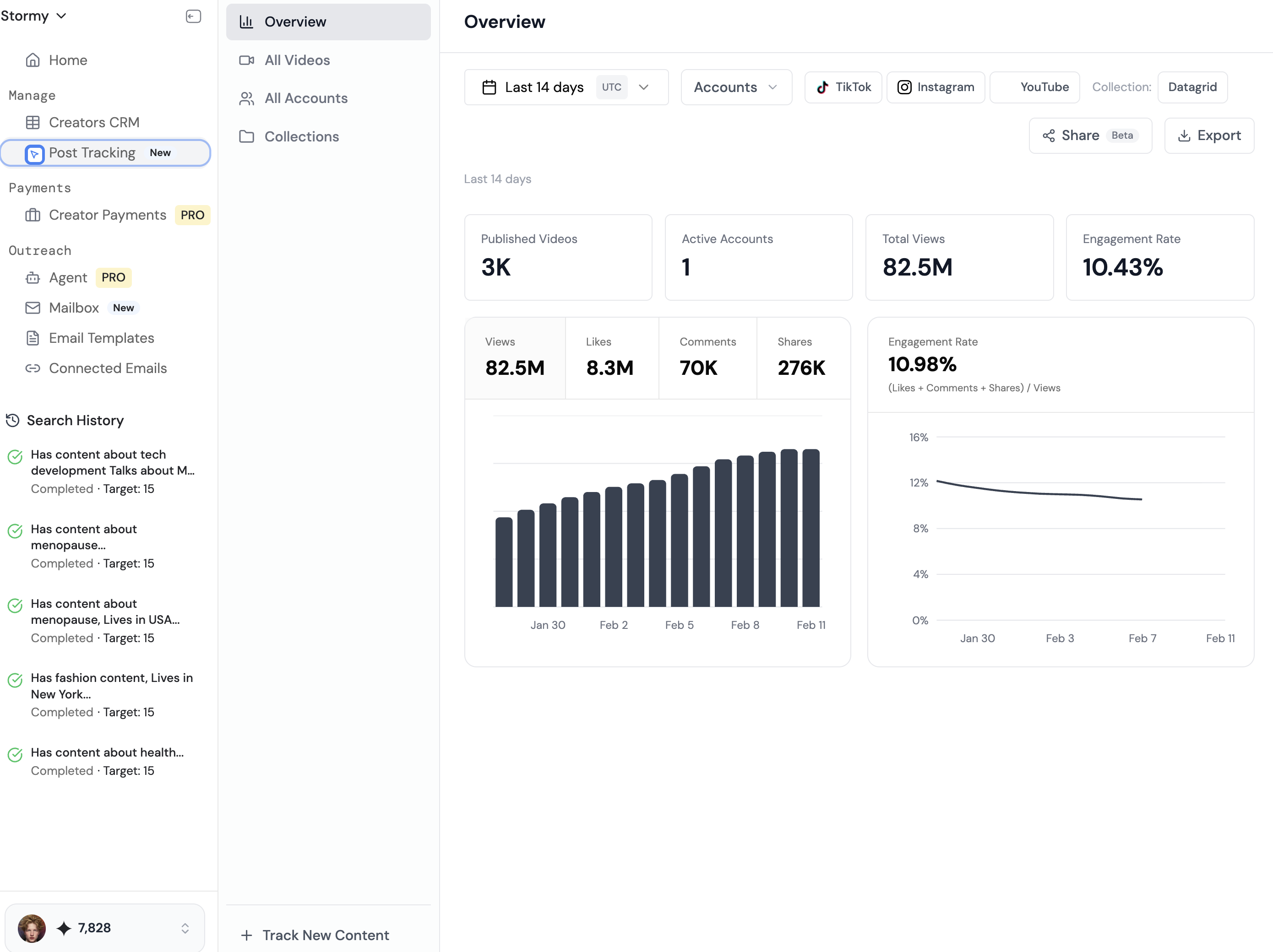
Once you have a proven organic funnel, it’s time to scale. This is where you bring in UGC creators to replicate your winning formats. By using Stormy AI, you can find creators who specialize in mobile app marketing, reach out with AI-personalized emails instantly, and track every video's performance in your post tracking dashboard. At this stage, you stop optimizing what works and start fixing the broken parts of your funnel.
Metric-Based Validation: When to Build?
Not every viral video is a business. To ensure your product market fit strategy is sound, you need to look past the view count. High views can be a vanity metric if they don't lead to engagement. Look for a high Save-to-View ratio and a high number of shares. These indicate that the viewer finds the utility of the app worth remembering or telling a friend about. Most importantly, look at the intent to pay. If you set up a simple waitlist with a "pre-order" option and people actually click it, you have moved from interest to validation.
The Tech Stack for Content-First Founders
Speed is the most important feature of your tech stack during the validation phase. You don't want to spend weeks on infrastructure. Many successful founders today use Compose Multiplatform for cross-platform mobile development, allowing them to hit iOS and Android simultaneously. Combining this with RevenueCat for managing subscriptions and Amplitude for tracking user behavior allows you to focus on the content while the tools handle the heavy lifting. Remember, the goal of content-first development is to reduce the time between an idea and its first dollar earned.
Conclusion: Build with Distribution in Mind
The era of "build it and they will come" is over. In a crowded market, app idea validation through content is the only way to ensure your startup doesn't become another statistic. By starting with a viral hook, testing the curiosity gap, and building an audience before an MVP, you eliminate the biggest risk in entrepreneurship: market rejection. Whether you are a solo developer or a funded team, adopting a content-first development mindset and using a modern tool like Stormy AI to manage your creator relationships and track post analytics will make your growth 10 times easier. Stop coding for a moment, grab your phone, and see if the world actually wants what you're planning to build. If they do, they'll tell you in the comments.