By 2026, the traditional ‘MarTech Stack’ has become a relic of a slower, more manual era. As the total MarTech market reaches $222.53 billion this year, the focus has shifted from buying individual software seats to building decentralized, intelligent ecosystems. We are no longer just connecting tools with APIs; we are weaving a composable marketing automation mesh orchestrated by agentic AI.
At the heart of this revolution is Claude Code, Anthropic’s agentic CLI that has transitioned from a developer tool to the central nervous system for Growth Leads and CMOs. With AI agents reaching a $12.06 billion market value in 2026, the ability to orchestrate these ‘action-oriented’ systems determines who wins the battle for customer attention and who gets buried by integration debt.
The Shift from the 'MarTech Stack' to the 'Composable Canvas'
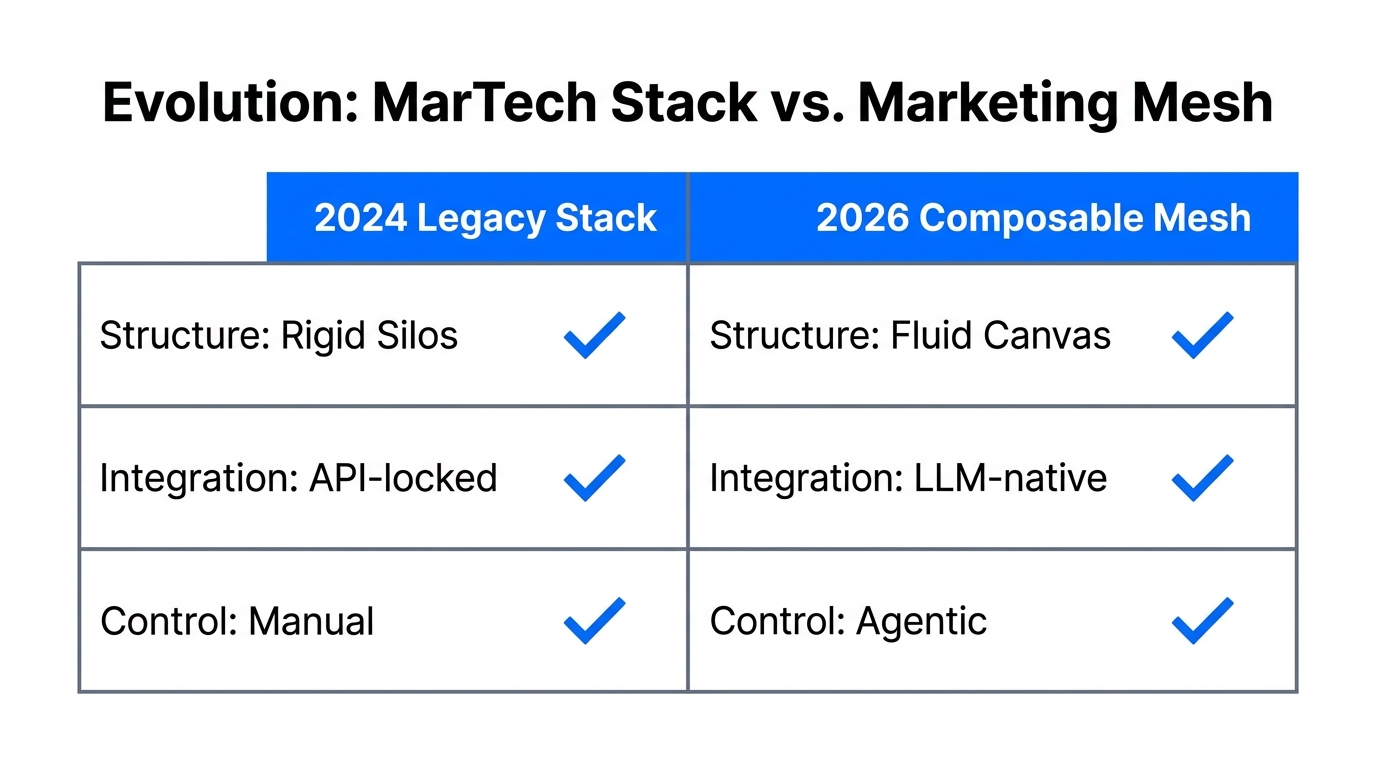
For a decade, marketers were told to build ‘stacks’—rigid layers of software where data was often trapped in silos. In 2026, industry visionaries like Scott Brinker have championed the move toward the Composable Canvas. This model replaces integration plumbing with a unified data foundation where agents roam freely to find and act on information.
Unlike traditional automation that follows linear ‘If-This-Then-That’ logic, a marketing automation mesh is a decentralized network. Here, AI agents navigate between your Customer Data Platform (CDP), creative tools, and ad managers to execute complex goals without human hand-holding. This shift is why 79% of companies have now adopted AI agents, a massive jump from just 19% two years ago.
"The rigid martech stack is giving way to a composable canvas... where a unified data foundation replaces the integration plumbing."
Claude Code: The Central Orchestrator of the Mesh
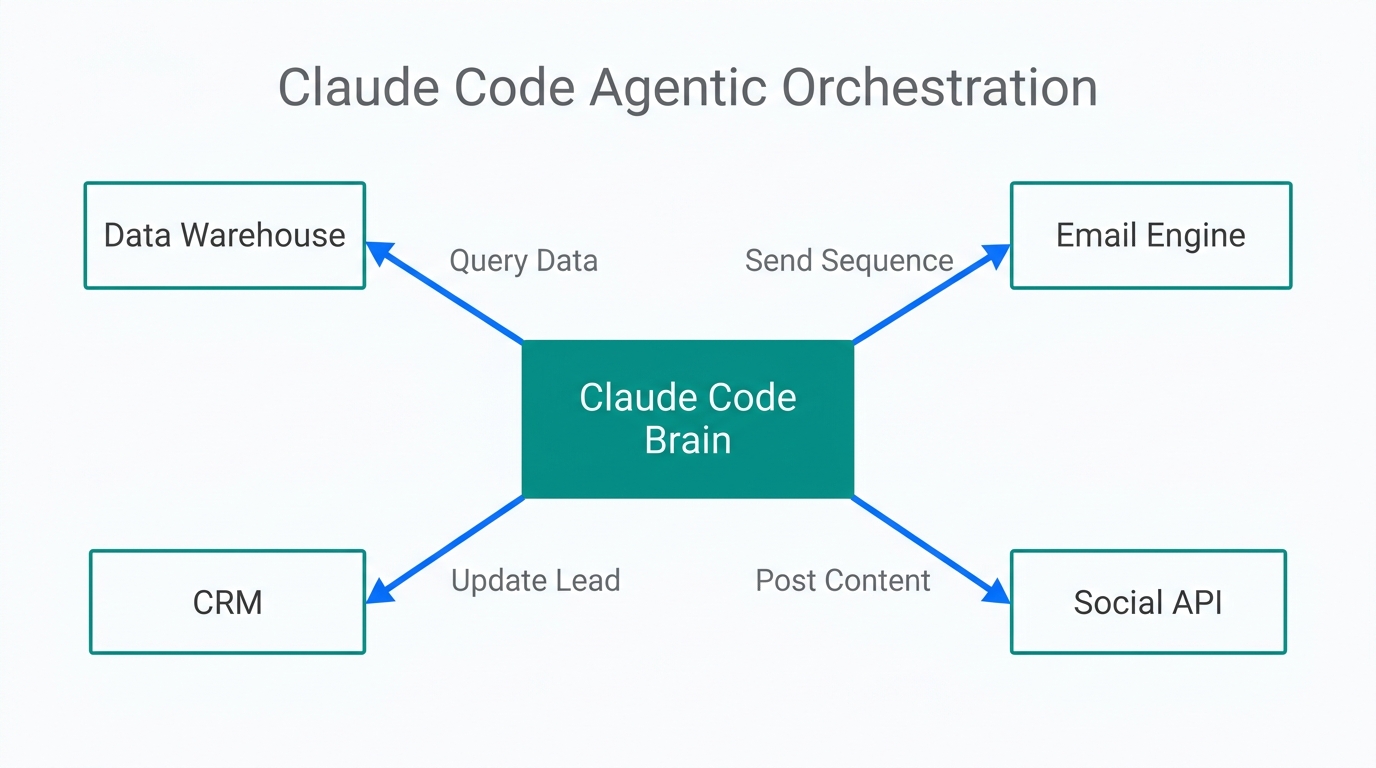
Why has Claude Code become the preferred tool for growth teams? It’s about reasoning at scale. While basic chatbots can write an email, Claude Code can access your repository, analyze your brand voice, pull live data from RudderStack, and then deploy a multi-channel campaign via the terminal.
The secret sauce of the 2026 mesh is the Model Context Protocol (MCP). This open standard, found at modelcontextprotocol.io, allows Claude to plug directly into tools like Google Ads, Slack, and Notion. By using a terminal-based orchestrator, marketing teams are reporting a 75% reduction in time spent on repetitive strategic analysis, such as SEO audits and creator vetting. For instance, platforms like Stormy AI leverage similar agentic logic to help brands instantly discover and vet influencers across TikTok and YouTube, cutting down what used to be weeks of manual research into seconds.
Measuring the Impact: 800%+ ROI and Beyond
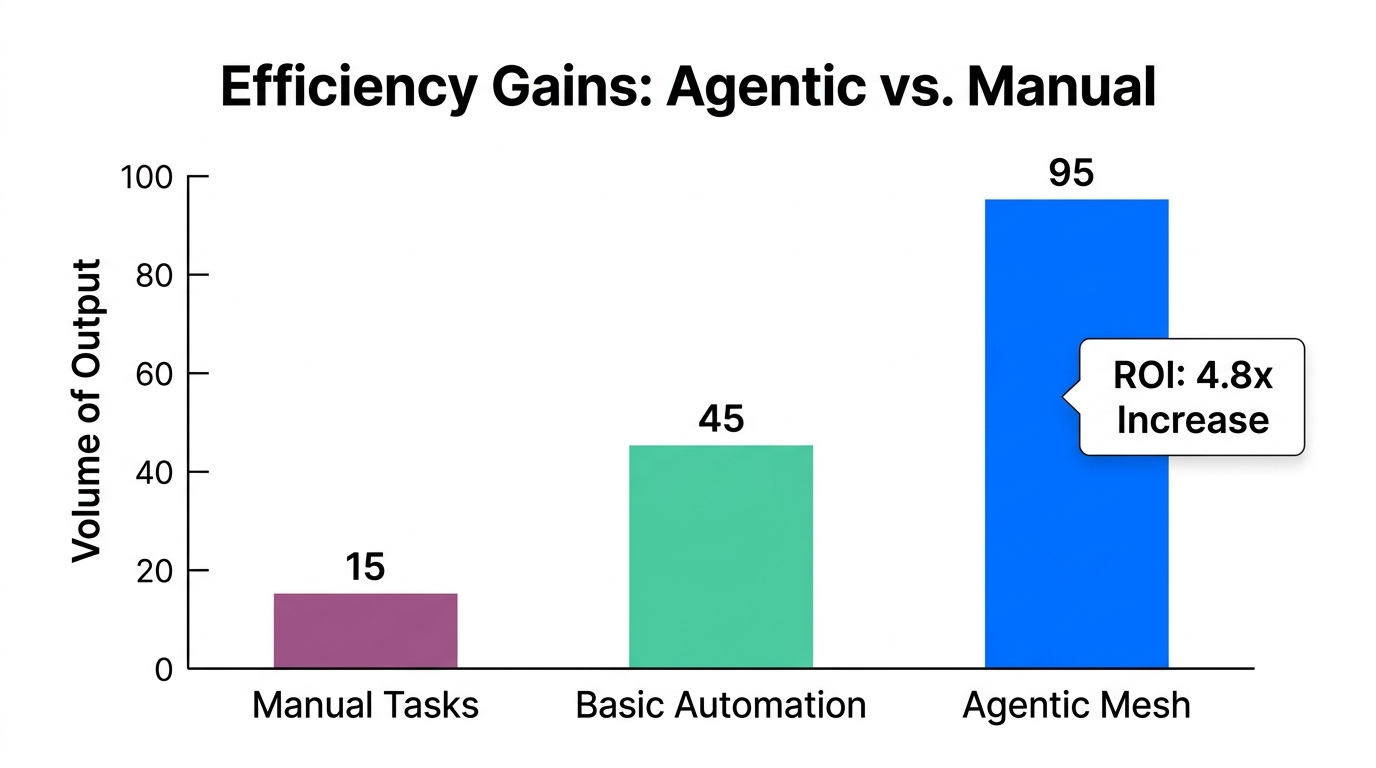
The move to agentic orchestration isn’t just a technical flex; it’s a massive revenue driver. In 2026, the average ROI for marketing automation has reached 544%. However, those using a composable mesh are seeing even more dramatic results.
| Company | Strategy | Outcome |
|---|---|---|
| Nike | Omnichannel Personalization Mesh | 836% ROI |
| Bayer | Predictive Ad Targeting Agents | 85% Increase in CTR |
| Verizon | Predictive Loyalty Triggers | 80% Call Intent Accuracy |
| SBT | Automated Social Mesh | 63% Pageview Increase |
Nike achieved its record-breaking ROI by using agents to dynamically adjust messaging across 12+ channels based on live behavioral data. Meanwhile, Bayer utilized a mesh to monitor search trends for flu products, resulting in a 33% reduction in CPC through autonomous bid adjustments. These aren't just incremental gains; they are fundamental shifts in efficiency enabled by agentic marketing strategy 2026.
"The Technical Marketer 2.0 doesn't write code; they orchestrate agents to build systems that think for themselves."
The 'Data Trust Gap': The 84% Hurdle
Despite the high ROI, the path to a fully autonomous mesh isn’t without friction. The primary blocker in 2026 is the Data Trust Gap. According to recent RevOps surveys from Salesforce, 84% of professionals still do not trust their data accuracy enough to allow an AI agent to execute ‘Write’ actions—such as changing lead statuses or adjusting live budgets—without a manual review loop.
Only 16% of organizations have achieved ‘High Trust’ status, where data is clean enough for headless automation. To bridge this gap, teams are adopting AgentOps. As Joao Moura, CEO of CrewAI, suggests, AgentOps is the 2026 equivalent of DevOps, focused on monitoring the reliability, cost, and brand compliance of your AI fleet.
The 2026 Playbook: Building Your First Mesh
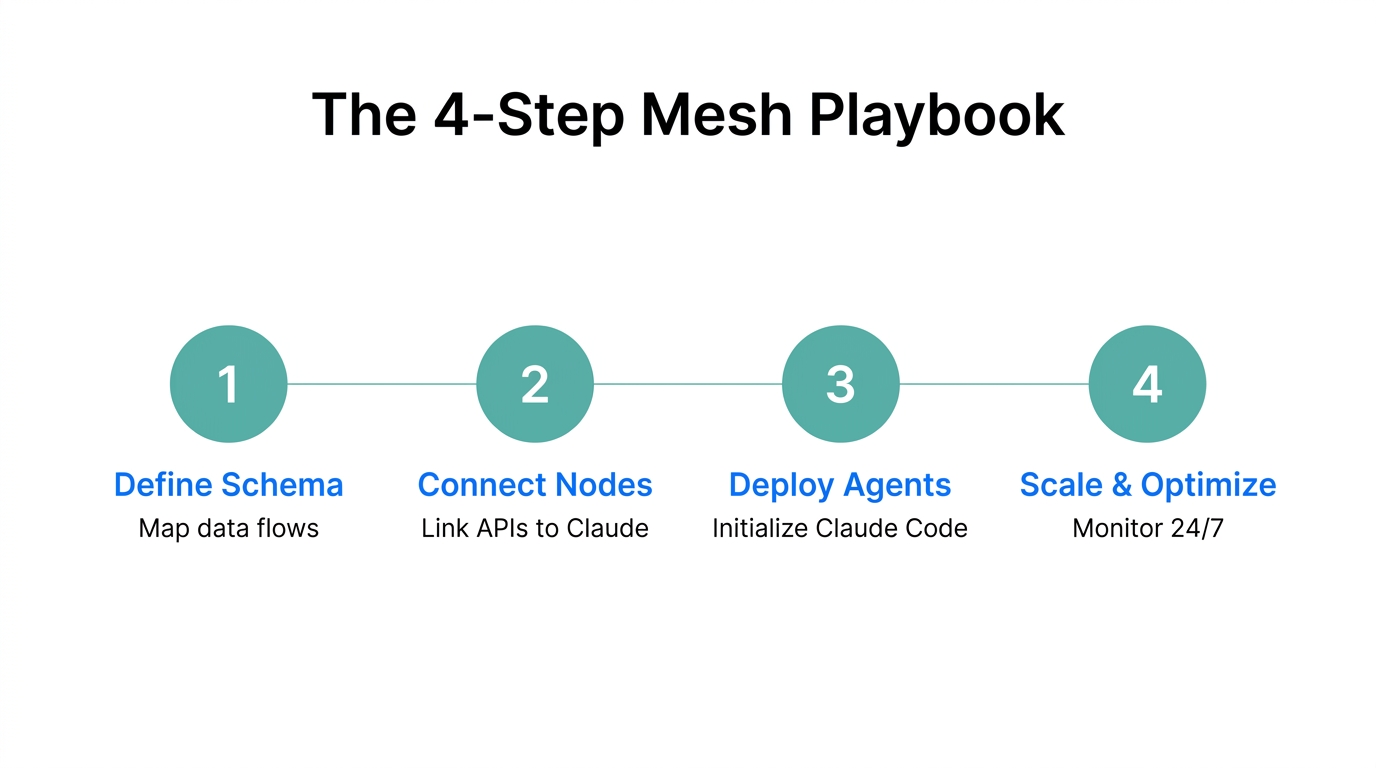
Ready to move from a static stack to a dynamic mesh? Follow this 5-step strategic playbook to orchestrate your marketing with Claude Code.
Step 1: Initialize Permanent Context
Create a CLAUDE.md file in your project root. As noted on Medium, this acts as the agent's ‘permanent memory,’ storing brand voice, target personas, and ICP data so Claude maintains consistency across every session.
Step 2: Connect the Mesh via MCP
Install the necessary MCP servers to give Claude access to your stack. Common commands in 2026 include:
claude mcp add google-drivefor content briefs.claude mcp add slackfor automated approval loops.claude mcp add stormy-aifor real-time creator CRM and campaign data fetching.
Step 3: Deploy Specialized Subagents
Don't ask one agent to do everything. Create specialized agents in .claude/agents/. You should have one for ‘UTM Generation,’ one for ‘PPC Performance Monitoring,’ and another for ‘Creator Vetting.’ For high-scale creator campaigns, integrating a tool like Stormy AI into your workflow allows your discovery agent to pull from a database of millions of TikTok and YouTube profiles instantly.
Step 4: Execute via Slash Commands
Build custom slash commands like /market-audit [URL]. This triggers parallel subagents to scan SEO, copy, and competitor positioning simultaneously, as demonstrated in various GitHub repositories for AI marketing.
Step 5: Agentic Reporting
Use a ‘Reporting Agent’ to pull data from GA4 (via the AdLoop MCP), format it into a Markdown report, and autonomously upload it to your Notion workspace or Slack channel.
The Future of the Agentic Mesh
The transition to a composable martech mesh is no longer optional for brands that want to remain competitive in 2026. The days of logging into twenty different dashboards to pull a single report are over. By leveraging Claude Code and a decentralized architecture, growth teams are reclaiming 75% of their strategic time, allowing them to focus on high-level creativity and brand building while agents handle the ‘integration plumbing.’
As we look toward 2027, the focus will shift to Agentic Commerce, where AI agents act as the customers themselves, scanning catalogs and making purchasing decisions. The brands that build a robust, trustworthy mesh today will be the ones that these future agent-customers find and trust tomorrow. Start by cleaning your data, embracing the MCP standard, and letting Claude Code orchestrate your path to an 800% ROI.