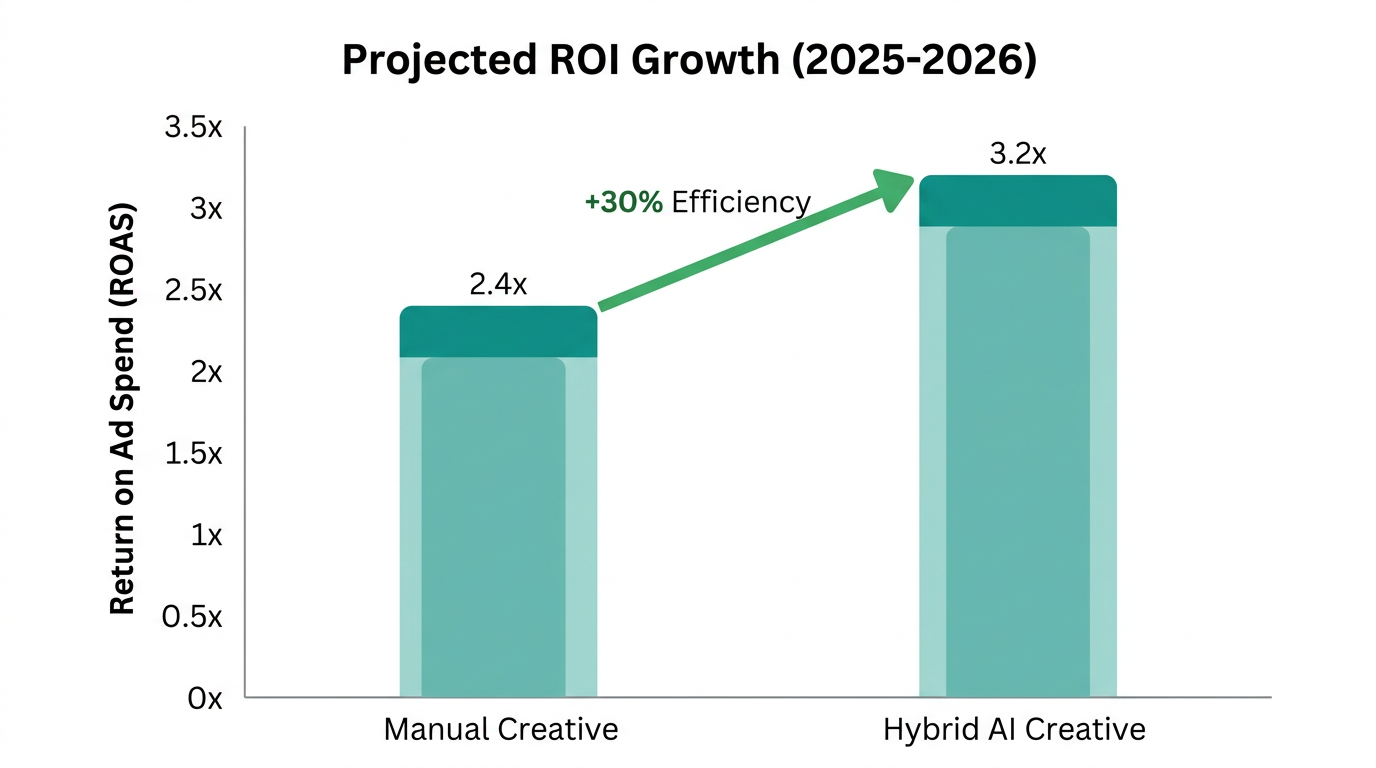
In 2026, the era of "using AI for copy" has officially died. It has been replaced by Agentic Performance Marketing—a paradigm where autonomous agents don't just write sentences; they manage bidding, audit competitor psychological triggers, and orchestrate multivariate testing across global channels. Performance marketing teams that have successfully integrated a specialized AI ad creative workflow report an average 30% higher ROI compared to those relying on legacy manual processes. As AI-influenced digital ad spend hurtles toward an estimated $81.6 billion by 2033 according to recent eMarketer reports, the gap between the "AI-native" advertiser and the traditionalist is becoming an unbridgeable chasm.
The secret to 2026's most successful campaigns isn't choosing between models; it’s a hybrid AI marketing strategy. By combining Claude's superior creative discovery and brand nuance with OpenAI's logical horsepower and massive integration ecosystem, brands are achieving a 27% improvement in campaign performance in under six months. This guide provides the tactical playbook for this hybrid workflow.
The 2026 Landscape: Claude vs. OpenAI for Paid Media
As we navigate 2026, the market share for AI models has stabilized into distinct roles. While OpenAI remains the volume leader with over 800 million weekly users, Anthropic’s Claude has surged to a 32% enterprise market share. This growth is largely attributed to Claude's massive context window—now reaching 1 million tokens in beta—and its reputation as a "Brand Guardian" that avoids the robotic, repetitive phrasing often found in earlier generative models.
| Feature | OpenAI (GPT-4o / GPT-5) | Claude (3.5 Sonnet / 4.5) |
|---|---|---|
| Primary Role | The "Logical Architect" | The "Creative Strategist" |
| Best For | Data analysis, automation scripts, and high-volume variations. | Brand voice adherence, deep account audits, and human-like copy. |
| Visuals | Native DALL-E integration. | Visual creative briefing and analysis. |
| Context | 128K - 400K tokens. | 200K standard (up to 1M beta). |
A major shift occurred in early 2026 when OpenAI began displaying contextually targeted ads within its free tiers. In response, Anthropic launched a "No Ads, Ever" campaign, positioning Claude as the premium, neutral choice for professional media buyers who don't want their strategy influenced by an ad-supported ecosystem. For the modern marketer, this means using OpenAI for the "math" of ads and Claude for the "soul" of the brand.
"The most dangerous mistake in 2026 is treating AI as a creative generator. It is a strategic orchestrator. If you aren't using a hybrid model, you're leaving 30% of your ROAS on the table."
The 'Claude-ChatGPT-Claude' Methodology
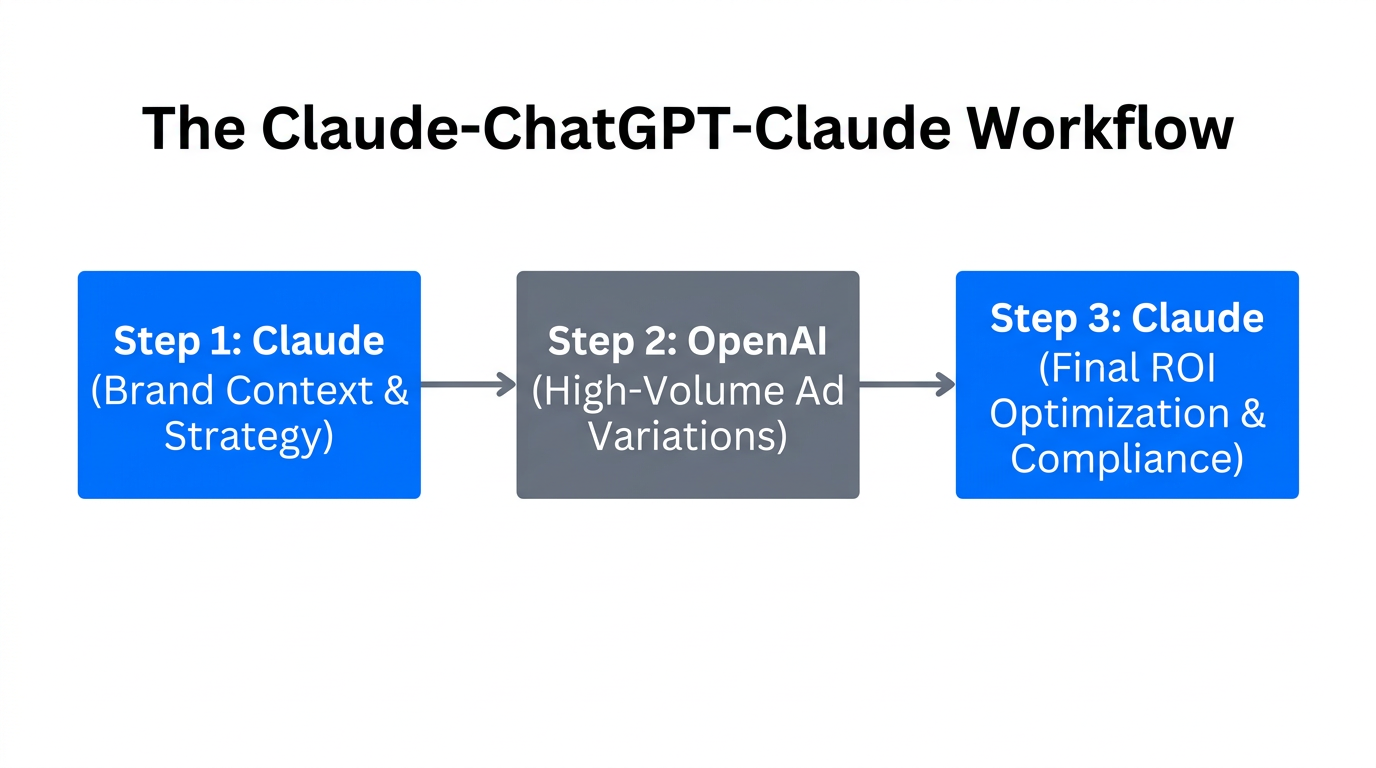
To maximize multivariate ad testing AI, leading agencies like LiftKit have popularized a three-step cycle that extracts the maximum value from both LLMs. This ensures that every ad hook is grounded in deep research, expanded for scale, and polished for human resonance.
Step 1: Creative Discovery (Claude)
Start with Claude’s 200K context window. Instead of guessing what works, feed Claude six months of competitor creative data—including screenshots of ads, landing page copies, and customer reviews. Use Claude to identify "belief friction": the unaddressed psychological barriers that prevent customers from clicking.
By analyzing the emotional triggers competitors are missing, you can position your product as the specific solution. For example, if competitors focus solely on "speed," Claude might identify that the market is actually anxious about "reliability," allowing you to pivot your messaging before you spend a single dollar.
Step 2: Logic Vetting & Scale (OpenAI)
Once Claude has identified the core hooks and belief friction points, move the workflow to OpenAI's GPT-5. OpenAI excels at high-volume multivariate headline generation. Feed the hooks into GPT-5 to generate 50+ variations of headlines and descriptions optimized for Meta's Advantage+ or Google’s PMax algorithms.
OpenAI’s mature integration with tools like Zapier and Make.com allows you to push these variations directly into your Meta Ads Manager or Google Ads dashboards. This is where the "math" happens—GPT-5 can even write Python scripts to automate your bidding based on real-time ROAS data.
Step 3: The 'Brand Guardian' Final Polish (Claude)
The final step is critical. High-volume AI generation often results in "robotic fluff"—generic phrases that savvy 2026 consumers ignore. Pass those 50+ OpenAI variations back to Claude. Ask Claude to act as your Brand Guardian, removing clichés and ensuring the tone perfectly aligns with your brand's unique voice.
"OpenAI is the muscle that builds the wall; Claude is the architect who ensures it doesn't look like every other wall in the neighborhood."
Tactical Prompts for Role-Based Copywriting
Generic prompting leads to generic results. To get high-converting copy, you must use Role-Based Prompting. This technique, highlighted by Thinking Loop, assigns a specific persona to the AI, forcing it to draw from deep direct-response principles.
The Senior Copywriter Prompt
"You are a senior direct-response copywriter specializing in B2B SaaS acquisition. Analyze this 50-page landing page structure. Identify the emotional triggers the brand is missing and suggest three Meta Ad angles that position our product as the specific solution for technical founders."
The Multivariate Expansion Prompt (OpenAI)
"Based on these three emotional angles, generate 20 headlines (max 40 characters) and 10 primary text variations (max 125 characters). Focus on the 'logic' of the offer. Ensure each variation is unique enough for Meta's algorithm to differentiate between them in an A/B test."
The Rise of Agentic Bidding and Audits
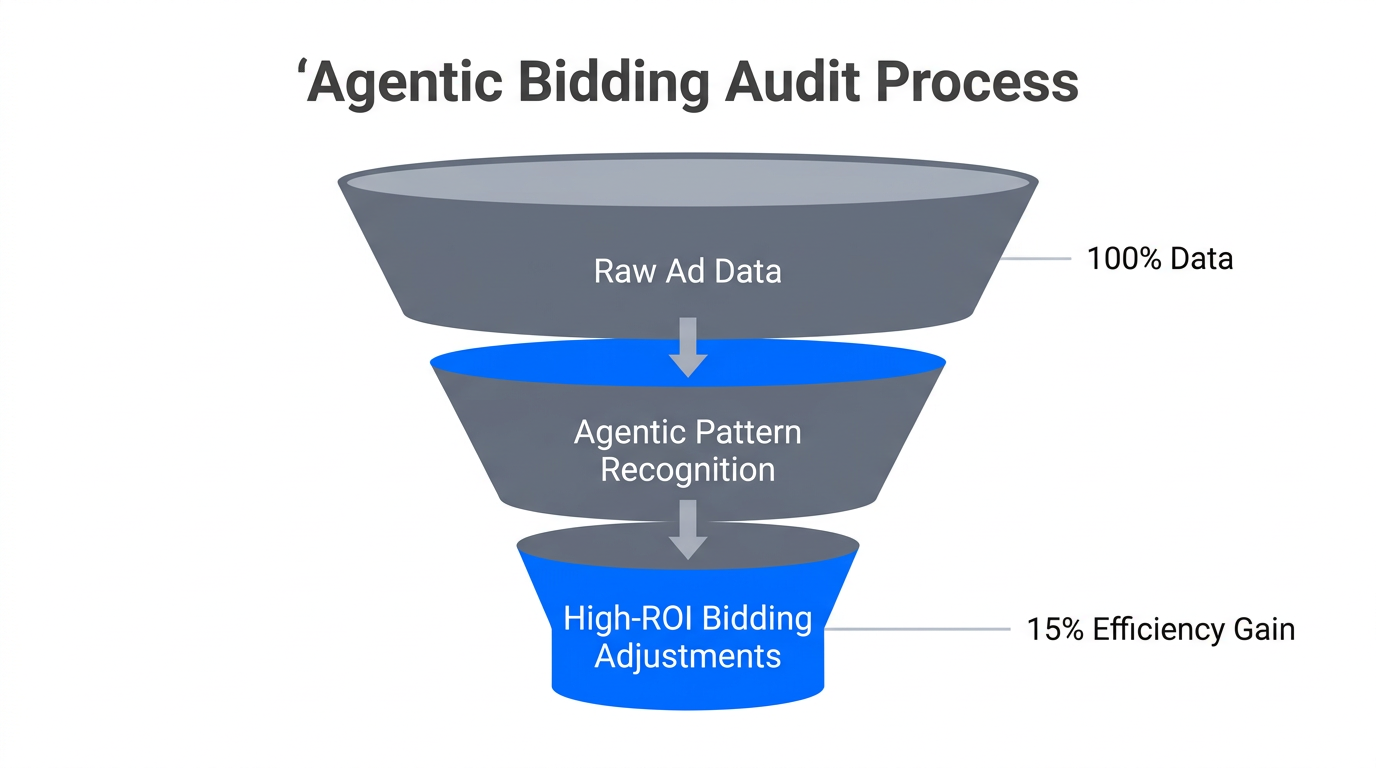
In 2026, the workflow extends beyond the creative. With Claude Code and the OpenAI Operator, performance teams are building autonomous agents that monitor campaigns 24/7. These agents can:
- Rebalance budgets: Automatically shift spend between TikTok Ads, Instagram, and LinkedIn based on real-time ROAS.
- Flag creative fatigue: Monitor Click-Through Rate (CTR) decay and trigger a request for new creative assets the moment performance dips.
- Audit data hygiene: Ensure that your Meta Ads Manager is receiving accurate conversion signals, preventing the "set and forget" trap that leads to hallucinated spend patterns.
Companies like TELUS have already seen the impact of this at scale, saving 500,000 hours of manual labor by deploying internal AI tools, much of which was reinvested into aggressive paid acquisition. Similarly, Monks (formerly Media.Monks) has demonstrated that an AI-led creative pipeline can slash creative costs by up to 97% while maintaining high performance.
"We are no longer buying media; we are managing the agents that buy media for us."
Common Pitfalls in the Hybrid AI Workflow
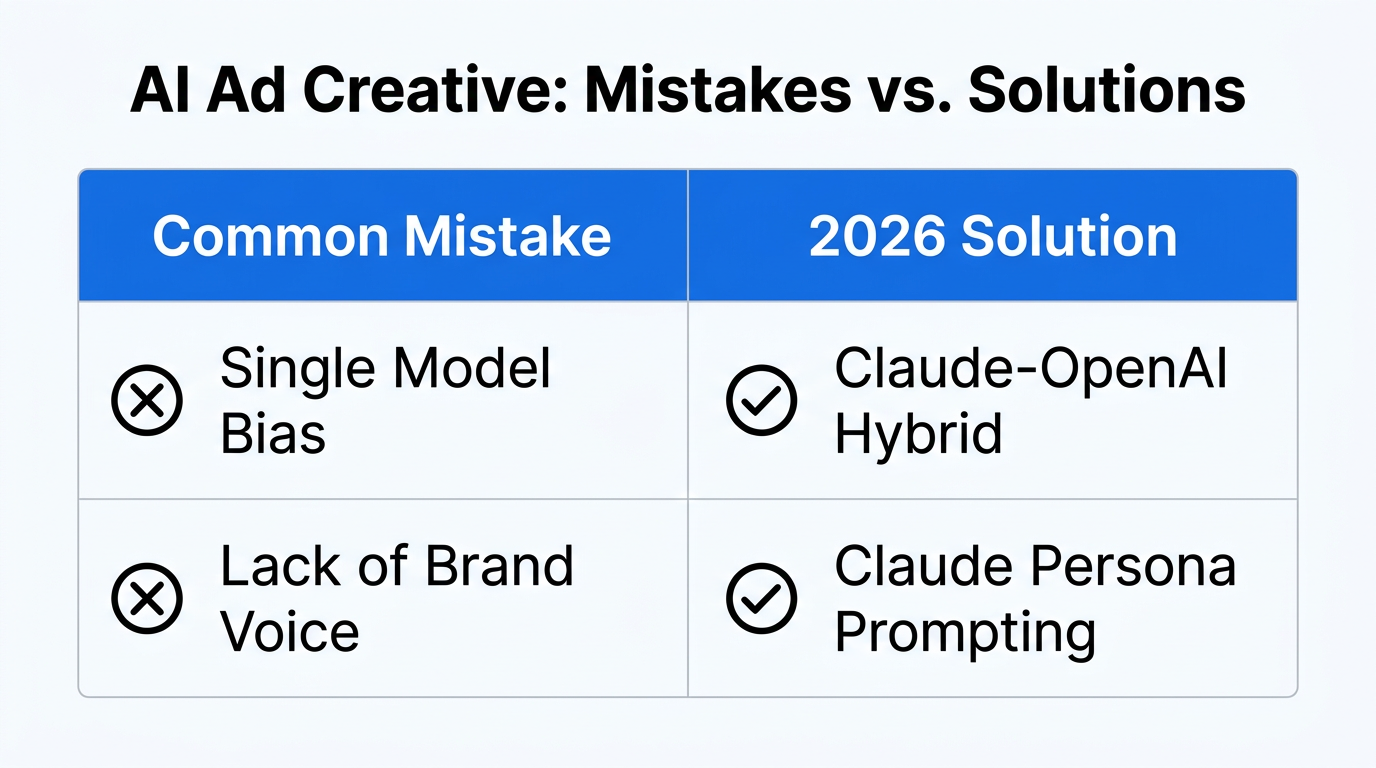
Even with the best tools, a flawed hybrid AI marketing strategy can lead to wasted budget. According to Hashmeta, the most common error is neglecting data hygiene. If you feed poor customer data into OpenAI's data analysis tools via Shopify or Google Analytics, the resulting targeting will be fundamentally flawed.
| Mistake | Impact | Solution |
|---|---|---|
| Over-Automation | Hallucinated spend patterns. | Keep a 20% "human-in-the-loop" gap. |
| Generic Prompting | Low CTR and high CPC. | Use Role-Based Prompting. |
| Treating AI as Strategy | Optimizing for clicks, not intent. | Guide AI with a conversion-led strategy. |
As noted by Primotech, AI often optimizes for the easiest path to a click rather than high-intent traffic. This is why the initial discovery phase with Claude is so vital—it ensures the AI is pointed at the right psychological triggers from the start.
The Future is Hybrid
Mastering the AI ad creative workflow in 2026 requires more than just a subscription to ChatGPT. It requires an orchestrator's mindset—knowing when to use Claude's creative intuition and when to lean on OpenAI's logic. By following the 'Claude-ChatGPT-Claude' methodology, brands can build a scalable, high-ROI machine that adapts to market shifts in real-time.
Start by auditing your current competitor data using Claude, then expand those insights with OpenAI, and finally, protect your brand voice with a final polish. To fuel this workflow with high-quality content, consider how platforms like Stormy AI can help you source the UGC creators who will provide the raw footage and transcripts that your AI agents will transform into winning ads.