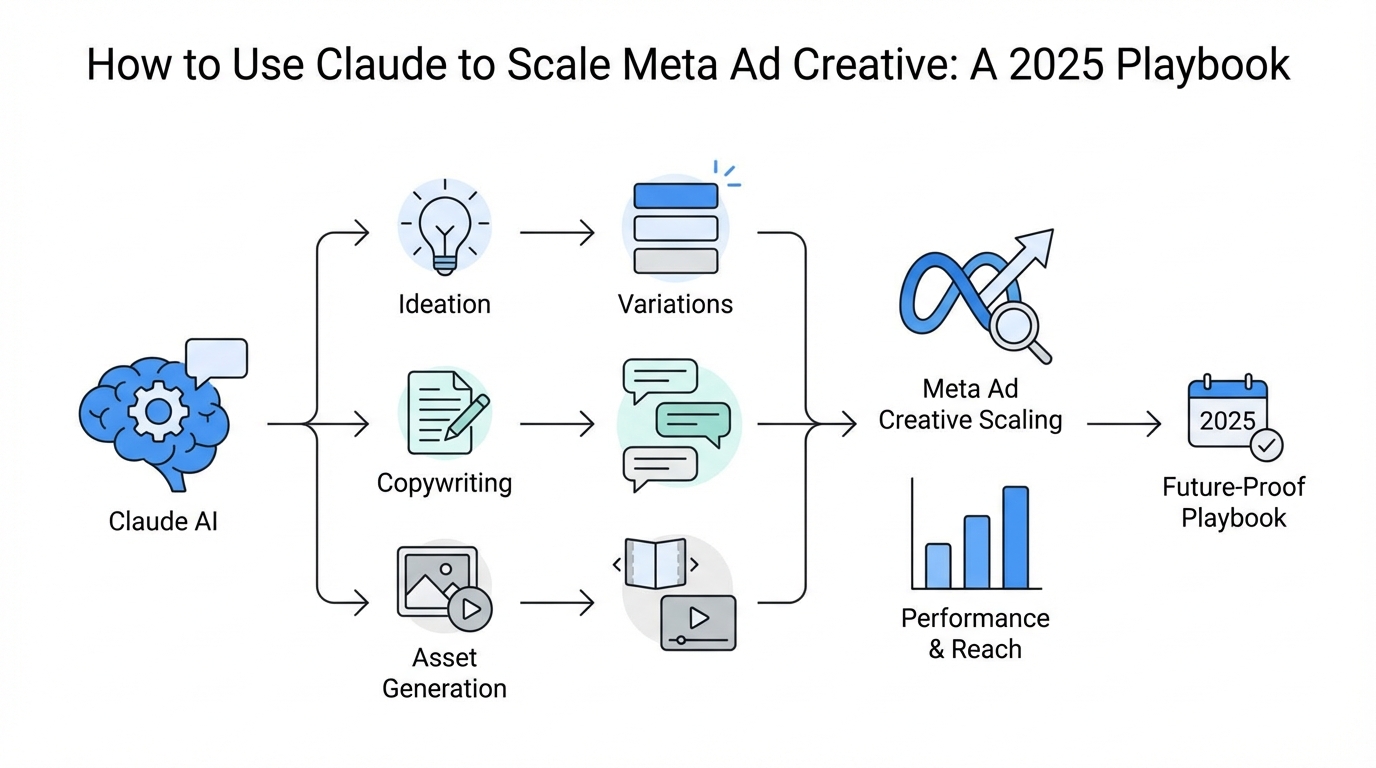
By 2025, the digital advertising landscape has undergone a tectonic shift, moving away from manual keyword bidding and toward AI-driven "agentic" workflows. For growth marketers, the challenge is no longer just managing budgets—it is managing the sheer volume of creative assets required by platforms like Meta. With AI-influenced digital ad spend projected to reach $81.6 billion by 2033, the competitive edge now lies in how effectively you can leverage an AI ad copy generator to maintain creative freshness and performance.
While OpenAI’s GPT models remain powerful for data analysis, Claude 3.5 and 4.5 have emerged as the preferred choice for scaling Facebook ad creative. This shift is driven by Claude’s superior brand voice alignment and its massive 200K+ token context window, which allows marketers to feed entire years of historical data into a single session. In this playbook, we will detail exactly how to build a high-converting Meta creative engine using Claude.
The Claude Advantage for Meta Ads
As of late 2025, roughly 69.1% of marketers have integrated AI into their strategies, but many are still using generic prompts that yield robotic results. Claude stands out because it acts more like a "thinking partner" and less like a database. According to experts at Optmyzr, Claude excels at copywriting and long-form strategy, avoiding the "robotic fluff" often found in other models.
The core of Claude for Meta ads is its ability to process nuances. While OpenAI Platform models are excellent for scripting and math, Claude is designed for the nuances of human persuasion. This makes it ideal for generating the 50+ unique headline variants required for Meta Advantage+ campaigns.
"The industry is moving from Chat to Action. Claude’s ability to understand brand voice across 200,000 tokens of context is what separates amateur AI ads from high-converting creative engines."
Step 1: Setting Up Your 'Brand Hub' in Claude Projects
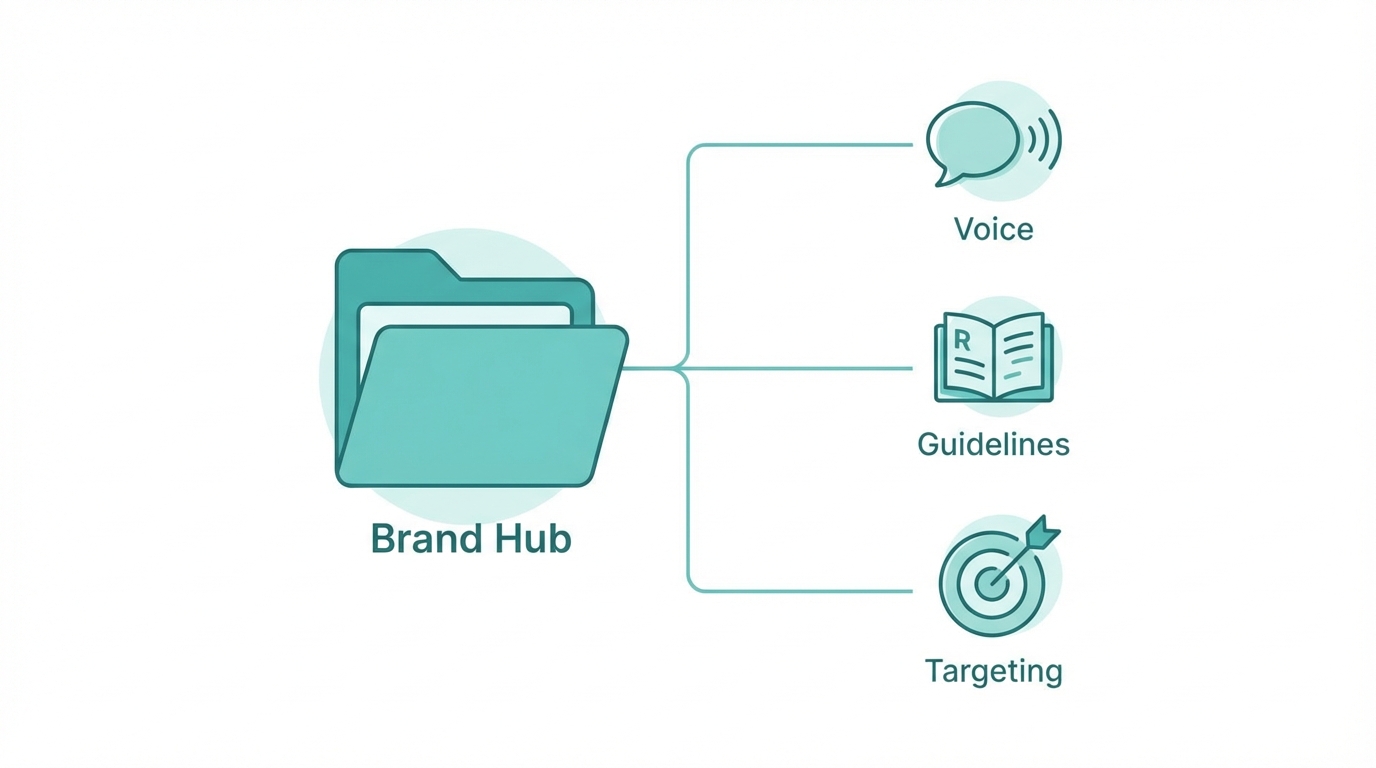
The biggest mistake growth marketers make is treating Claude like a search engine. To achieve automated ad copywriting that actually sounds like your brand, you must first build a "Brand Hub" using Claude Projects.
Start by uploading your foundational documents to the project knowledge base:
- Brand Style Guide: Include your tone of voice, forbidden words, and preferred sentence structures.
- Customer Personas: Upload detailed breakdowns of your primary and secondary target audiences based on demographic data.
- Product Data: Technical specs, unique selling propositions (USPs), and customer pain points.
By housing these in a Claude Project, you ensure that every prompt you send thereafter is filtered through your brand’s specific lens. This eliminates the need to repeat your brand story in every single message, allowing for AI creative strategy that is consistent across every ad set.
Step 2: Training Claude on Historical Winners
Once your Brand Hub is set, you need to apply few-shot learning. This involves feeding Claude your top-performing ads from the last 12 months. Export a CSV of your Meta Ads Manager report, focusing on creative that achieved the lowest CPA and highest CTR. Programmatic ads leveraging AI bidding models have already reduced CPA by 30% on average; your goal is to use Claude to double down on those winning patterns.
How to Prompt for Analysis:
Upload your performance data and use a prompt like this: "Analyze these top 10 ads from the last 12 months. Identify the underlying psychological triggers, the hook structures, and the specific calls to action that drove the highest conversion rates."
This "few-shot" approach trains the model to recognize what your specific audience responds to. Instead of guessing, you are providing a data-backed blueprint for scaling Facebook ad creative.
"The secret to AI creative isn't the prompt; it's the context. Upload your last 12 months of winners and let the machine find the patterns you missed."
Step 3: Generating 50+ Meta Advantage+ Headlines in 30 Minutes
With your Brand Hub active and your historical data analyzed, you are ready for execution. The goal is to generate a massive volume of variants for Meta’s Advantage+ campaigns, which thrive on creative diversity. High-volume creative testing is the primary driver of performance in 2025.
To do this efficiently, use "chained prompts." Rather than asking for everything at once, break the task into three stages:
- Research Stage: Ask Claude to list 10 unique angles based on your customer pain points.
- Outlining Stage: Select the best 3 angles and ask Claude to draft 5 hooks for each.
- Drafting Stage: Take the winning hooks and ask Claude to generate 50 unique headlines and 10 primary text variants.
This workflow allows a solo growth marketer to complete a task that previously took 2.5 hours per week in under 30 minutes. While Claude handles the narrative and copy, sourcing the high-quality visual assets or user-generated content (UGC) needed for these ads can be managed through platforms like Stormy AI, which helps you instantly find creators who can bring these AI-generated scripts to life.

Applying Psychological Triggers to Improve CTR

The best AI ad copy generator isn't just a writer; it’s a psychologist. Use Claude to audit your copy for specific triggers such as loss aversion, social proof, or the "curiosity gap." According to QuickLeap, identifying these triggers through AI can significantly improve click-through rates (CTR) by aligning the message more closely with the user's stage in the marketing funnel.
Ask Claude: "Review these 5 headlines. Which one uses the strongest 'loss aversion' trigger? Rewrite the others to focus on the 'FOMO' (Fear Of Missing Out) trigger while maintaining my brand voice." This level of AI creative strategy ensures that your ads aren't just loud, but psychologically resonant.
Common Pitfalls in AI-Powered Ad Creation
Even with the best models, there are risks. A common mistake is the "set-and-forget" mentality. AI lacks cultural context and empathy; over-automation without a human-in-the-loop often leads to generic ads that suffer from rapid audience fatigue. Experts at AdGPT recommend following the 80/20 rule: let AI do 80% of the heavy lifting, but ensure a human provides the final 20% of creative polish and cultural vetting.
Another danger is "data hallucinations." While Claude is excellent at narrative, it can sometimes misinterpret complex spreadsheets. The "Double-Check" method suggested by Shared Physics involves using ChatGPT for the raw math and Claude for the creative summary. Finally, be wary of premature automated bidding; according to Visible Factors, moving to Meta's automated bidding without enough historical conversion data can cause the AI to optimize for low-quality traffic.
"AI doesn't replace the marketer; it replaces the mundane. If you don't apply a human filter to your AI output, your brand will eventually sound like every other bot on the timeline."
Conclusion: The Future is Multi-Model
Scaling Meta ad creative in 2025 requires a sophisticated AI creative strategy. By setting up a Brand Hub in Claude, training the model with few-shot learning on your historical winners, and using chained prompts to generate high volumes of variants, you can dramatically increase your output without sacrificing quality. Efficiency is the new currency of performance marketing.
Large enterprises like TELUS and Brex are already saving hundreds of thousands of hours by integrating models like Claude into their workflows via AWS Bedrock. For the growth marketer, the path forward is clear: use tools like Stormy AI to find the right creators and UGC talent, and use Claude to write the high-converting copy that makes those visuals perform. By combining AI speed with human strategy, you can stay ahead of the curve and dominate the Meta auctions in 2025 and beyond.