In 2026, the gap between a marketing manager and a software engineer has narrowed to a single prompt. We have entered the era of the citizen developer, where growth teams no longer wait on three-week IT tickets to fix a broken Facebook Pixel or build a custom multi-touch attribution dashboard. The global AI code assistant market has exploded to over $27 billion, and marketers are the fastest-growing cohort of users. But as we look at the landscape of marketing operations AI tools, a critical debate has emerged: Should your team use Cursor, the sleek AI-powered editor, or Claude Code, Anthropic’s new agentic powerhouse?
Choosing the wrong tool doesn't just waste time; it wastes budget. With 92% of developers already using AI tools according to the latest GitHub Octoverse report, the competitive advantage now lies in how you deploy these agents. For marketing teams looking to achieve a 15–20% reduction in Customer Acquisition Cost (CAC) through automation, understanding the nuance between an 'accelerator' and a 'delegator' is the difference between scaling and stalling.
The Delegator vs. The Accelerator: A Strategic Comparison
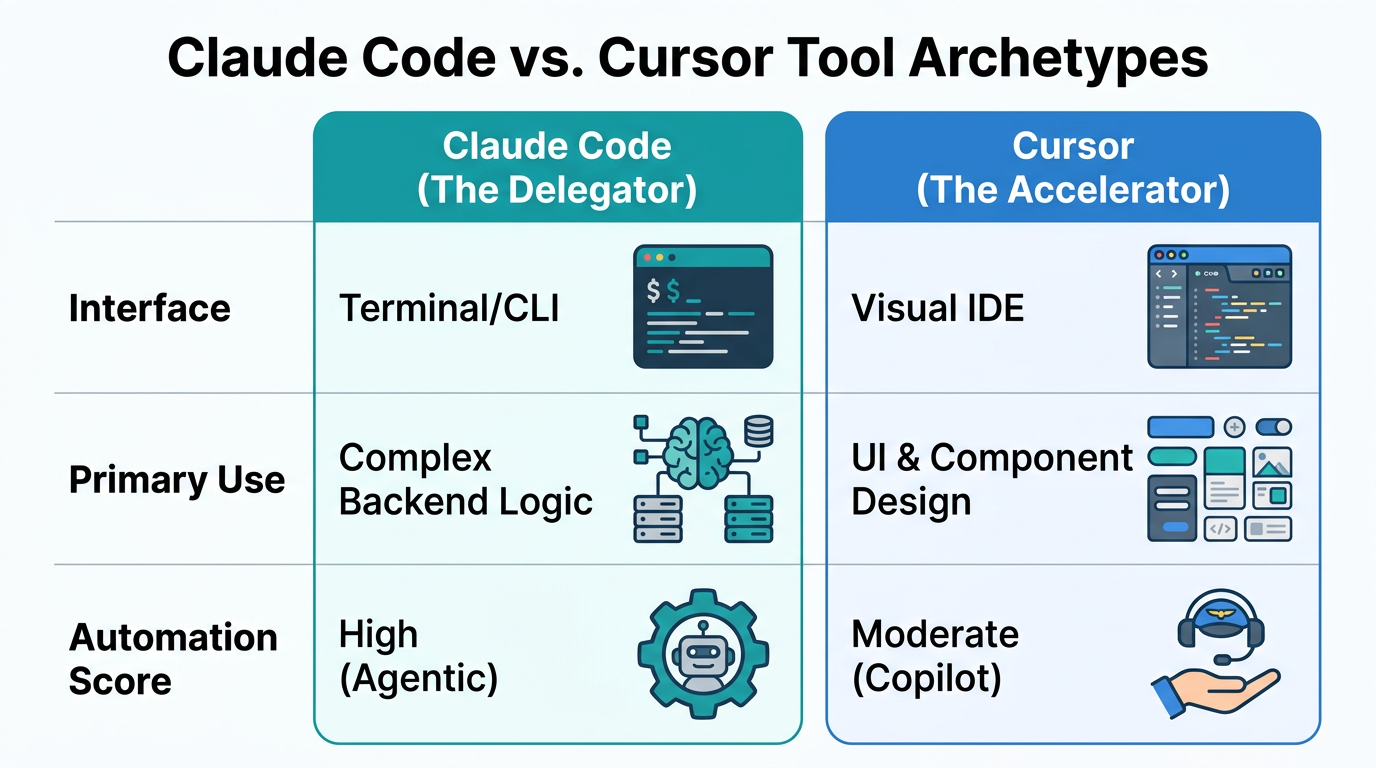
When comparing Claude Code vs Cursor for non-developers, the distinction lies in their fundamental philosophy. Cursor is built as an Accelerator. It is an evolution of the VS Code editor that makes you faster at typing and navigating files. It suggests the next line of code before you think of it. For a marketer who wants to 'vibe code'—experimenting with UI changes on a landing page in real-time—Cursor is a dream.
"The hottest new programming language is English, and by 2026, the barrier between intent and execution has finally vanished for marketing teams."
However, Claude Code, released by Anthropic, represents the Delegator. It is an agentic command-line interface (CLI) that doesn't just suggest code; it performs tasks autonomously. You don't just ask Claude Code to write a script; you tell it to research the Google Ads API, write the script, run it against your local files, and notify you when the CSV is ready. This agentic approach is why many are pivoting to Claude for complex marketing operations AI tools.
Benchmark Data: Why Claude Code Wins on Token Efficiency
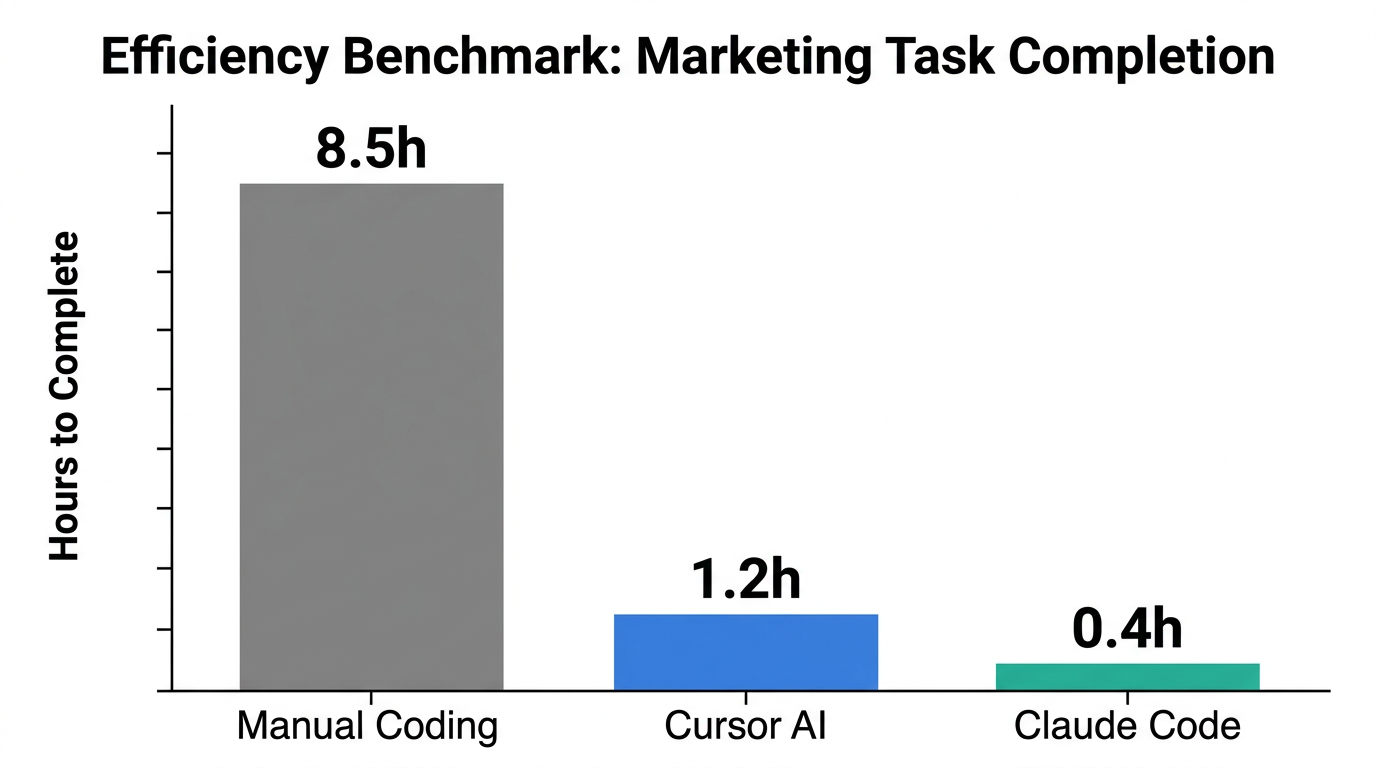
For marketing teams, AI-assisted coding ROI is often measured in token costs versus output quality. In 2026, benchmark data from Builder.io shows that Claude Code is significantly more efficient for large-scale tasks. While Cursor often truncates large files due to a smaller context window (typically 70K–120K tokens), Claude Code utilizes a massive 200K context window (with a 1M token beta), allowing it to 'see' your entire marketing site and its dependencies simultaneously.
| Feature | Claude Code (Anthropic) | Cursor (Independent) | GitHub Copilot CLI |
|---|---|---|---|
| Context Window | 200K - 1M | 70K - 120K | Variable (Small) |
| Token Efficiency | 5.5x More Efficient | Standard | High (Short tasks) |
| Primary Interface | Terminal / Agentic | Visual Editor (IDE) | Terminal Assistant |
| Best For | Complex Refactors | UI/UX Iteration | Simple Commands |
This 5.5x token efficiency means that when you ask an agent to audit 1,000 URLs for SEO gaps, Claude Code manages its 'memory' better, resulting in fewer errors and lower API costs. This is critical because, as noted by StartupHakk, agentic tools can occasionally loop and burn through budget if not properly monitored. Claude's reasoning model, particularly the hybrid Claude 3.7 Sonnet, is designed to minimize these 'infinite loops' that plague earlier AI models.
Choosing Your Stack: When to Use Lovable vs. Claude Code
Not every marketing task requires a CLI. For UI-heavy landing pages or simple lead magnets, tools like Lovable.dev or Bolt.new are often superior to both Cursor and Claude Code. These platforms allow marketers to build entire apps by just chatting, hiding the code entirely. However, these are 'sandboxes.' They live in the browser.
When you need to manage local files—such as your actual Shopify theme files, a local database of influencer contacts from Stormy AI, or your company's proprietary Python scripts—you must transition to Claude Code. Claude Code has the permission to read and write directly to your computer's folders, making it the superior tool for long-term marketing infrastructure rather than temporary landing pages.
"The 'No-Code' revolution is being swallowed by the 'AI-Code' revolution. Marketers won't use drag-and-drop; they will use agents to generate custom solutions."
Cost-Benefit Analysis: Claude Max vs. Cursor Pro
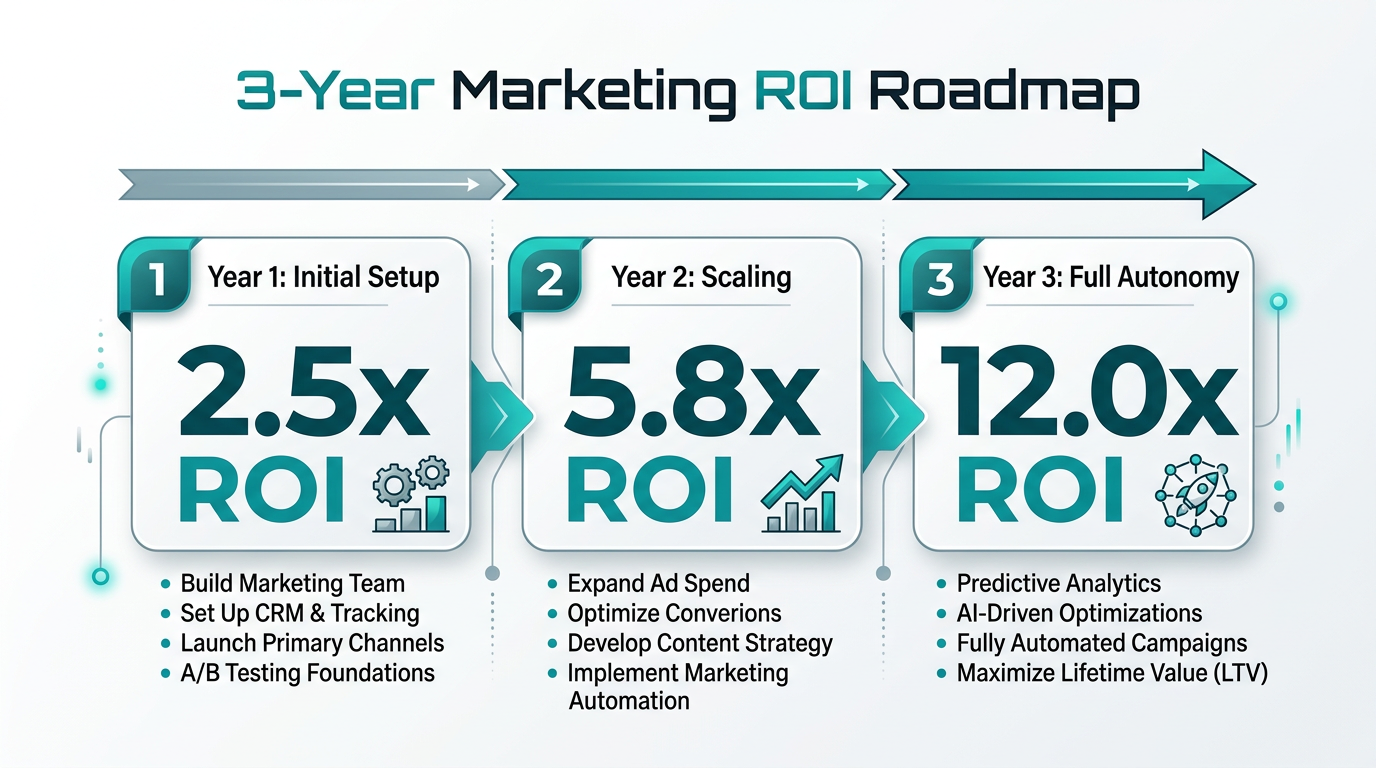
In 2026, growth teams are moving away from simple $20/month seats and toward 'Consumption Models.' Cursor Pro remains a flat $20/month, which is excellent for predictable budgeting. However, Claude Max (and the standard Claude Pro) operates on a pay-per-token basis for CLI work, typically $3 per 1M input tokens. While this sounds complex, digital agencies report saving $1,200+ per multi-channel campaign by using these agents to handle cross-channel data analysis that used to take 40 hours of manual labor, according to research from AdVenture Media.
For a team doing high-volume Shopify API automation or competitor price scraping, the ROI of Claude Code is unmatched. A 300% ROI increase is common for organizations that successfully implement agentic layers into their Google Ads management, as highlighted by Digital Applied.
Case Study: Saving 10 Hours a Week via Shopify API
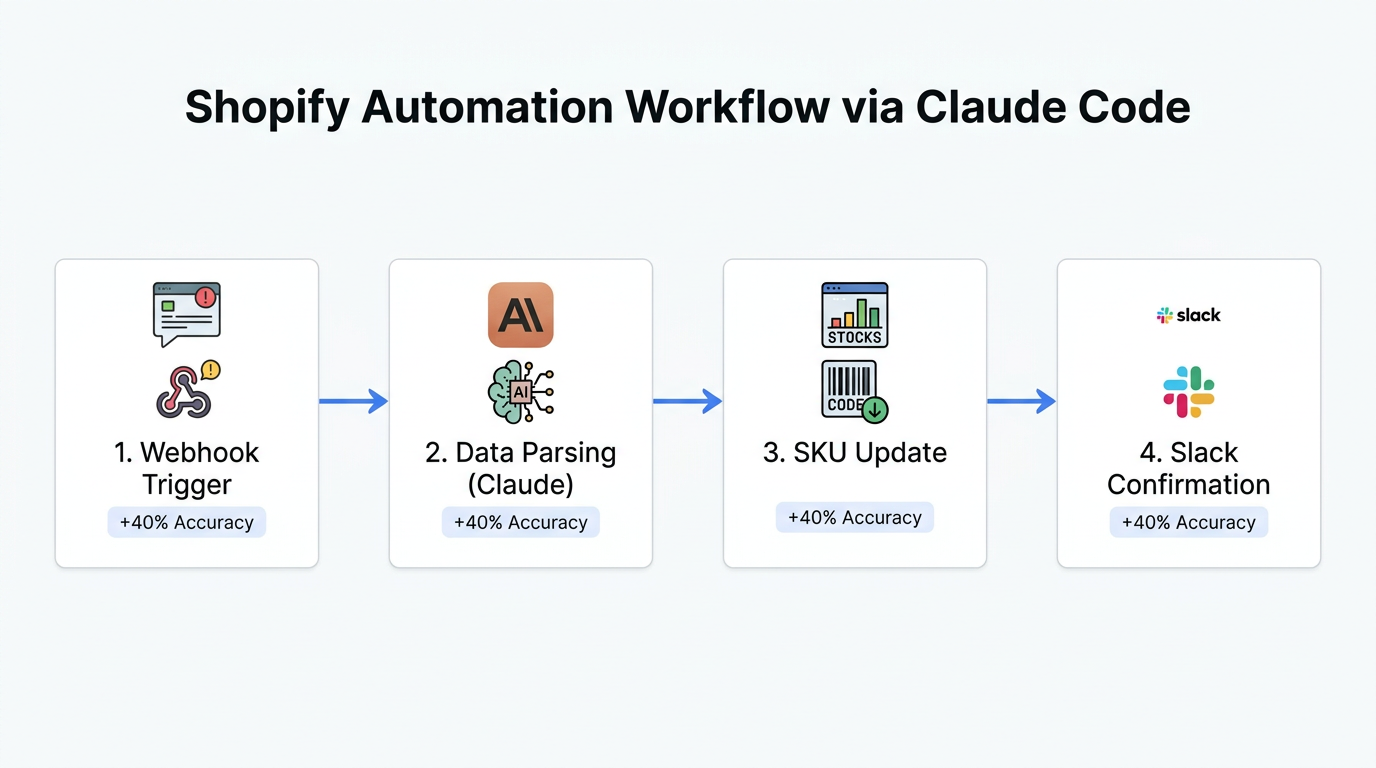
Consider a mid-market e-commerce brand that needed to adjust prices daily based on competitor movement. Previously, a marketing assistant spent two hours every morning manually checking competitors and updating Shopify. By using Claude Code, the team built a Python script that scrapes competitor data and pushes updates via the Shopify API in just three days. This didn't just save time; it increased conversion rates by 8% by ensuring they were always the most competitive option on Google Shopping.
Similarly, content agencies are using these tools to build Self-Healing Marketing Stacks. If a tracking script fails, a Claude Code agent can automatically detect the error in the console and deploy a fix. This moves the marketing team from a reactive 'firefighting' mode to a proactive 'building' mode. For those managing complex creator campaigns, pairing these scripts with discovery data from Stormy AI allows for automated outreach sequences that update based on real-time creator performance.
The Marketer’s Playbook: How to Start with Claude Code
If you are ready to transition from a 'vibe coder' to a 'marketing engineer,' follow this sequence to overcome the 'Terminal Wall':
- Step 1: Install Node.js. Most marketers quit here. Go to nodejs.org and install version 18 or higher. This is the 'engine' that allows Claude Code to run.
- Step 2: Get your API Key. You'll need a paid Claude account. Ensure you have credits in your Anthropic Console.
- Step 3: Run the Install Command. Open your terminal (don't be scared!) and type:
npm install -g @anthropic-ai/claude-code. As detailed by Blake Crosley, this is a one-time setup. - Step 4: Start your first agent. Type
claudefollowed by your request: "Analyze my local 'analytics.js' file and tell me if the GA4 events are firing correctly."
A Note on Security
While the rewards are high, 2026 has seen new risks. Specifically, CVE-2025-59536 revealed that giving AI 'shell access' (permission to run terminal commands) can be dangerous if the AI interacts with malicious third-party code. Always review the commands Claude suggests before hitting 'Enter,' and as suggested by IT Pro, never use the --dangerously-skip-permissions flag unless you are an absolute expert on LLM security protocols.
The Final Verdict: Which Tool Should You Choose?
In the battle of Claude Code vs Cursor, the winner depends on your role. If you are a Content Marketer or Designer who needs to build beautiful landing pages and UI elements quickly, Cursor remains the gold standard for its visual feedback loop. It is the best AI coding tool for marketing 2026 if your primary goal is visual output.
However, if you are a Growth Marketer or Ops Manager focused on data pipelines, API integrations, and scaling infrastructure, Claude Code is the undisputed champion. Its agentic capabilities allow you to delegate entire workflows rather than just accelerating your typing speed. By 2026, the most successful marketing teams will use both: Cursor for the 'look and feel,' and Claude Code for the 'brain and muscle' of their operations. Start small, verify everything, and prepare to scale your marketing operations at speeds that were impossible only two years ago.