By early 2026, the role of the growth marketer has fundamentally shifted. We are no longer just prompting for ad copy or tweaking landing page headlines; we are building autonomous engines. The rise of "Action AI" has moved the industry from simple generative text to sophisticated agentic frameworks that can orchestrate entire marketing stacks. As the market for autonomous agents surges past $10.9 billion this year, according to market research reports, growth teams are facing a critical choice: which AI-native coding tool should power their operations?
Two giants dominate the conversation: Claude Code and Cursor. While both leverage advanced LLMs to write code, they serve diametrically opposite philosophies. One is a terminal-based autonomous agent designed for complex logic and system orchestration; the other is a high-performance, AI-native IDE built for fluid, "flow-state" development. Choosing the wrong one can lead to "hallucinated metrics" or inefficient token usage that drains your budget. In this guide, we evaluate Claude Code vs Cursor through the lens of modern marketing operations and rapid MVP development.
The 2026 Context: The Action AI Explosion
The transition from "Chat AI" to "Agentic AI" is complete. As of 2026, over 90.3% of marketing organizations use some form of AI agents within their MarTech stack, a trend highlighted by Scott Brinker at Chiefmartec.com. The goal is no longer just creation, but system orchestration. Marketing teams are increasingly bypassing traditional IT departments to build "disposable apps"—small, highly specific automation tools used for a single campaign and then discarded.
This shift has turned growth leads into "Technical Marketers 2.0." Instead of waiting weeks for an engineering sprint, these marketers use tools like Adventure Media to build in-house reporting tools that pull ad data via API in a matter of days. The debate isn't just about which tool writes better code; it's about which tool builds the best marketing logic.

Claude Code: The Autonomous Logic Engine
Anthropic’s Claude Code represents the "Engineer" persona. It is a Command Line Interface (CLI) agent that doesn't just suggest lines of code—it thinks across multiple files, executes terminal commands, and fixes bugs autonomously. For growth teams, this is the tool of choice for building backend automation and data pipelines.
"The Technical Marketer 2.0 doesn't write code; they orchestrate agents. If you can describe a workflow, Claude Code can build the pipeline."
One of the most significant advantages of Claude Code is its efficiency. Benchmarks show it is 5.5x more token-efficient than Cursor for complex, multi-file architectural changes. Because it operates with high autonomy, you can give it a high-level goal—like "build a Python script to scrape competitor pricing from these 50 URLs using Firecrawl"—and let it handle the environment setup, library installation, and error handling while you focus on strategy.
Marketers like Emily Kramer of MKT1 have utilized Claude Code's "Skills" feature to recreate their "marketing brains." By storing brand playbooks as Markdown files, the agent automatically pulls that brand logic into every campaign it builds, ensuring 100% alignment without constant re-prompting.
Cursor & Bolt.new: The Masters of 'Vibe Coding'
If Claude Code is the engine, Cursor is the cockpit. Built as a fork of VS Code, Cursor is designed for the "Editor" persona—someone who wants to stay in the flow, getting sub-second autocompletes and instant UI tweaks. It excels at frontend development and "vibe coding," where visual feedback is more important than deep architectural logic.
When you need to visualize an idea quickly, many growth teams start with Bolt.new to build a browser-based MVP. Once the "vibe" is right, they move to Cursor for daily edits or Claude Code for the heavy lifting. Cursor’s strengths lie in its accessibility; it feels like a standard code editor but with a genius sitting next to you, making it less intimidating than Claude’s "black screen" terminal for non-technical marketers.
| Feature | Claude Code | Cursor | Bolt.new |
|---|---|---|---|
| Best For | Autonomous logic & data pipelines | Flow-state daily coding | Rapid UI/Frontend MVPs |
| Interface | Terminal (CLI) | Full IDE (VS Code) | Web Browser |
| Autonomy | High (The Delegator) | Medium (The Accelerator) | Low (Prompt-to-UI) |
| Efficiency | 5.5x more efficient | Higher "code churn" | High (requires rebuilds) |
Integration Potential: Connecting the MarTech Stack
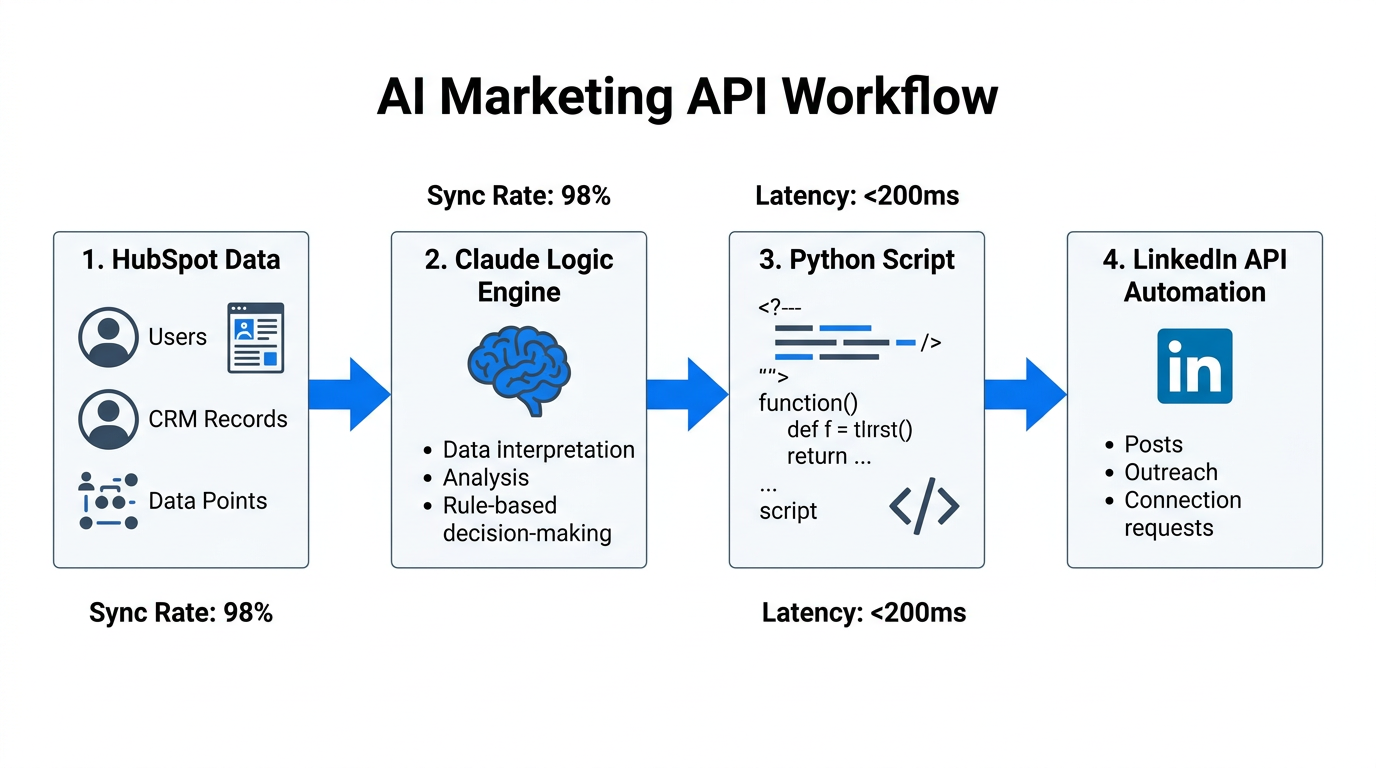
In 2026, the real power of these tools lies in the Model Context Protocol (MCP). MCP acts as the "USB-C for AI," allowing Claude Code to pull data directly from your favorite tools. Marketers are now using specialized MCP servers to connect to Google Ads, HubSpot, and Slack.
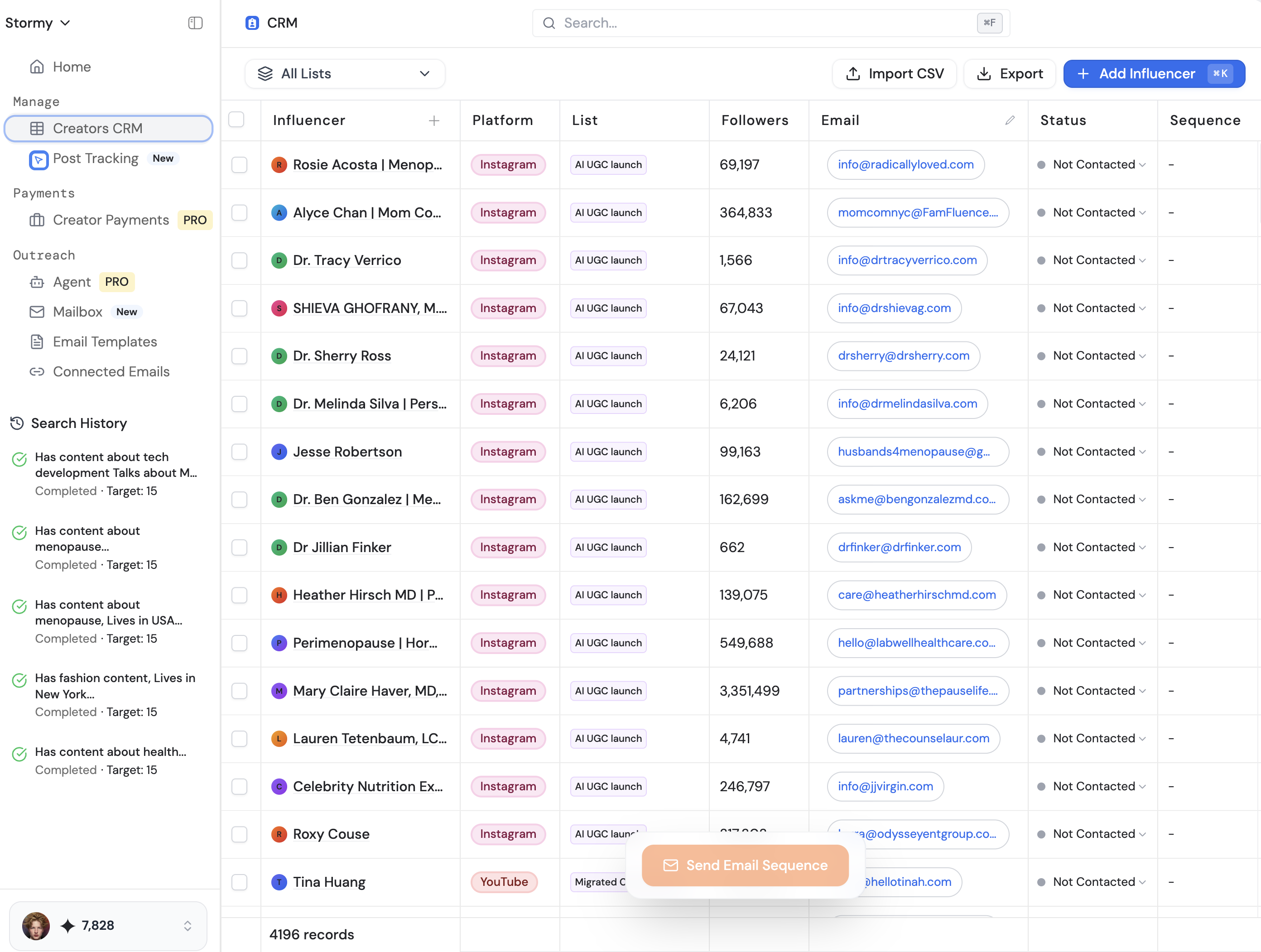
For example, using an AdLoop MCP, a growth marketer can tell Claude: "Identify keywords wasting budget in my current campaign and add them as negatives." The agent doesn't just give advice; it executes the change. This capability is fundamentally changing how influencer discovery platforms like Stormy AI and general marketing operations function. By connecting Claude to Meta Ads via API, teams can automate creative testing and budget allocation across thousands of ad sets simultaneously.
"In 2026, the shift feels as dramatic as when we got ChatGPT. I've basically recreated my marketing brain in 'Skills'—reusable sets of instructions Claude pulls into context automatically."
The Marketer’s Setup: A 2026 Playbook
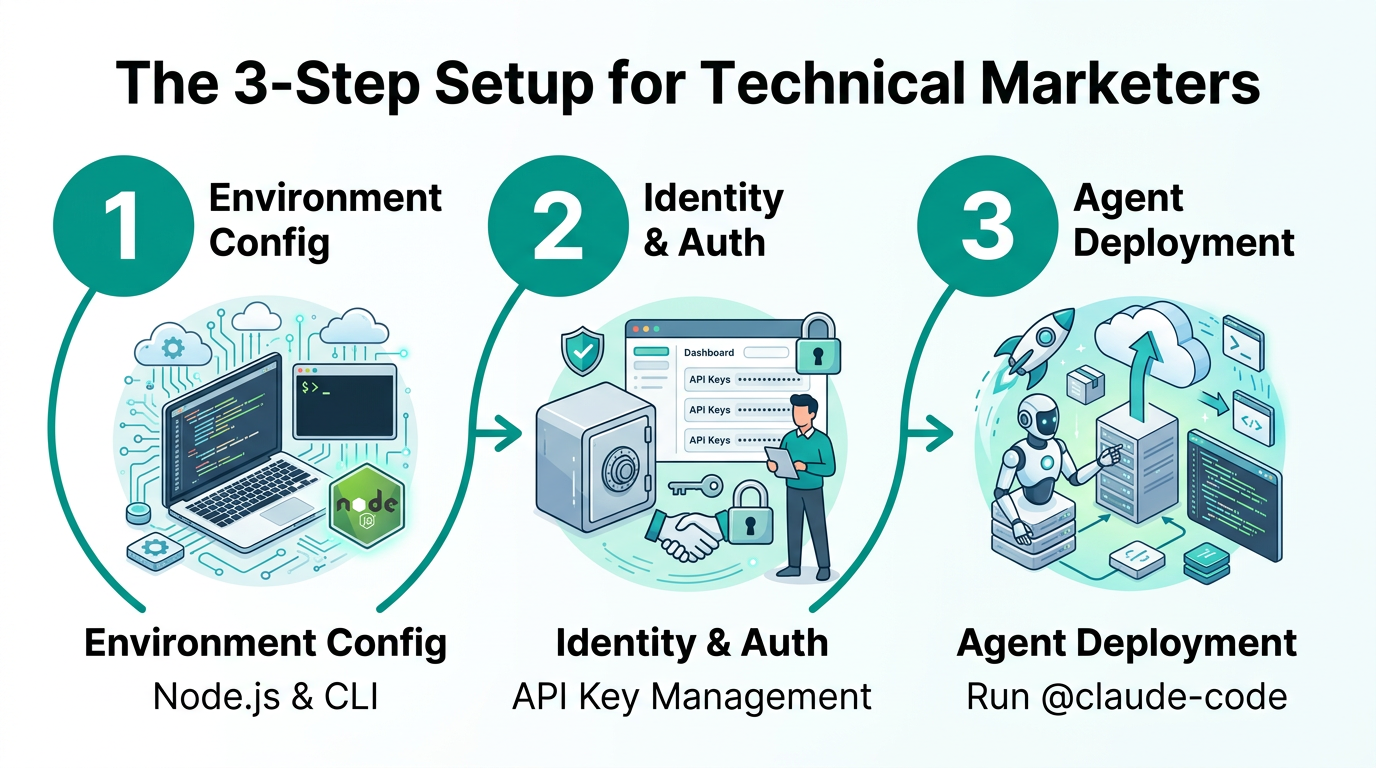
If you're ready to transition into a more agentic workflow, follow this setup playbook to get Claude Code running for your growth team:
- Install the Environment: Growth marketers are bypassing npm for faster performance. Use the native installer provided by Anthropic.
- Initialize Project Memory: Run
/initto create aCLAUDE.mdfile. This serves as the "Project Memory." Define your project purpose (e.g., "Automated SEO Audit Tool") and brand voice. - Add Marketing Skills: Download task-specific plugins from GitHub to add commands for technical SEO and automation logic.
- Data-First Prompting: Instead of asking for a script, provide context. "Using the CSV data from my keyword research, build a script to check current rankings via Google Search Console and output a report to markdown."
Risks: Silent Failures and the Gartner Gap
Despite the efficiency gains—including a 30% reduction in CPA for early adopters—the transition to autonomous agents isn't without risk. Experts at MarketingProfs warn of "silent failures at scale," where an AI agent might misinterpret a small policy detail (like a refund rule) and propagate that error across thousands of automated customer interactions.
Furthermore, a 2026 study found that 87% of pull requests generated by AI agents contained at least one security vulnerability. This is why the industry consensus remains: use AI for commodity work, but maintain a Human-in-the-Loop (HITL) as the "Air Traffic Controller." Gartner predicts that 40% of agentic AI projects will fail by 2027 if teams ignore this critical governance layer.
"40% of agentic AI projects will fail by 2027 due to poor governance and the Gartner Failure Gap—where marketers underestimate implementation complexity."
The 2026 Winner: Why You Need a Multi-Tool Stack
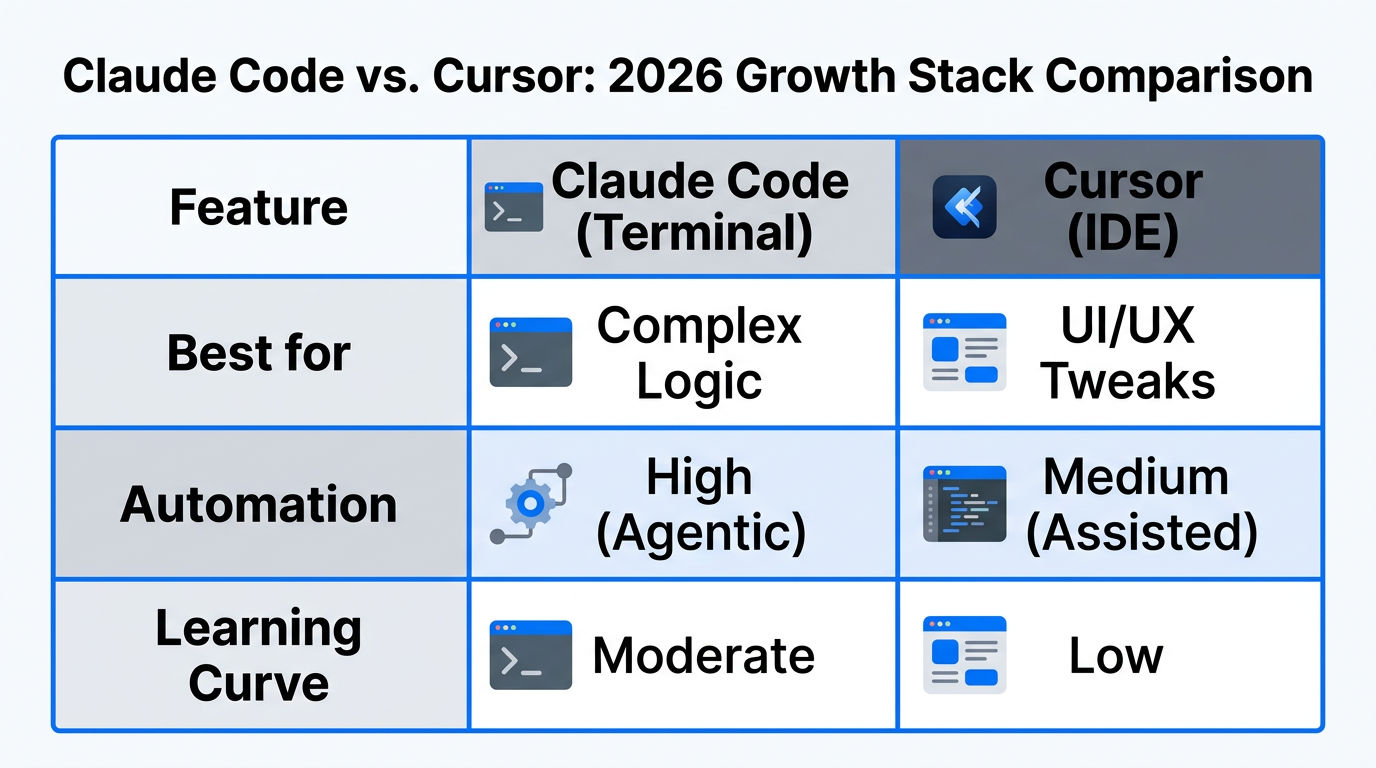
So, which is the best AI-native tool for growth? The answer is both. The modern growth stack isn't about choosing one tool; it's about orchestration.
- Use Bolt.new or Lovable to "visualize" your idea and build a quick UI.
- Use Cursor for daily "hands-on-keyboard" editing and frontend refinements.
- Use Claude Code as your primary engineer for backend logic, data pipelines, and autonomous system management.
For organizations looking to scale their influencer efforts alongside these custom builds, platforms like Stormy AI provide the perfect complement, offering AI-powered search, discovery, and automated outreach that integrates seamlessly into a growth team's broader AI strategy. In 2026, the winners won't be those who write the best code, but those who orchestrate the most efficient agents.
| Tool | Persona | Best Use Case | Price (2026) |
|---|---|---|---|
| Claude Code | The Engineer | Multi-file architecture & data pipelines | $17-20/mo |
| Cursor | The Editor | Daily coding with high IDE UX | $16-20/mo |
| Devin | The Autonomous | Fully hands-off engineering backlogs | $500/mo |