In the high-velocity landscape of 2026, the traditional distinction between "Marketing" and "Sales" has effectively collapsed into a single, unified architectural framework: the GTM Mesh. No longer are we waiting for weekly batch syncs or manual CRM updates. Instead, the most sophisticated revenue teams are using agentic CLI tools like Claude Code to build, maintain, and orchestrate real-time data pipelines that turn 'Dark Social' signals into immediate sales actions.
The era of the siloed GTM is over. According to GTM Partners, enterprises adopting an agentic mesh have seen a 45% reduction in 'Ops Debt'—the time-consuming maintenance of fragile no-code connections. By shifting from a "buying SaaS" mindset to a "building agentic workflows" approach, companies are finally closing the gap between a customer's intent signal and a representative's response. This guide provides an actionable playbook for using Claude Code to automate social signal capture and identity resolution within your 2026 growth stack.
Understanding the GTM Mesh in 2026
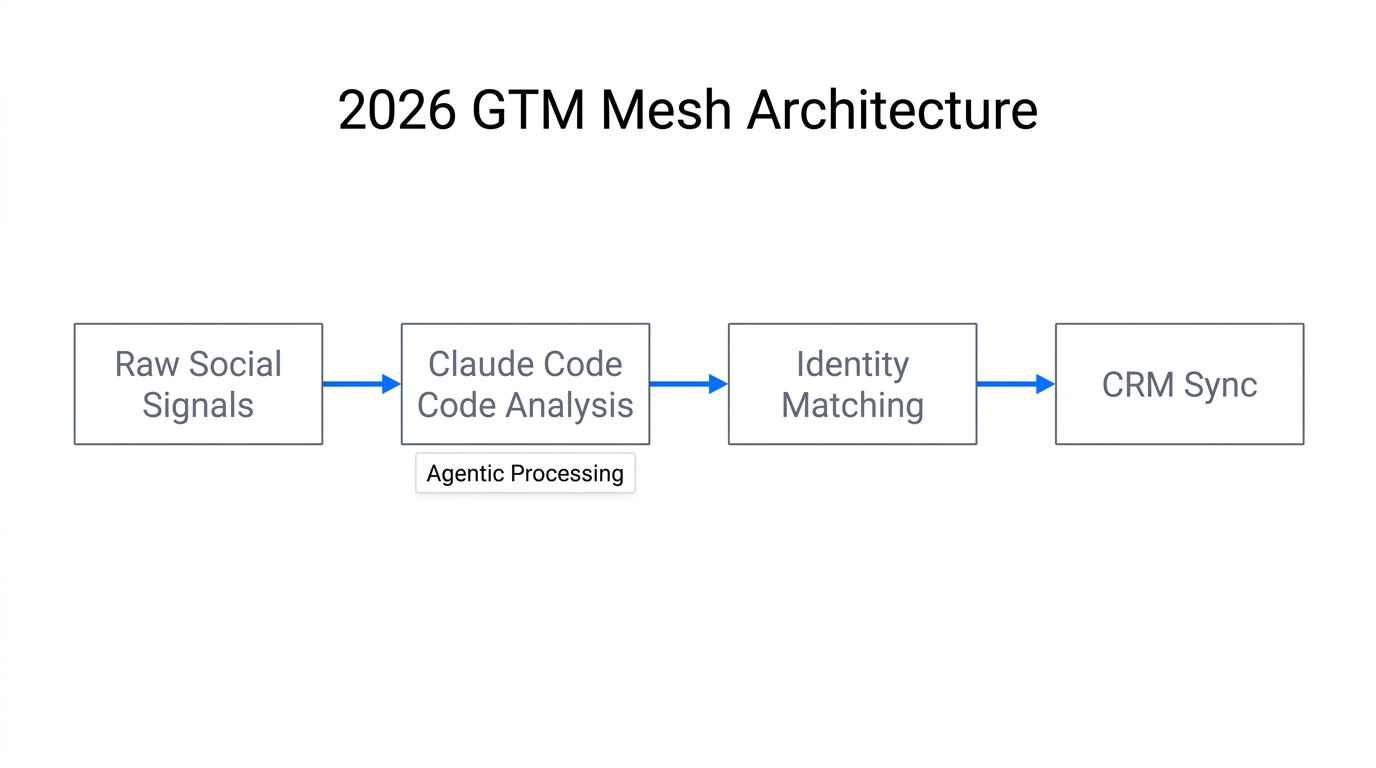
As of March 2026, the global spend on GTM technology has reached a staggering $132 billion, with Gartner reporting that "Composable GTM" tools now represent 18% of that total. The GTM Mesh is defined by its ability to act as a customer data platform (CDP), a reverse ETL, and an identity resolution engine simultaneously.
Claude Code has emerged as the preferred tool for orchestrating this mesh. Since its launch in early 2025, it has captured 22% of the agentic CLI market. Unlike traditional IDEs, Claude Code allows RevOps teams to act like software engineers, writing custom Python functions to handle complex lead routing logic that platforms like Zapier simply cannot manage.
"The GTM Mesh is no longer a concept; it’s the requirement. If your sales team is waiting for a batch sync from Marketing, you’ve already lost." — Sangram Vajre, CEO of GTM Partners.
Phase 1: Defining and Monitoring Product Signals
The first step in building your automated capture system is identifying the high-intent triggers within your own infrastructure. For many SaaS companies, this means monitoring product telemetry stored in data warehouses like Snowflake or engagement on developer platforms like GitHub.
Using Claude Code, you can initialize a session and immediately begin building "ephemeral" scrapers. For example, you might prompt: "Write a Python script to monitor our Snowflake 'Product_Signals' table for any user who hits the 'Export' button 5+ times in 24 hours."
By leveraging the Claude Opus 4.6 model, which features a massive 64K output token limit, you can refactor entire middleware applications in a single pass. This allows you to build sophisticated logic that goes beyond simple "if-then" statements, incorporating historical usage patterns and churn risk indicators.
Phase 2: Automated Identity Resolution
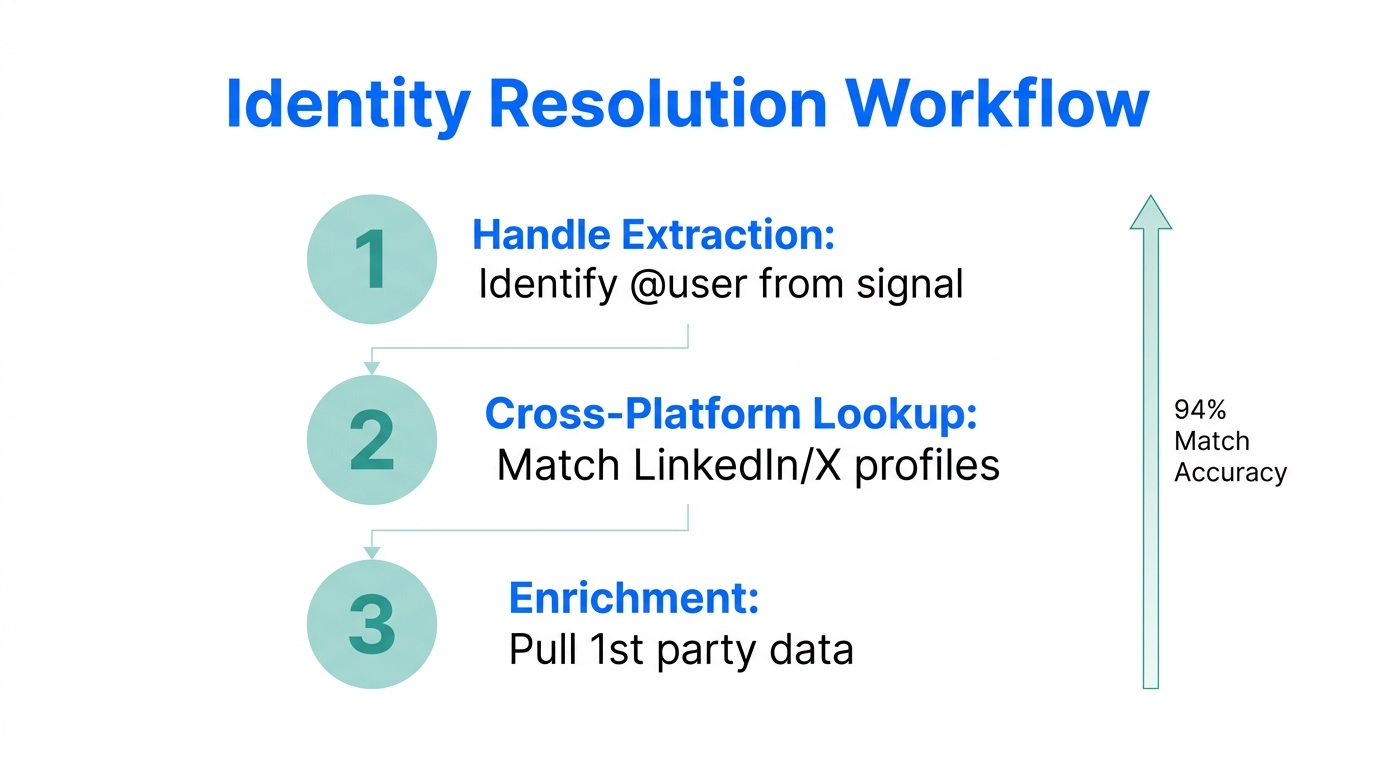
A signal without an identity is just noise. "Dark Social"—the interactions happening in private Slacks, LinkedIn DMs, or niche forums—often leaves you with nothing but a username or an IP address. This is where automated identity resolution becomes critical.
In the GTM Mesh, tools like Clay and Common Room act as the enrichment layer. Claude Code can bridge these APIs to transform a vague social signal into a rich lead profile. For instance, when a brand needs to identify which high-quality creators are mentioning their products on TikTok, they might use platforms like Stormy AI to source those creators and then use Claude Code to sync that data into their internal CRM.
| Tool | Function in the Mesh | 2026 Starting Price |
|---|---|---|
| Clay | Data orchestration and 75+ enrichment providers | $149/mo |
| Common Room | Identity resolution for "Dark Social" signals | $2,000/mo (Team) |
| Claude Code | Agentic CLI for building/fixing API connectors | Usage-based (Tokens) |
| Segment | Central Nervous System / CDP | ~$1,000/mo (Business) |
When you prompt Claude Code to "Take these users and find their LinkedIn profiles using the Clay API," you are creating a Just-in-Time (JIT) infrastructure. This significantly increases MQL-to-SQL conversion rates, with some reports showing a 22% increase in companies utilizing these automated scrapers.
Phase 3: MCP Servers and CRM Sync
One of the most powerful features released in the 2026 Claude ecosystem is the Model Context Protocol (MCP). MCP allows Claude Code to securely connect to your data sources—like Postgres or Salesforce—and treat them as part of its internal context.
By setting up interactive MCP servers, you can sync social intent data directly to Salesforce without writing hundreds of lines of boilerplate integration code. Use the `/mcp` command in the Claude Code CLI to run the interactive wizard. This allows the agent to not only write the data sync script but to execute it and verify the results against your live database.
"Tools like Claude Code are designed to shorten the distance between a business logic idea and a functional deployment." — Dario Amodei, CEO of Anthropic.
Companies like Vanta have used this "Signal-to-Ship" pipeline to reduce customer churn risk notifications by 60%. By the time a CSM receives a Slack notification, Claude Code has already enriched the lead, checked their contract status in Vitally, and drafted a personalized reach-out email.
Phase 4: GTM Compliance and Privacy
As automation scales, so does the risk of privacy violations. In 2026, GTM compliance is not optional. Claude Code provides built-in mechanisms to ensure that your automated captures don't violate PII (Personally Identifiable Information) rules or internal privacy standards.
Practitioners now use the `/rules` command to enforce compliance. By maintaining a `./GTM_MESH/CLAUDE.md` file, you can set global instructions such as "Never push PII to Slack" or "Always mask email addresses before sending to the analytics endpoint." This ensures that even as the AI agent autonomously routes leads, it adheres to the strict governance required by the modern enterprise.
/compact command frequently during long sessions. This summarizes the context to save token costs, which can otherwise spiral—some RevOps teams report burning 200M to 1B tokens per month on large-scale CRM refactoring.Measuring Pipeline Contribution
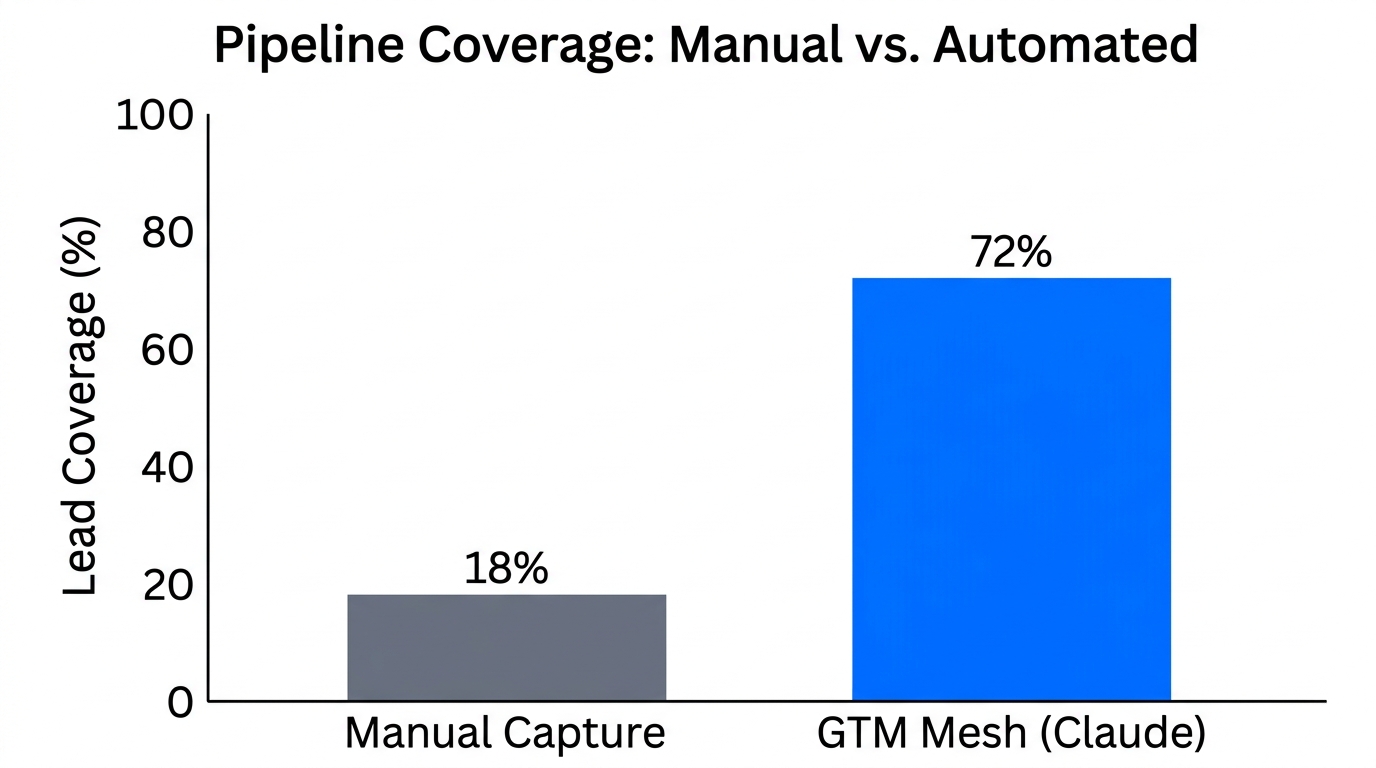
The ultimate metric for the GTM Mesh is Pipeline Contribution from Organic Agentic Search. This measures how many leads were generated via AI-orchestrated SEO clusters and automated social capture. According to data found on Blake Crosley's CLI Guide, 4.1% of all public GitHub commits are now authored by Claude Code, illustrating the sheer volume of code being generated to support these growth initiatives.
To measure success, track the following:
- Latency to Action: The time from social mention to CRM entry.
- Enrichment Accuracy: The percentage of resolved identities vs. raw signals.
- Prefix Reuse Rate: In Claude Code, prefix caching can reduce token costs by up to 92% for repeated GTM tasks.
- Ops Debt Reduction: The decrease in manual ticket resolution for broken integrations.
The Risks of "Agentic Debt"
While the benefits are clear, practitioners on r/ClaudeCode warn of "Agentic Debt." This occurs when Claude Code writes complex scripts that no human on the team fully understands. If the person who prompted the AI leaves the company, the GTM Mesh becomes a "black box" integration that is impossible to maintain.
Furthermore, the risk of hallucinated dependencies remains. Claude Code may assume an API capability exists within legacy CRM platforms that isn't enabled on your specific tier, leading to silent failures in your lead routing. Always test your scripts in a sandbox environment using Claude's internal terminal before pushing to production via the GitHub Action for Claude Code.
Conclusion: The Future is Real-Time
The transition to an automated GTM mesh powered by Claude Code is not just a technical upgrade; it's a strategic mandate. By bridging 'Dark Social' signals with real-time sales actions, you are no longer reacting to the market—you are operating at the same speed as your customers' intent.
As you build your mesh, remember that the goal is to shorten the distance between a customer signal and a meaningful interaction. Whether you are using Stormy AI to discover creators for your next campaign or Claude Code to resolve their professional identities, the future of GTM belongs to the teams that can move the fastest from data to revenue.