In the first quarter of 2026, the startup landscape has undergone a seismic shift. We have officially moved past the era of "autocompletion" and entered the age of "agentic planning." For founders, this means the ability to build complex software products with a fraction of the traditional headcount. However, this new superpower comes with a hidden trap: the "Virtual Cost" shock. Without a disciplined strategy, the very tools meant to save you money—like Anthropic's Claude Code—can generate API bills that rival a senior developer's salary. Many unoptimized power users are reporting burns of $400 per week, a figure that can instantly kill a bootstrapped startup's runway.
But it doesn’t have to be this way. By shifting your habits and leveraging the latest 2026 pricing tiers, you can reduce that burn to a sustainable $15 per week ($60/month) while maintaining elite-level output. This playbook outlines the exact financial and technical steps to achieve that 96% cost reduction without sacrificing product velocity.
The 2026 AI Coding Landscape: From Plugins to Agents
As of 2026, the global AI coding assistant market has swelled to an estimated $8.5 billion. It is no longer a niche hobby for early adopters; 84% of developers now report using these tools, with over half using them daily. The leaders of the pack—Cursor and Claude Code—are no longer just suggesting the next line of code. They are autonomous agents capable of multi-file refactors, shell execution, and self-testing.
The primary driver of cost in 2026 is token consumption. With the general availability of 1-million-token context windows, it is tempting to feed your entire codebase into every prompt. However, every time you send a 100k-token session to the API, you are paying an "input tax" that compounds with every follow-up message. This is how a single complex feature request can jump from pennies to $25 in a single execution.
"The shift from 2025 to 2026 wasn't about the models getting smarter—it was about the models getting more autonomous. If you don't cap their 'thinking,' they will spend your entire budget exploring dead ends."
The Financial Trap: Why Unoptimized API Usage Kills Startups
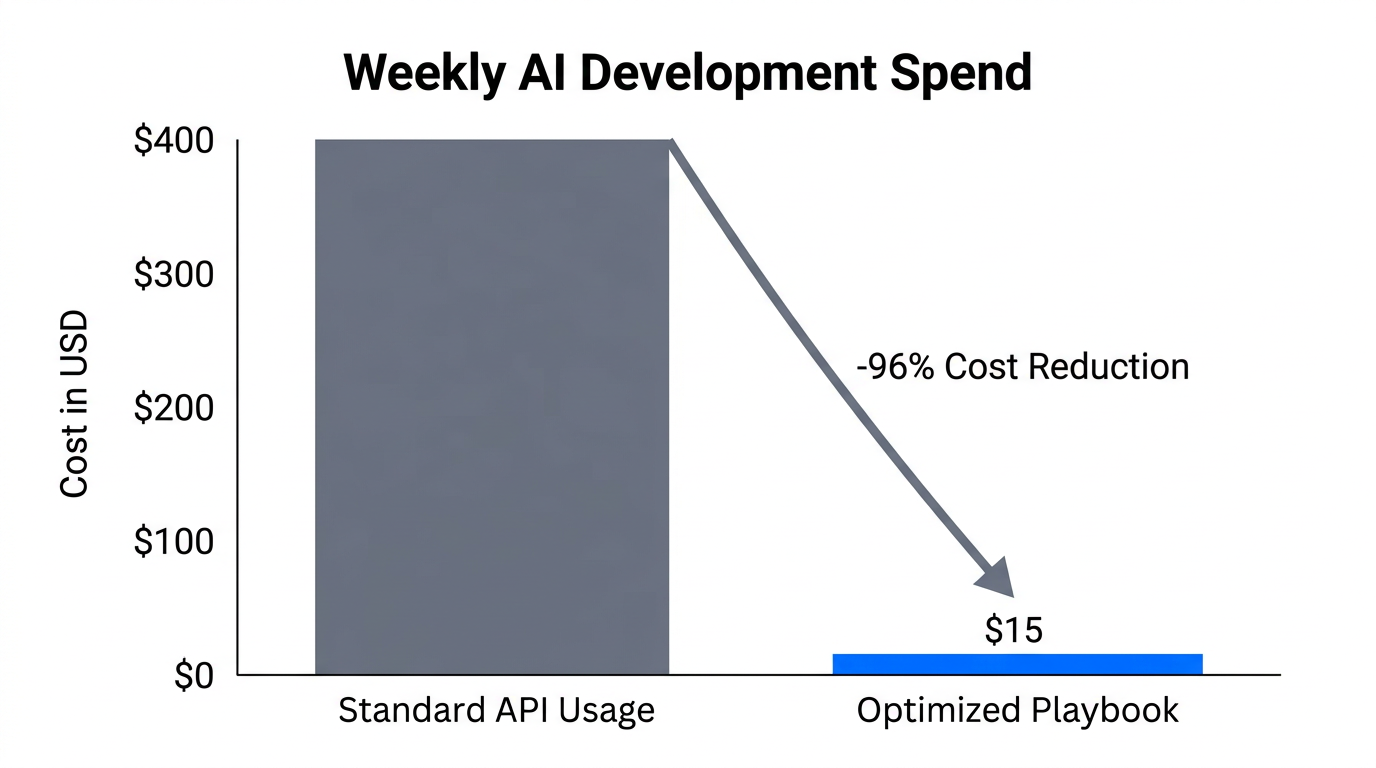
The term "Virtual Cost" shock originated from community reports on Reddit, where power users on Claude's Max plan discovered they were consuming upwards of $336 in tokens in just six days. For a solo founder, an unmonitored Claude Code instance can easily rack up a $1,600 monthly bill. This is largely due to Context Bloat: the habit of carrying a massive, stale conversation history into new prompts.
To navigate this, founders must understand the 2026 pricing tiers. Anthropic bifurcated the market into "Pro" ($20/mo) and "Max" ($100-$200/mo) plans. While the Max plan seems expensive upfront, it acts as a critical financial ceiling for high-intensity development. Relying on raw API pay-as-you-go is a recipe for bankruptcy for any founder who is "vibe coding"—the 2026 trend of building products through high-level natural language instructions.
| Tool | Weekly Cost (Unoptimized) | Weekly Cost (Optimized) | Best Use Case |
|---|---|---|---|
| Claude Code (API) | $50 - $400 | $15 (via Z.ai) | Deep autonomous refactors |
| Cursor (Pro) | $20 | $5 | General IDE workflows |
| Aider (BYOK) | $20 - $50 | $2 - $10 | Open-source purists |
| Windsurf | $15 | $3.75 | Solo dev high-speed flow |
Step-by-Step Playbook: Optimizing to $15/Week
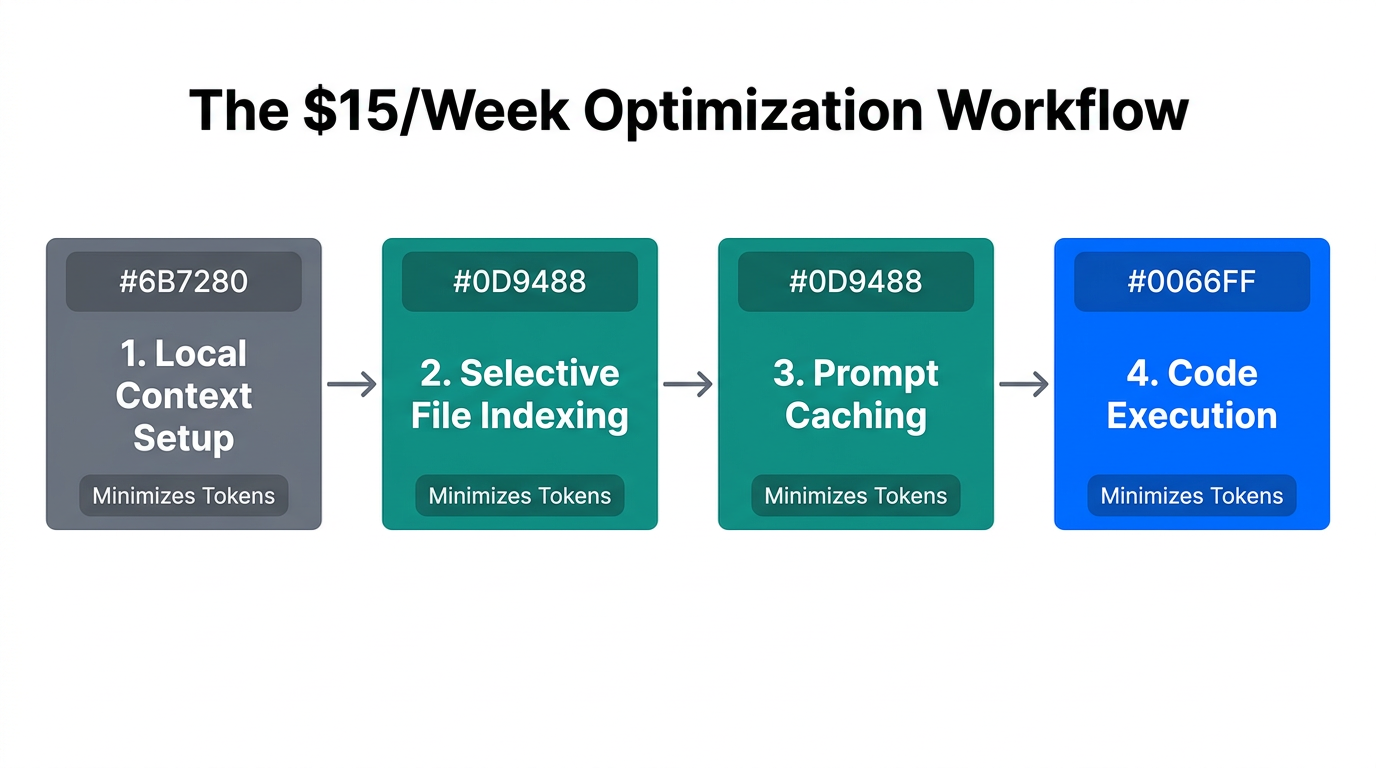
To hit the $15/week target, you must treat your AI tokens like physical inventory. Here is the habit-shift playbook for the modern founder.
Step 1: Shift to Subscription Over API
If you are developing more than 10 hours a week, move away from the Anthropic API and onto the Claude Max 20x Plan. For $200/month, you get up to 900 messages per rolling 5-hour window. As IntuitionLabs notes, this essentially eliminates the "context reset" penalty that forces users into expensive API usage once they hit the $20 Pro plan usage walls.
Step 2: Implement "Plan Mode" First
Never let Claude Code execute a multi-file change without a plan. Use the Read-Only Plan Mode (Shift+Tab). This forces the tool to use a cheaper Haiku 4.5 subagent to explore the codebase. Boris Cherny, the creator of Claude Code, recommends this workflow to prevent "implementation drift"—where the AI writes hundreds of lines of code that you eventually delete because it misunderstood the architecture.
Step 3: Proactive Compaction and File Tiering
Run the /compact command when your session reaches 70% capacity. This summarizes your history while preserving your critical CLAUDE.md instructions. Furthermore, adopt a File Tiering strategy using tools like Repomix for proactive context management. By only loading "HOT" files (active tasks) and keeping "COLD" files (archives) out of the context window, developers have reported a 94.5% reduction in session costs.
"The $400/week burn isn't a sign of productivity; it's a sign of a 'Goldfish' session where the AI is re-reading your entire project every five minutes."
Step 4: Use the "Z.ai" Shortcut
For founders on an extreme budget, routing Claude Code to third-party providers like Z.ai can be a game-changer. By setting your ANTHROPIC_BASE_URL to a provider that offers high-intelligence coding models at lower subscription rates, you can maintain agentic performance for the price of a few cups of coffee. Freelancers have reported saving over $180 a month using this simple swap.
ROI Analysis: The $53 Agentic Refactor vs. The $250k Senior Dev
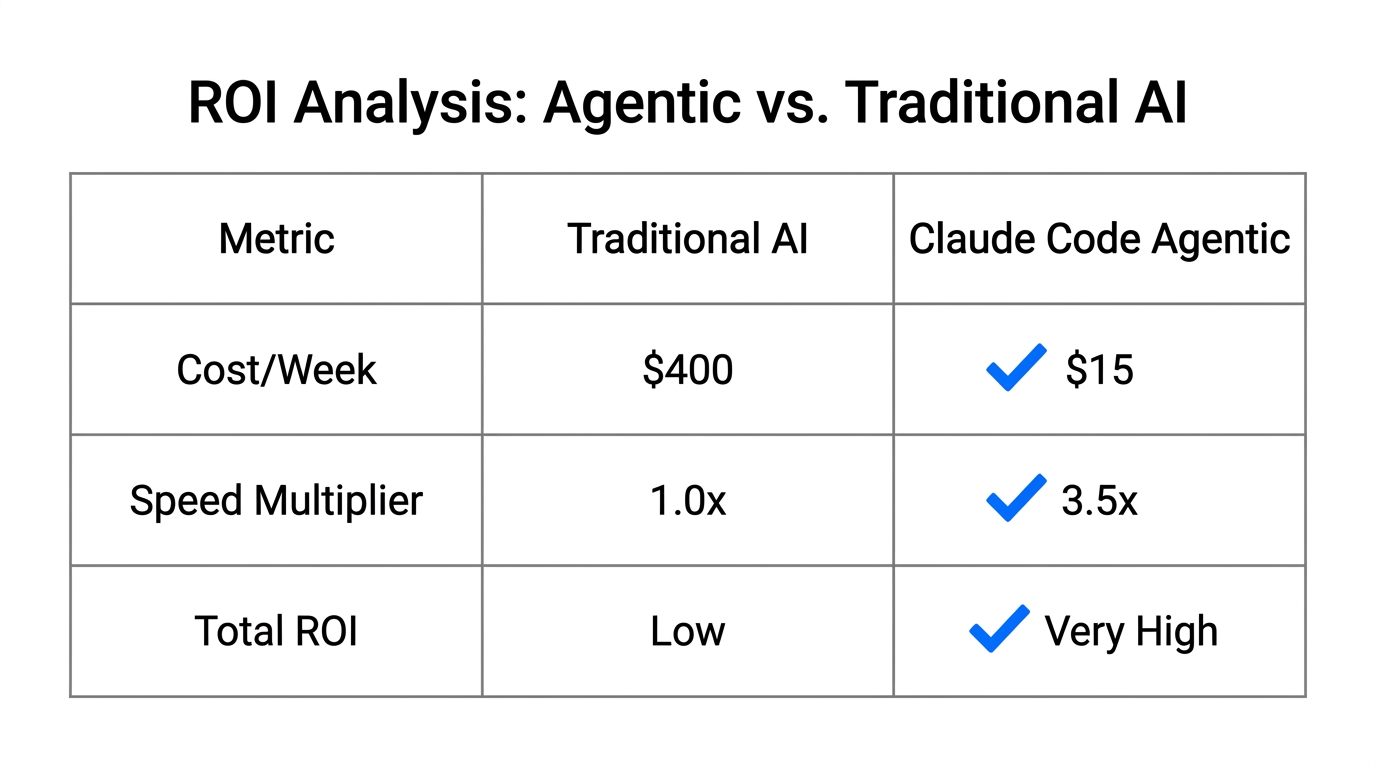
The financial case for agentic coding in 2026 is undeniable. A March 2026 case study documented a massive backend refactor that would typically cost a startup $258,000 in senior developer hours. Claude Code, when properly guided through a "Plan-Execute" loop, completed the equivalent task for just $53 in API tokens. That is a 4,868x ROI.
However, this ROI is only achievable if the founder avoids the "Thinking Trap." 2026 models like Claude 3.7 introduce an "Extended Thinking" mode. While powerful, it can be "too enthusiastic," often adding unrequested features or over-complexifying codebases. Setting a thinking_token_budget of under 1,000 for routine tasks is essential to prevent your budget from ballooning on simple boilerplate. Once your product is built and you need to scale your user base, using platforms like Stormy AI to find and outreach to influencers can ensure your marketing ROI matches your development efficiency.
Implementing Predictive Billing with Tarmac
One of the biggest pain points in the Claude Code ecosystem is the zero-visibility nature of prompts. By default, you don't know the cost until the prompt is finished. To combat this, smart founders are installing tarmac-cost, a CLI tool that uses conformal prediction to give you a cost range before the agent executes. This prevents the "$20 surprise" that occurs when you accidentally include a large database dump in your context.
Furthermore, savvy founders take advantage of Off-Peak windows. In early 2026, Anthropic doubled usage limits for Pro and Max users during weekends and weekdays outside 8 am–2 pm ET. Moving your massive architectural refactors to these windows is a simple habit that effectively halves your cost per output.
"The ultimate founder skill in 2026 isn't writing code—it's managing the 'Thinking Budget' of your AI agents."
Conclusion: The Bottom Line for Founders
Building a startup in 2026 requires a radical rethink of the development budget. The path from a $400/week burn to a $15/week lean operation isn't about working less; it's about context hygiene and subscription management. By moving to the Claude Max plan, enforcing Plan Mode, and utilizing tools like tarmac-cost and GitHub-integrated context managers, you can build a world-class product on a hobbyist's budget.
Remember that tools like Stormy AI can help you find the right UGC creators and influencers to market your new product once it's built, ensuring that your low-cost development is met with high-impact growth. The founders who win in 2026 will be those who treat tokens with the same respect they treat their equity.