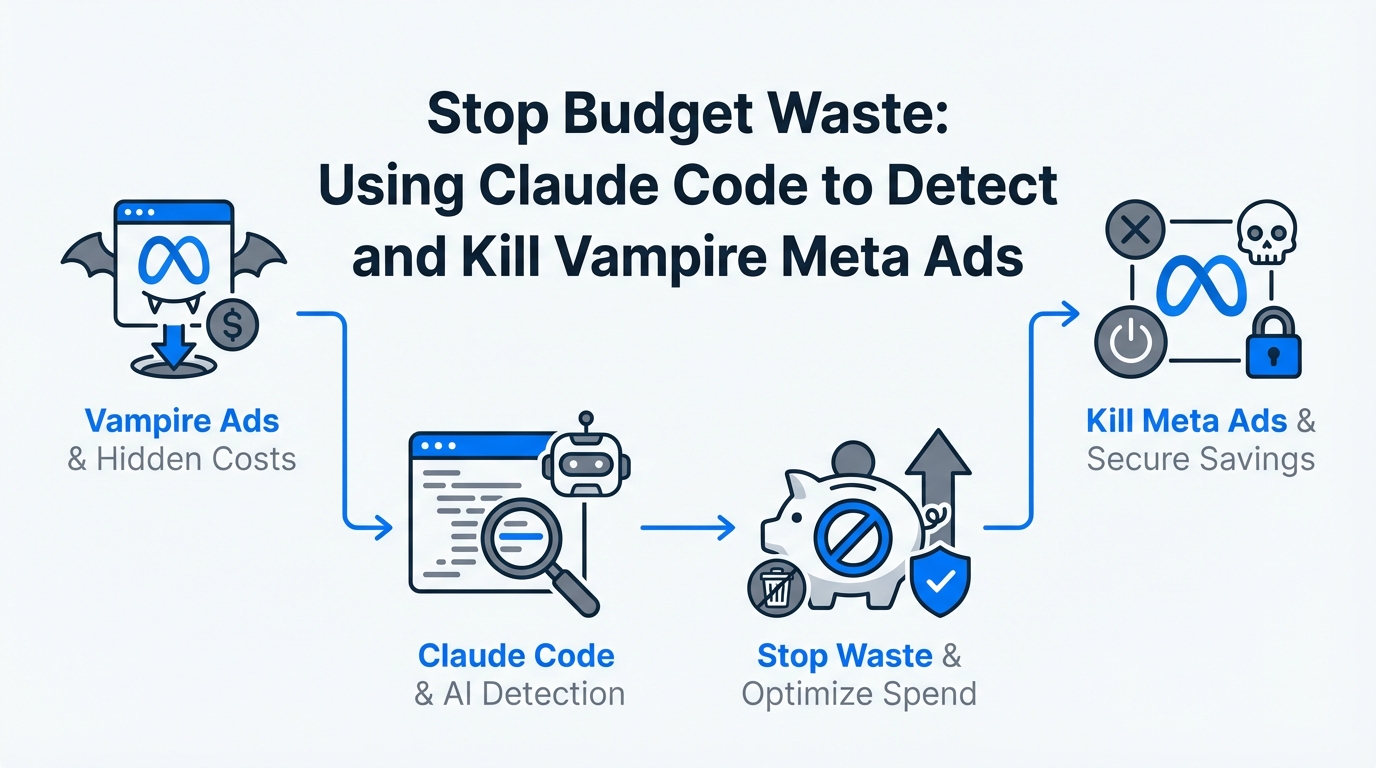
Every media buyer knows the sinking feeling of logging into Meta Ads Manager on a Monday morning only to find a 'vampire ad' has sucked dry a weekend's worth of budget with zero conversions to show for it. Despite the advances in Meta's internal algorithms, the platform is still fundamentally designed to spend your money first and optimize second. In the high-stakes world of performance marketing, waiting for the algorithm to 'figure it out' is an expensive luxury. However, as we enter 2026, the era of manual monitoring is coming to an end. By leveraging agentic workflows through tools like Claude Code, advertisers can now build autonomous guardians that audit, detect, and kill underperforming ads in real-time, effectively automating the most tedious parts of Meta Ads optimization.
The Shift from Chatbots to 'Action AI' in Media Buying
For the past two years, AI in marketing was largely synonymous with generating catchy headlines or resizing images. But the landscape has shifted. We have moved past simple 'Chat AI' and into the territory of Action AI—autonomous agents capable of interacting directly with the Meta Marketing API to execute changes without human intervention. This shift is driving significant performance gains across the industry.
Furthermore, advertisers using Meta’s AI-enabled tools like Advantage+ are seeing an average ROAS of $4.52 for every $1 spent, which is 22% higher than standard manual campaigns. While Meta's native tools are powerful, they are often a 'black box.' Using Claude Code provides the transparency and custom control that professional media buyers require. It allows you to set your own 'Kill/Scale' logic that goes beyond Meta's generic suggestions.
"Action AI represents the move from AI suggesting what you should do to AI actually doing it—executing complex audits in seconds rather than hours."
Building the Infrastructure: Claude Code and Meta MCP
To turn Claude into an autonomous ad manager, you need more than just a chat interface. You need the Model Context Protocol (MCP). This protocol acts as the bridge between Claude's reasoning capabilities and your live marketing data. By connecting an MCP server—specifically the Meta Ads MCP—Claude gains real-time visibility into your account performance.
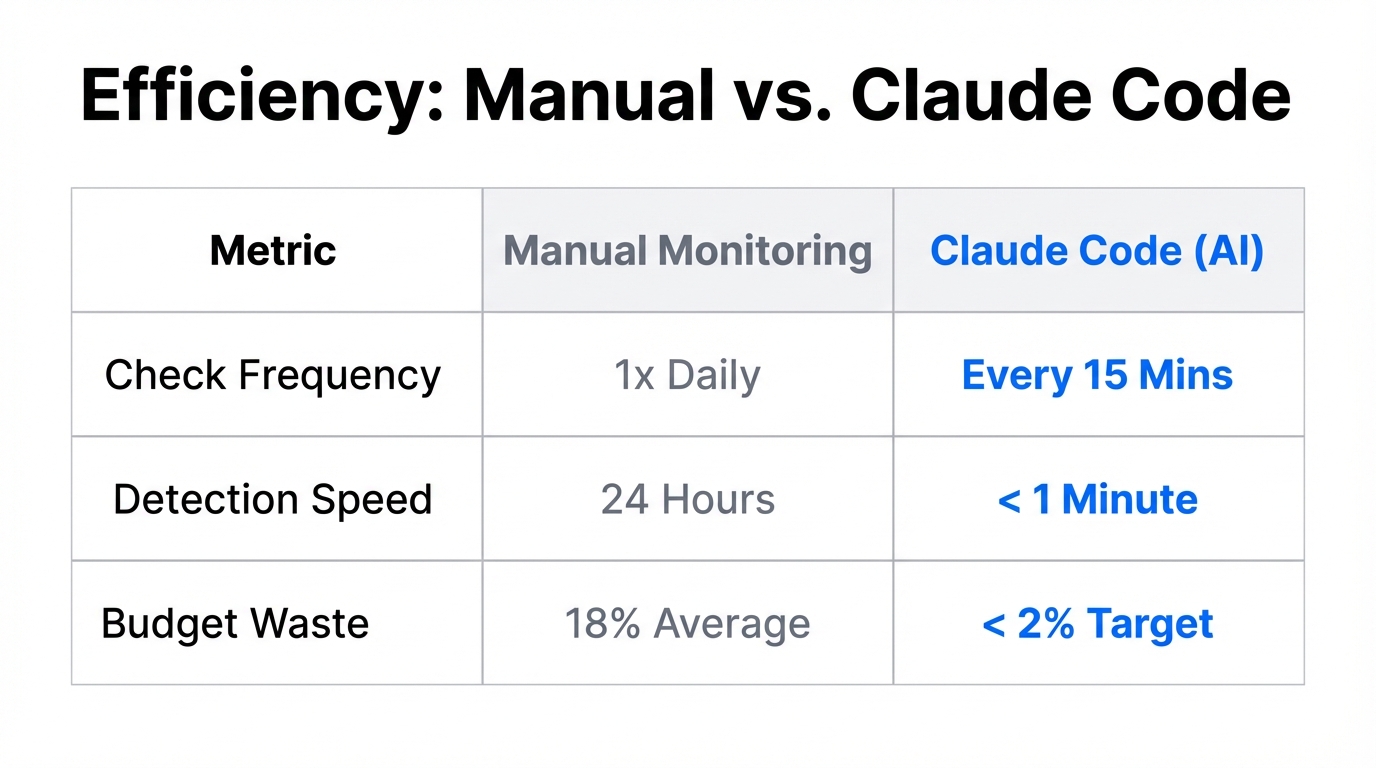
This integration eliminates the 'knowledge cutoff' issue that plagues traditional LLMs. Instead of Claude guessing based on old training data, it queries your actual Ads Manager data for the last 24, 48, or 72 hours. This is the foundation of a modern Meta Ads audit AI. With this setup, you can perform 'vibe coding'—using natural language commands to build custom monitoring software that calculates advanced metrics like Hook Rates (3-second views/impressions) and Hold Rates (15-second views/impressions) that aren't natively highlighted in the main Ads Manager dashboard.
| Feature | Manual Ads Manager | Claude Code + MCP |
|---|---|---|
| Audit Frequency | Human-dependent (daily/weekly) | Real-time / Scheduled |
| Custom Metrics | Limited to standard columns | Unlimited (Hook/Hold/Custom CPA) |
| Execution Speed | Minutes per ad set | Seconds across thousands of ads |
| Data Privacy | Native to Meta | Local execution via CLI |
The 'Ad-Eater' Strategy: Automated Detection and Kill Logic
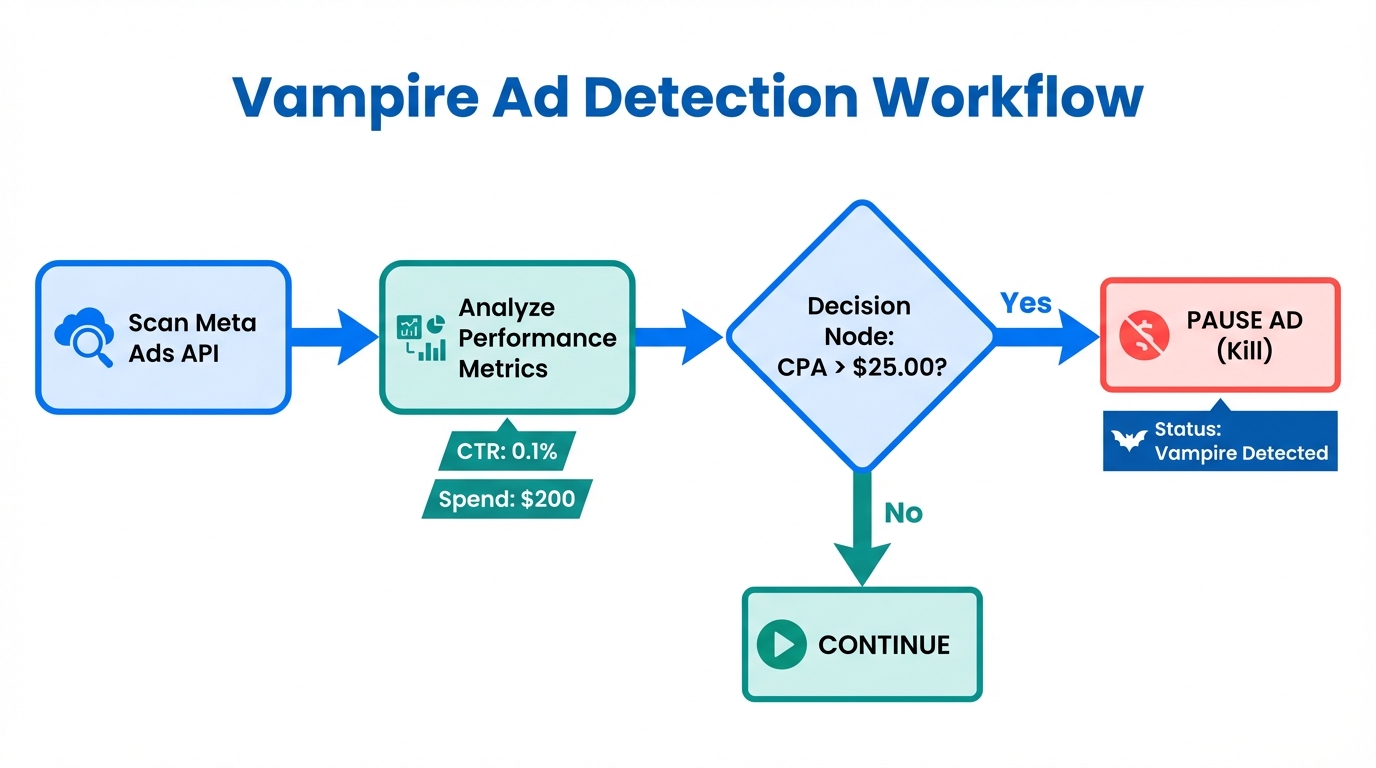
The core objective of the 'Ad-Eater' strategy is to identify ads that are consuming disproportionate budget without delivering results. These are your 'vampire' ads. To reduce CPA Meta Ads, you must be ruthless with underperformers. Using Claude Code, you can set a recurring 48-hour monitoring cycle that follows a strict logic gate.
Defining Your 'Kill' Thresholds
Before letting the AI loose, you must define what constitutes a failure. A standard 'Ad-Eater' prompt might look like this: "Analyze my Meta Ads spend from the last 48 hours. Identify any ad sets where spend is greater than $50 but the CPA is 20% above my $30 target. Draft the command to pause them immediately."
This approach allows for context-first optimization. Claude can even look at your landing page code hosted on Shopify or Webflow using tools like Ryze AI to ensure that the ad copy matches the 'Message Match' on the page. If the ad is driving clicks but the landing page isn't converting, Claude might suggest pausing the ad not because the creative is bad, but because the technical friction on the site is too high.
"The goal isn't just to spend less; it's to ensure every dollar spent has the highest probability of returning a conversion through algorithmic ruthlessness."
Avoiding the 'Learning Phase' Trap
One of the most common mistakes in automated ad management is over-optimization. Meta’s algorithm requires a period of stability to find your audience—typically referred to as the Learning Phase. If your AI agent makes changes every hour, the campaign will stay in 'Learning Limited' forever, and performance will tank.
When prompting Claude to manage your ads, you must bake in 'patience' logic. Tell the agent to ignore any ad sets created within the last 72 hours or those that haven't reached a minimum impression threshold. This ensures you are making decisions based on statistically significant data rather than noise. Media buyers who ignore this often find themselves making mistakes at scale, which is why platforms like Stormy AI prioritize data-driven creator selection before a campaign even launches.
The Playbook: Executing Pause Commands with Claude Code
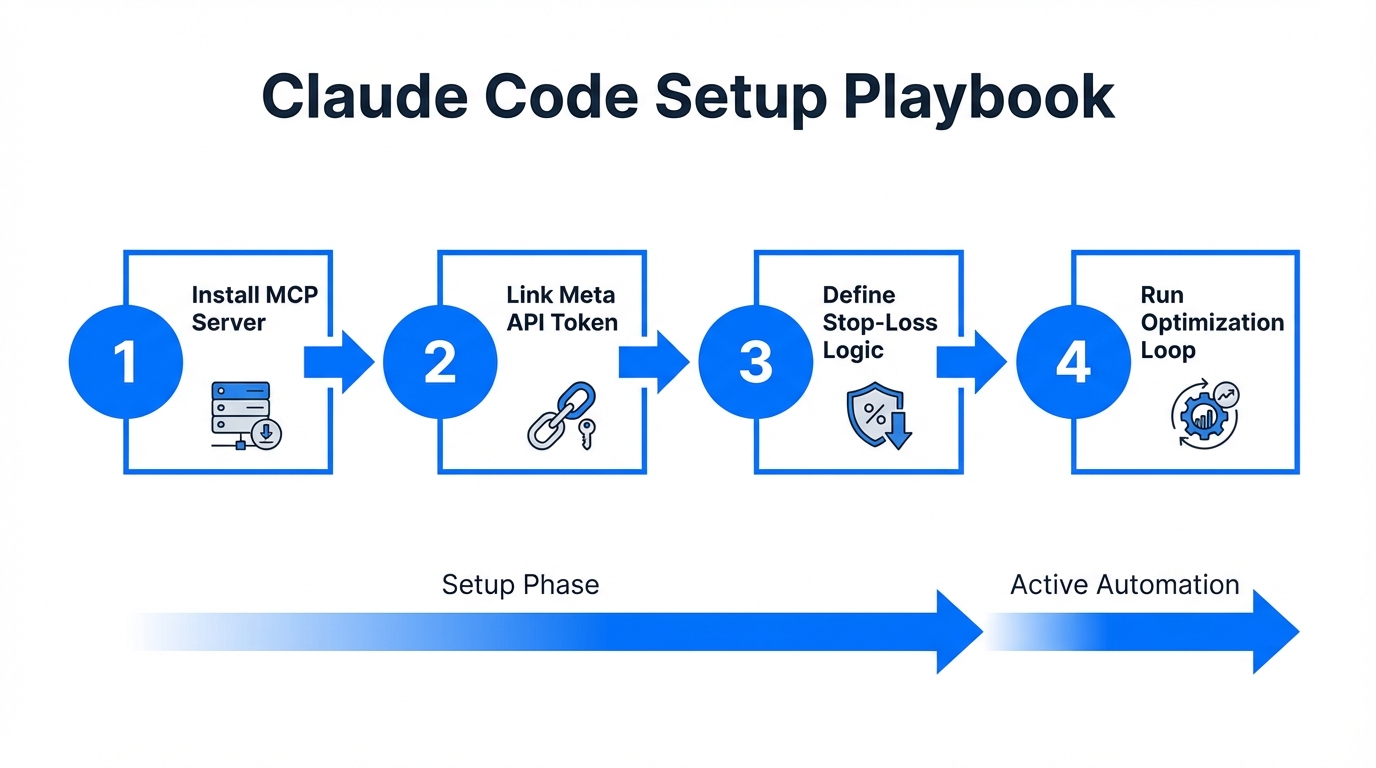
Ready to deploy your first automated audit? Follow this step-by-step Claude Code automation tools playbook to clean up your account.
- Step 1: Install the CLI: Download the Claude Code CLI and authenticate your account.
- Step 2: Connect the MCP: Initialize the Meta Ads MCP server using
mcp install wipsoft/meta-mcp. This gives Claude the 'eyes' to see your account. - Step 3: Run the Audit: Open your terminal and enter:
/code "Audit my 'App Install' campaign. List all ad sets with a CPA > $5.00 over the last 7 days and more than $100 in spend." - Step 4: Verify the Recommendations: Claude will return a table of underperformers. Review them to ensure no 'high-potential' new ads are caught in the net.
- Step 5: Execute the Kill: Once verified, tell Claude:
"Execute the pause command for these 4 ad sets."Claude will interface with the Meta Marketing API and update your status in seconds.
While Claude handles the technical execution of pausing ads, it is equally important to manage the creative pipeline. For brands scaling UGC (User-Generated Content), platforms like Stormy AI are essential for sourcing and managing the creators who produce the assets Claude is auditing. You can use Claude to analyze which creator styles are working and then use Stormy's AI-personalized outreach to find similar creators for your next campaign flight.
The Human Element: Strategy Over Syntax
As Giorgio Liapakis has demonstrated in his experiments with autonomous account management, it is possible to give an AI full access to an account, where it handles everything from ICP research to budget scaling. However, the most successful media buyers use AI as an exoskeleton, not a replacement.
The AI handles the how and the when, but the human must handle the why. As growth expert Marcus Burke points out, over-optimizing for short-term signals can lead to low-quality traffic. Your AI might see a 'vampire' ad and kill it, but you need to understand if that ad was actually contributing to assisted conversions or brand awareness that isn't captured in a 1-day click attribution model.
Conclusion: The Future of the Automated Media Buyer
The era of staring at the Meta Ads Manager refresh button is over. By integrating Claude Code and the Meta MCP into your workflow, you can reclaim hours of your week and significantly reduce CPA Meta Ads. This automated ad management approach allows you to focus on what actually moves the needle: high-level creative strategy and creator relationships.
Tools like Stormy AI complement this tech stack by ensuring your creative pipeline is always full of high-quality UGC, while Claude ensures that only the best-performing assets get your budget. Start by setting up a simple audit today, and watch your budget waste vanish as your efficiency skyrockets in this new agentic marketing landscape.