In 2026, the marketing landscape has shifted from "Chat AI" to "Action AI." While last year was about asking chatbots for content ideas, this year is defined by autonomous agents that actually execute technical workflows. At the heart of this revolution is Claude Code, a command-line tool that doesn't just suggest scripts—it writes, tests, and deploys them. For technical marketers, the ability to orchestrate automated marketing data pipelines using Claude Code and the Model Context Protocol (MCP) has become a non-negotiable skill for staying competitive.
As of early 2026, approximately 42.8% of surveyed developers and technical marketers use Claude or Claude Code, making it the most dominant force in generative AI for engineering tasks. Organizations utilizing these agentic tools report a 2x to 3x acceleration in data-driven projects. If you are still manually exporting CSVs from Google Search Console, you are working in the past. This playbook will show you how to build a 2026-ready SEO command center.
"The shift from 'writing code' to 'orchestrating agents' is the single biggest productivity jump in marketing history. We are no longer limited by our technical bandwidth, but by our strategic vision."Understanding the Model Context Protocol (MCP): The Marketer's Bridge
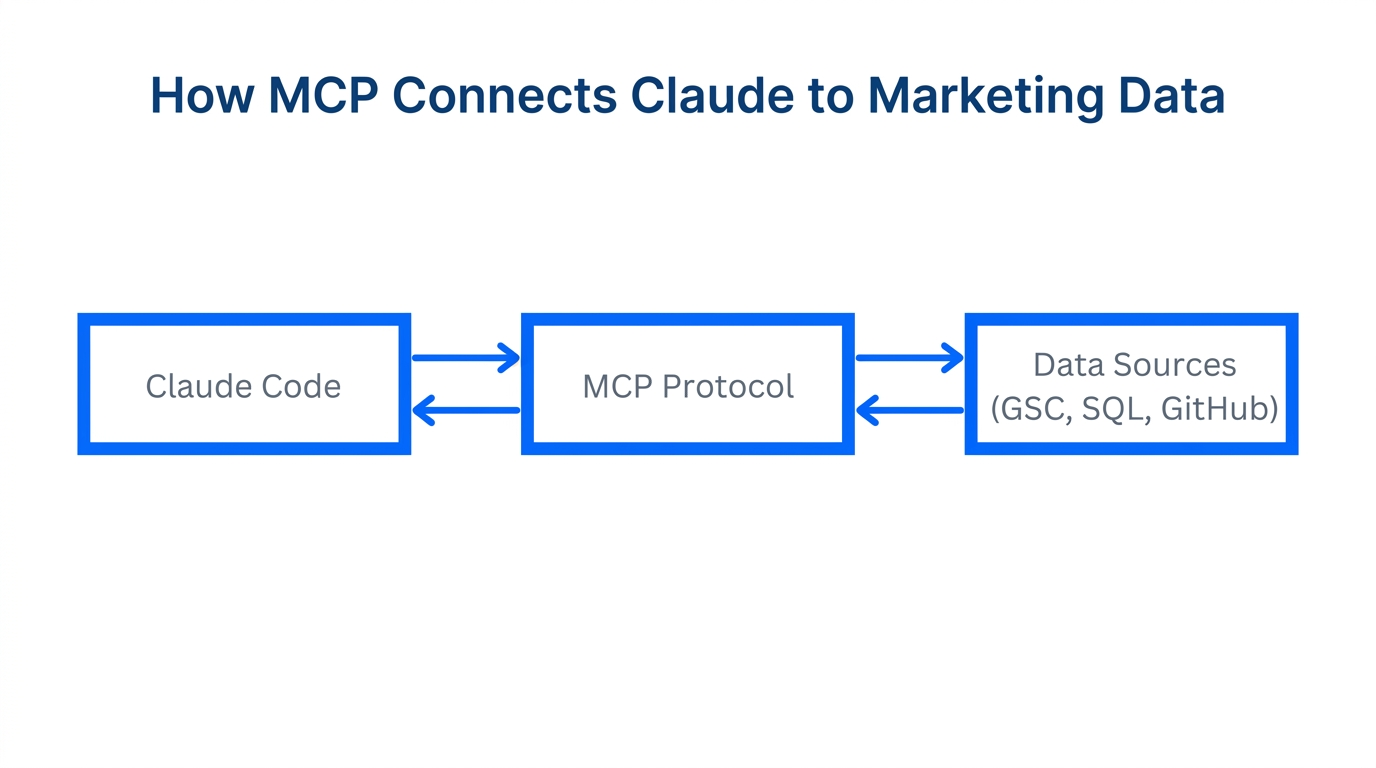
The biggest hurdle in SEO automation has always been data silos. Connecting your analysis tools to live data from Google Search Console (GSC), GA4, or a database used to require complex API integrations or third-party connectors. In 2026, the Model Context Protocol (MCP) has standardized this process. MCP allows Claude to connect directly to external data sources without custom middleware.
For a growth marketer, an MCP setup for marketers means Claude Code can "see" your live SEO data in real-time. Instead of downloading a report, you give Claude a terminal command to fetch the last 30 days of keyword performance directly from the GSC API. This creates a seamless loop where agentic data analysis happens instantly within your workflow. Anthropic's ecosystem now holds a 29% enterprise market share, largely because MCP makes it so easy to bridge the gap between AI reasoning and corporate data.
Setting Up Your Claude Code SEO Automation Environment
Before building pipelines, you need the right environment. While many still use the web interface at claude.ai/code, the real power for automation lies in the Command Line Interface (CLI). Claude Code operates as an autonomous agent in your terminal, capable of running commands, managing Git, and editing multiple files simultaneously.
Technical SEO teams are increasingly moving toward a "Hybrid Stack": using tools like Cursor for visual front-end adjustments and Claude Code for deep back-end Claude Code SEO automation and ETL (Extract, Transform, Load) tasks. This setup allows you to treat your SEO strategy like a software project. According to expert comparisons, Claude Code excels as the "architect" for these complex, multi-file refactors.
Step 1: Installing the CLI
Ensure you have Node.js installed, then run the global installation for Claude Code. This will give you access to the `claude` command in your terminal. For marketing teams, it's critical to use Claude Enterprise to ensure your proprietary search data isn't used for training the model, a common pitfall in AI adoption.
Step 2: Authenticating with MCP
Use the MCP configuration to point Claude toward your GSC and GA4 credentials. This setup allows Claude to pull live metrics without you ever leaving the terminal. High-growth teams often pair this with tools like Stormy AI to discover new creator opportunities and feed that data back into their primary growth dashboards.
Step-by-Step: Building a 'Paid-Organic Gap Analysis' Script
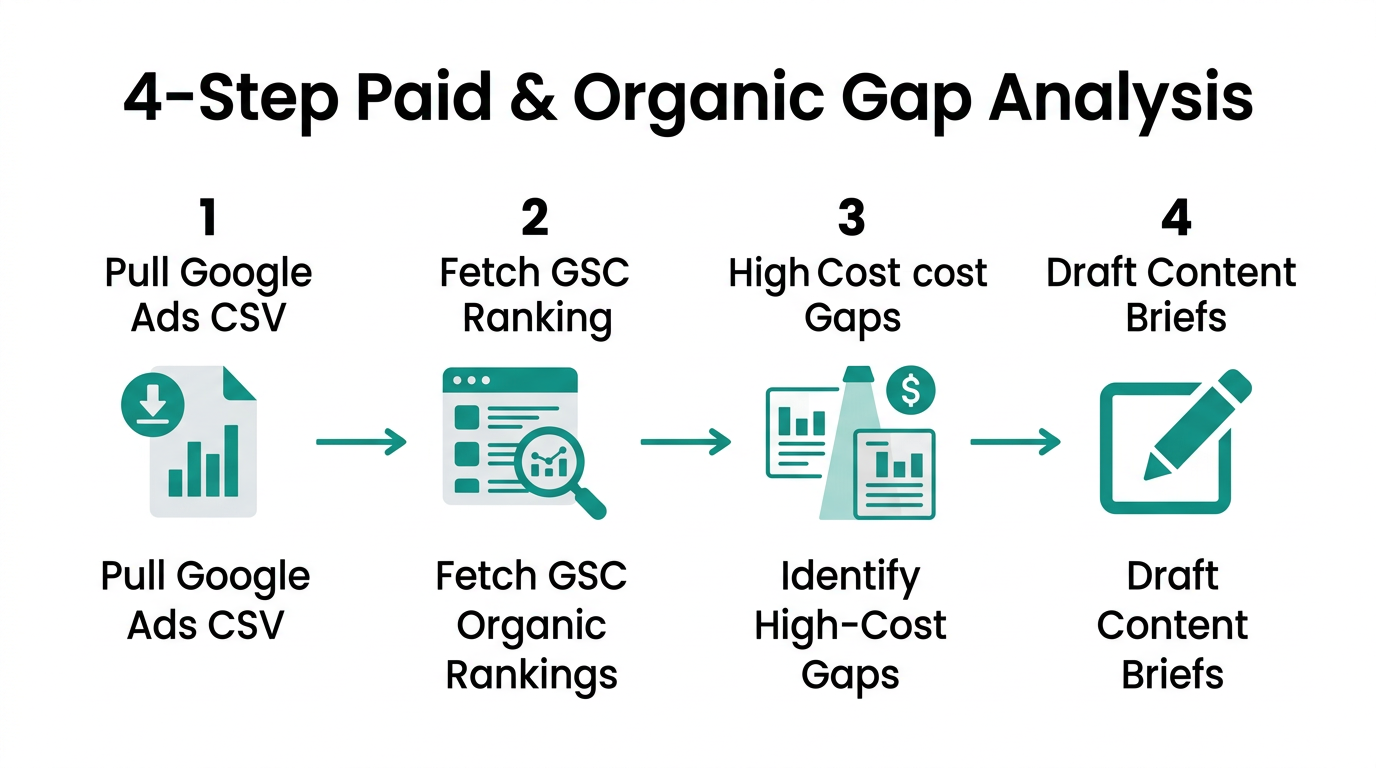
One of the most valuable automated marketing data pipelines you can build is a script that identifies keywords where you are paying for ads but already rank #1 organically (saving budget) or where you rank poorly organically but have high ad conversion rates (identifying SEO targets).
Phase 1: Data Extraction
Command Claude to write a Python script that fetches data from two sources: your Meta Ads Manager or Google Ads and your Google Search Console. Because of Claude's reasoning capabilities, it can handle the schema mapping between these two disparate datasets automatically.
Phase 2: The Logic Engine
Instruct Claude: "Analyze the GSC and Ads data. Flag any keyword with an organic position < 3 and an ad spend > $500/month. Also, flag keywords with an ad conversion rate > 5% where organic position is > 10." In the past, this was a manual Excel nightmare; now, it's a 7-second terminal command.
Phase 3: Automated Reporting
Finally, have Claude Code wrap this logic into a cron job that runs every Monday morning. You can even have it output the results directly to a Google Sheets dashboard or a marketing CRM. As ALM Corp notes, this "Data Command Center" setup is the gold standard for 2026 performance marketing.
| Metric Type | Legacy Workflow (2024) | Agentic Workflow (2026) |
|---|---|---|
| Data Collection | Manual CSV exports & VLOOKUPs | MCP-driven automated fetching |
| Insight Generation | Static monthly reports | Real-time Slack alerts & triggers |
| Action Taken | Human interprets and edits site | Claude Code edits site/files directly |
"We've seen a 30% reduction in rework and a 3x increase in campaign velocity by letting Claude handle the data heavy-lifting."Agentic AI for Codebase-Wide SEO Audits
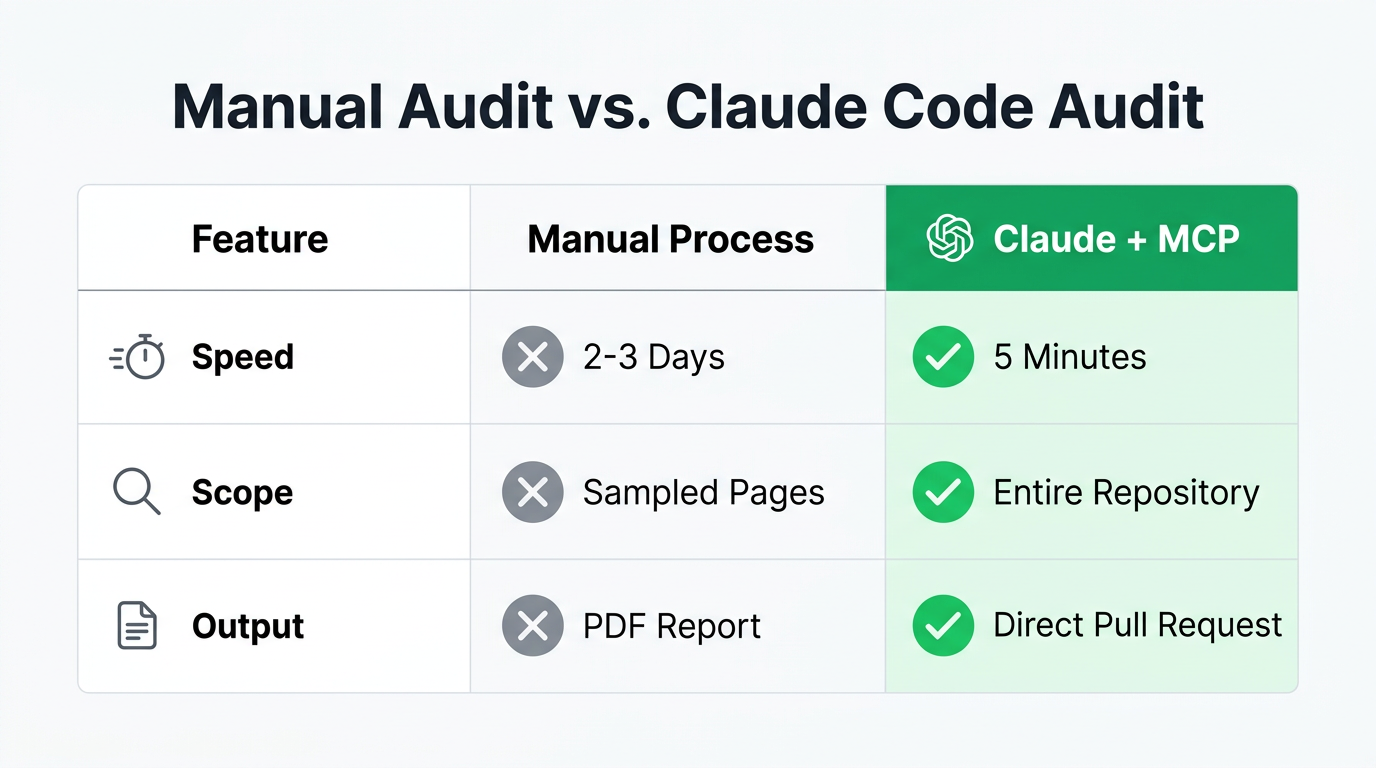
For enterprise marketing sites with thousands of pages, a standard SEO crawler only sees the surface. In 2026, we use agentic data analysis to perform deep audits of the actual source code. Claude Code can read an entire 12.5-million-line codebase—a feat famously demonstrated by Rakuten's implementation—to find technical debt that hurts SEO.
Instead of just telling you that "page speed is slow," Claude Code can identify the specific React component causing the layout shift and submit a pull request to fix it. This is why approximately 4% of all public GitHub commits are now assisted by Claude Code. For a marketer, this means your "audit" doesn't end with a PDF of suggestions; it ends with a GitHub Pull Request ready for approval.
Automating Real-Time Insights to Slack and Dashboards
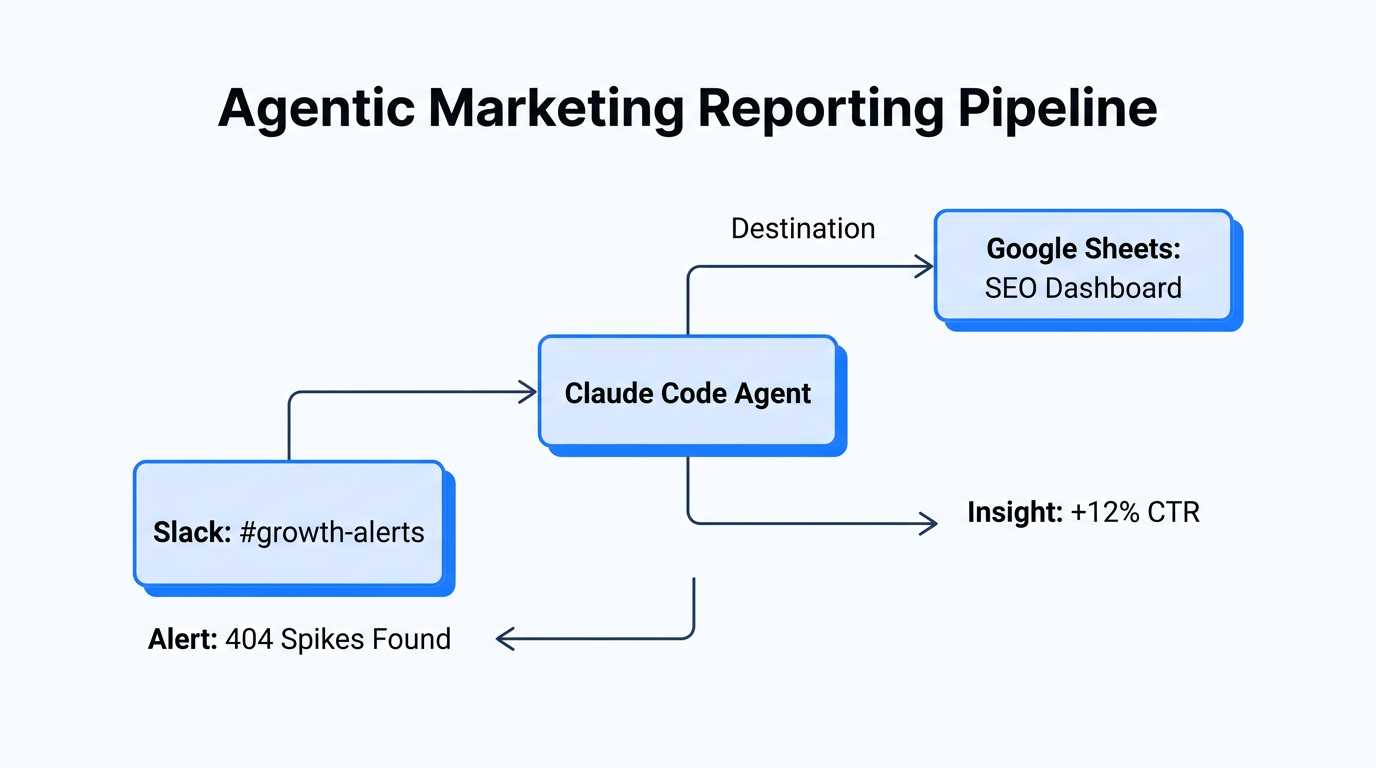
Insights are only useful if the right people see them. By connecting Claude Code to your communication stack via MCP, you can turn your AI agent into a 24/7 marketing analyst. For example, you can set a trigger: "If any top-10 keyword drops more than 5 positions in 24 hours, alert the SEO channel in Slack with a summary of recent code changes that might have caused it."
Teams are also using Claude to feed internal dashboards built on platforms like Framer or Webflow. By pushing cleaned SEO data to a custom API endpoint, you can create high-fidelity visualizations without the bloat of legacy BI tools. This level of agentic data analysis ensures that growth teams are always looking at the most current data, not a week-old snapshot. Leading agencies often pair these insights with creator discovery on Stormy AI to quickly pivot content strategies based on what the SEO data reveals.
According to eesel.ai, the integration of these agents into daily apps like Slack is the top trend for enterprise productivity this year. It moves the "AI moment" from a separate tab into the center of the team's conversation.
Security and Privacy: The Move to Claude Enterprise
As marketing teams pipe more proprietary data into AI models, security has become the primary concern of 2026. A common mistake is using a free-tier AI for sensitive SEO and financial data, which can lead to data leaks or your data being used for training. Experts at Business Plus AI warn that these mistakes are costing companies millions in potential revenue and security breaches.
To build automated marketing data pipelines safely, enterprise teams must use Claude Enterprise. This tier provides SOC 2 Type II compliance and ensures that your data remains yours. When Claude Code accesses your codebase via the CLI, it does so through secure protocols that respect your local environment's permissions. This is why 70% of Fortune 100 companies now trust the Claude ecosystem for their core operations.
"Privacy is no longer a feature; it is the foundation of the agentic workflow. If you can't trust the agent with your data, you can't benefit from the automation."Conclusion: Your SEO Strategy is Now an Engineering Problem
In 2026, the line between "Marketer" and "Engineer" has blurred. By mastering MCP setup for marketers and leveraging Claude Code SEO automation, you are no longer just managing content—you are managing a high-performance data engine. The ability to perform agentic data analysis across your entire stack gives you a massive advantage over competitors who are still stuck in manual workflows.
Start small: connect Claude to your Google Search Console via MCP, build a single gap analysis script, and automate one Slack alert. As you gain confidence, move toward codebase-wide audits and full ETL pipelines. The future belongs to those who treat their marketing data with the same rigor and automation as their production code. For teams looking to scale their creator and influencer efforts alongside these technical SEO improvements, platforms like Stormy AI provide the perfect AI-powered discovery and outreach engine to complete your 2026 growth stack.