In the high-speed world of digital growth, the bottleneck is rarely a lack of ideas—it is the friction of execution. For years, growth marketers have been caught between two extremes: manually grinding through repetitive tasks or waiting weeks for a developer to build a custom script. However, the paradigm shifted in 2025. We have moved beyond "Chat AI," where we ask questions to a bot, and entered the era of "Action AI," where autonomous agents execute entire marketing workflows from your terminal. According to research from Snowflake, we are seeing a massive shift from simple Copilots to fully Agentic AI, where humans move "hands off the keyboard" for end-to-end campaign deployment.
The centerpiece of this revolution is Claude Code. Unlike the standard chat interface, Claude Code is a command-line interface (CLI) agent that can read your files, run terminal commands, and interact with your entire MarTech stack. For growth marketers, this means the ability to automate marketing workflow automation, execute automated SEO audits, and generate ad creative in seconds rather than hours. This playbook will show you how to set up your own terminal-based marketing agent to act as a one-person growth engineering team.
The Rise of the Agentic Marketer: Why the CLI Matters
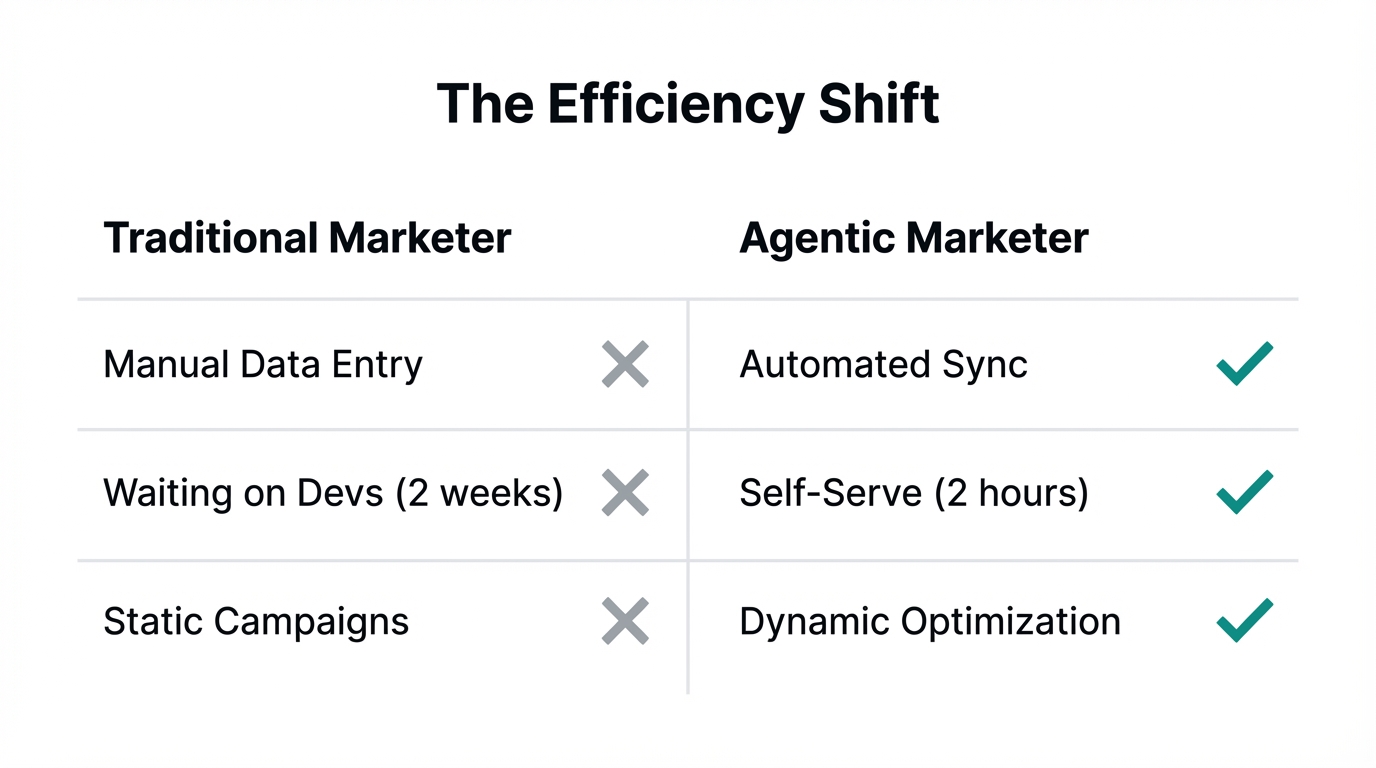
Why should a marketer care about a terminal? Because the terminal is where the power resides. While web interfaces are limited by buttons and forms, the CLI allows Claude to act as an autonomous employee. Statistics from Claude Code indicate that 79% of interactions are now classified as "automation" rather than mere "augmentation." Marketing teams utilizing these agentic chains report a staggering 40–60% increase in output speed and an 18% increase in content consistency.
By 2027, Forrester predicts that 50% of marketing teams will employ AI agent orchestration as a core operational model. We are no longer just prompting; we are building systems. This shift is turning the "Context Marketer" into a high-leverage operator who manages a fleet of agents instead of a manual task list. The AI in marketing market is already projected to reach $107.5 billion by 2028, according to the Digital Marketing Institute, and the marketers who master the CLI will be the ones capturing that value.
"The new edge is not hustle, but leverage—the ability to turn strategy into autonomous systems." — Austin Lau, Growth Marketer at AnthropicEstablishing the 'CLAUDE.md' Source of Truth
One of the biggest frustrations in AI marketing agents is the "context death spiral"—the need to repeatedly copy and paste brand guidelines, SEO keywords, and persona documents into every new chat. Claude Code solves this through a local source of truth: the CLAUDE.md file.
By placing a CLAUDE.md file in your marketing project folder, you provide the agent with a persistent memory of your brand's DNA. Every time you run a command in VS Code or your terminal, Claude reads this file first. Your CLAUDE.md should include:
- Brand Voice Guidelines: (e.g., "Professional but accessible, use smart-friend tone.")
- Target Personas: Detailed breakdowns of who you are talking to.
- SEO Pillars: Your primary and secondary keywords for growth marketing automation.
- Slash Commands: Custom instructions like
/rsato instantly generate Google Responsive Search Ads that follow character counts.
The Ralph Wiggum Loop: Forcing Quality Through Iteration
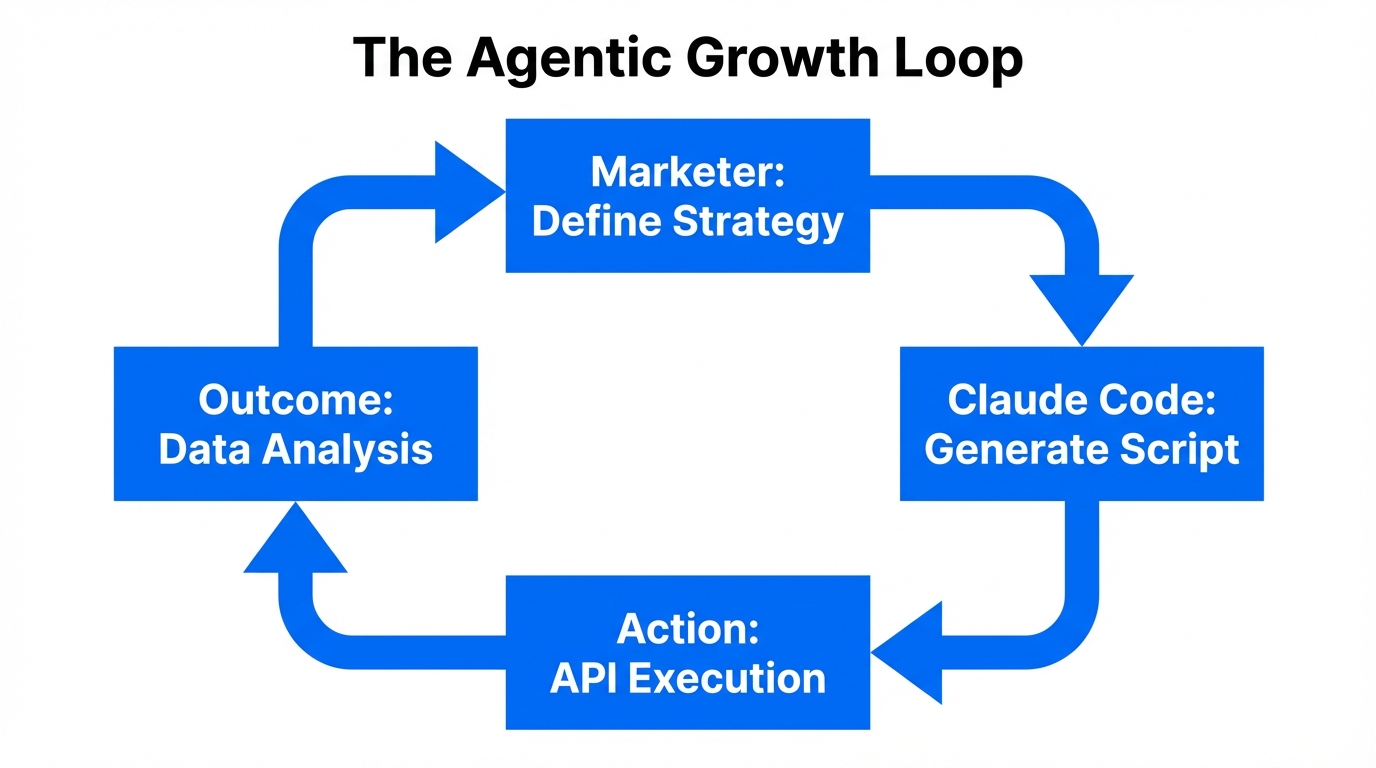
In traditional marketing, you might ask an AI to write a blog post and then manually check it for SEO. In the agentic workflow, you use what is known as the "Ralph Wiggum Technique," popularized by Geoffrey Huntley. This technique treats marketing as a codebase that must pass specific "tests" before it is considered finished.
Instead of a one-off prompt, you command Claude to run a bash loop. For example, you can tell the agent: "Generate a landing page, run an automated SEO audit using Apify MCP, and if the score is below 90, rewrite the copy and repeat until the benchmark is met." This forces the AI to iterate until it reaches a quality threshold that would normally require a human editor. The goal is to fail predictably until you succeed flawlessly.
| Task Type | Traditional Chat AI Workflow | Claude Code (Agentic) Workflow |
|---|---|---|
| SEO Audits | Manual copy-paste into audit tools. | Autonomous Bash Loop that repeats until score > 90. |
| Ad Creative | 30 minutes of manual variations. | 30 seconds via CLI-driven Figma/Ad plugins. |
| CRM Sync | Manual data entry into your CRM. | Real-time update via Salesforce or CRM MCP. |
Connecting Your MarTech Stack via MCP
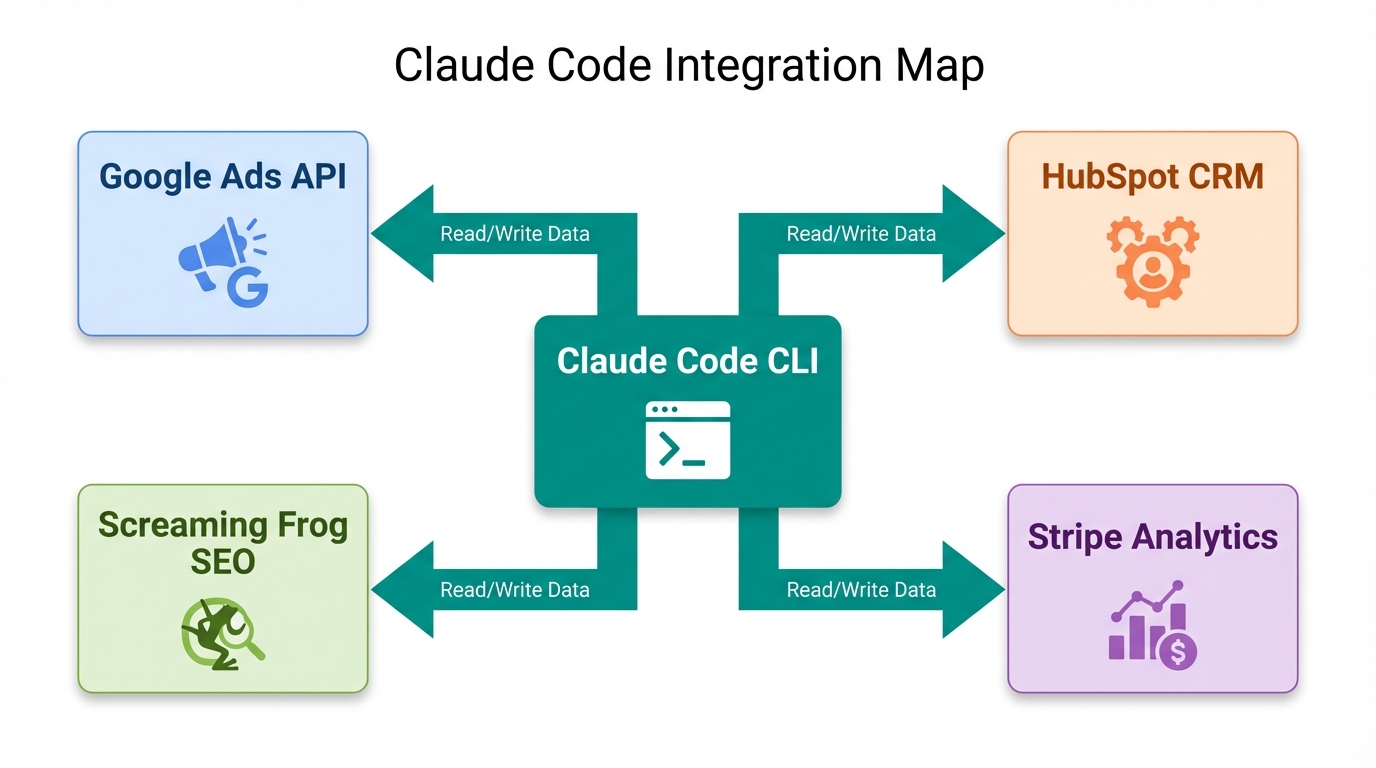
The true power of Claude Code for marketers lies in the Model Context Protocol (MCP). This is a standardized protocol that allows Claude to securely connect to your data and tools. You are no longer limited to the information Claude was trained on; you are giving it live access to your business data.
For instance, you can use the Salesforce MCP to query your CRM in real-time. Imagine asking your terminal, "Which leads from last week's webinar haven't been contacted? Draft a personalized follow-up based on their LinkedIn profile found via web scraping." Similarly, tools like Zapier MCP bridge the gap between Claude and over 8,000 marketing apps, allowing you to update Google Ads bids or generate invoices via Stripe MCP directly from the CLI.
This level of integration is how companies like TELUS have built over 13,000 internal AI tools, saving over 500,000 staff hours. Similarly, tools like Stormy AI utilize Claude Code sub-agents to reduce what used to be 8-hour manual influencer audits into 2-hour automated workflows, allowing brands to vet creators at scale without hiring an army of coordinators.
"Agentic AI marks the end of channel-based marketing, shifting the focus toward hyper-personalized, autonomous engagement spanning sales, marketing, and support." — Emily Weiss, GartnerPlaybook: Setting Up Your Marketing Agent
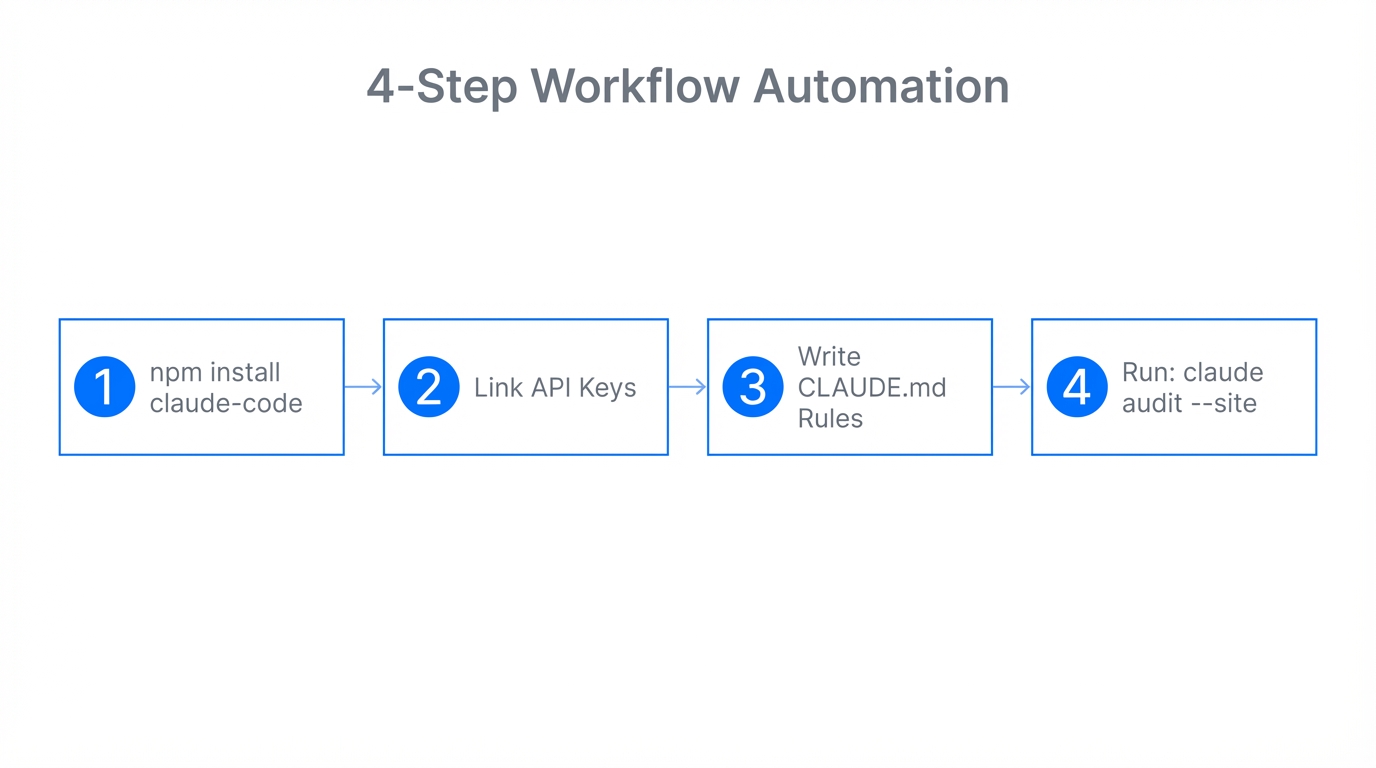
Ready to move from chat to action? Follow these steps to set up your own terminal-based marketing agent for daily growth marketing automation tasks.
Step 1: Install the Prerequisites
Before you can run Claude Code, you need a technical foundation. Install Node.js on your machine. This allows you to run the CLI. Once installed, open your terminal and run the command provided by Anthropic to install the @anthropic-ai/claude-code package.
Step 2: Create Your Marketing Environment
Create a dedicated folder for your marketing project. Open this folder in VS Code. Inside, create your CLAUDE.md file as described earlier. Include your brand's unique "vibe" and your primary SEO targets.
Step 3: Connect Your Live Data
Configure your MCP connections. Start with the Zapier MCP to give Claude access to your existing workflows. If you are doing heavy competitive research, add the Apify MCP so Claude can scrape real-time web data for automated SEO audits.
Step 4: Execute Your First Automated Loop
Start small. Try a command like: "Claude, look at the top 5 ranking pages for 'marketing workflow automation'. Analyze their headers and write a better outline for our new blog post. Then, check if our draft follows these suggestions and fix it if it doesn't."
Common Mistakes to Avoid in Marketing Automation
While the potential for AI marketing agents is massive, there are pitfalls that can lead to "AI Slop"—low-quality content that damages brand trust. To avoid this, keep these three rules in mind:
- Never skip the Human-in-the-Loop (HITL): Use Claude to build the 90%, but always have a human provide the final 10% of creative flair and fact-checking.
- Avoid Data Silos: Running Claude on unclean or fragmented data will lead to poor results. Use data unification tools like Syncari to ensure your agent has a single, clean view of the customer before letting it loose.
- Don't Over-Automate: Start by automating high-frequency, high-friction tasks (like checking ad character counts) rather than trying to automate your entire brand strategy on day one.
For those focused on influencer and creator campaigns, platforms like Stormy AI can help source and manage UGC creators at scale, providing the specialized vetting that a general-purpose agent might miss.
Conclusion: The End of the Non-Technical Marketer
The barrier between "marketing" and "engineering" is dissolving. In 2026 and beyond, the most successful growth marketers won't just be the ones who can write a good headline; they will be the ones who can orchestrate marketing workflow automation through agentic systems. By leveraging Claude Code for marketers, you can turn your strategy into a self-executing engine that works while you sleep.
Start by establishing your CLAUDE.md source of truth, connecting your stack via MCP, and using iterative loops to maintain high quality. The era of the agentic marketer has arrived—it's time to take your hands off the keyboard and start building the future of growth.