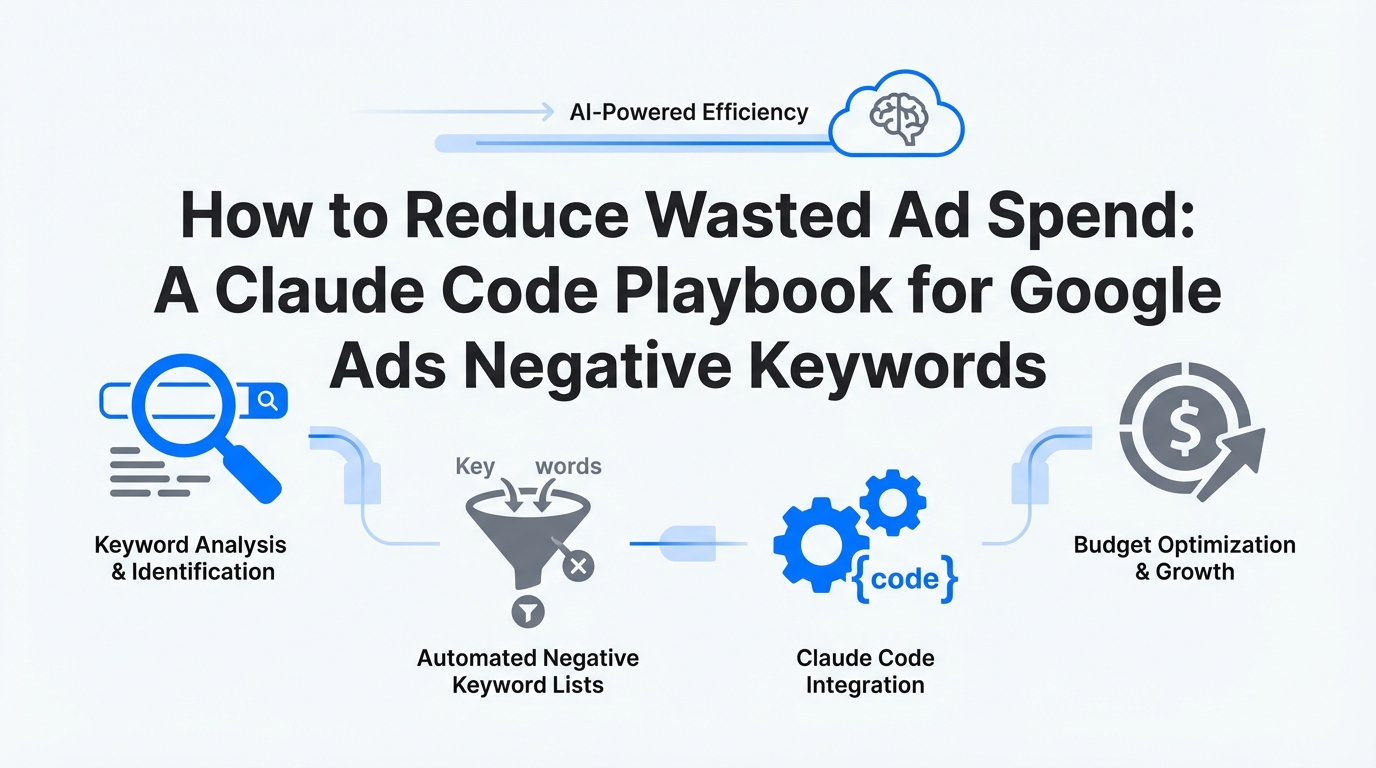
For years, pay-per-click (PPC) managers have been locked in a manual battle against the "Search Terms Report." Every Monday morning involves sifting through thousands of irrelevant queries, manually clicking check-boxes, and adding terms to lists in a desperate attempt to reduce wasted ad spend. But as of 2026, the era of "Chat AI" has evolved into the era of "Action AI." High-performance marketing teams are no longer just asking AI for advice; they are deploying agentic tools like Claude Code to interact directly with the Google Ads API, identifying and excluding money-wasting keywords in real-time.
By moving from browser-based copy-pasting to a terminal-based environment, advertisers can query their account's actual performance history to see exactly what is working and what is bleeding cash. This shift is significant: organizations using AI for negative keyword automation report 90%+ time savings on manual reviews and a 15–30% reduction in wasted spend, according to research cited by Toffu.ai. This playbook provides a step-by-step guide for PPC managers to harness these agentic workflows to improve ROAS and automate their google ads negative keywords management.
The Agentic Shift in PPC Optimization
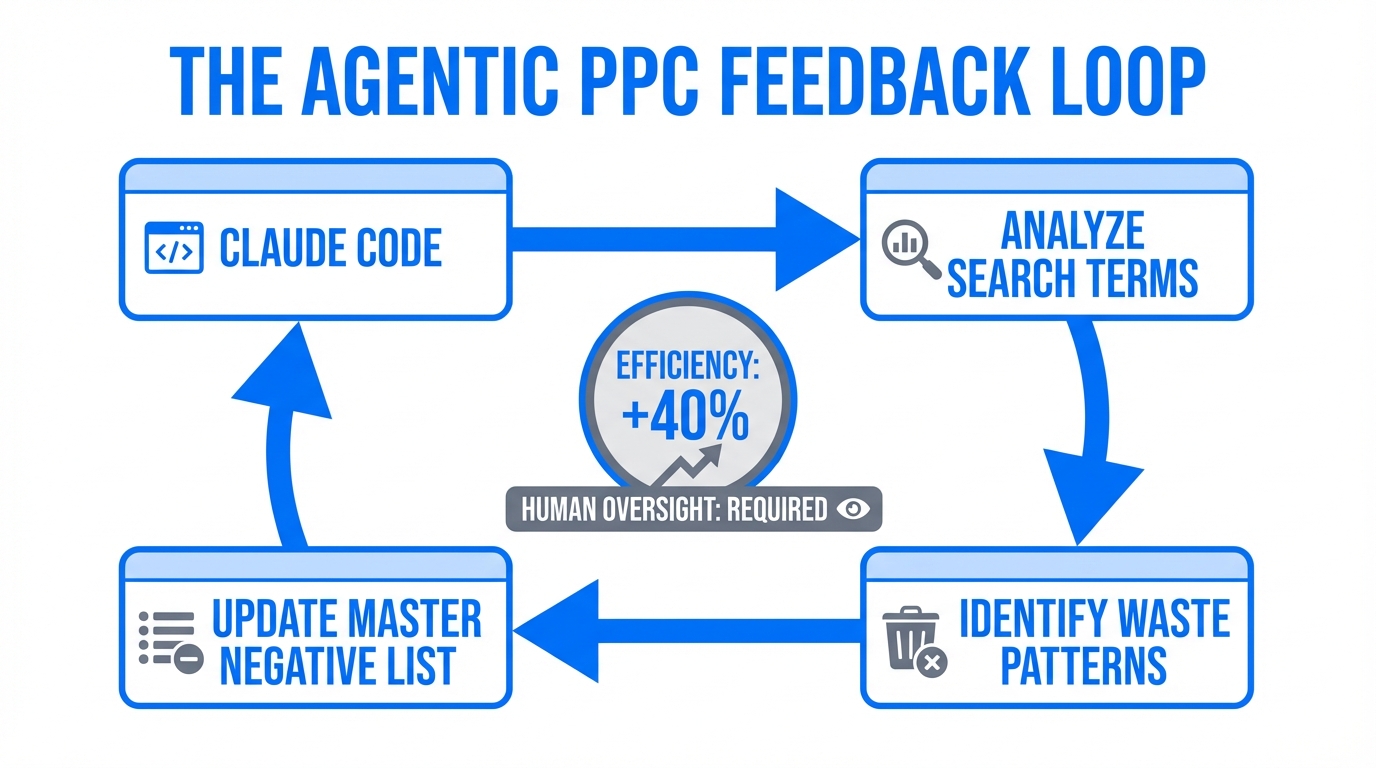
The transition to "Action AI" represents a fundamental change in how ppc optimization is handled. Previously, a marketer might ask an AI to "suggest negative keywords for a shoe brand." The AI would provide a generic list like "cheap," "free," or "repair." Today, with Claude Code and the Model Context Protocol (MCP), the AI can actually "see" that your account spent $450 last week on the search term "how to fix running shoes" without a single conversion.
This has given rise to a new class of digital marketers known as "Vibe Coders." These are professionals who may not have a computer science degree but use tools like Claude Code or Cursor to deploy complex automation scripts that manage multi-million dollar budgets. They maintain a human-in-the-loop oversight while the AI handles the data-heavy lifting of google ads automation.
"The shift from manual search term reviews to agentic AI execution allows marketers to focus on strategy while the AI surgically removes waste from the budget in real-time."
Step 1: Setting Up the Google Ads MCP Server
To use Claude Code for ppc optimization, you must first give it a way to communicate with your Google Ads account. This is achieved through an MCP (Model Context Protocol) server. MCP allows Claude to step outside its training data and interact with live API data.
The Setup Process
- Install Claude Code: Ensure you have the Claude Code CLI installed on your machine via npm.
- Install an MCP Server: Use a dedicated server like jgdeutsch/google-ads-mcp. This acts as a bridge, giving Claude the tools to execute GAQL (Google Ads Query Language) queries.
- Configure Permissions: You will need to set up Google Cloud Console OAuth credentials. This ensures that Claude only accesses the accounts you authorize.
- Initialize in Terminal: Run
claudein your project folder and point it to your configuration.
Once connected, Claude can perform tasks that were previously impossible for a standard chatbot. While ChatGPT is excellent for creative ideation, Claude (Sonnet 3.5/4.6) is often preferred for complex coding and data analysis due to its higher functional accuracy—benchmarked at 95% for technical tasks.
Step 2: Identifying High-Spend, Zero-Conversion Terms
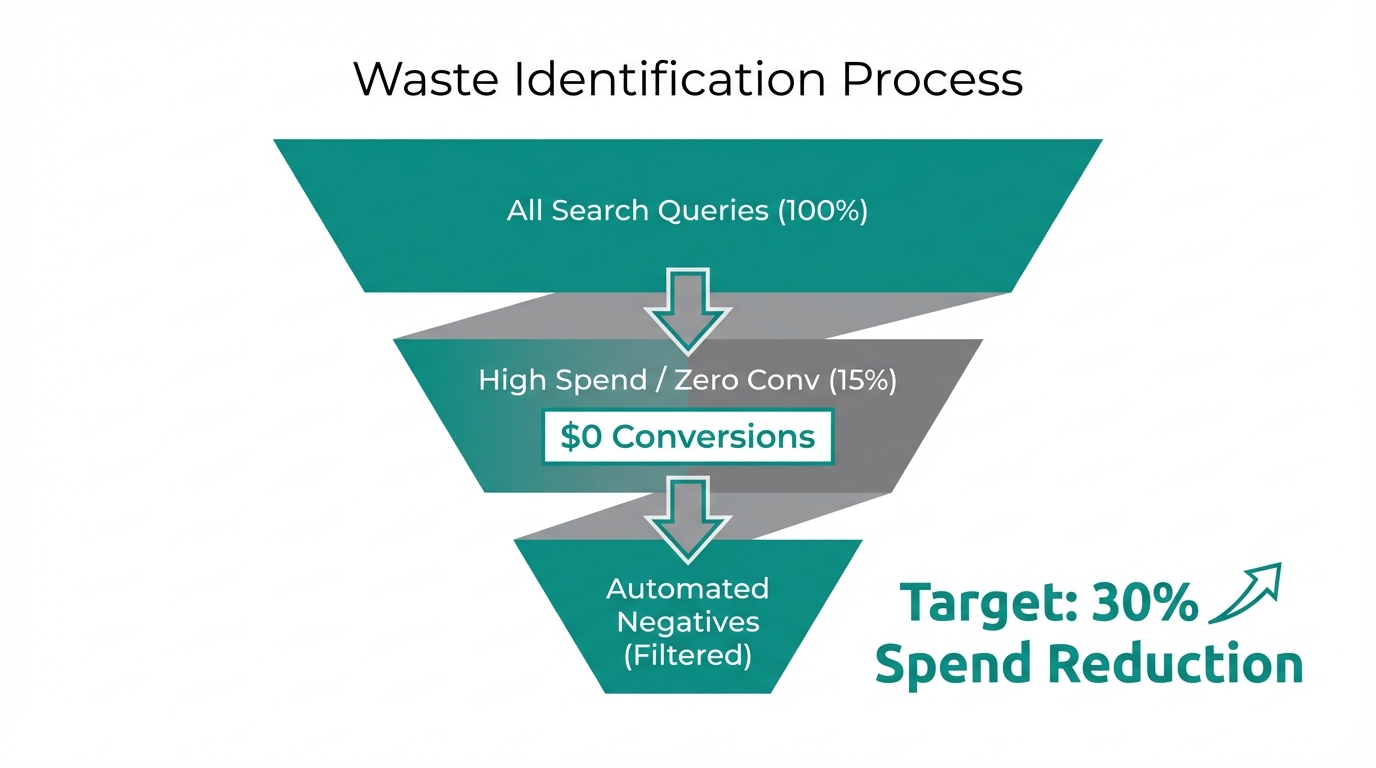
The most immediate way to reduce wasted ad spend is to find the "bleeding" search terms. These are queries that look relevant on the surface but never result in a sale or lead. In your terminal, you can now issue a natural language prompt to Claude:
"Analyze the last 30 days of search terms. Identify any query with >$50 spend and 0 conversions. Group these by semantic theme and suggest which should be added to our negative keyword list."
Claude will then use the MCP tools to pull a search term report, analyze the performance metrics, and categorize the results. For example, it might find that search terms containing "jobs" or "salary" are costing your SaaS company hundreds of dollars because people are looking for employment rather than software. Using this data-driven approach, major advertisers have seen significant decreases in CPA by leveraging AI-powered negative keyword management.
| Management Method | Analysis Frequency | Accuracy | Avg. Spend Reduction |
|---|---|---|---|
| Manual Review | Weekly/Monthly | Moderate (Human Error) | 5-10% |
| Claude Code Agentic | Daily/Real-time | 95% (Data-driven) | 15-30% |
Step 3: Deploying Scripts for Master Negative Lists
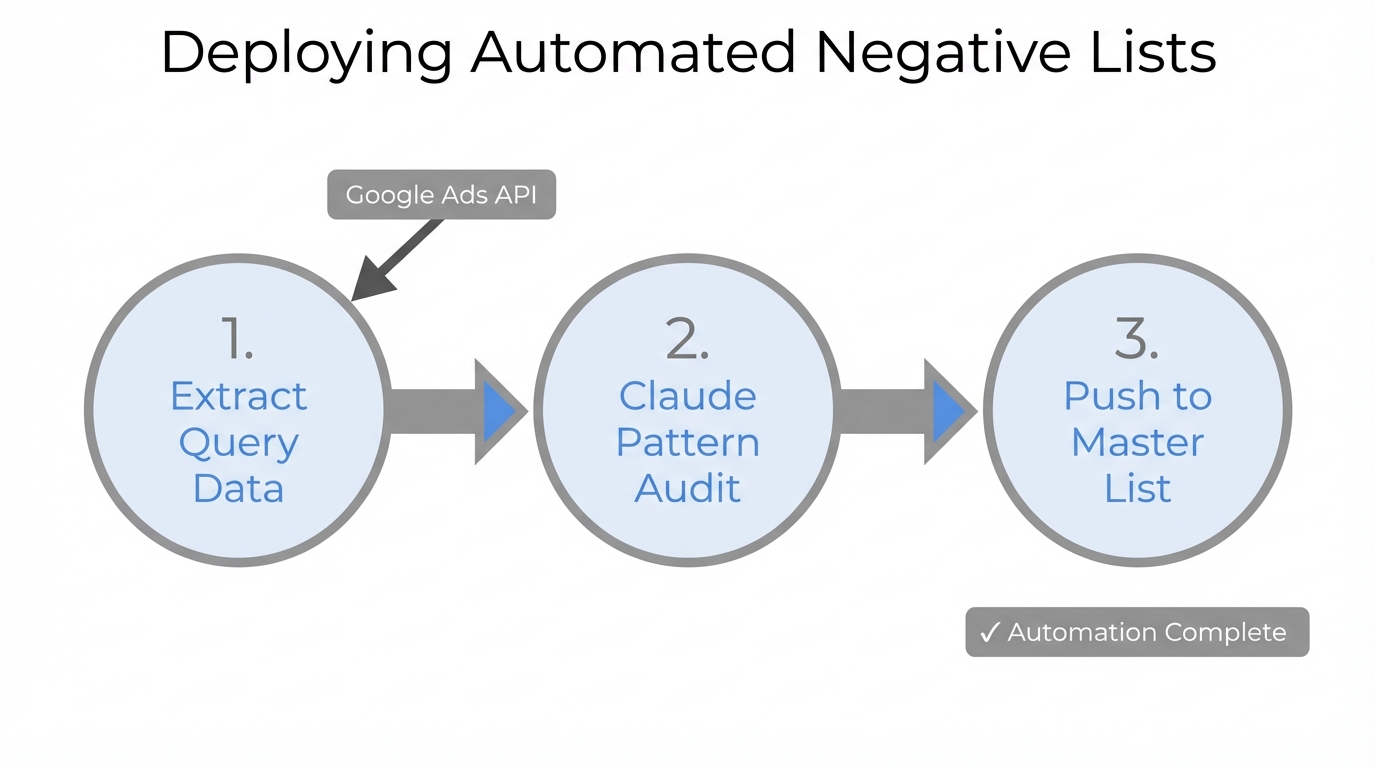
Once you have identified the patterns of waste, the next step in google ads automation is to ensure these terms never appear again. Instead of manually adding keywords to every campaign, you can have Claude Code write and deploy a Google Ads Script (JavaScript) that updates a "Master Negative List."
Claude excels at generating and debugging scripts that use the AdsApp API. You can prompt it to create a script that automatically flags terms matching specific patterns—such as the word "free" when you sell a premium service—and moves them to a shared library list. According to Shopstory, using free scripts for negative keyword automation is one of the most effective ways to scale account management without increasing headcount.
For brands working with influencers or UGC creators, platforms like Stormy AI can help source and manage creators who generate high-converting content, which you can then amplify through these optimized Google Ads campaigns. Combining clean search traffic with high-quality creator content is a winning formula for modern growth teams.
Best Practices for Match Types: Avoiding Over-Blocking
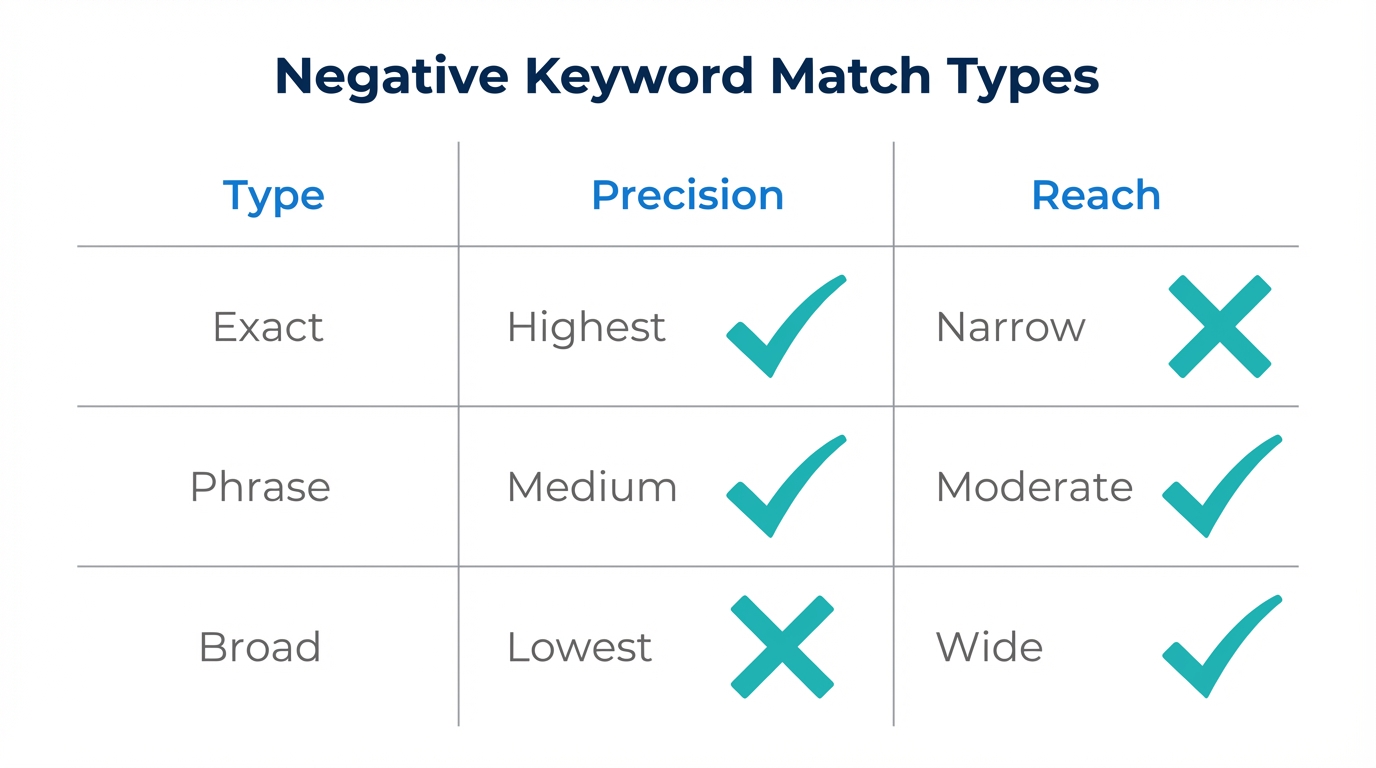
One of the most common mistakes in ppc optimization is being too aggressive with negative keywords. If you add the word "free" as a broad-match negative, you might accidentally block profitable traffic like "sugar free protein powder" if you sell health supplements. Careful match type selection is critical to maintaining volume while cutting waste, as detailed in the Google Ads Help Center.
- Exact Match Negatives: Use these for specific queries that are totally irrelevant but contain keywords you might want to rank for in other contexts.
- Phrase Match Negatives: Use these to block specific sequences of words, like "how to build a..." for a product that is sold pre-assembled.
- Sanity Checks: Always ask Claude to run a "Conflict Check." Use a prompt like: "Does this suggested negative keyword list conflict with our top 100 converting search terms from the last 90 days?"
Maintaining Context with CLAUDE.md
To ensure your agentic AI doesn't forget your brand's specific needs, you should maintain a CLAUDE.md file in your project directory. This is a best practice recommended by Anthropic Engineering to provide persistent context to the AI model.
Your CLAUDE.md should include:
- Brand Guidelines: Explicit lists of terms that must never be blocked (e.g., your brand name and its common misspellings).
- Performance Thresholds: "Do not block any term that has at least 1 conversion in the last 90 days, regardless of CPA."
- Project Architecture: Links to your primary Negative Keyword Lists in the Google Ads UI so Claude knows where to push updates.
By keeping this "source of truth" updated, you prevent the AI from making repetitive mistakes or "hallucinating" that a high-performing term should be excluded. This level of control is why more organizations are moving toward this model for google ads automation, often integrating it with tools like Zapier or Make.com for full workflow orchestration.
Real-World Success Stories
The impact of AI-driven optimization isn't just theoretical. Several global brands have seen massive improvements in their digital advertising efficiency through these methods:
- L’Oréal Vietnam: By utilizing AI-optimized campaigns and custom signals, they achieved a 4.1x higher ROAS, as reported by Seer Interactive.
- PostAffiliatePro: Automated their keyword management to identify wasted spend in real-time, significantly cutting costs and improving conversion rates.
- Agencies: Many agencies use the Claude Code CLI with live API access to manage dozens of client accounts simultaneously, providing a level of surgical precision that manual management cannot match.
As you refine your search campaigns, remember that google ads negative keywords are only half the battle. Managing the creative side—identifying which creators are driving the best engagement—is equally vital. Platforms like Stormy AI can streamline the discovery and vetting of those creators, ensuring your ad budget is spent on both the right keywords and the right content.
Conclusion: The Future of Paid Search
The manual days of PPC are numbered. To remain competitive and reduce wasted ad spend, marketers must embrace the agentic capabilities of tools like Claude Code. By setting up an MCP server, automating the identification of non-converting terms, and maintaining a robust CLAUDE.md file, you can transform your Google Ads account into a lean, conversion-driving machine. PPC optimization is no longer just about knowing the platform; it's about knowing how to command the AI that runs on top of it. Start small, verify every automated change with Google Analytics, and watch your ROAS climb as the waste disappears.