How to Use Claude Code to Build 2026 Ecommerce Data Pipelines for 2x Marketing ROI
Learn how to use Claude Code to automate 2026 ecommerce data pipelines, eliminate silos, and drive a 2x marketing ROI through autonomous data engineering.
In 2026, the distance between a high-growth ecommerce brand and a struggling one is measured in milliseconds and data purity. As global ecommerce sales surge toward $6.42 trillion this year, the complexity of managing multichannel signals has outpaced traditional human-led data engineering. Marketing leads are no longer just creative directors; they are systems architects. The arrival of agentic tools like Claude Code has shifted the paradigm from manual ETL (Extract, Transform, Load) to autonomous data orchestration, allowing brands to bridge the gap between raw Shopify events and actionable marketing ROI.
The 2026 Ecommerce Data Gap: Silos as Growth Killers
Despite the advancement in AI, 81% of IT leaders still cite data silos as the primary barrier to digital transformation. For most brands, customer data is trapped in fragmented black boxes: Shopify handles the orders, Meta Ads Manager holds the top-of-funnel intent, and TikTok Shop manages a separate stream of social commerce. This fragmentation leads to a terrifying reality where 40% of enterprise data is estimated to be inaccurate or incomplete.
"In 2026, 'garbage in, garbage out' isn't just a warning; it's a financial death sentence for ecommerce brands scaling on thin margins."
The rise of AI-enabled ecommerce, currently an $8.65 billion market, has introduced agentic coding tools that don't just suggest code—they execute it. Tools like Claude Code are now delivering a 2x improvement in developer velocity, enabling marketing teams to build sophisticated marketing analytics architectures that were previously reserved for Fortune 500 companies.
The 4-Layer Stack: Implementing Your AI Data Pipeline
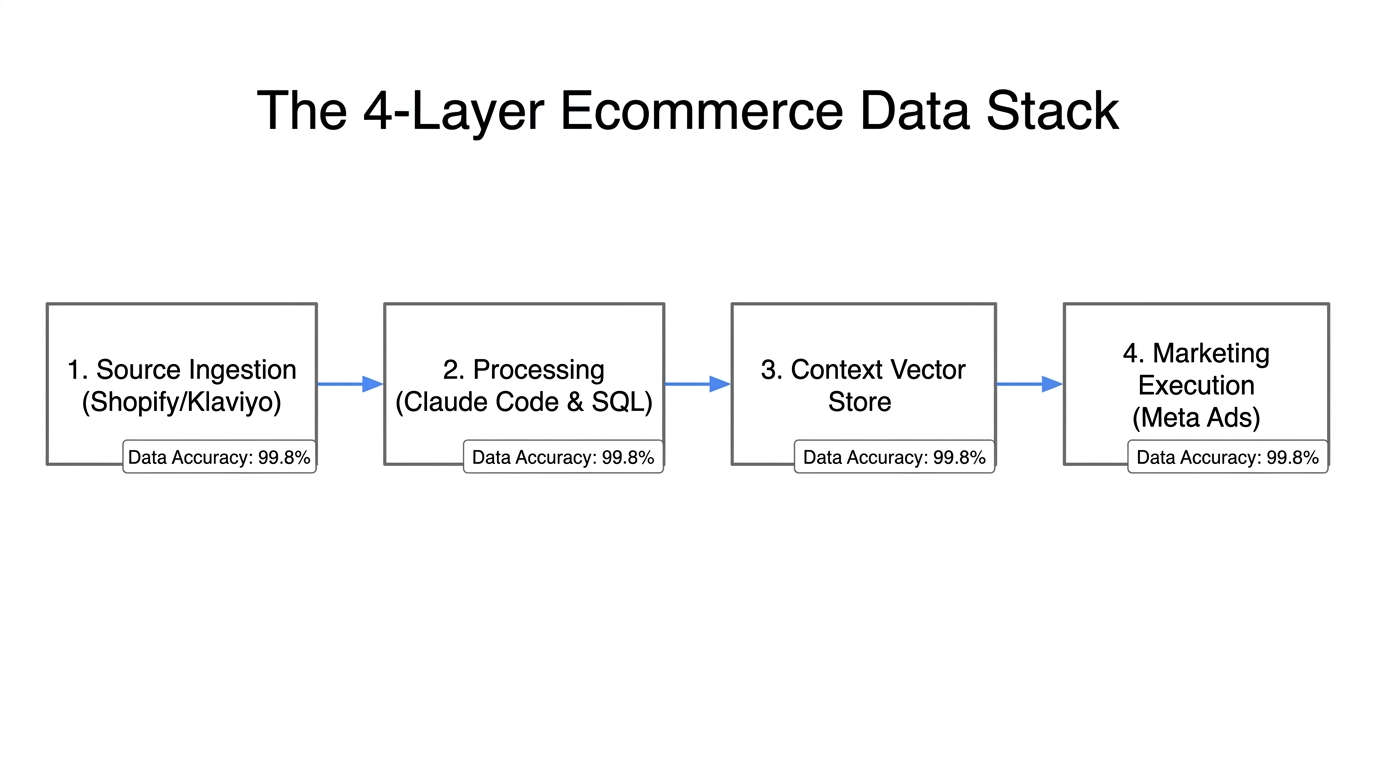
To achieve a data-driven growth strategy, you need a robust, automated stack. The modern AI data stack for 2026 focuses on interoperability and agentic access. By using Airbyte for ingestion and Claude Code for transformation, teams report a 40% increase in pipeline development speed.
| Layer | Tooling Recommendation | Role of AI Agent |
|---|---|---|
| Ingestion | Airbyte | Automating connector setup for Shopify/Amazon APIs. |
| Storage | Google BigQuery / Snowflake | Centralizing raw event data and mobile commerce logs. |
| Transformation | dbt + Claude Code | Autonomous SQL modeling and schema refactoring. |
| Orchestration | Orchestra / Kestra | Monitoring lineage and triggering real-time alerts. |
Step 1: Ingestion with Airbyte
Start by pulling raw data from your primary sources. In 2026, mobile commerce accounts for 44% of total US ecommerce sales, so your Shopify data automation must prioritize real-time mobile event streams. Use Airbyte to sync your Shopify, Amazon, and Meta Ads data into a BigQuery warehouse.
Step 2: Storage and Schema Design
Centralize everything. Whether you use Snowflake or BigQuery, ensure your warehouse is the "single source of truth." Avoid the temptation to leave data in the native platform UI; if it's not in your warehouse, it doesn't exist for your AI agent.
Step 3: Autonomous Transformation with Claude Code
This is where the magic happens. Instead of writing manual SQL for days, you invoke Claude Code in your terminal. Because Claude Code has multi-file reasoning capabilities, it can look at your entire dbt project, understand the dependencies between your "Orders" and "Customers" models, and write the necessary join logic to calculate Customer Lifetime Value (LTV) across channels.
"Claude Code isn't just an assistant; it's a junior data engineer that works at the speed of thought and never forgets a naming convention."
Context Engineering: The Secret to Reliable AI Agents
The shift from 2025 to 2026 marked the move from "prompt engineering" to Context Engineering. To ensure Claude Code doesn't hallucinate your brand's specific metrics, you must maintain a CLAUDE.md file in the root of your repository. This file serves as the "Source of Truth" for the AI, as recommended by Anthropic Docs.
CLAUDE.md should define exactly how you calculate "Net Profit" vs "Gross Revenue" to prevent the AI from making lethal accounting errors in your reports.Furthermore, use the Model Context Protocol (MCP) to grant Claude secure, read-only access to your database schemas. This allows the agent to "see" the data structures it is coding for without ever needing to handle sensitive raw credentials. This security layer is essential for 2026 ecommerce data pipelines where privacy compliance is non-negotiable.
Case Study: How an 8-Figure Brand Doubled Marketing ROI
A $20M ecommerce brand recently implemented what they call "Context Stacking." By integrating their influencer performance data with live Shopify sales via Claude-managed pipelines, they identified a high-LTV customer segment that was previously invisible. Using agentic workflows, they automated the push of these segments directly into Meta Ads Manager and TikTok Ads Manager.
The result? A 2x increase in ROAS (Return on Ad Spend) because their ads were finally targeting users with a proven history of high retention rather than just one-time purchasers. For brands using Stormy AI to discover creators, this pipeline allows for the automatic vetting of creator-led traffic quality by checking the long-term value of the customers they bring in.
Avoiding Context Rot: Maintenance for 2026 Pipelines
One of the biggest mistakes in Claude Code for marketing is "vibe coding"—the practice of letting AI generate code without human oversight. As sessions run longer, agents can suffer from Context Rot, where performance degrades as the context window fills with irrelevant logs.
- Refresh Sessions: After completing a major dbt model or a new segment automation, clear the Claude session and "re-index" your repository.
- Test-Driven Development (TDD): Always provide a "verification oracle." Show Claude a sample JSON of what a "Churned Customer" segment should look like before asking it to write the SQL.
- Human-in-the-loop: Treat AI-generated code as a draft. Use platforms like GitHub for code reviews and unit tests.
"Automation without verification is just a faster way to make expensive mistakes."
Conclusion: The Future of Data-Driven Ecommerce
The ecommerce landscape of 2026 demands more than just a Shopify data automation; it requires an agentic ecosystem that turns data into a competitive weapon. By leveraging Claude Code to bridge the gap between ingestion and action, you eliminate the friction that kills ROI. Start by building your 4-layer stack, implement a CLAUDE.md for context, and use tools like Stormy AI to ensure your top-of-funnel creator data is just as structured as your warehouse. The brands that win this year will be the ones that stop managing data and start orchestrating intelligence.