The marketing landscape has reached a definitive tipping point in 2025. While the last two years were defined by generative AI—marketers using chatbots to draft emails or social posts—the current era is defined by Agentic Marketing Operations. We are moving away from simple prompt engineering and toward autonomous execution. According to recent market data, the global AI in marketing market has reached $47.32 billion in 2025, but the real winners are the 26% of organizations that have moved beyond "chatting" and into fully integrated, autonomous workflows.
Defining Agentic Marketing: Beyond the Chatbox
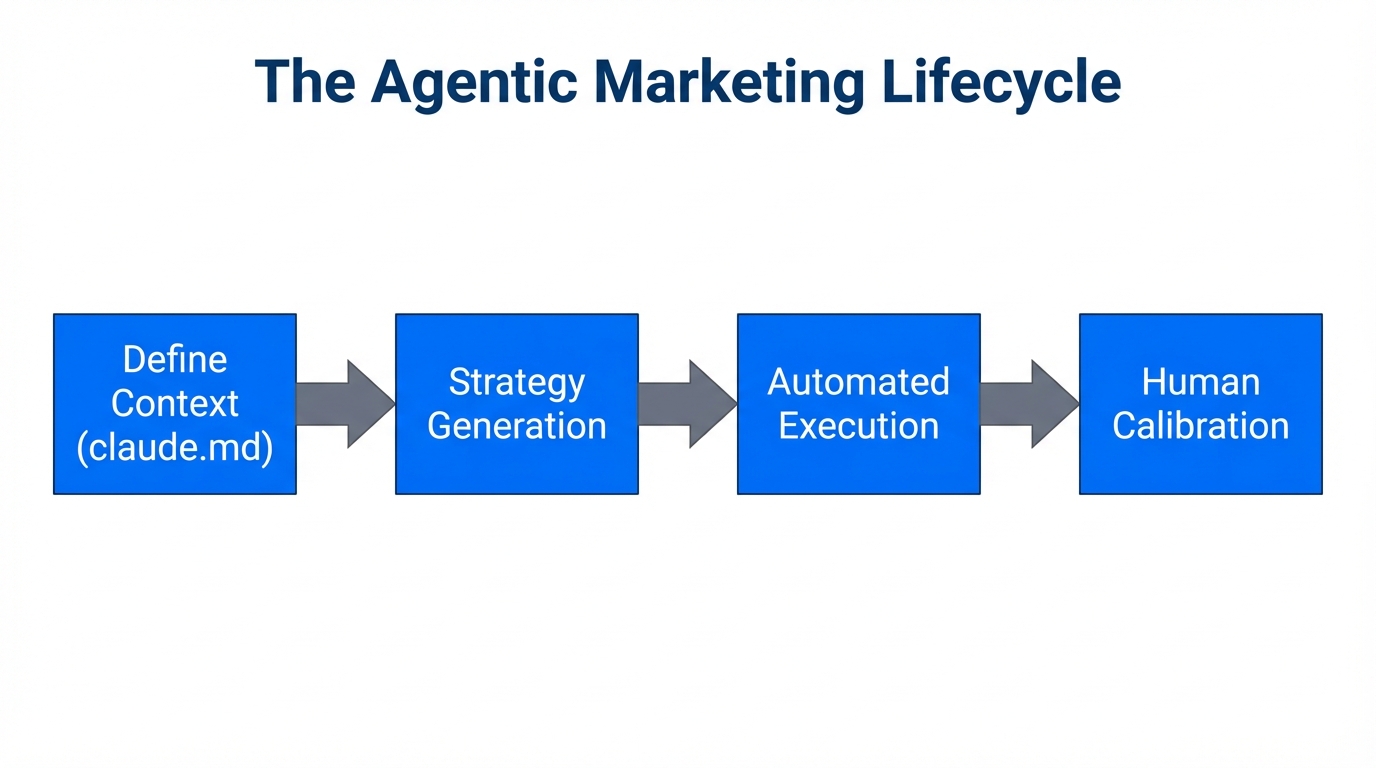
Agentic marketing is the transition from AI as a writing assistant to AI as an autonomous operator. In a traditional workflow, a growth lead might ask an AI to "write five headlines for a Facebook ad." In an agentic workflow, a tool like Claude Code is given access to your ad account APIs, your brand guidelines, and your performance data. It doesn't just write the headlines; it analyzes which current ads are failing, generates variants to solve the problem, and pushes them live.
This shift is critical because while 88% of marketers now use AI daily, the vast majority are stuck in a "manual prompt" cycle that creates bottlenecks. By implementing Claude Code for marketing, growth teams are seeing a 30% boost in advertising efficiency and a staggering 65% reduction in campaign launch times. The goal is no longer to scale headcount, but to scale agency.
"The future of growth isn't about who can write the best prompt, but who can code the most resilient agentic system to handle the execution while humans focus on creative calibration."
The CLAUDE.md Strategy: Building Your Marketing Source of Truth
One of the most powerful features of using a CLI-based tool like Claude Code is the ability to maintain persistent context. In the past, marketers suffered from the "context death spiral"—starting new chats every day and losing the nuances of their brand voice. To solve this, sophisticated growth teams now use a CLAUDE.md file in their project root.
This file acts as the Source of Truth for your AI agents. It should contain:
- Target Audience Personas: Detailed breakdowns of who you are talking to.
- Brand Voice Guidelines: Specific rules on tone, forbidden words, and preferred syntax.
- KPI Benchmarks: What does "success" look like? (e.g., "Maintain a CPA under $45").
- Negative Keywords: Lists of terms the AI should never associate with the brand.
By keeping this in a Markdown file, you can pipe it directly into your commands. For example, you can run a command like: cat product_specs.json | claude -p "Generate 10 Facebook Ad headlines following our CLAUDE.md voice." This ensures every single output is mathematically aligned with your brand strategy, rather than a hallucinated guess.
Achieving a 65% Reduction in Campaign Launch Times
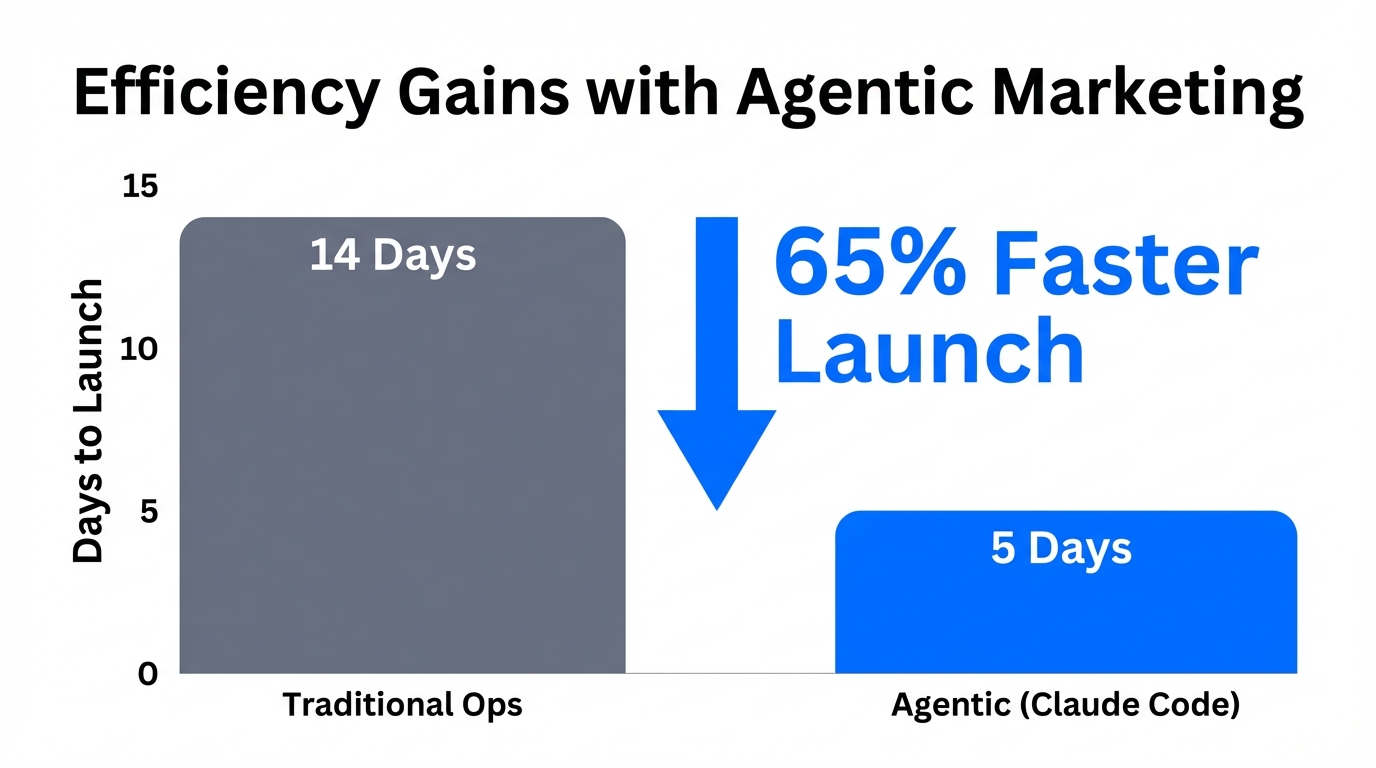
The traditional campaign launch process is a linear chain of approvals, creative requests, and manual uploads. Anthropic’s own growth team demonstrated the power of this by automating their Google Ads creative generation. They successfully reduced ad copy creation time from 2 hours down to just 15 minutes, while simultaneously increasing their creative output by 10x.
| Process Step | Manual Workflow | Agentic Workflow (Claude Code) |
|---|---|---|
| Creative Briefing | 60 Minutes | Instant (via CLAUDE.md) | Copy Generation | 120 Minutes | 5 Minutes (Bulk Generation) | API Upload/Sync | 30 Minutes | 2 Minutes (via MCP) |
| Performance Audit | Weekly | Real-time / Daily |
To implement this, you must treat your marketing campaigns as a software codebase. When you update a product feature in a JSON file, your automated ad management system should detect that change and automatically regenerate the relevant copy across Meta Ads Manager and Google Ads. This level of synchronization is what allows DTC brands to scale from 5 to 50 active campaigns per month without increasing headcount.
The 'Creative Calibration' Model: Maintaining Human Oversight
As we enter the era of "Vibe Marketing," a term championed by industry experts like Greg Isenberg, the role of the marketer shifts from "creator" to "calibrator." If an AI can generate a million variations, the human's value lies in setting the vibe and ensuring the output resonates on a human level.
This is where the Creative Calibration model comes in. Instead of micro-managing every word, the Growth Lead manages the system. You audit the AI's logic, refine the CLAUDE.md instructions, and use high-level tools to source the raw materials that the AI can't create—like authentic human emotion and user-generated content (UGC). For instance, platforms like Stormy AI can help source and manage UGC creators at scale, providing the "raw human ingredients" that Claude can then package into high-performing ad sets.
"AI shouldn't just write your ad copy; it should audit the API, detect a CPA spike, and autonomously pivot the budget."
Building a Marketing Command Center to Reduce Costs
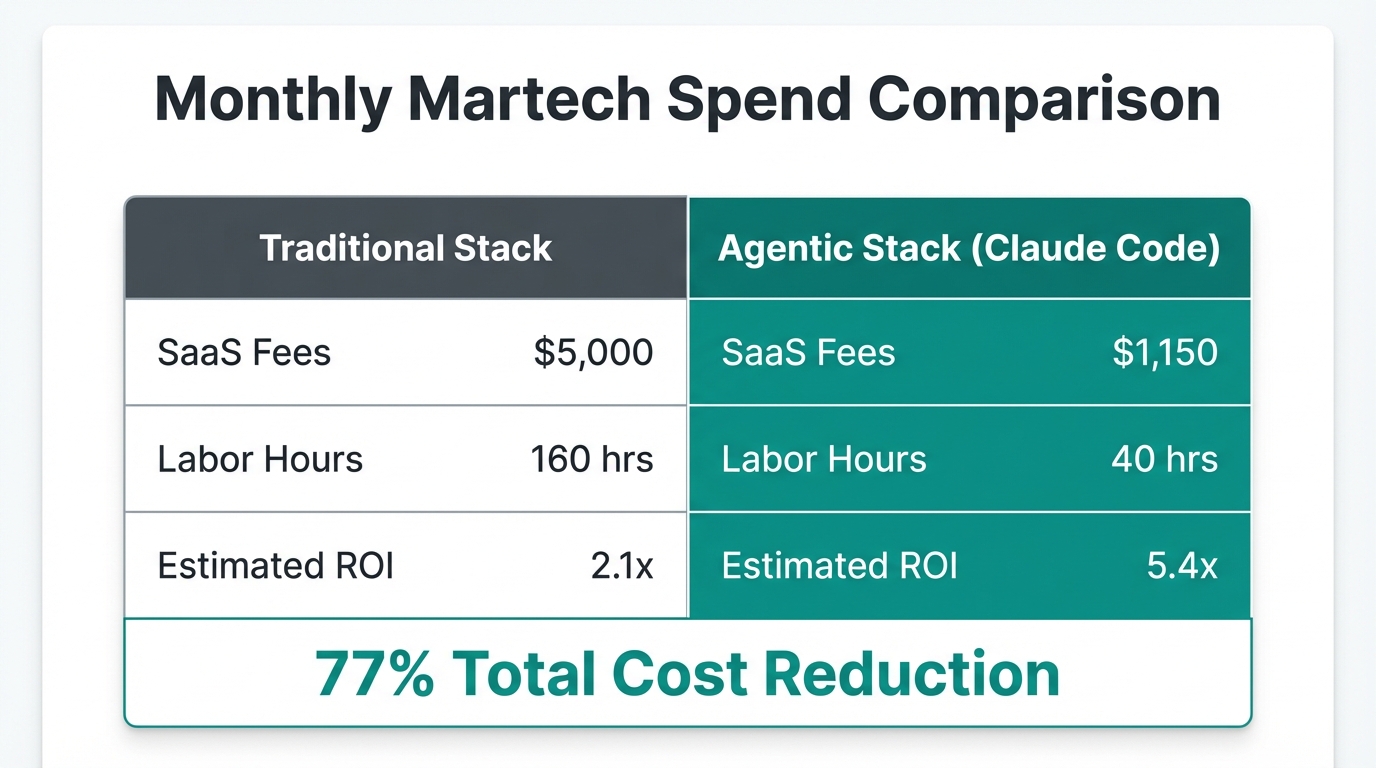
One of the most overlooked benefits of agentic marketing is stack consolidation. Most marketing departments are drowning in 20+ fragmented SaaS tools, leading to data silos and massive subscription overhead. Organizations that consolidate their martech stacks into centralized AI-powered "Command Centers" report cost reductions of 50-77%.
By using Claude Code alongside the Model Context Protocol (MCP), you can create a unified interface that talks to everything. MCP allows Claude to "talk" directly to live ad accounts and databases. For example, using n8n.io as a bridge, you can connect Claude to your CRM data and your Google Ads API.
A 2025 AI Growth Hacking Playbook
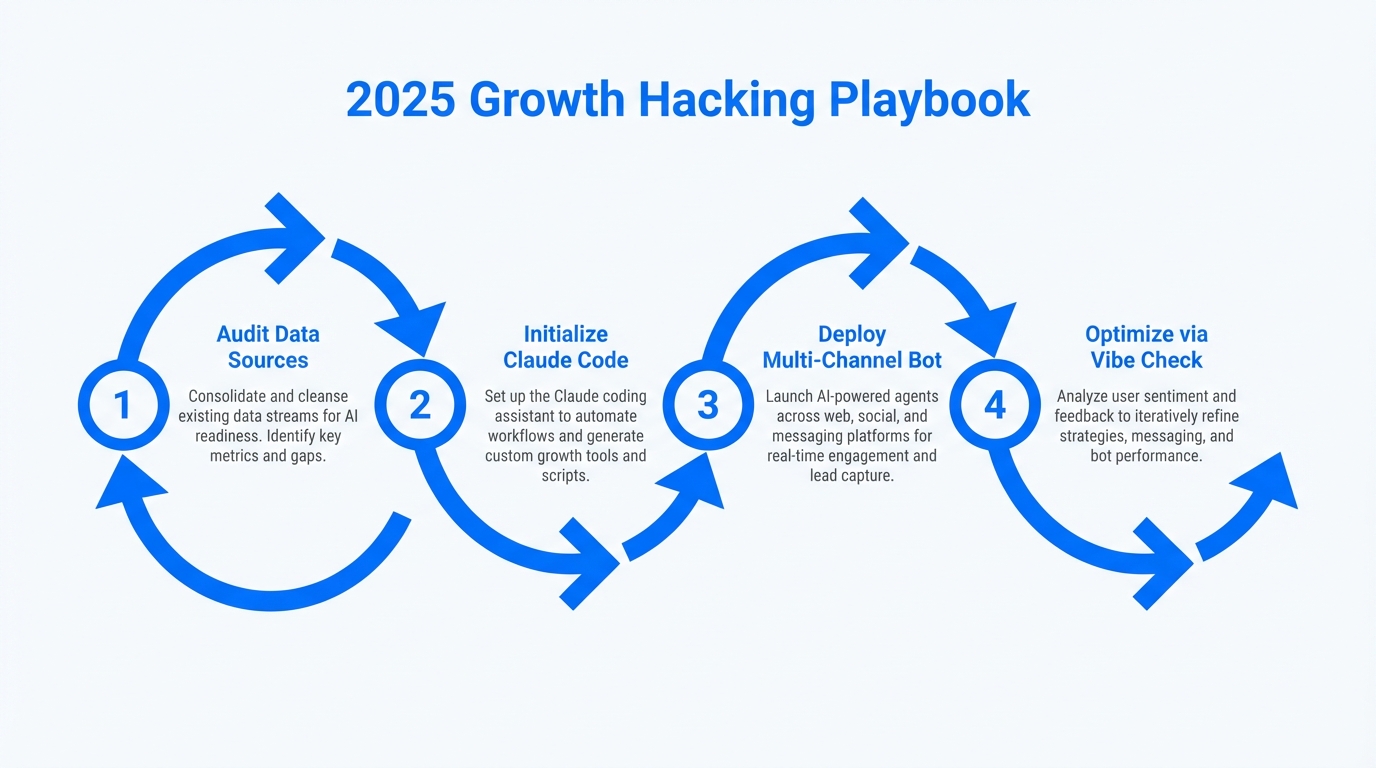
If you are a CMO or Growth Lead looking to transition to an agentic model, follow this sequential playbook to avoid common pitfalls like "context death spirals" or poor data hygiene.
Step 1: Audit Your Data Hygiene
AI is only as good as its data source. Before deploying agents, clean your product spreadsheets and audience lists. Ensure your data is in machine-readable formats like JSON or clean CSVs. Messy data leads to "hallucinated" marketing strategies.
Step 2: Deploy Your Primary CLI
Install Claude Code and initialize your project repository. This is where your marketing "codebase" will live. Treat your ad copy, target lists, and brand guidelines as version-controlled files.
Step 3: Connect Live Data via MCP
Use tools like Firecrawl for web scraping competitor data and CData Connect AI for live database connectivity. This allows your agent to see what is happening in the real world before it makes a decision.
Step 4: Source Human Elements
Automated copy needs human faces. Use Stormy AI to discover creators who fit your brand persona. Feed the resulting video transcripts into Claude to extract high-performing "hooks" for your automated ad variations.
Step 5: Implement the Calibration Loop
Set up a weekly review where humans audit the AI's performance. Is it staying on brand? Is it detecting ad fatigue? Use these insights to update your CLAUDE.md file, making the agent smarter with every iteration.
Common Mistakes in Agentic Operations
Even the most advanced teams hit roadblocks when implementing marketing operations strategy through AI. Here are the four horsemen of agentic failure:
- Over-Automation without QA: Never allow an AI to push a $10,000/day campaign live without a final "human-in-the-loop" calibration step.
- Ignoring Ad Fatigue: AI can generate millions of ads, but if you don't use it to monitor frequency and performance, your audience will quickly tune out.
- The Context Death Spiral: Starting fresh chats for every task instead of using a persistent CLI environment. This leads to inconsistent branding and wasted time.
- Siloed AI Tools: Buying 10 different "AI for X" tools instead of building one cohesive Command Center. This negates the 77% cost saving potential of consolidation.
Conclusion: The Agentic Advantage
The transition to agentic marketing operations isn't just about saving time—it's about survival in an increasingly crowded digital landscape. Companies like TELUS have already saved over 500,000 staff hours by building internal AI tools, while companies like Zapier use over 800 internal agents to manage their global growth. By shifting your mindset from "managing people" to "orchestrating agents," you can achieve a level of scale and precision that was previously impossible. The future belongs to the calibrators.