As we navigate through the second quarter of 2026, the Go-To-Market (GTM) landscape has moved far beyond the "chat with your PDF" era of early generative AI. The industry is witnessing a fundamental shift from human-led copilots to autonomous-led agentic mesh systems. For GTM leaders, this isn't just a technical upgrade; it is a total reconstruction of the conversion funnel. Early adopters of Claude AI agent mesh networking are no longer just automating emails; they are deploying multi-agent swarms that operate with a level of precision and autonomy that was science fiction just twenty-four months ago.
The 2026 Evolution: From Copilots to Agentic Mesh Networking
In 2024 and 2025, we focused on individual "Copilots"—AI assistants that required constant human prompting. By 2026, the paradigm has shifted toward autonomous-led agentic mesh networking. This architecture focuses on "small-context specialized agents" that communicate via standardized protocols rather than a single massive LLM attempting to handle a complex workflow alone. According to Gartner, 40% of all enterprise applications now feature these embedded task-specific agents, a massive leap from less than 5% in 2024.
The core of this revolution is delegation. As Dario Amodei, CEO of Anthropic, recently noted in his essays on AI scaling, the question in 2026 is no longer how smart a model is, but how effectively it can delegate. We are now seeing models sustain seven-hour autonomous sessions by acting as a technical lead over a mesh of specialized sub-agents. This allows GTM teams to move from sequential, slow-moving workflows to Parallel Swarms where dozens of agents work on lead qualification, technical vetting, and personalized outreach simultaneously.
"The global Agentic AI market reached $10.86 billion in Q1 2026. It's no longer an experiment; it's the nervous system of the modern enterprise." — [Source: Grand View Research]
Benchmarking ROI: Achieving the 192% ROI Average
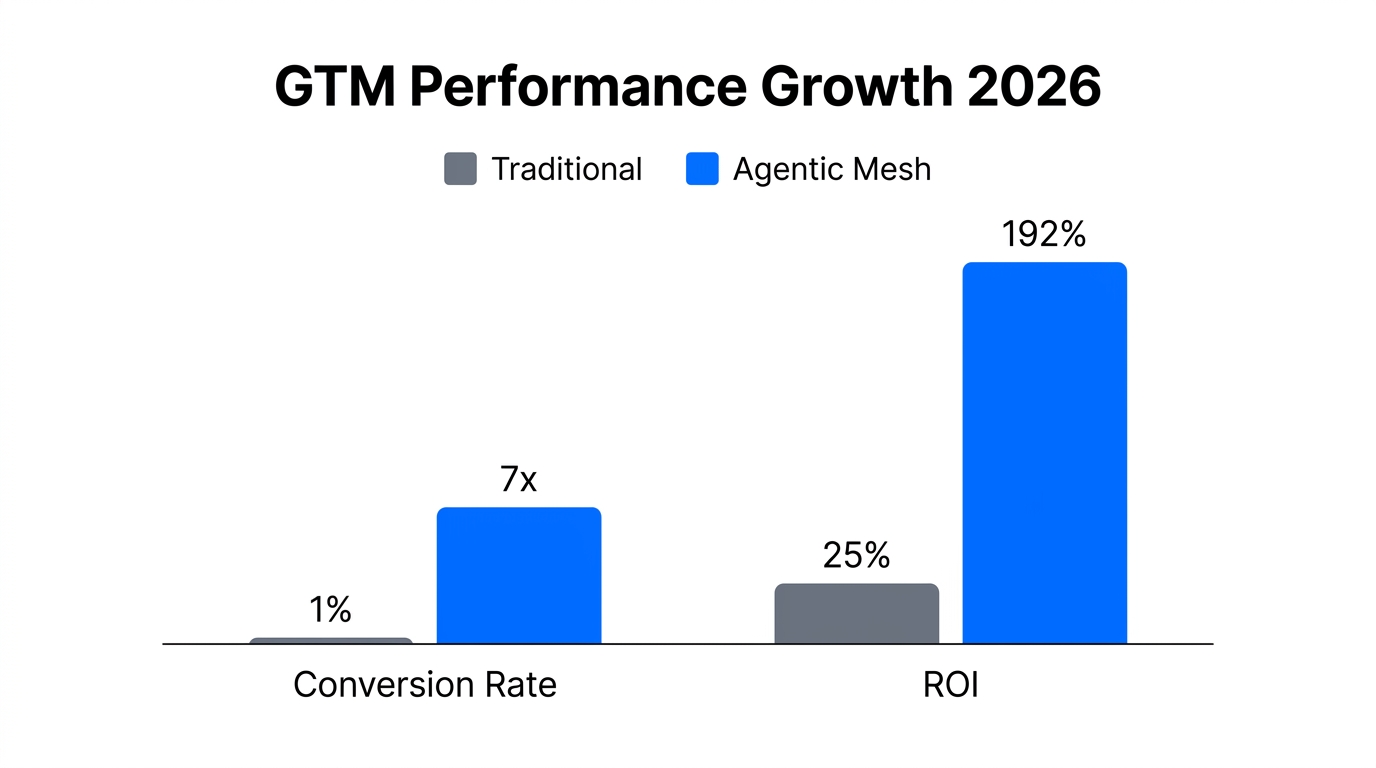
For GTM leaders, the primary driver for adopting a GTM AI strategy in 2026 is the unprecedented efficiency gains. U.S.-based tech firms utilizing Claude-based meshes are reporting an average ROI of 192%. These aren't just marginal gains; they are transformative shifts in unit economics. Agentic platforms are now delivering 4x to 7x improvements in conversion rates compared to the static chatbots of the previous era.
The economic impact is felt most acutely in operational costs. Organizations have seen a 70% reduction in manual task costs for data-heavy operations. While a 3-agent mesh might cost more in raw tokens than a single API call, it reduces human-in-the-loop intervention by 62%. This results in a net saving of approximately $12 per task, according to research from Digital Applied.
| Metric | Single Agent (2024) | Claude Mesh (2026) |
|---|---|---|
| Conversion Growth | Baseline | 4x - 7x Increase |
| Manual Task Cost | $100 (Indexed) | $30 (70% Reduction) |
| Human Intervention | 80-90% | 18-25% |
| Avg ROI (Tech) | N/A | 192% |
Case Study: How Fountain Slashed Fulfillment Time by 60%
One of the most compelling examples of Claude-based meshes in action comes from Fountain, a leader in workforce management. Fountain implemented a hierarchical mesh of Claude agents to automate the incredibly complex process of candidate screening and onboarding for massive fulfillment centers.
By using a mesh of specialized agents—one for initial screening, one for document verification via Computer Use, and one for scheduling—Fountain reduced the time to staff a new center from over 7 days to under 72 hours. This 50% increase in screening speed led directly to a 2x increase in candidate conversion rates. It highlights how autonomous agents can connect disparate systems (like background checks, ERPs, and SMS gateways) to move a lead through a pipeline without a single human click.
"Fountain's move to a Claude-powered mesh didn't just speed up their process—it redefined the speed of business in the labor market."
The GTM 'Lead Mesh' Playbook: A Step-by-Step Guide
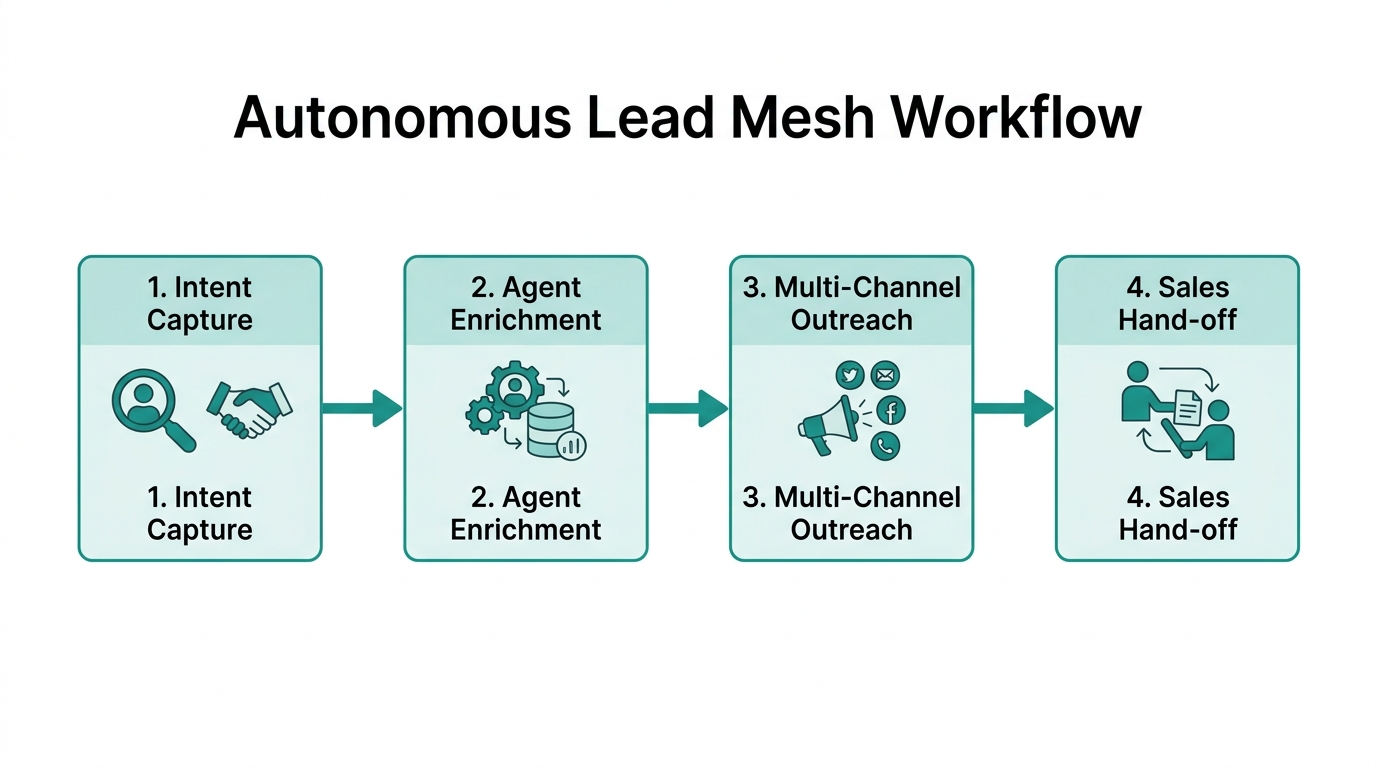
To implement an effective lead mesh that syncs real-time inventory, billing, and creator data, GTM teams in 2026 follow the SPARC (Systematic Planning, Acting, & Reviewing Cycle) methodology. This ensures that the multi-agent system remains grounded and focused on revenue goals.
Step 1: Initialize the Architect
Start by deploying a high-reasoning model, such as Claude 4.6 Opus, as the Lead Architect. Its primary function isn't to execute tasks but to analyze the GTM goal and generate a MULTI_AGENT_PLAN.md. This document acts as the source of truth for all worker agents in the swarm.
Step 2: Deploy Specialized Workers
Assign specific roles to smaller, faster models like Claude 4 Haiku. In a GTM context, you might have a "Scraper Agent" that monitors LinkedIn and TikTok Ads Manager, a "Technical Vetting Agent" that checks lead compatibility via API, and a "Copywriter Agent" that generates hyper-personalized outreach. For brands scaling through UGC, integrating a Stormy AI-driven creator discovery workflow into your mesh ensures a constant stream of high-performing creative assets to fuel these campaigns.
Step 3: Establish the MCP Communication Protocol
The Model Context Protocol (MCP), standardized by Anthropic and now hosted by the Linux Foundation, acts as the "Universal Bluetooth" for agents. Instead of custom API integrations, use an MCP server so your agents can "discover" tools like HubSpot, Salesforce, or Stripe to sync billing and inventory data in real-time.
Step 4: Implement Parallel Reasoning
Move away from sequential handoffs. Use frameworks like LangGraph or CrewAI to allow your agents to work on different parts of the same project simultaneously. For example, while one agent is verifying a lead's budget in Close, another can be drafting the contract in Notion.
Step 5: The Validation Layer
Always include a "Validator Agent" whose only tool is a "No-Op." This agent does not perform tasks; its only job is to critique the work of others. This layer is critical to preventing the 40% failure rate seen in unverified agent pilots where agents essentially "hallucinate" to each other until the system crashes.
Managing the 'Coordination Tax' and Agent Sprawl
While the benefits of agentic mesh networking are clear, GTM leaders must be wary of the Coordination Tax. Research from Gartner and the UC Berkeley AI Research (BAIR) Lab suggests that adding more agents can actually make a system dumber if not managed correctly. On certain benchmarks, performance dropped by 35% in multi-agent setups because agents spent too many tokens talking to each other rather than solving the task.
Furthermore, the "200K Token Trap" is a significant financial risk. Anthropic's pricing for the Claude 4.6 family doubles once context exceeds 200,000 tokens. To keep your multi-agent ROI benchmarks positive, developers are using "context-narrowing" supervisor agents to strip out irrelevant history before passing data to worker agents. This keeps the mesh lean, fast, and profitable.
Platform Showdown: Claude Mesh vs. OpenAI Agents SDK
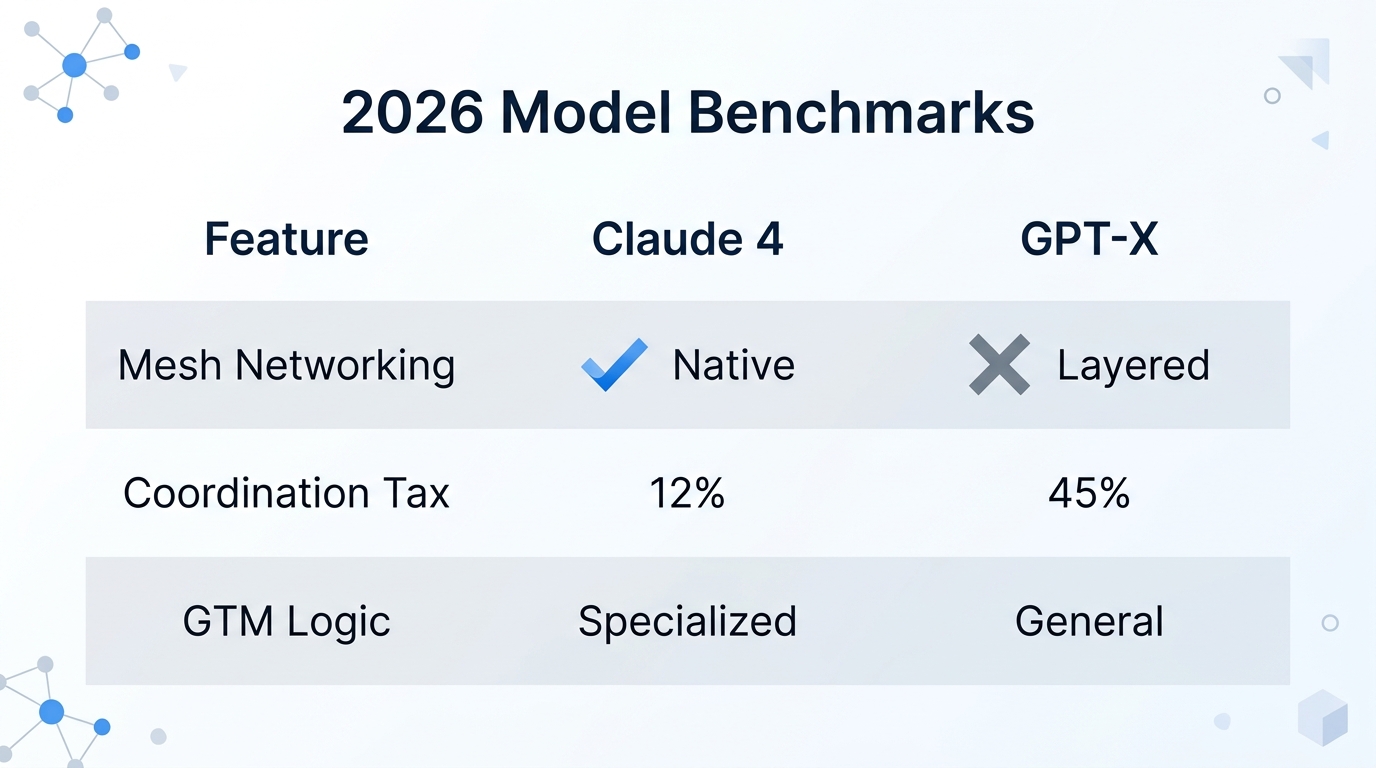
In 2026, the market has bifurcated. While OpenAI's Agents SDK is optimized for fast, boilerplate-heavy development with low latency, Claude's Mesh is the clear winner for complex engineering and R&D. Claude's "Extended Thinking" traces allow human supervisors to monitor the internal reasoning of agents before they execute commands, providing a level of transparency that OpenAI's more concise models often lack.
| Feature | Claude Mesh (Anthropic) | OpenAI Agents SDK |
|---|---|---|
| Reasoning | Superior (Extended Thinking) | Strong / Concise |
| Tool Use | Native Computer Use | API Function Calling |
| Safety | Constitutional AI at Mesh Layer | Post-hoc Guardrails |
| Protocol | Tool-centric (MCP) | Handoff-centric (Transfer) |
| Best For | Complex Systems & GTM Strategy | High-speed app development |
As UBOS.tech reports, the choice of model often comes down to the "long-horizon" capability. Claude is significantly more reliable for tasks lasting over an hour, making it the preferred choice for autonomous GTM workflows that span multiple days of lead nurturing and follow-ups.
Conclusion: Preparing for the AI Workforce
The year 2026 marks the end of "stand-alone experiments" and the beginning of the AI Workforce. GTM leaders are no longer just hiring sales reps; they are hiring "Agent Architects" to define KPIs for their digital co-workers. By leveraging Claude AI agent mesh networking, companies like Fountain and TELUS are proving that the bottleneck to growth is no longer human bandwidth, but the sophistication of your agentic mesh.
To stay competitive, GTM teams must move aggressively to implement the MCP protocol, manage their coordination tax, and treat agents as first-class IT citizens. Whether it's using Stormy AI to discover the right influencers for your mesh to target, or using AgentOps to monitor your swarm's performance, the infrastructure for 7x conversion rates is here. The only question is how fast your organization can adapt.