In 2026, the marketing landscape has undergone a tectonic shift. We have moved past the era of 'one-size-fits-all' chatbots into a sophisticated reality where autonomous intelligence doesn't just assist humans—it operates as a collaborative ecosystem. The centerpiece of this revolution is Claude AI agent mesh networking, a paradigm where specialized, small-context agents communicate via standardized protocols to handle complex marketing funnels. By decentralizing tasks across an 'Agentic Mesh,' enterprises are no longer just improving efficiency; they are fundamentally rewriting the economics of customer acquisition.
The 2026 Shift: Why Single LLMs Are No Longer Enough
For years, the industry standard was the 'Long-Context' approach: feeding a single, massive LLM like Claude 3 or GPT-4 every piece of data and hoping for a coherent output. However, as we enter 2026, that strategy has reached its breaking point. Recent data from Precedence Research shows the global Agentic AI market has exploded to $10.86 billion in Q1 2026, signaling a shift toward 'small-context' specialized architectures. These meshes use a multi-agent system (MAS) to break down complex workflows into bite-sized, executable tasks.
According to Gartner, 80% of Fortune 500 companies now have at least one multi-agent system in production. The reason is simple: single-agent prompts lack the reliability required for high-stakes marketing. A mesh network allows for a 'Technical Lead' agent to delegate sub-tasks to 'Worker' agents, ensuring that hallucinations are caught by internal verification layers before they ever reach a customer or a budget-holder.
"In 2026, the question isn't how smart the model is, but how effectively it can delegate. We are seeing models sustain 7-hour autonomous sessions by acting as a technical lead over a mesh of specialized sub-agents." — Dario Amodei, CEO of Anthropic.
Achieving 30% CPA Reduction with 'Vibe Marketing' Meshes
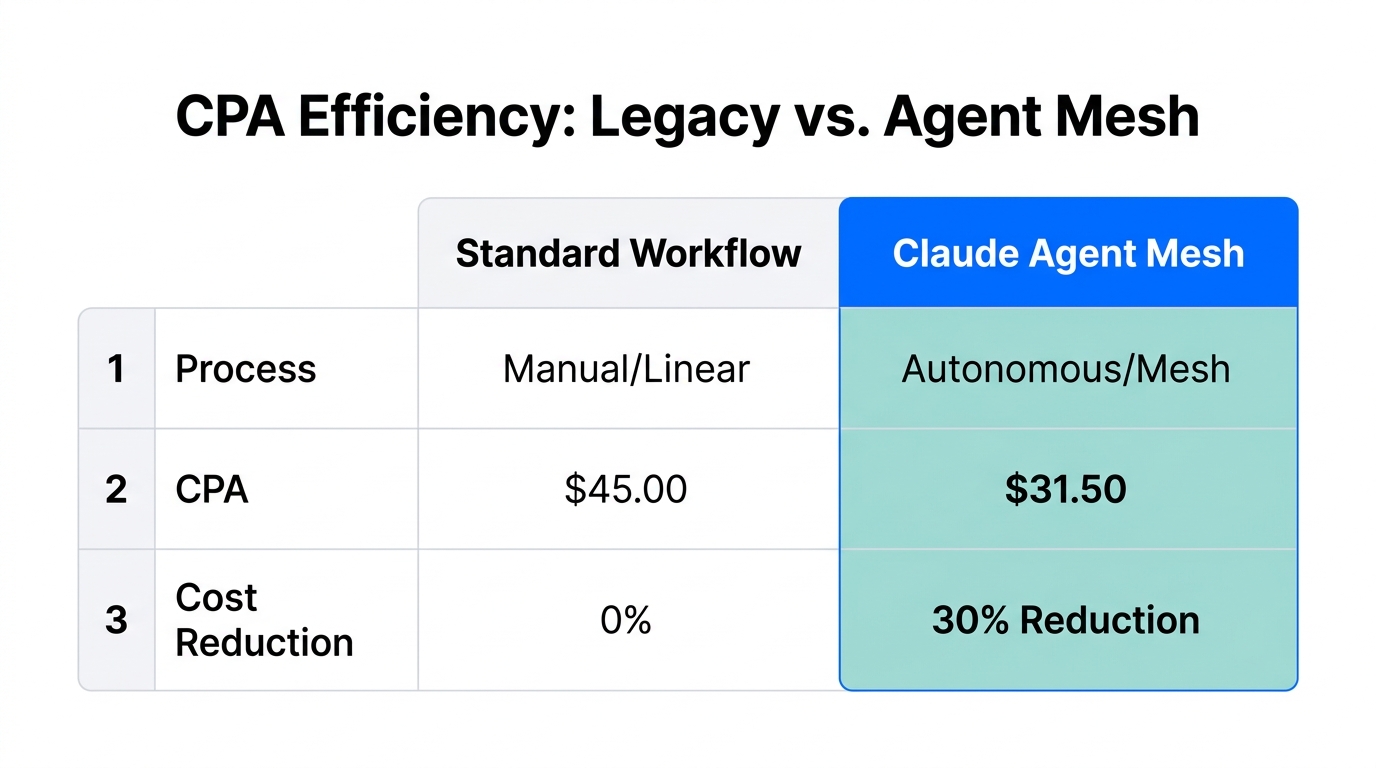
One of the most impactful applications of Claude AI agent mesh networking is in the realm of Vibe Marketing. This refers to the real-time, micro-adjustment of ad messaging based on current social sentiment, trending topics, and real-time performance data. In the past, this required a team of analysts; in 2026, it requires a mesh of specialized agents.
Early adopters of these meshes have reported a 30% reduction in Cost Per Acquisition (CPA), according to Landbase ROI benchmarks. This efficiency is driven by three distinct agent roles working in parallel:
- The Sentiment Monitor: Scans platforms like TikTok and X for shifts in consumer 'vibe' or brand sentiment.
- The Creative Re-writer: Adjusts ad copy and headlines instantly to align with the detected sentiment.
- The Budget Allocator: Shifts spend between campaigns based on real-time conversion velocity.
For brands sourcing UGC and influencer talent, platforms like Stormy AI have integrated these agentic principles to automate the vetting and outreach process, ensuring that Conversion Growth is not just a hope, but a predictable 4x to 7x outcome compared to static 2024-era campaigns. By using autonomous SEO agents and real-time mesh networking, marketers can now execute at a scale that was previously physically impossible for human teams.
Escaping the '200K Token Trap': Cost-Effective Multi-Agent Architecture
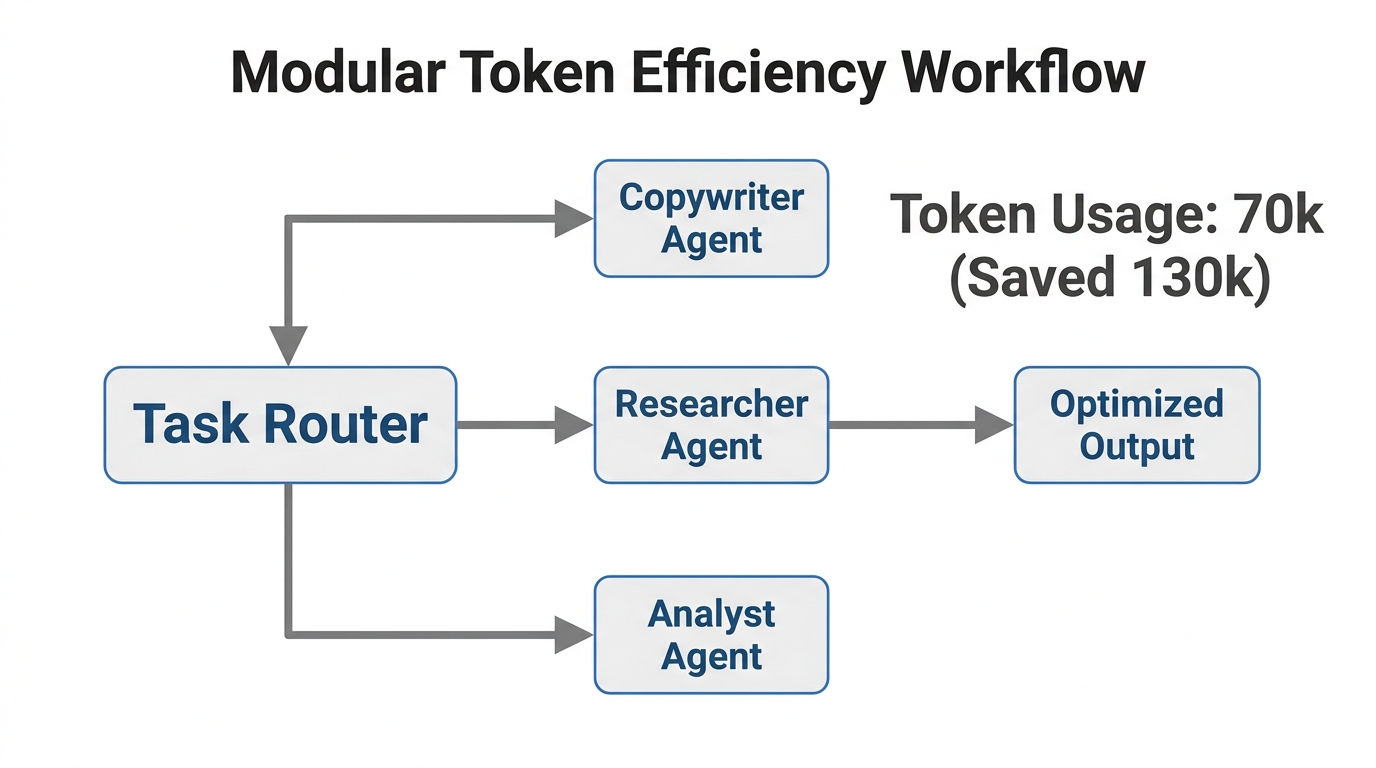
As marketing operations scale, token expenses can skyrocket if not managed correctly. In early 2026, Anthropic introduced a 'step-up' pricing model that has become a major hurdle for the uninitiated. This is known as the 200K Token Trap.
To maximize AI marketing efficiency in 2026, sophisticated teams are using context-narrowing supervisor agents. Instead of passing a 200,000-token campaign history to every worker, a Supervisor Agent summarizes only the strictly necessary context for each specific sub-task. This architectural shift has led to an average 32.3% reduction in token costs across enterprise applications, as reported by the Anthropic Economic Index.
Heterogeneous vs. Homogeneous Meshes: The War on Shared Bias
A major risk in multi-agent systems is 'Shared Bias.' If you build your entire mesh using only the Claude 5 family (a Homogeneous Mesh), the agents are likely to share the same blind spots. If the supervisor hallucinates a marketing metric, the worker agent will treat it as fact, leading to a 'cascade of errors' that causes 40-50% of multi-agent pilots to fail within six months.
The solution used by the top 1% of growth teams is the Heterogeneous Mesh. This involves using Claude 4.6/5 as the 'Architect' or 'Supervisor' due to its superior reasoning, while using smaller, faster models for execution. In fact, many teams are now utilizing the Model Context Protocol (MCP) to allow Claude to supervise agents built on other models like Llama 3 or Gemini.
| Feature | Homogeneous Mesh (Single Model) | Heterogeneous Mesh (Multi-Model) |
|---|---|---|
| Risk of Bias | High (Shared blind spots) | Low (Diverse reasoning) |
| Implementation | Simple (One SDK) | Complex (Requires MCP) |
| Reliability | Prone to cascading errors | High (Cross-validation) |
| Cost | Predictable | Optimized via cheaper worker models |
"An agent mesh provides a real-time data platform that connects AI to the nervous system of the enterprise. It moves us away from standalone experiments to first-class IT citizens." — Edward Funnekotter, Chief AI Officer at Solace.
Reducing Human-in-the-Loop Intervention by 62%
The ultimate goal of Claude AI agent mesh networking is to free humans from the 'drudge work' of marketing. In 2026, we have seen a 62% reduction in human-in-the-loop (HITL) intervention for data-heavy operations. Consider the case of Fountain, a workforce management platform that used a hierarchical mesh of Claude agents to automate candidate screening. By delegating tasks through a mesh, they reduced staffing time from 7 days to under 72 hours, as documented in Anthropic's 2026 Trends Report.
In marketing, this means moving from a 'hands-on' to a 'supervisor' role. Instead of writing every outreach email, marketers now set the 'Constitutional AI' parameters for their agent swarm. AI-driven systems now handle influencer discovery, vetting, and daily outreach sequences while the user is asleep, effectively creating an AI Workforce that operates 24/7.
Eliminating the 'Zombie Agent' Drain with AgentOps
One of the darkest sides of the agentic revolution is Agent Sprawl. Without proper observability, companies often find 'zombie agents' running in infinite loops, consuming thousands of dollars in tokens on redundant or failed tasks. This is where AgentOps—the 'Datadog for Agents'—becomes essential.
By using observability tools, marketers can identify which agents are generating high ROI and which are simply 'hallucinating' to one another. Successful 2026 stacks include a Validator Agent whose only job is to critique the work of others using a 'No-Op' toolset. This creates a self-correcting system that prevents the budget-draining loops that plagued early 2025 implementations.
The 2026 Multi-Agent Playbook: From Strategy to Execution
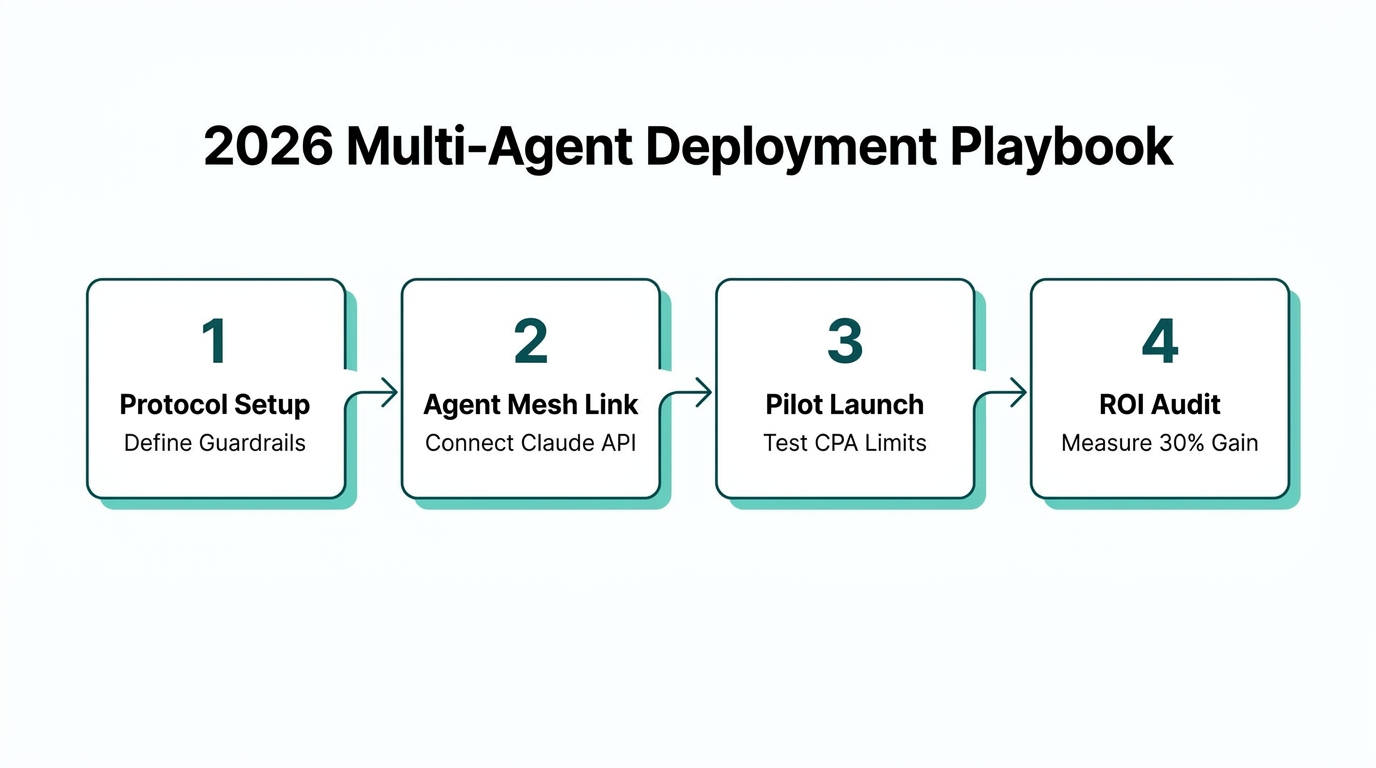
If you are ready to implement a mesh to reduce token costs and boost marketing ROI, follow the SPARC methodology (Systematic Planning, Acting, & Reviewing Cycle):
- Step 1: Initialize the Architect: Use a high-reasoning model (Claude 4.6 Opus) as the leader. Its only output should be a
MULTI_AGENT_PLAN.md. - Step 2: Define Specialized Workers: Deploy smaller models (Claude 4 Haiku) as specialized workers for tasks like SQL generation, copy editing, or TikTok Ads Manager data analysis.
- Step 3: Establish the Communication Protocol: Use an MCP server so agents can 'discover' each other's progress and share a unified context without bloating the prompt.
- Step 4: Implement a Validator: Always have a separate agent review the final output against your brand's Constitutional AI guidelines before any external action is taken.
Conclusion: The Future of Agentic Marketing ROI
As we navigate 2026, the transition from 'standalone chatbots' to Claude AI agent mesh networking is no longer optional for brands that want to remain competitive. With a 30% reduction in CPA and a 171% average ROI on agentic systems, the data is clear: the future belongs to those who can manage an AI workforce at scale. By avoiding the 200K token trap and embracing heterogeneous architectures, marketers can achieve unprecedented efficiency.
Whether you are using LangGraph for complex stateful logic or leveraging Stormy AI for autonomous creator sourcing and outreach, the goal remains the same—leveraging AI marketing efficiency to drive growth while humans focus on high-level strategy and 'The Big Idea.'