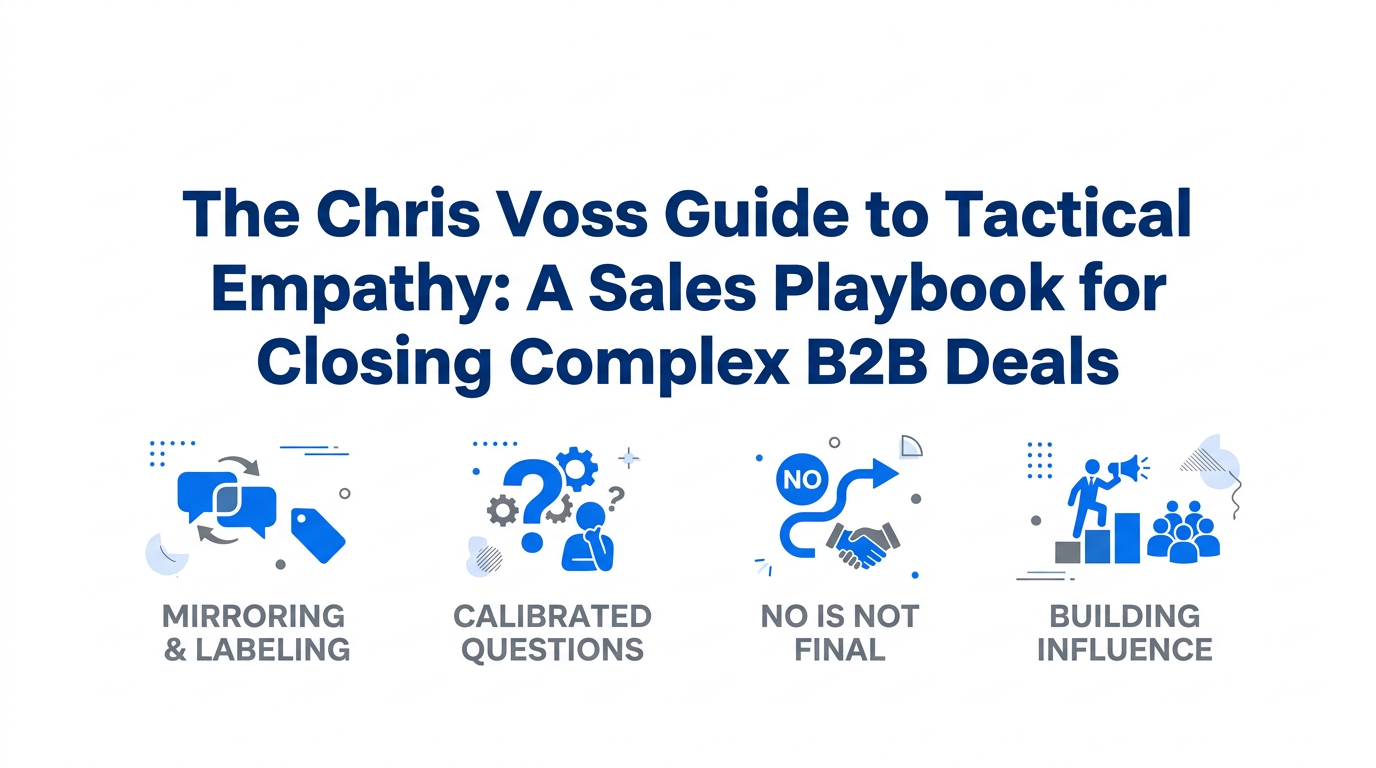
Most B2B sales professionals walk into a meeting with a pitch deck and a prayer. They believe that the "Art of the Deal" is about being the loudest person in the room or the most charismatic persuader. But in the world of high-stakes contracts, those tactics often lead to stalemates or, worse, bad deals that fail during implementation. True B2B sales negotiation isn't about winning an argument; it's about FBI-grade collaborative discovery. By applying tactical empathy, sales teams can move beyond adversarial posturing and start uncovering the hidden information that actually closes deals.
As legendary hostage negotiator Chris Voss explains, the most dangerous moment in any conversation is when you stop listening to understand and start listening to rebut. This shift, often occurring within seconds of a prospect speaking, is where most deals are lost. To win in the modern marketplace, you must master the sales playbook of tactical empathy, turning every interaction into a search for "Black Swans"—those pieces of proprietary information that change everything.
The Hijack Point: Why Your Brain Wants to Kill the Deal
Chris Voss explains the hijack moment and why we feel the urge to correct others.
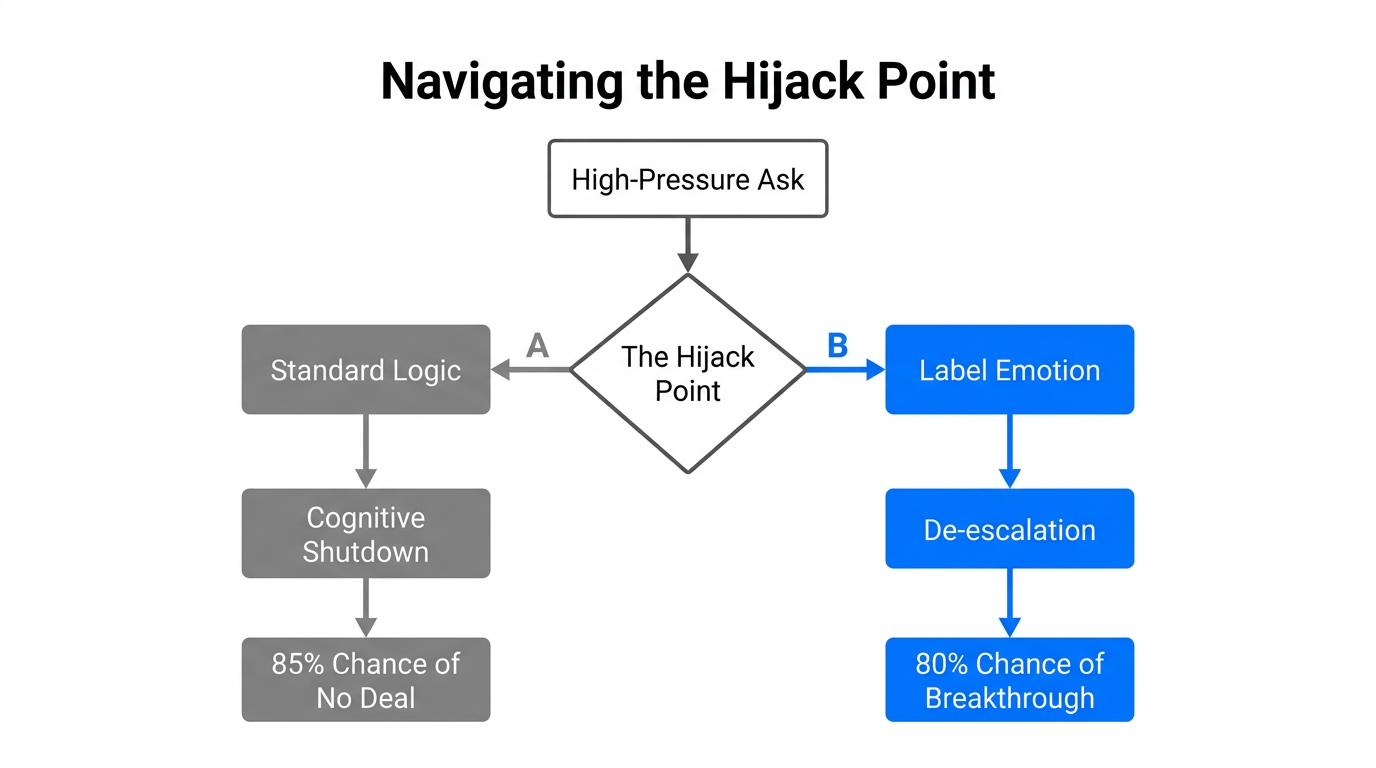
In any business negotiation strategy, there is a phenomenon Voss calls the "Hijack Point." This occurs when the other person is talking, and you feel an irresistible urge to jump in. Most people think they are listening, but they are actually just waiting for their turn to speak. There are two primary ways we hijack a conversation: to correct and to relate.
The urge to correct is a psychological baseline. When someone says something factually incorrect, our brains crave the satisfaction of setting them straight. Voss suggests that master negotiators actually use this against prospects. By intentionally saying something slightly wrong, you can trigger a prospect to correct you with the truth, revealing sensitive data they never intended to share. They won't regret it because the act of correcting you feels so good in the moment. According to research from Harvard Business Review, understanding these psychological triggers is what separates top performers from the rest of the pack.
The second hijack is story stealing. A prospect mentions a challenge, and you immediately jump in with, "Oh, the same thing happened to me!" While you think you're building common ground, you're actually squashing the prospect. They feel unheard and one-upped. In a complex B2B environment, common ground is often a fallacy; what matters is making the prospect feel uniquely understood, a principle often discussed in behavioral psychology studies on active listening.
"The urge to correct is so irresistible that we actually use it as a negotiation skill. I’ll say something wrong on purpose because you won't be able to resist the urge to correct me with the truth."The 'Late Night FM DJ Voice': De-escalating High Stakes
When a contract renewal is on the line or a prospect is pushing back on pricing, the natural reaction is to become defensive or aggressive. This triggers a "threat" response in the prospect's brain, shutting down collaboration. To counter this, Voss advocates for the Late Night FM DJ Voice: a calm, slow, and soothing downward-inflecting tone.
This isn't just about sounding cool; it’s about neurochemistry. A soothing voice triggers the release of oxytocin (the bonding chemical) and serotonin (the satisfaction chemical) in the listener. When a prospect is hit with oxytocin, they become more honest. When they feel the satisfaction of serotonin, they become less demanding. This is critical for de-escalating high-stakes tensions during contract negotiations.
Think of it as a tool for tactical empathy sales. By removing the threat through your tone, you invite the prospect to sit on the same side of the table as you. You aren't fighting them; you are both looking at a third party—the problem—together. This mental model shift is what allows The Black Swan Group to achieve results where others see only roadblocks.
Why Compromise is the Enemy of a Great Deal
Understand why compromise in negotiation often correlates strongly to mediocrity and poor results.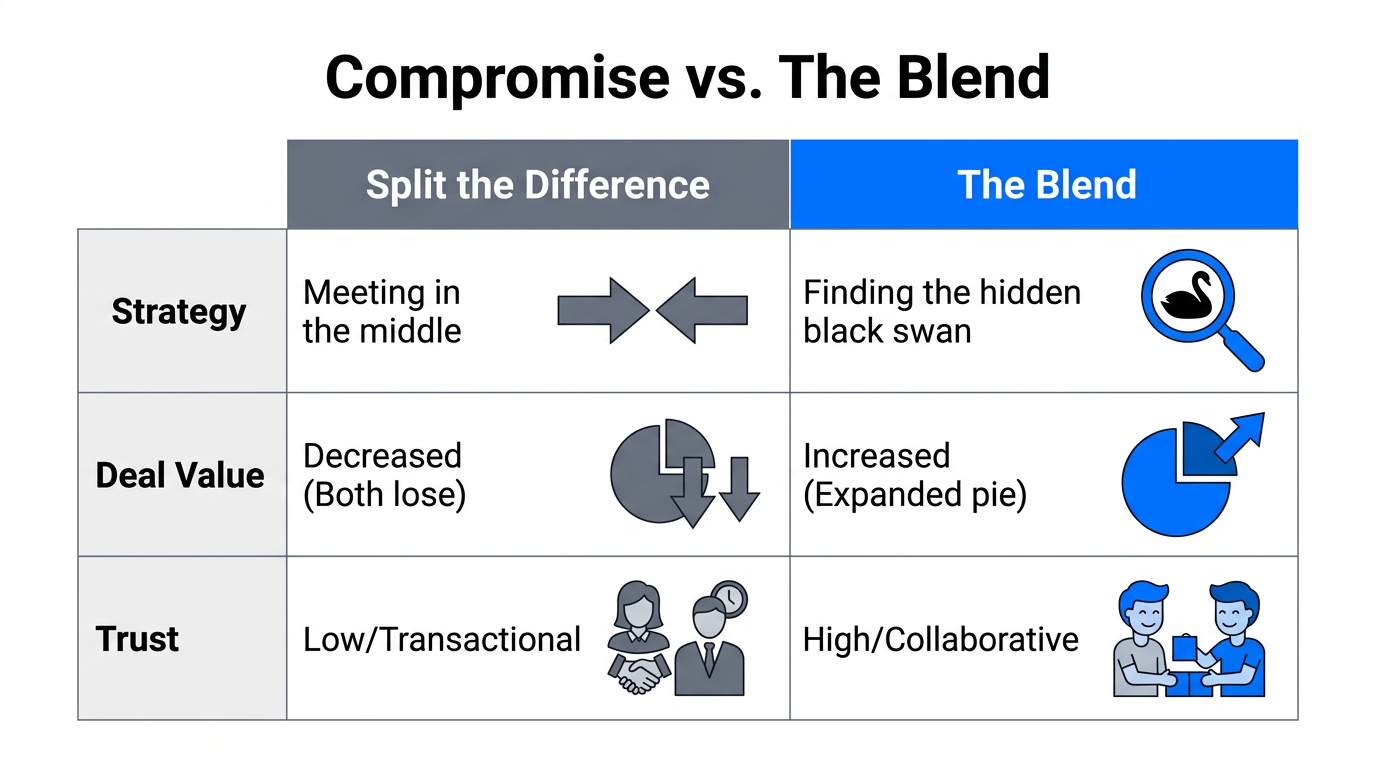
In traditional sales training, we are taught that a 50/50 split is a win. Voss argues that compromise is synonymous with mediocrity. If you compromise, you are essentially creating a "lose-lose" scenario where neither party is truly satisfied. This leads to poor implementation and resentment.
Instead of compromise, aim for 'The Blend.' Voss uses the analogy of steel: it is 98% iron and 2% carbon. If they compromised at 50/50, you'd have a useless material. But by finding the right blend—where one party provides 98% of the structure and the other provides the 2% catalyst—you create something stronger than either could build alone. In B2B sales, this means using labels to find out what the prospect truly values, rather than just splitting the difference on price, much like how Shopify merchants negotiate unique terms with high-volume suppliers.
| Feature | Traditional Compromise | The Tactical Blend |
|---|---|---|
| Goal | Split the difference (50/50) | Find the high-value trade |
| Emotion | Resentment & Mediocrity | Trust & Prosperity |
| Outcome | Weak implementation | Strong long-term relationship |
| Strategy | Give-and-take haggling | Deep discovery & labeling |
The 'Note Technique': Spotting Inflection Points
One of the most powerful tools in the FBI's arsenal, which applies directly to sales teams using platforms like Lemlist for outreach or Meta Ads Manager for growth, is the Note Technique. During a live negotiation, the person on the phone is often too close to the fire to see the patterns. You need a "coach" or a teammate listening in who can pass notes on the emotional inflection points they hear.
Voss tells the story of a bank robbery where the breakthrough didn't come from a demand, but from a teammate handing him a note that said, "Ask him if he wants to come out." By pivoting from the hostages to the bank robber's own desire for safety, the standoff ended in 90 minutes. In a B2B sales call, your "note-taker" might spot that a prospect sounds stressed when a specific deadline is mentioned. That is your Black Swan. Labeling that stress ("It sounds like there is a lot of internal pressure on this timeline") can unlock the deal faster than any discount ever could.
"The last impression is the lasting impression. No matter what happens, you must make sure they feel respected, heard, and appreciated at the very end."Handling the 'Corporate CEO Negotiator'
Every B2B salesperson has encountered the "Corporate CEO Negotiator." This is the person who seems like they are on your side but constantly uses outside stakeholders as leverage. They say things like, "I'd love to sign this, but my board will kill me if I agree to that price."
This is a calculated move to avoid being cornered. They diminish their own influence at the table to force you to lower your guard. To handle this, you must use no-oriented questions. Instead of asking, "Can we get this past the board?" (which invites a 'Yes' that creates friction), ask, "Is it ridiculous to think your board would see the ROI in this implementation?" This allows the negotiator to feel safe in their 'No' while moving the deal forward. Managing these complex relationships requires a sophisticated creator CRM approach, where every stakeholder's motivations are tracked and addressed.
When you are sourcing partners or creators for a campaign, platforms like Stormy AI streamline creator sourcing and outreach by helping you vet the right influencers who align with these high-level brand values, ensuring your outreach is personalized and credible from the first touchpoint. By combining AI-powered discovery with tactical empathy, you ensure your initial outreach on platforms like LinkedIn doesn't feel like a "slimy sales pitch" but like a genuine collaboration offer.
Your Tactical Empathy Sales Playbook
Discover how to use labeling and tactical empathy to gain a deeper understanding of counterparts.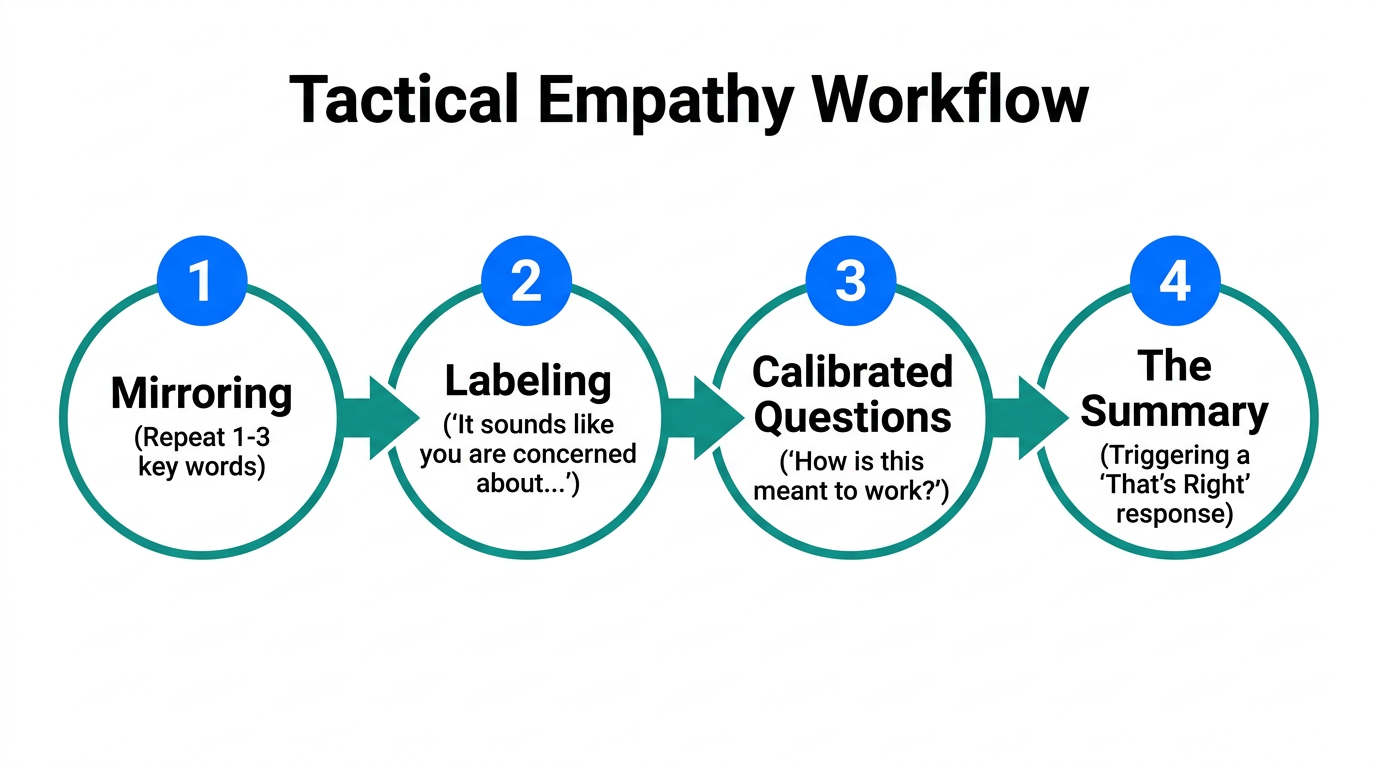
To implement these business negotiation strategies today, follow this step-by-step sequence in your next discovery call:
- Deactivate the Negatives: Start by labeling the elephant in the room. "I'm probably going to seem like just another salesperson wasting your time." This builds instant trust through honesty.
- Use Labels, Not Questions: Instead of "Why are you doing this?", say "It seems like there is a specific goal you're trying to hit by Q3." Observation triggers information; interrogation triggers defensiveness.
- Go for 'No': Ask questions that allow the prospect to say no to feel in control. "Would it be a bad idea to walk through the technical specs now?"
- The Mirror: Repeat the last 1-3 critical words of their sentence back to them as a question. It encourages them to elaborate without you having to lead the witness.
- The FM DJ Voice: Keep your tone downward and calm, especially when discussing pricing or contract hurdles.
Conclusion: Winning the Implementation
Learn why the last impression is lasting and how to finish every negotiation effectively.As Chris Voss notes, negotiation is not an act of war; it is a process of discovery. The goal isn't just to get a signature on a contract—it's to ensure a successful implementation. If you use leverage to bully a prospect into a deal, they will resent you, and the project will likely fail. But if you use tactical empathy to make them feel heard and understood, they will bond with you, share their most proprietary secrets, and work with you to solve any problems that arise.
By mastering the "Hijack Point" and resisting the urge to correct, you become a partner rather than a vendor. Whether you are using Stormy AI to discover the perfect UGC creators or negotiating a multi-million dollar SaaS contract, the rules of human nature remain the same. Make them feel heard, and they will make you successful.