In 2026, the digital storefront is no longer a static page; it is a high-velocity psychological battlefield. As we navigate this year, the global average for cart abandonment sits at a staggering 70.19% according to research from the Baymard Institute. For growth marketers and e-commerce founders, this isn't just a metric—it represents a collective $260 billion in recoverable revenue left sitting in digital aisles. To win in this landscape, checkout flow optimization must move beyond aesthetic tweaks and into the realm of technical precision and frictionless execution.
The $260 Billion Leak: Understanding 2026 Benchmarks
To fix a funnel, you must first understand where the pressure is highest. Current data from the 2026 Digital Experience Benchmark indicates that the average e-commerce conversion rate this year hovers between 2.5% and 3.3%. However, these numbers fluctuate wildly depending on the industry and the level of brand authority.
| Industry Niche | Avg. Conversion Rate (2026) | Primary Driver |
|---|---|---|
| Food & Beverage | 6.1% | High frequency, low stakes | Beauty & Personal Care | 5.1% | Brand loyalty & UGC | Fashion & Apparel | 3.0% – 4.1% | Visual storytelling | Luxury & Jewelry | 1.2% | High consideration time |
While mobile traffic accounts for over 70% of all e-commerce visits, mobile conversion rates (1.8% to 2.8%) continue to lag significantly behind desktop (3.2% to 3.9%). This discrepancy highlights a fundamental failure in reduce cart abandonment 2026 strategies: we are still designing for keyboards when our customers are using their thumbs. A one-second delay in mobile load time can slash your conversions by 7%, making technical performance the literal foundation of your checkout flow, often monitored via tools like Google PageSpeed Insights.
"The most expensive traffic is the traffic that reaches the checkout but never completes the purchase. Recovery is the highest-ROI activity in growth marketing."
The 1-Click Mandate: Eliminating Friction with Shop Pay and Apple Pay
In 2026, friction is the enemy of profit. The "1-Click Revolution" is no longer a luxury—it is a baseline consumer expectation. Implementing 1-click checkout solutions like Google Pay, Shop Pay, or Apple Pay can drive an immediate 16-21% conversion lift. According to insights from Flatline Agency, the goal is to reduce the time-to-purchase to under 30 seconds.
When a user has to manually type their credit card number, expiration date, and CVV on a mobile device, the probability of a typo—or worse, a change of heart—skyrockets. By leveraging digital wallets, you bypass the most tedious part of the checkout flow optimization process. Furthermore, integration with modern payment gateways like Stripe allows for seamless 'Buy Now, Pay Later' (BNPL) options through providers like Klarna, which are essential for high-ticket items in the luxury and jewelry sectors.
The Hidden Cost of Friction: Why Forced Accounts Kill Conversions
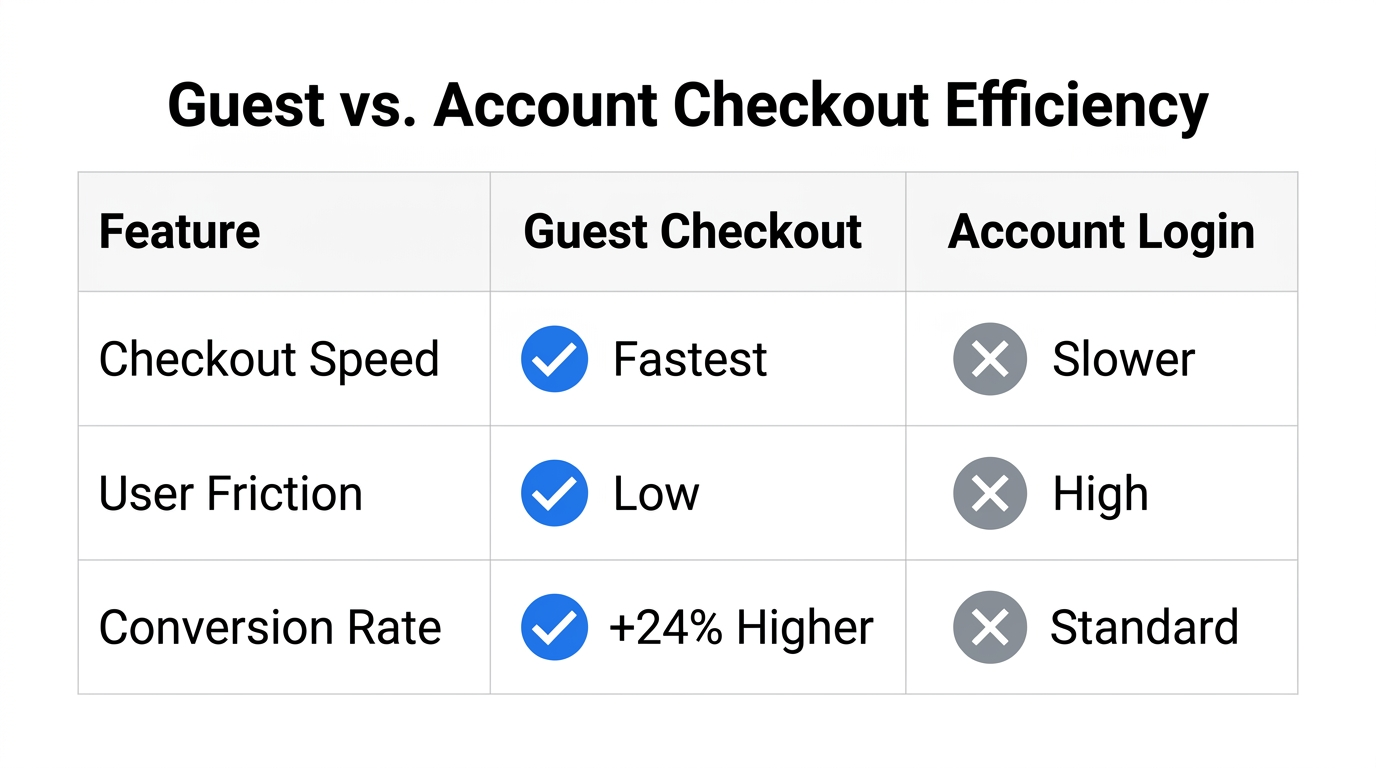
One of the most persistent conversion killers in 2026 remains the forced account creation screen. Data shows that 35% of shoppers abandon their carts specifically because a site required them to create an account before checking out. Consumers view account creation as a barrier to their goal: owning the product.
To maximize your reduce cart abandonment 2026 efforts, you must prioritize the Guest Checkout. You can always capture the customer's data *after* the transaction is complete on the 'Thank You' page. By allowing the purchase to happen first, you reduce the perceived effort and build trust. Analytics partners like Humblytics emphasize that minimizing the number of form fields is directly correlated with higher completion rates.
Data-Driven Validation: Masterclass in VWO Ecommerce Testing
Stop guessing and start testing. VWO ecommerce testing (Visual Website Optimizer) has become the gold standard for growth teams in 2026 because it allows for deep behavioral analysis beyond simple A/B splits. Instead of testing arbitrary button colors, focus on testing user hypotheses based on psychological triggers.
For instance, Talia Wolf of Getuplift suggests that every conversion is an emotional decision. Using VWO, you can test whether your audience responds better to "Safety and Security" messaging (focusing on SSL badges and guarantees) or "Social Validation" messaging (focusing on the 50,000+ happy customers).
Advanced testing workflows in 2026 include:
- Multi-variate testing: Testing combinations of shipping alerts, payment icons, and progress bars simultaneously.
- Session Recordings: Using tools like Hotjar or Microsoft Clarity to see exactly where users rage-click or hesitate during checkout.
- AI-Powered Personalization: Dynamically adjusting the checkout experience based on the traffic source (e.g., users coming from TikTok Ads see a different layout than those from LinkedIn).
When running tests, don't just look at the conversion rate. Look at the impact on Average Order Value (AOV) and Customer Lifetime Value (CLV). Tools like Optimizely are excellent for enterprise-level experimentation, but VWO remains the favorite for mid-market brands due to its ease of use and integrated heatmaps.
"If you aren't testing, you're leaving your revenue to chance. In 2026, the data always beats the 'expert' opinion."
The Psychological Layer: Social Proof and Urgency
Trust is the currency of the internet. In 2026, users are hyper-aware of marketing tactics, meaning your social proof must be authentic. Integrating real-time purchase notifications or "Low Stock" alerts can create a healthy sense of urgency, but only if they are true. 93% of consumers say reviews influence their decisions, so displaying high-quality UGC (User Generated Content) directly on the Product Detail Page (PDP) is critical.
For brands looking to scale this social proof, Stormy AI provides an essential edge by helping marketers discover and vet UGC creators who produce the authentic video content that drives these conversions. By finding creators who truly align with your brand's niche via an AI influencer search engine, you ensure that the social proof integrated into your checkout flow optimization feels organic rather than manufactured.
Beyond the First Transaction: Optimizing for CLV with Klaviyo
Conversion rate optimization doesn't end when the "Buy" button is clicked. Valentin Radu of Omniconvert argues that the real profit is in Customer Lifetime Value (CLV). This is where Klaviyo retention marketing becomes your secret weapon.
By segmenting your "Power Users"—the top 20% of customers who often generate 80% of your revenue—you can create bespoke checkout experiences just for them. Use Klaviyo to trigger personalized SMS or email flows based on cart abandonment behavior. For example, if a high-value returning customer abandons their cart, your 2026 strategy should involve an automated, hyper-personalized reach-out that offers a specific loyalty incentive, rather than a generic 10% discount.
The 2026 Checkout Playbook: Step-by-Step Implementation
Ready to reclaim your share of that $260 billion? Follow this high-action playbook to overhaul your checkout flow this quarter.
Step 1: The Friction Audit
Run a full audit using UX audit principles to identify your highest drop-off points. Is it the shipping calculation? The account login? Pinpoint the leak before you buy the tape.
Step 2: Implement 1-Click Payments
Enable Shop Pay, Apple Pay, and Google Pay. If you are on Shopify, this is a one-toggle fix that can yield a 16% lift almost overnight. Ensure these buttons are prominent on both the cart page and individual product pages.
Step 3: Deploy VWO Experimentation
Set up a VWO ecommerce testing campaign. Start by testing the removal of the navigation header during the checkout process. This "enclosed checkout" prevents users from wandering back to the blog or social links when they should be finishing their purchase.
Step 4: Launch Abandonment Recovery Flows
Connect your store to Klaviyo. Set up a three-part email sequence:
- 1 Hour Later: The "Did you forget something?" helpful reminder.
- 24 Hours Later: The Social Proof email (featuring reviews and UGC found via Stormy AI).
- 48 Hours Later: The final incentive or urgency-based offer.
"2026 is the year of Agentic Commerce. If your checkout isn't automated, frictionless, and personalized, you're effectively closing your doors to 70% of your potential customers."
Conclusion: The Future of Frictionless Commerce
The path to reduce cart abandonment 2026 isn't paved with complex gimmicks; it is built on the elimination of effort. By prioritizing 1-click payments, embracing guest checkout, and using VWO ecommerce testing to validate every change, you transform your checkout from a hurdle into a slide. Remember, the transaction is just the beginning. Use Klaviyo retention marketing to turn those recovered carts into lifelong brand advocates. Start your audit today—those $260 billion in recoverable sales aren't going to claim themselves.