In the gold rush of generative AI, the market is flooded with "wrappers"—thin layers of software built on top of LLMs that offer little more than a customized prompt. Yet, while thousands of these tools struggle to find product-market fit, a few have transcended the noise to build sustainable, high-growth businesses. Cast Magic is the poster child for this evolution. In less than a year, the platform scaled from zero to $120,000 in Monthly Recurring Revenue (MRR) by focusing on a specific, high-friction problem: content repurposing for podcasters. Their success isn't just about the technology; it's a masterclass in ai go-to-market strategy and the power of embedding a product directly into an existing user workflow.
Solving the "Show Notes" Problem: Identifying High-Friction Tasks
The genesis of Cast Magic didn't come from a brainstorming session about AI's potential; it came from the sheer boredom and friction of manual labor. Co-founder Blaine hosted a podcast and realized that the post-production process—specifically writing show notes, social posts, and summaries—was a massive bottleneck. He couldn't easily outsource it to a virtual assistant because they lacked the specific context of the conversation, and doing it himself took hours away from higher-value tasks.
This is the essence of a painkiller product rather than a vitamin. A vitamin is something that is "nice to have," like a tool that generates generic poems or art. A painkiller solves an immediate, recurring agony that costs a business time or money. By identifying that writing show notes was the "pain," the team at Cast Magic found a wedge into a massive market of creators who were already spending money to solve this problem via human editors or VAs.
"If you can embed yourself into an existing workflow and radically remove the friction... those are the tools that are really taking off. These are real needs and not just a vitamin."
Why Workflow-Specific Tools Beat General AI for Retention
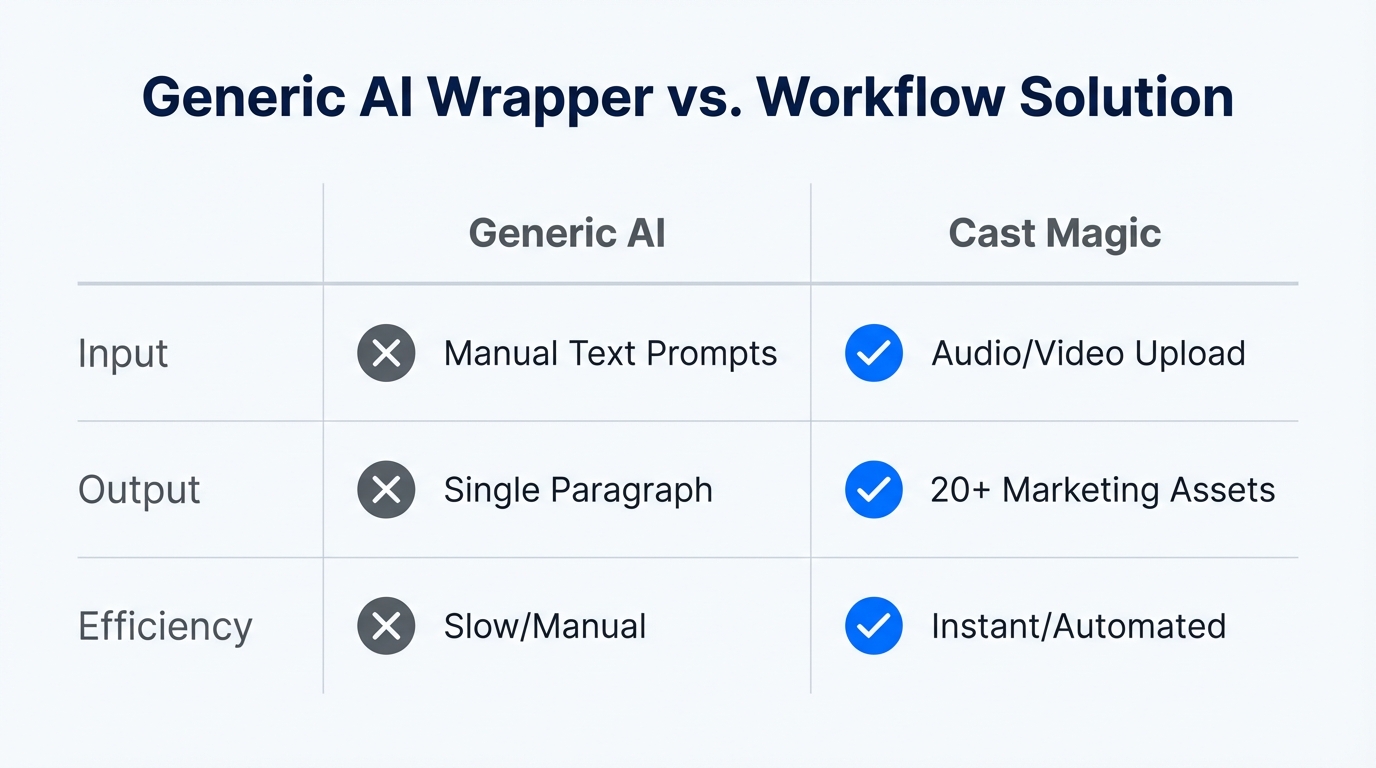
Many skeptics argue that tools like ChatGPT will eventually kill all specialized AI apps. However, the team behind Cast Magic understood a fundamental truth about saas differentiation: general AI models are infrastructure, not products. While Claude or ChatGPT can write a summary, they don't handle the A to Z workflow of a podcaster.
A workflow-specific tool manages the entire lifecycle of a task. For Cast Magic, this means handling the upload, the transcription, the context-aware speaker identification, and the formatting for specific platforms like LinkedIn or TikTok. When a tool is embedded in the workflow, it becomes much harder to replace because it saves the user from the "copy-paste" fatigue of jumping between multiple tabs and tools.
| Feature | Generic AI (e.g., ChatGPT) | Workflow-Specific SaaS (Cast Magic) |
|---|---|---|
| Input Handling | Manual copy-paste of text blocks. | Direct audio/video uploads and RSS feed integration. |
| Context Awareness | Requires long, complex prompts every time. | Pre-configured templates that understand speaker roles. |
| Output Reliability | Variable quality based on prompt engineering. | High-quality, formatted assets ready for publishing. |
| User Retention | Low (users churn when they find better prompts). | High (single-digit churn) due to saved preferences and speed. |
The "A to Z" Solution: Preventing Churn Through Completeness
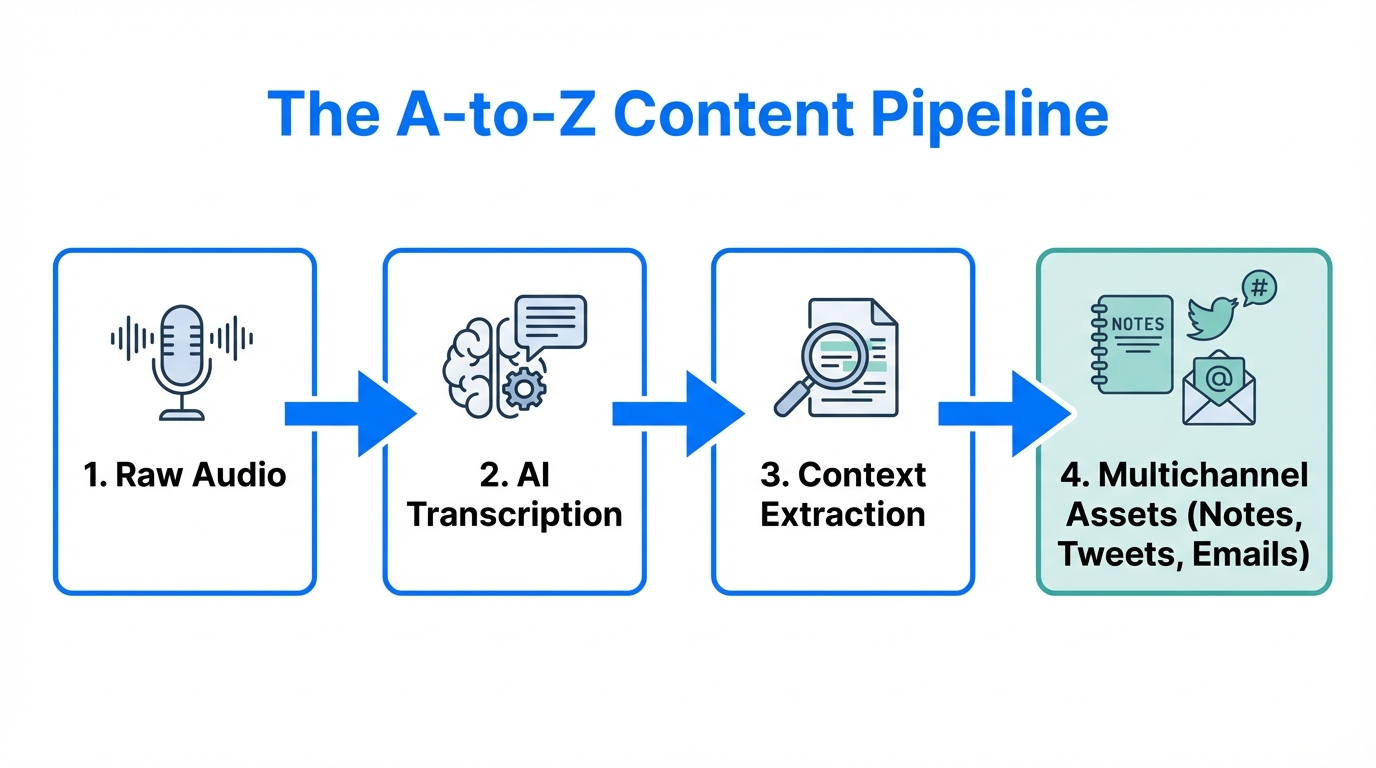
To achieve single-digit net churn, a product must do more than just the "cool" part of the task. It must handle the boring parts, too. Cast Magic doesn't just give you a summary; it gives you the social media captions, the email newsletter draft, and the time-stamped show notes. This completeness is what drives product led growth. When a user sees that they can go from a raw recording to a week's worth of content in 30 seconds, the value proposition is undeniable.
The founders focused heavily on output quality as their primary competitive moat. While many AI wrappers take shortcuts on the back end, Cast Magic invested in ensuring the transcriptions and the resulting content felt human and contextually accurate. By providing an integrated platform rather than a feature, they moved from being a utility to being a mission-critical part of a creator's tech stack, alongside tools like Canva for design or Shopify for commerce.
Marketing at Scale: Distribution Partnerships and Systems
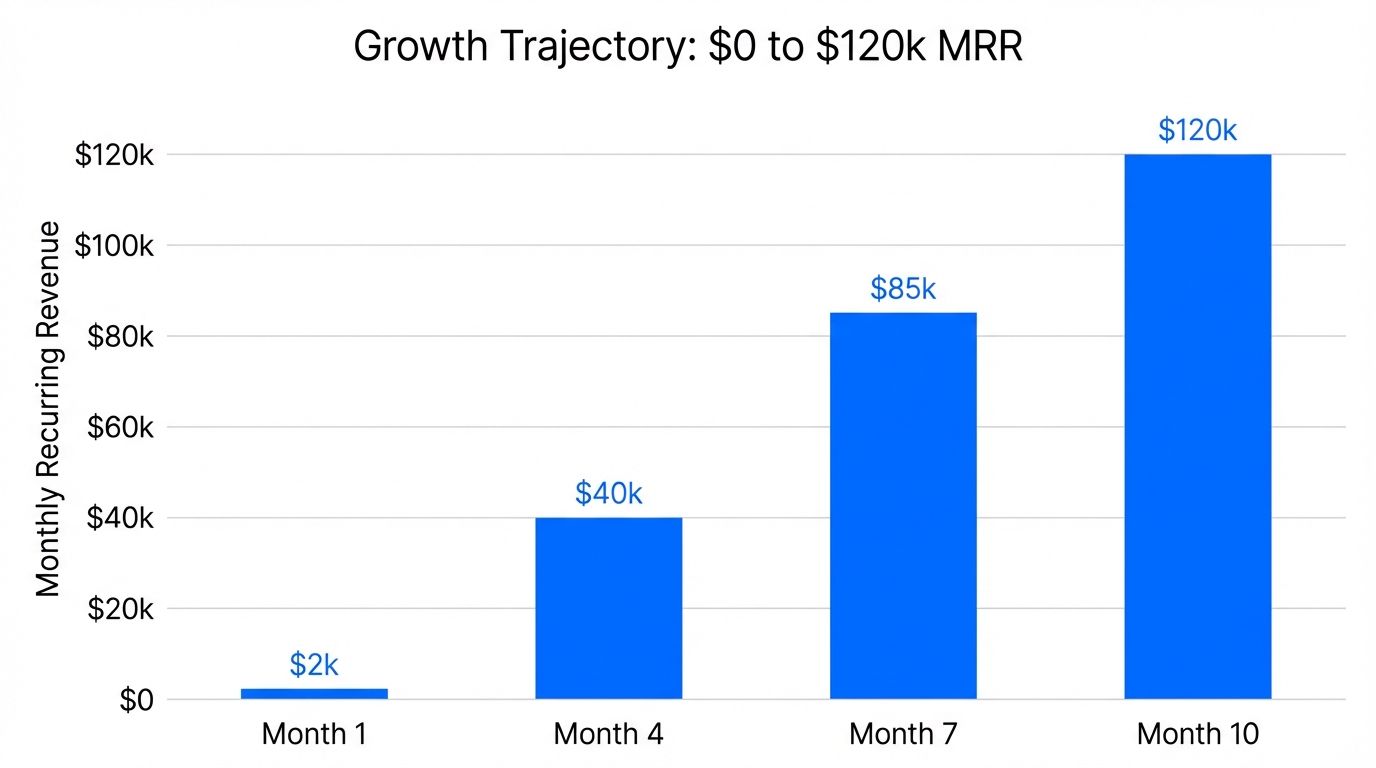
You can have the best product in the world, but without a solid workflow automation marketing plan, you will fail. Cast Magic used a two-pronged approach to reach $120k MRR in record time. First, they used AppSumo as a springboard. While many founders shy away from lifetime deals (LTDs), the Cast Magic team saw it as a way to generate $350,000 in upfront revenue and acquire 10,000 beta testers who provided invaluable feedback.
Second, they built a "one-man marketing team" powered by systems. Instead of hiring a massive agency, they leveraged creator partnerships and affiliates. They scraped social platforms to find influencers in adjacent niches—like B2B marketing or DTC—and built a volume-based outreach system. For brands looking to scale creator discovery similarly, platforms like Stormy AI streamline creator sourcing and outreach, allowing small teams to run massive influencer campaigns without the overhead.
"Research how companies similar to you got distribution. In our case, I mapped out businesses that grew through affiliates and created a Notion system so I didn't have to ideate content with creators on every single call."
By using systems over headcount, they kept their marketing spend under 20% of revenue, ensuring the business remained highly profitable even during rapid scaling. They managed these relationships with the same rigor one might use in a traditional CRM, but tailored for the fast-paced creator economy.
Pricing Strategies for AI Apps: Balancing LLM Costs
One of the biggest risks for AI-based SaaS is the fluctuating cost of API calls to providers like OpenAI or Anthropic. Cast Magic mitigated this by implementing usage-based monthly subscriptions. Instead of offering unlimited access—which is a recipe for bankruptcy in the AI world—they capped usage based on the volume of audio processed. This ensured that their margins stayed healthy even as users scaled their content production.
Their technical stack also contributed to their speed. Built using Elixir and Phoenix LiveView, they were able to develop the entire front end and back end in a single language, allowing them to ship an MVP in just two weeks. By using Webflow for their landing page, they avoided wasting engineering time on design and focused entirely on the core product functionality.
The Future of AI SaaS: Why Being an "Anti-VC" Poster Child Works
The founders of Cast Magic, having previously run venture-backed startups, intentionally chose the bootstrapped path. By avoiding the "VC treadmill," they were able to focus entirely on customer needs rather than investor decks. They spend their time talking to users and building for themselves, a strategy that has led to 20% month-over-month growth.
For modern founders, the lesson is clear: differentiation doesn't come from having a unique AI model; it comes from having a unique understanding of a user's day-to-day pain. Whether you are using TikTok Ads to drive traffic or Stormy AI to discover the right influencers for your niche, the goal is to build a brand that stands for quality and reliability.
Conclusion: Building Your Own Workflow Solution
Cast Magic’s journey from a podcasting pain point to a $1.4M+ ARR business proves that there is still massive opportunity in the AI space for those who look beyond the "wrapper." To replicate their success, focus on these three pillars:
- Solve your own problem: The best insights come from personal frustration.
- Own the workflow: Don't just provide an output; handle the entire A-Z process.
- Build a system for distribution: Use partnerships, affiliates, and automated outreach through tools like Instantly or lemlist to build a brand that outlasts the AI hype.
By prioritizing output quality and workflow integration, you can build a product that users don't just use, but rely on. Stop building vitamins and start building the painkillers that your industry is searching for.