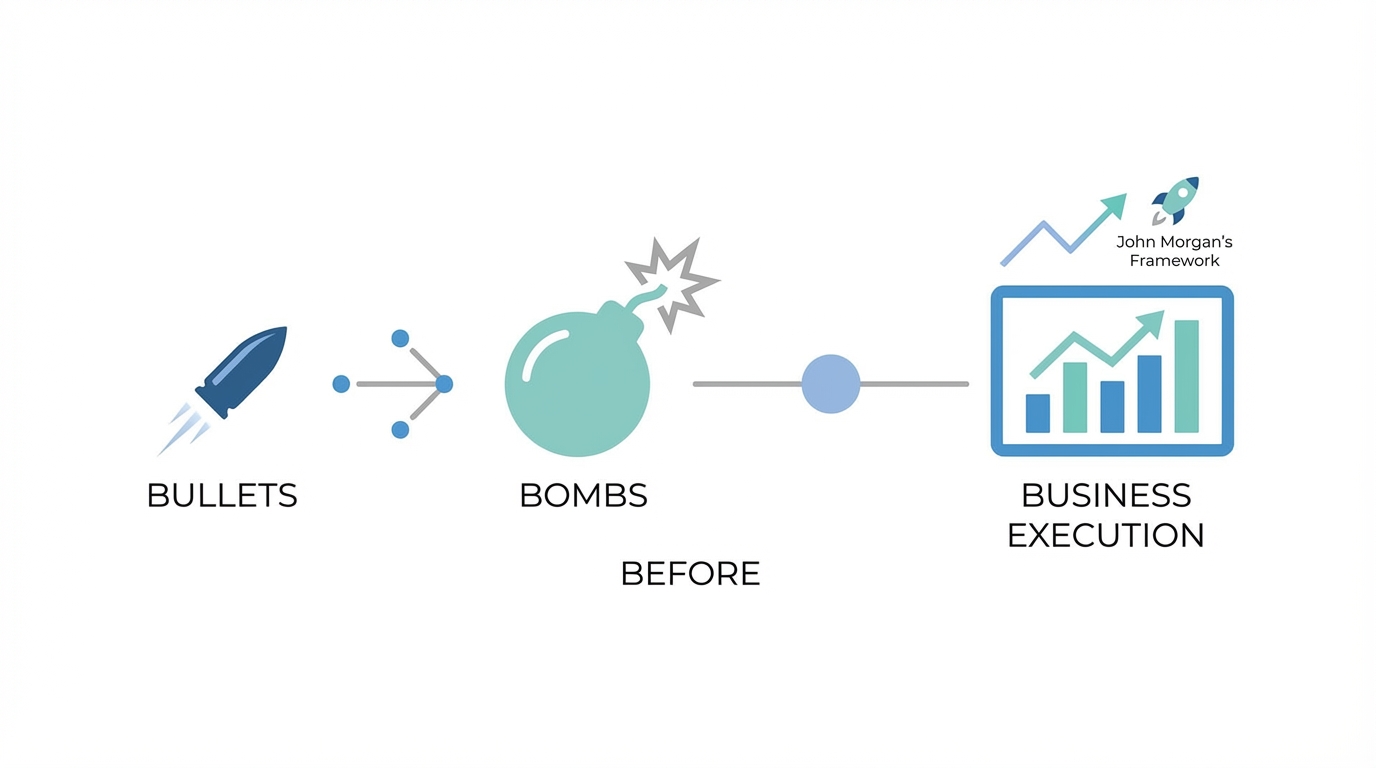
When John Morgan says, "I don't hunt deer, I hunt money," he isn't just leaning into a Southern persona. He is describing a cold, calculated approach to entrepreneurial risk management that has built one of the largest legal empires in the United States. While many founders get paralyzed by the fear of a massive failure, Morgan has spent decades perfecting a framework that treats failure not as a disaster, but as a data point. This approach, known as "Bullets before Bombs," (originally conceptualized by Jim Collins) provides a blueprint for any business leader looking to scale aggressively without gambling the entire farm on a single unproven idea.
Morgan’s success isn't limited to the courtroom. From $33 million in annual EBITDA from his Wonderworks attractions to a $600 million valuation for his legal tech company Litify, his portfolio is a masterclass in diversification and high performance leadership. The core of his philosophy lies in first principles thinking: deconstructing an industry to its basic truths and then applying aggressive capital to the most efficient levers. Whether you are scaling a mobile app or a chain of retail stores, understanding how to transition from small-scale testing to massive capital deployment is the difference between a market leader and a casualty of competition.
The "Bullets Before Bombs" Method: Scalable Risk Management


The "Bullets before Bombs" strategy is the cornerstone of how Morgan enters new markets. Instead of committing millions of dollars in capital and signing long-term leases on day one, he starts by firing "bullets"—small, targeted tests designed to prove a concept. In the context of scaling a business, this might mean launching a new city with just a handful of staff and a limited budget on Google Ads. If the lead volume and conversion rates show promise, he then brings the "bombs," which involves saturation-level advertising and massive infrastructure investment.
This method is particularly effective for mobile app developers and digital marketers. Before committing to a multi-month campaign on Apple Search Ads, smart teams use platforms like Stormy AI, an AI-powered platform for creator discovery, to discover and test UGC creators at a small scale. By seeing which creator's content resonates with a small audience, you can identify the "bullets" that hit the target before spending your entire budget on a "bomb" of a campaign that might miss entirely. This ensures that when you do decide to go big, you are doing so with a proven creative asset.
Morgan notes that many competitors fail because they try to build two or three pilots at once without ever getting the first one right. The goal of the bullet is to find the pilot that prints money. For Morgan, this meant testing the Atlanta market and realizing it could be a massive revenue driver, even after an initial struggle that left him $14 million in the hole. Because the underlying "bullet" data showed potential, he had the conviction to eventually deploy the capital necessary to turn Atlanta into a profit machine. In the digital space, this translates to monitoring your ROAS on Meta Ads Manager closely before scaling your daily spend from hundreds to tens of thousands.
Hunting "Big Game" vs. "Cockroaches"


A major differentiator in Morgan’s business growth strategy is his refusal to engage in low-margin, high-volume tasks that consume time without moving the needle. He calls this "hunting big game, not cockroaches." In the legal world, this means focusing on massive settlements rather than thousands of small, trivial cases. Morgan realized early on that 20% of his cases generated 80% of his revenue. By optimizing for the top 20%, he was able to scale his firm to over $2 billion in annual revenue.
This principle applies directly to app marketing and creator partnerships. If you are managing an influencer program, spending hours vetting small-scale creators who only drive a handful of installs is "hunting cockroaches." Instead, leveraging AI-powered tools like Stormy AI for finding UGC creators and influencers allows brands to identify "big game" creators who have the reach and engagement to drive massive app install volume. Focusing your energy on these high-impact partnerships ensures that your scaling efforts are concentrated where they will yield the highest return on investment.
Morgan’s focus on high-value targets also extends to his reputation and results. He doesn't take the "last best offer" from insurance companies. Instead, he prepares to go to trial, where the biggest payouts occur—often on the Friday before trial or even after a jury is selected. He recently secured a $500 million verdict in a landmark case, proving that holding out for the "big game" is a strategy that pays off for those with the infrastructure to support it. To replicate this, businesses must ensure their back-end operations and analytics on platforms like Google Ads are robust enough to handle high-stakes campaigns.
The "Walter Payton Rule": Parachuting in Top Talent
One of the most fascinating aspects of Morgan’s high performance leadership is what he calls the "Walter Payton Rule." Named after the legendary Chicago Bears running back, the rule is simple: when it is fourth and goal, you give the ball to your best player. Morgan employs a "stable of racehorses"—elite trial lawyers who don't necessarily live in the cities where they work. Instead, they are parachuted into high-stakes situations across the country to ensure a win.
In the world of growth marketing, this means identifying your top-performing "racehorse" assets—whether that's a specific UGC creator, a high-converting landing page, or a particular ad set on Meta Ads Manager—and deploying them aggressively when the stakes are highest. For example, during a major app launch or a seasonal push, you shouldn't be testing new, unproven talent. You should be using the creators who have already proven their value on Stormy AI to lead your campaign.
The Power of Specialization
Morgan’s "racehorses" are specialists. They aren't bogged down with administrative tasks or preliminary filings; they are focused entirely on the trial. This level of specialization is a first principles thinking masterstroke. By removing distractions, he allows his top performers to operate at their highest potential. Business owners should look at their own teams and ask: Are my top performers "hunting cockroaches" or are they focused on the fourth-and-goal situations? High-growth companies often find that by automating discovery through AI and delegating low-impact tasks, they can free up their "Walter Paytons" to drive 10x results.
Vetting Partnerships: "Love Them, Feed Them, Focus"

Scaling a business requires partners, but Morgan is meticulous about how those partners are managed. He follows a simple three-part rule: Love them, Feed them, Focus. To build the "Greatest Show on Earth," you must treat your top performers and partners with respect (Love), ensure they are making significant money (Feed), and keep them aligned on the primary goal (Focus). Morgan gives many of his partners a piece of the deal, ensuring their loyalty and performance are tied directly to the firm's success.
When working with content creators or external agencies, this framework is invaluable. If you find a creator via Stormy AI who consistently delivers high-quality UGC for mobile app ads, "feeding" them means increasing their compensation and providing them with consistent work. This builds a long-term partnership where the creator feels invested in your brand’s growth. At the same time, you must maintain "Focus" by providing clear creative briefs and tracking performance metrics on Apple Search Ads to ensure the content continues to meet your KPIs.
Morgan warns against the "drunk clown" circus—a business filled with low-quality partners and uninspired staff. By sharing the profits and maintaining a high standard of execution, he has created an environment where the best in the industry want to work for him. This is a vital lesson in entrepreneurial risk management: the biggest risk to a growing company is often not the market, but the quality of the people representing the brand.
Failure as a Friend: The Pigeon Forge Pivot
One of Morgan’s most cited lessons is that "failure can be your friend." He points to the National Museum of Crime and Punishment in Washington D.C. as a prime example. Despite a great concept and world-class artifacts (like OJ Simpson's Bronco and Ted Bundy’s VW), the museum struggled in D.C. due to high rent and competition from free Smithsonian museums. While his investors took their losses and walked away, Morgan had the conviction to double down.
He moved the entire attraction to Pigeon Forge, Tennessee, rebranded it as Alcatraz East, and invested an additional $8 million of his own money. Today, the attraction nets $5 million in annual profit. The lesson? A good concept in a bad location is still a good concept. In digital marketing, if a high-quality UGC video fails to convert on Meta Ads Manager, it might just be the wrong platform or the wrong targeting. Before abandoning the asset, consider a "pivot"—test it on Apple Search Ads or adjust the hook. Like Morgan, you must be able to distinguish between a bad idea and a bad execution environment.
The Aggressive Growth Playbook: How to Scale Like John Morgan

To implement Morgan’s high-stakes growth strategy in your own business or app marketing campaign, follow this step-by-step playbook:
Step 1: Identify Your First Principles
Deconstruct your business to its core truths. For Morgan, it was the realization that advertising for legal services was a "train leaving the station" that others were too proud to board. In app marketing, it might be the realization that UGC is the primary driver of installs in the current social landscape. Use data from Google Ads to identify what truly moves the needle.
Step 2: Fire the Bullets
Conduct small-scale tests. Hire a few creators from a platform like Stormy AI and run low-budget campaigns. Don't worry about profit yet; worry about brand building and data collection. If you can break even while building your brand, as Morgan did in his early days, you are winning.
Step 3: Analyze the Hit Rate
Review your results. Are you "hunting cockroaches" or have you found "big game"? Identify the creators and the ad sets on Meta Ads Manager that are delivering the highest LTV (Lifetime Value) users. Look for the "Walter Paytons" of your creative assets.
Step 4: Bring the Bombs
Once you have a proven hit, deploy your capital aggressively. This is where scaling a business happens. Increase your budgets on Apple Search Ads and saturate the market. As Morgan says, once you figure out the formula, your goal is to become "Kleenex instead of tissue."
Step 5: Love, Feed, and Focus Your Team
As you scale, ensure your partners are incentivized to stay with you. Whether it's through higher commissions for top creators or equity for key employees, make sure your "lions" are well-fed and focused on the next big win.
Conclusion: The Morgan Mindset
John Morgan’s success is not just a result of his legal expertise; it is the product of a high performance leadership style that embraces aggressive growth and calculated risk. By using the "Bullets before Bombs" method, focusing on high-value "big game" targets, and leveraging the "Walter Payton Rule" for talent, Morgan has built a multi-industry empire that prints money regardless of the economic climate.
For modern marketers and business owners, the takeaway is clear: Don't be afraid to test small, but be ready to go big when you find a winner. Whether you are finding the next viral creator on Stormy AI or optimizing your spend on Google Ads, the Morgan framework provides the discipline needed to scale without losing your shirt. Stop overthinking, start firing bullets, and when you see the target, don't hesitate to bring the bombs.