In 2026, the retail landscape has shifted from traditional SEO to Generative Engine Optimization (GEO). With the global AI-enabled e-commerce market projected to reach over $16 billion by 2030, with significant acceleration occurring here in 2026, the "manual" approach to catalog management is officially dead. For high-volume merchants, the challenge is no longer just writing 1,000 product descriptions—it is ensuring those descriptions are structured for AI shopping agents like Amazon’s Rufus or Shopify Sidekick.
Scaling a brand to thousands of SKUs requires more than just a copywriter; it requires an operational pipeline. While 89% of retailers have adopted some form of AI as of 2026, recent Gartner surveys suggest only a small fraction have fully scaled it across all back-office operations. This guide breaks down how elite brands are using bulk product descriptions Shopify strategies to eliminate the content bottleneck once and for all, often by hiring an AI ecommerce employee like Stormy AI to manage the messy back-office data flows.
"We're moving into a period where complexity is handled by systems, not by people. Connected intelligence is the operating model needed to stay relevant in 2026." — Aruna Ravichandran, SVP Cisco.
The Data-to-Description (D2D) Pipeline
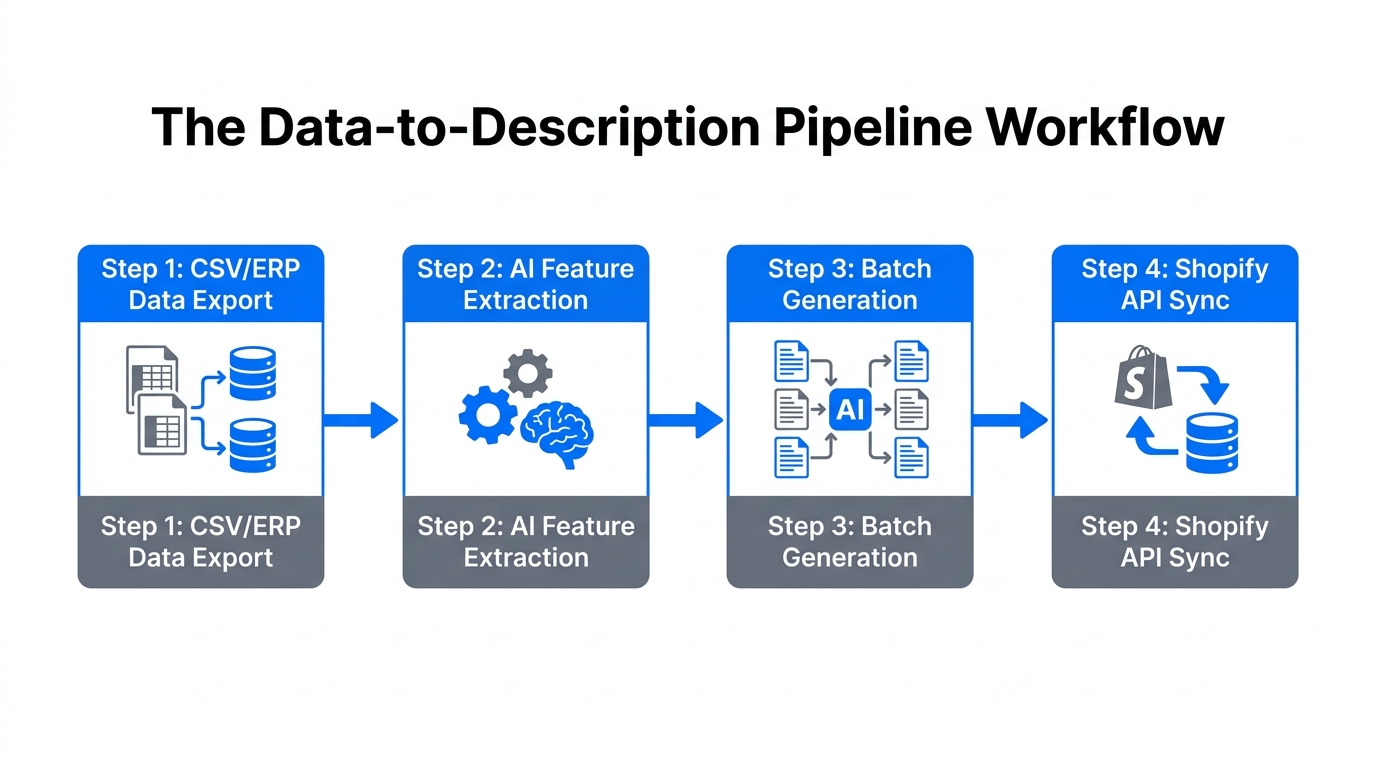
The most common mistake Shopify operators make is treating AI as a "creative writer" rather than a "data processor." In 2026, professional workflows use a Data-to-Description (D2D) pipeline. This ensures that every generated word is anchored in raw product specifications, preventing the dreaded "hallucination" where an AI claims a cotton shirt is fireproof.
Step 1: Rich Data Ingestion
Start by exporting your product data using a tool like Matrixify. Instead of just a title and price, you must feed the AI a Bullet String. This includes material, weight, target audience, and at least three technical benefits. An AI ecommerce employee like Stormy AI can automate this by scraping supplier PDFs or reading inbound emails from vendors to populate your master spreadsheet.

Step 2: Prompt Templating
Do not use "freestyle" prompting. Instead, map Shopify Metafields (like fabric_weight or compatibility_list) to a structured framework. The P-A-S-B Framework is the 2026 gold standard for high-converting PDPs:
- Problem: Identify the customer’s specific pain point.
- Agitation: Explain why that problem matters (e.g., wasting time, lost revenue).
- Solution: Introduce the product as the hero.
- Benefit Stack: 3-5 bullet points focusing on outcomes, not just specs.
Bulk SEO Tool Comparison: Describely vs. Hypotenuse vs. Stormy AI
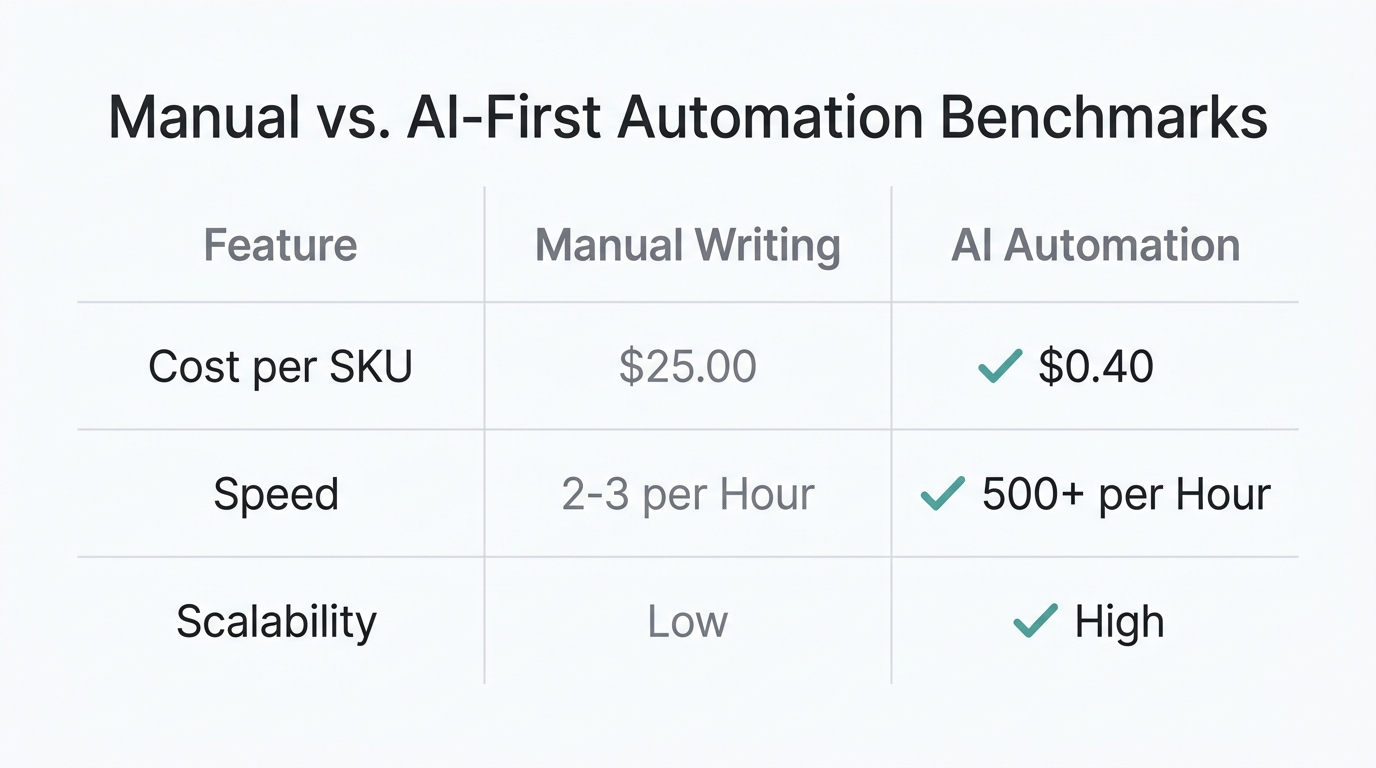
Choosing the right Shopify automation tools depends on your volume. While Shopify Magic is excellent for boutique stores with under 50 SKUs, enterprise-level brands require platforms that handle mass CSV imports and multi-platform syncing.
| Metric | Describely / Hypotenuse | Manual Copywriting | Stormy AI (Autonomous) |
|---|---|---|---|
| Speed | < 10 secs per product | 30-60 mins per product | Instant & Continuous |
| Cost | ~$0.10 - $1.00 per item | $50 - $200 per item | Included in Ops Salary |
| Scalability | High (CSV Uploads) | Hard (Linear Hiring) | Infinite (Agentic) |
| Workflow | SaaS Tool (Human-driven) | Manual | Autonomous (AI Employee) |
As seen in the table, while tools like Describely and Hypotenuse AI are powerful, they still require a human to log in, upload a file, and click 'generate.' In contrast, Stormy AI acts as a teammate that watches your inventory levels and supplier updates, generating and updating descriptions in the background without being asked.

Using Shopify Flow AI for Real-Time Updates
In 2026, static descriptions are a liability. Your automated product descriptions should change based on real-world events. Using Shopify Flow, you can set triggers that re-generate your copy whenever a supplier updates a raw specification or when a product’s inventory level drops below a certain threshold.
The "Dynamic PDP" Workflow
- Trigger: Product Metafield Updated (e.g., Supplier changes material from Polyester to Recycled Nylon).
- Action: Stormy AI detects the change in the shared spreadsheet, drafts a new SEO-optimized description emphasizing the sustainability angle.
- Approval: The draft is sent to a Slack channel for a quick "thumbs up" before going live.
This level of connected intelligence allows brands like Doe Beauty to save thousands in operational costs every week while keeping their catalog 100% accurate.
"AI is making some founders significantly more profitable, but others just busier... the difference is applying AI to a clearly defined problem." — Jay Wright, Founder of Ecommerce Equation.
Automated Auditing: Preventing 'Dangerous Hallucinations'
One of the biggest risks of ecommerce content scaling is the hallucination liability. AI models occasionally invent safety specs—claiming a toy is "BPA-free" when the data doesn't support it. Following the recent Search Quality updates, engines also penalize "low-value, repetitive AI content" that lacks factual grounding.
To scale safely to 1,000+ SKUs, you should implement an automated auditor. You can use Regex (Regular Expressions) inside a Google Sheet or ask Stormy AI to cross-reference every generated description against a "Prohibited Claims" list. If the AI detects a word like "waterproof" or "fire-resistant" in a product that doesn't have those attributes verified, the row is flagged for manual review immediately.
The 'Review by Exception' Strategy
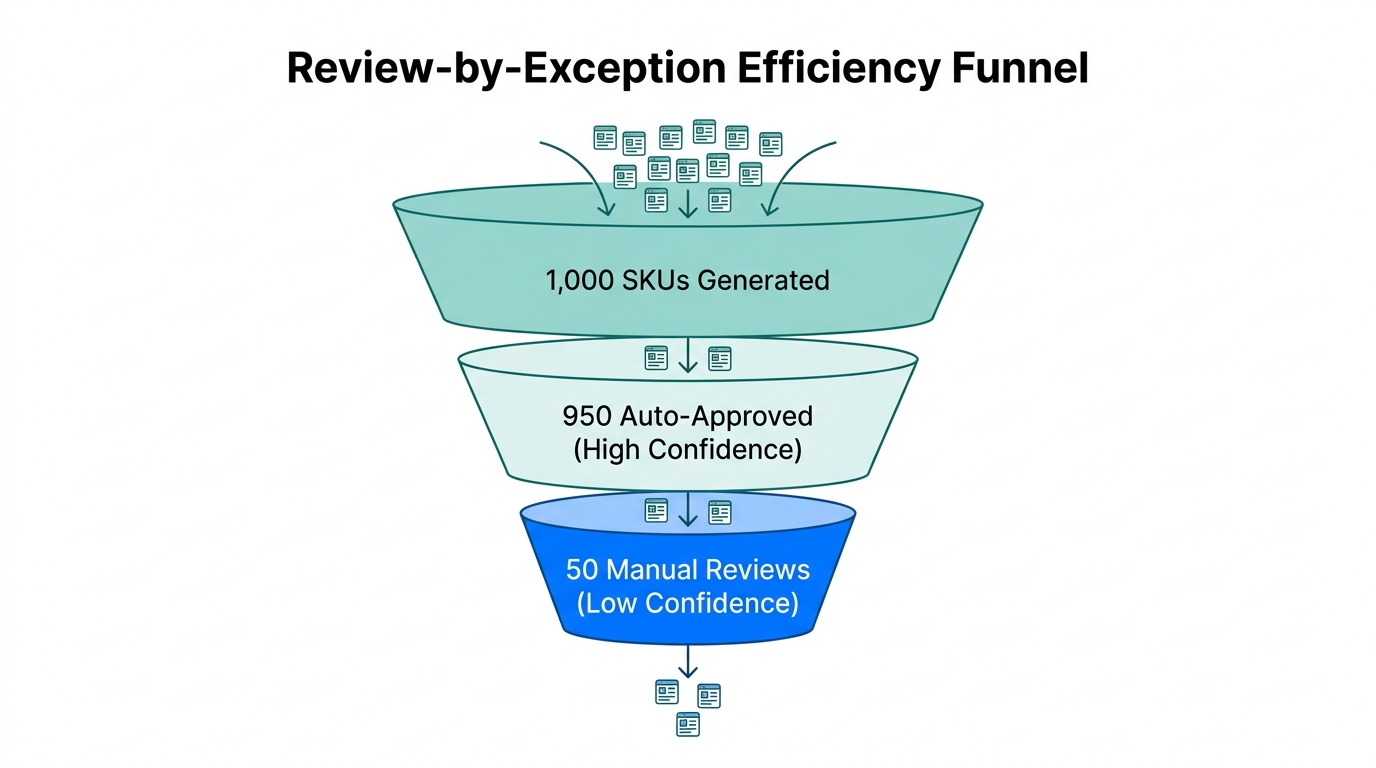
You cannot manually read 1,000 descriptions. The 2026 winning strategy is Review by Exception. This method allows you to save significantly on editorial costs while maintaining elite brand quality.
- The 80/20 Rule: Identify the 20% of products that drive 80% of your revenue. These "Hero SKUs" get a 2-minute human polish.
- The Automated Bulk: The remaining 80% of your catalog (long-tail items) are handled entirely by Stormy AI, which ensures they meet SEO and GEO benchmarks without human intervention.
- Feedback Loops: If a product starts trending or has a high return rate due to "item not as described," Stormy flags it for a human editor to rewrite.
By treating AI as a teammate that handles the volume while humans handle the nuance, you achieve a level of ecommerce content scaling that was impossible even two years ago. High-growth brands like Target Australia have already seen search revenue increases in the millions by automating metadata and personalizing product discovery through these types of AI workflows.
The Bottom Line for 2026
Scaling to 1,000+ SKUs on Shopify no longer requires a massive content team. By setting up a D2D pipeline, leveraging Shopify Flow AI, and hiring an autonomous AI employee like Stormy AI, you can manage your entire back office while you focus on brand strategy. The hybrid approach is the only way to win: use AI for the scale, the speed, and the structured data, but keep a human in the loop for the high-stakes hero products. Ready to stop being the bottleneck? Let Stormy handle your messy catalog spreadsheets so you can get back to growing your business.