By the start of 2026, TikTok is projected to reach a staggering 1.9 billion monthly active users. For growth marketers, this isn't just a statistic; it is a clear signal that the era of boutique, manual content creation is over. To compete in an environment where US TikTok Shop sales have exploded by over 108% to reach $15.82 billion in 2025, brands must evolve. The solution isn't hiring more editors—it is building a TikTok marketing automation engine. In this guide, we will explore how to transition from the slow "Chat AI" era to an "Action AI" model using Claude Code, Anthropic’s terminal-based agent, to build a high-volume content factory that maintains brand integrity at scale.
The Shift from Chat AI to Action AI
For the past two years, marketers have used Claude and ChatGPT as sophisticated typewriters. You paste a prompt, it gives you a caption. This is the "Chat AI" era. However, 2025 marks a pivot toward Action AI. Tools like Claude Code represent a shift where the AI doesn't just talk about work; it performs the work directly in your file system and terminal.
Unlike the web interface, Claude Code can read your brand guidelines, execute terminal commands, and interact with external APIs via the Model Context Protocol (MCP). According to research by Stormy AI, approximately 34% of Claude users are now utilizing the tool for mathematical and computer-based automation tasks rather than simple text generation. For a growth team, this means the terminal is becoming the new marketing dashboard, allowing you to bypass the productivity-killing context switching of jumping between browser tabs.
Setting Up Your Marketing Context: The /init Command
The biggest failure in AI content factory models is the loss of brand voice. When you automate, content often becomes generic. Claude Code solves this through the /init command. When you initialize a project, it creates a CLAUDE.md file—a persistent memory bank for the AI.
Instead of re-pasting your persona in every prompt, you hardcode your target audience personas and brand voice into this file. You can instruct the agent: "Always use a cynical but helpful tone," or "Never use emojis in the first 3 seconds of a script." This ensures that every sub-agent spawned by Claude Code adheres to your 2025 marketing strategy without manual oversight.
"The terminal is the new marketing dashboard. By staying in the CLI, marketers avoid the context switching that kills creative momentum."
Orchestrating the Creative Process with Sub-Agents
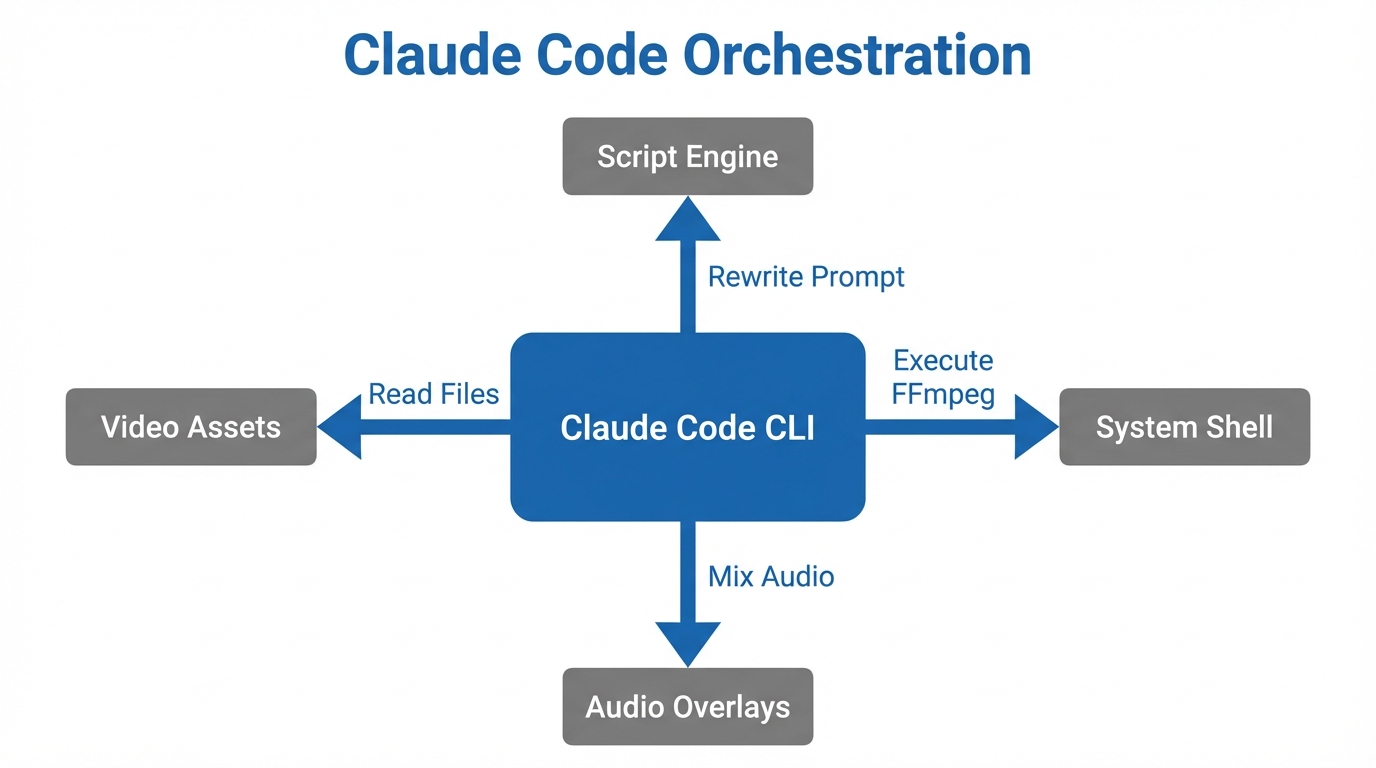
Building a social media automation 2025 workflow requires specialized roles. Rather than asking one AI to "do everything," Claude Code allows you to orchestrate sub-agents—mini-bots specialized in specific parts of the funnel. This architecture is what separates a chaotic automated mess from a professional content factory.
- The Researcher: Uses the Apify TikTok Scraper to identify trending sounds and hashtags in your niche.
- The Scriptwriter: Takes the research and generates 50 variations of automated video marketing hooks based on high-performing transcripts.
- The Visual QA Agent: Reviews the metadata and technical specifications of generated assets to ensure they meet TikTok’s upload requirements.
By using Simon’s TikTok MCP Server, you can even allow Claude to pull live data from the platform to inform its creative decisions in real-time. This level of orchestration ensures your content is data-driven, not just randomized.
| Feature | Manual Content Model | AI Content Factory (Claude Code) |
|---|---|---|
| Production Speed | 2-4 videos per day | 50+ videos per hour |
| Trend Integration | 24-48 hour delay | Near real-time via MCP scraping |
| Brand Consistency | Dependent on editor mood | Hardcoded via CLAUDE.md |
| Cost per Asset | High (Labor intensive) | Low (Compute intensive) |
The Step-by-Step Playbook: From CSV to Video Drafts
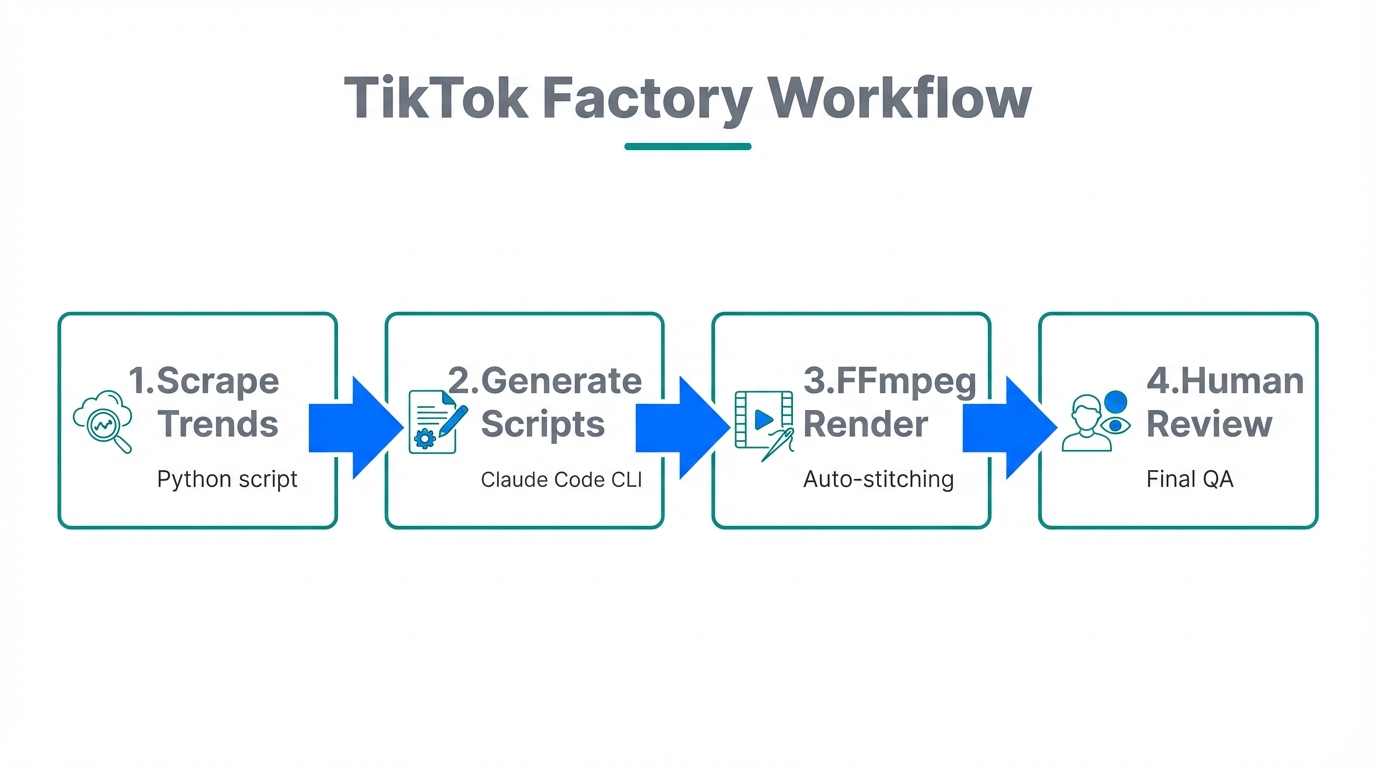
Ready to build? Follow this sequential playbook to set up your automated video marketing pipeline using Claude Code and local media tools.
Step 1: Data Sourcing and Trend Research
Start by pointing Claude Code at the TikTok Ads Library Fast MCP. Instruct the agent to scrape the top 20 performing ads in your category. Have it extract the first 3 seconds of the transcript—this is your hook data. Since 63% of successful TikTok ads deliver their message in the first three seconds, according to House of Marketers, this step is critical for performance.
Step 2: Programmatic Script Generation
Feed Claude a CSV of your product features. Use a prompt like: "Generate 30 TikTok scripts. Each must use a hook style found in the scraped data. Format as a JSON object with 'hook', 'body', and 'CTA'." At this stage, you might use Stormy AI to identify which creator styles are currently driving the highest engagement to further refine your scripts.
Step 3: Automated Asset Orchestration
This is where the magic happens. Ask Claude Code to write a Python script that uses FFmpeg or Remotion to overlay your script text onto background footage. You can programmatically add captions, sync the cuts to a specific BPM, and even remove watermarks. This removes the need for a human editor for high-volume, top-of-funnel testing.
"Automation should focus on content production and scheduling, not faking social proof through bots."
Measuring the Impact: Volume vs. Engagement
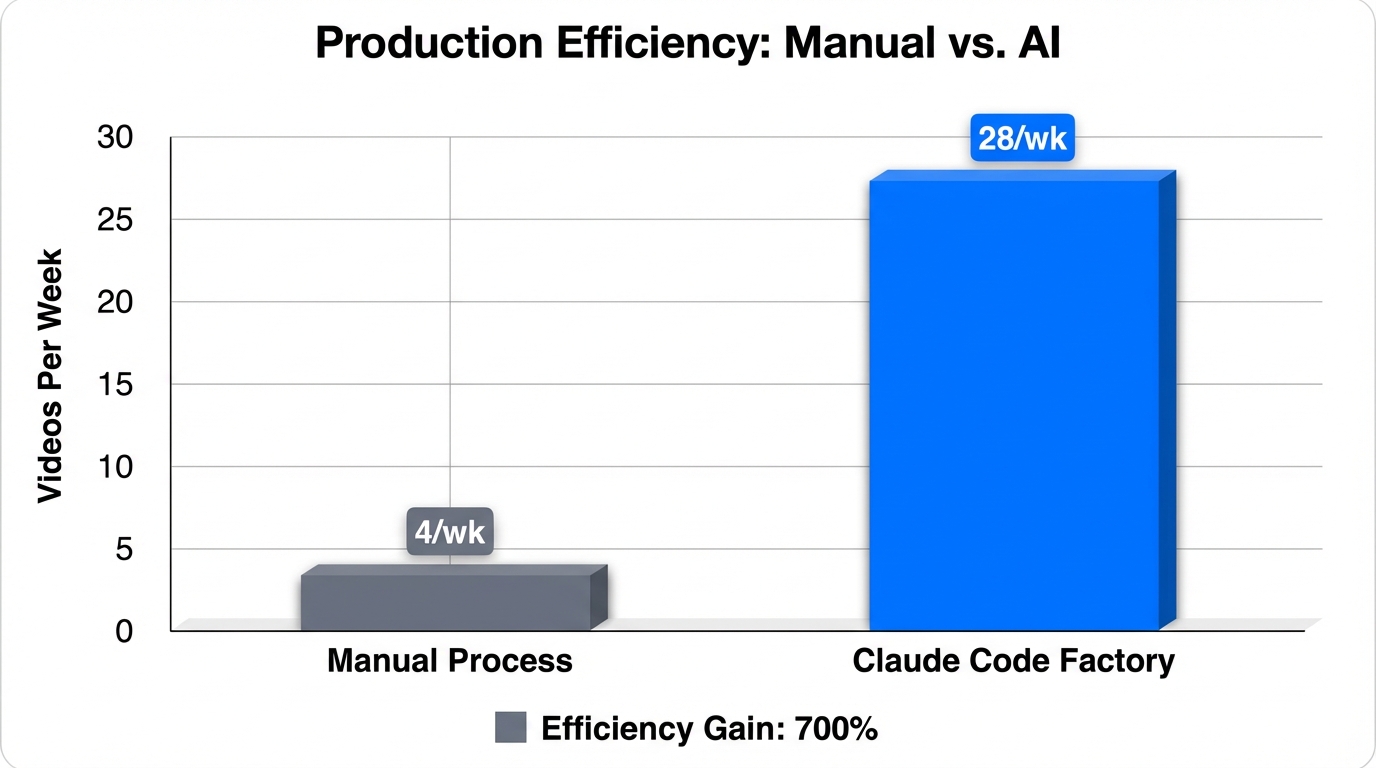
In 2025, TikTok rewards volume, but only if the quality threshold is met. TikTok maintains an average engagement rate of 4.86%, which is vastly superior to Instagram’s 0.48% as noted by Buffer. By moving to a factory model, you can test 10x more hooks than your competitors, finding the "winners" faster.
However, keep in mind that pure automation has its limits. While the factory handles bulk assets, platforms like Stormy AI can help source and manage UGC creators at scale to provide the authentic, high-impact human content that complements your automated efforts. Using the TikTok Ads MCP Server, you can then instruct Claude Code to monitor these campaigns: "Pause any ad group with a CPA over $15 and reallocate budget to the top-performing creative."
Common Pitfalls to Avoid in TikTok Automation
The most common mistake growth teams make is direct repurposing. Posting videos with watermarks from other platforms is an instant red flag for the TikTok algorithm. Use Claude Code to automate original rendering via FFmpeg instead of "ripping and shipping."
Another mistake is over-automation of social interactions. As emphasized by Octoparse AI, your automation should focus on the supply chain of content—research, scripting, and editing—rather than trying to fake likes or comments, which triggers platform penalties.
Conclusion: The Future is Programmatic
Transitioning to a TikTok marketing automation model with Claude Code isn't just about saving time; it's about gaining a competitive edge through data-driven volume. By moving your workflow into the terminal, you enable a level of speed and precision that manual teams simply cannot match. Start small: use Claude Code to scrape one trend and generate five scripts today. As you build your CLAUDE.md and refine your MCP connections, you'll find that your capacity for growth is limited only by your creativity, not your headcount. For managing the human side of this equation—the influencers and UGC creators who bring your brand to life—integrate Stormy AI into your workflow to ensure your factory always has the best human talent to work with.