The traditional workflow of digital advertising is broken. For a decade, creative directors and growth leads have been locked in a manual cycle of design, launch, and burn—only to repeat the process when performance inevitably dips. This phenomenon, known as ad fatigue, is the silent killer of ROAS. As algorithms become more sophisticated, the bottleneck has shifted from media buying to creative production. Today, the most successful brands are abandoning the concept of "static ads" entirely. Instead, they are building generative creative systems that leverage Smartly.io and Marpipe to generate, test, and iterate thousands of ad variations in real-time. This isn't just about efficiency; it's about survival in an era where AI handles the targeting, leaving the creative as the only remaining lever for growth.
The Shift from Static Ads to Creative Systems
We are entering what many industry insiders call the "Black Box" era of advertising. According to research from Dataslayer.ai, Meta is moving toward a future where advertisers will eventually input only a business URL and a budget, while AI handles the creative generation, audience selection, and spend optimization. This shift is already reflected in the numbers: Meta’s Advantage+ campaigns are delivering up to 22% higher ROAS than manual campaigns, generating an average of $4.52 for every $1 spent compared to $3.70 for manual setups, according to Get-Ryze.ai.
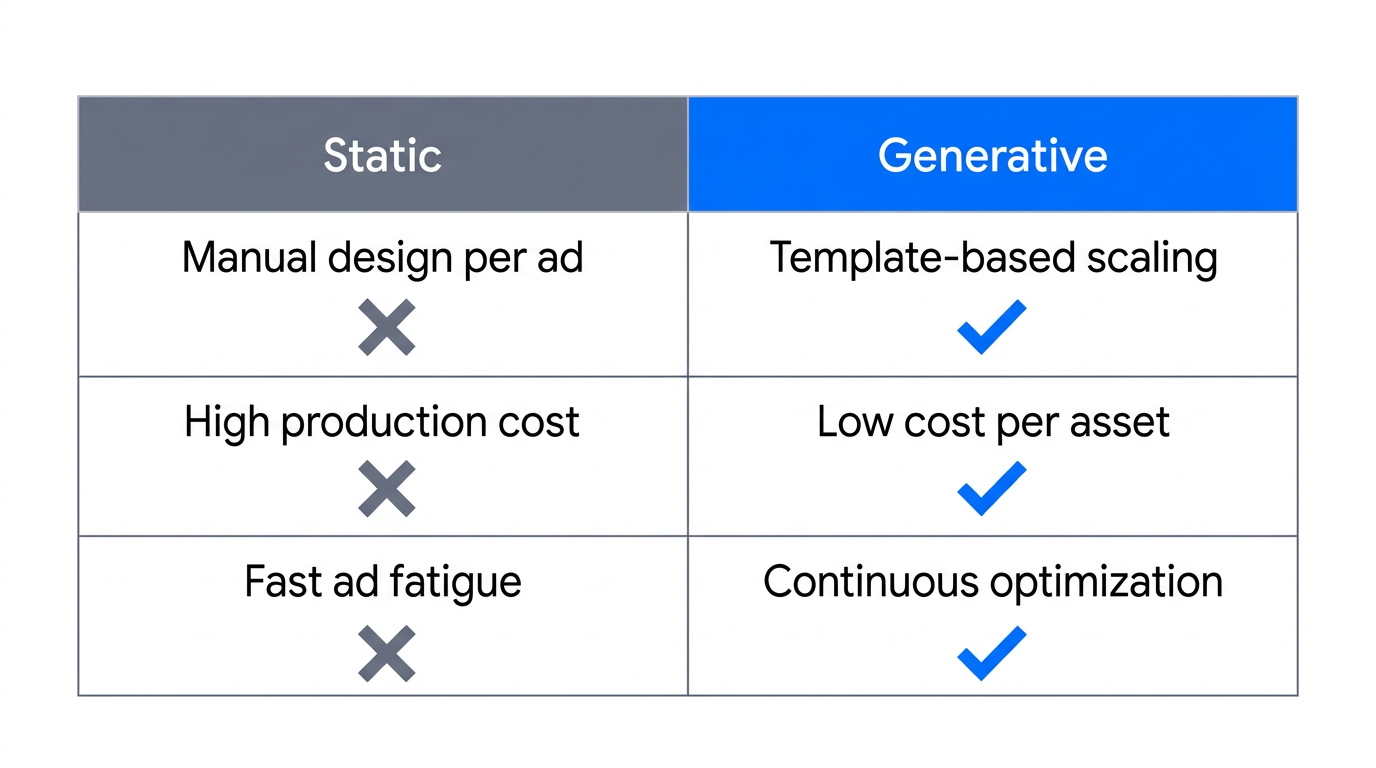
To keep up, brands must move from manual design to generative creative scaling. This involves using AI for automated resizing, background generation, and the creation of "Video Highlights" that extract key scenes for Instagram Reels. By automating these repetitive tasks, marketing teams can save an average of 52 hours per month, as noted by Templated.io. The goal is no longer to create one perfect ad, but to build a system that produces a constant stream of high-quality content optimized for every placement and user preference.
"The bottleneck has shifted from media buying to creative production. In the AI era, the creative is the only remaining lever for growth."
Hypothesis Testing with Marpipe: The Science of CTR
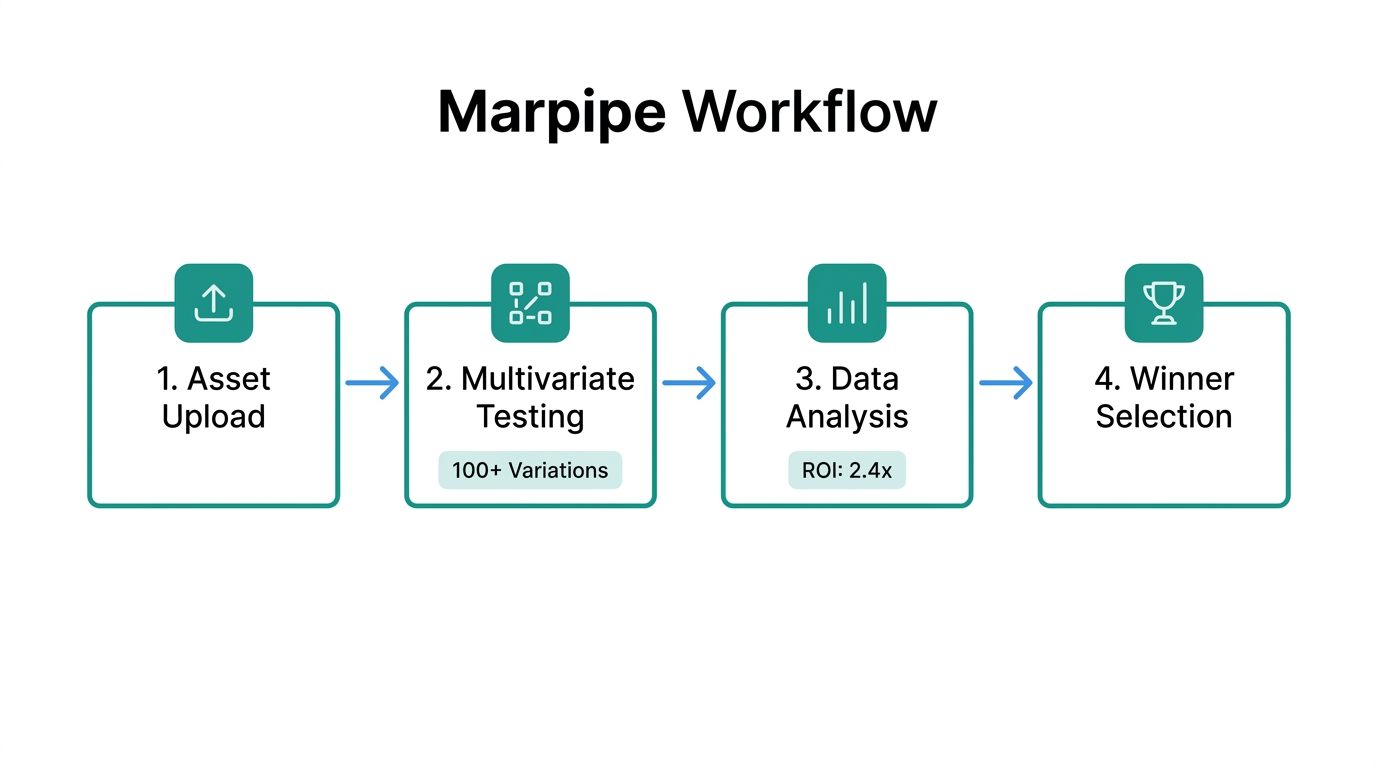
If Smartly.io is the engine of creative scale, Marpipe is the laboratory. One of the biggest mistakes brands make when moving to AI ad creative is generating volume without a hypothesis. Without a structured testing framework, you are simply creating noise. Experts recommend the "3-6 Rule": providing the algorithm with 3 to 6 distinct creative variations per ad set to give the AI enough data to learn effectively (AdAmigo.ai).
Marpipe allows you to break down your creative into modular components—backgrounds, headlines, CTAs, and talent. By testing these variables in isolation, you can determine exactly which elements drive CTR. For example, does a lifestyle background outperform a studio shot? Does a "Buy Now" button work better than "Shop Now"? This level of granularity ensures that your generative system is fed with data-backed insights rather than creative guesswork. Using AI to optimize for "Value" (high-revenue customers) instead of just generic conversions can increase in-app revenue by as much as 59%, according to Topkee.com.sg.
Enterprise-Level Creative Automation with Smartly.io
For global brands, the challenge isn't just creating a few variations—it's managing thousands across multiple languages, regions, and platforms. This is where Smartly.io excels. It allows teams to create a single master template and then use Dynamic Creative Optimization (DCO) to automatically populate it with different assets based on the viewer's profile. This level of automation is why approximately 85% of digital advertisers have now adopted some form of AI-powered bidding or creative strategies (SocialPulseStats.com).
| Feature | Traditional Manual Ad Production | AI Generative Creative System |
|---|---|---|
| Production Time | Days or Weeks | Minutes |
| Variations | 3-5 total | 1,000+ |
| Testing | Sequential A/B testing | Multivariate (DCO) |
| Localization | Manual translation & design | Automated template population |
| Optimization | Human intuition | Algorithmic (ROAS-based) |
To truly scale this system, you need a steady stream of raw assets. While AI can generate backgrounds and text, authentic user-generated content (UGC) remains the highest-converting fuel for these templates. When sourcing and vetting creators to feed your creative pipeline, platforms like Stormy AI can help growth leads discover and manage UGC creators at scale, ensuring the system never runs out of fresh, human-centric assets to modularize.
Case Study: How Generative AI Increased CTR by 450%
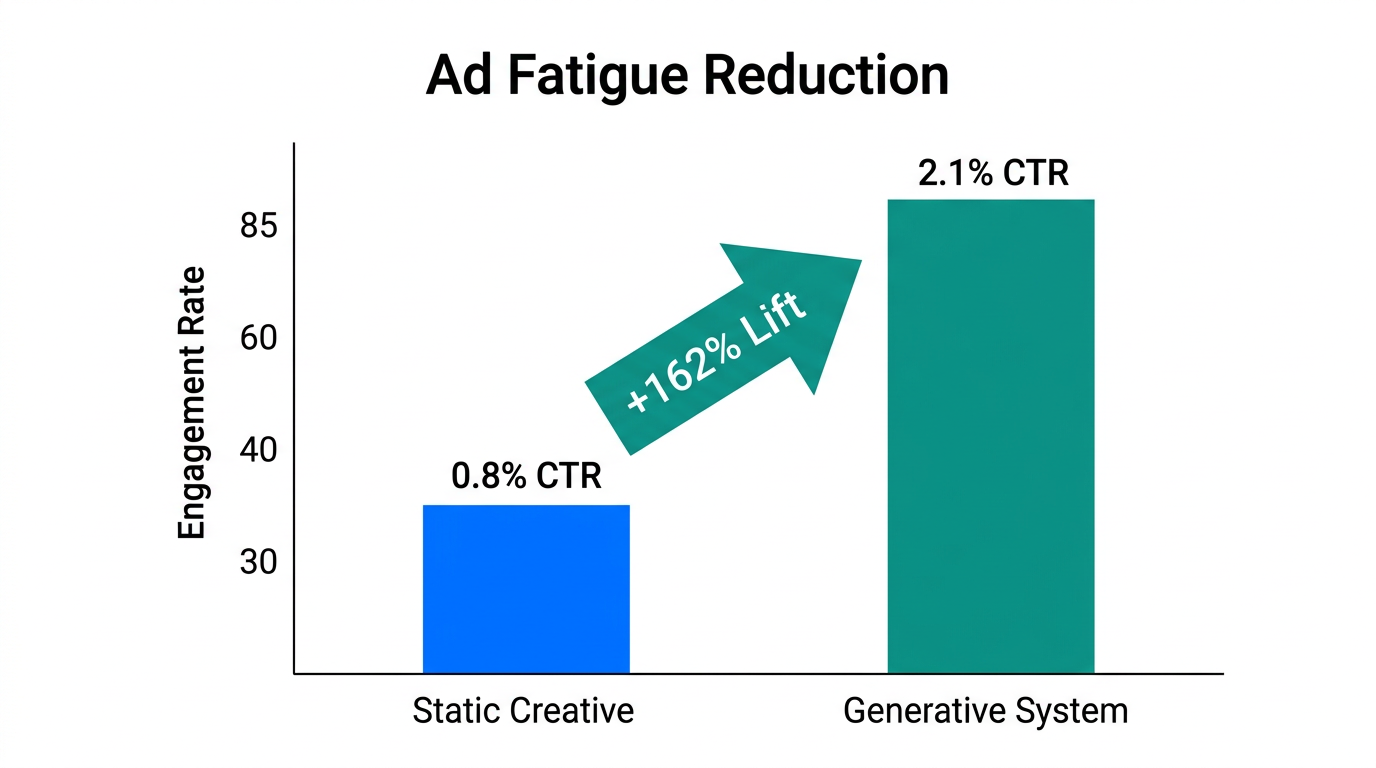
The power of generative AI for marketing is best illustrated by the success of JPMorgan Chase. The financial giant partnered with Persado to apply generative AI to their ad copy and headlines. Instead of relying on a human copywriter's intuition, Persado’s AI analyzed millions of data points to determine which specific words and emotions resonated with different audience segments.
The results were staggering: the AI-generated headlines resulted in a 450% increase in CTR compared to those written by the bank’s internal marketing team (DataFeedWatch.com). This case study highlights a critical reality—AI can predict human response better than humans can, provided it has access to enough historical performance data.
"JPMorgan Chase saw a 450% lift in CTR by letting AI handle the nuance of ad copy, proving that data-driven creativity is the new standard."
Maintaining Brand Consistency and Avoiding the "Uncanny Valley"
While the scale provided by AI is seductive, it comes with risks. In 2025, major brands like Coca-Cola and McDonald's faced significant backlash for AI-generated holiday ads that consumers described as "glitchy" or "uncanny" (The Verge). Neglecting brand consistency can lead to "brand dilution" where the AI generates thousands of variations that drift away from your established visual identity (SizeIM.com).
To prevent this, creative directors must set strict brand guardrails within tools like Smartly.io. This includes:
- Locking Brand Colors and Fonts: Ensure the AI cannot deviate from the hex codes and typography defined in your brand book.
- Template Overlays: Use fixed borders or logo placements that remain constant across all AI-generated variations.
- Human-in-the-Loop Review: Even with automation, a human should audit a sample of variations to ensure they don't feel "soulless" or "creepy."
- Feeding High-Quality Signals: Ensure your Conversions API is correctly integrated so the AI optimizes for the right brand-aligned actions (Webmoghuls.com).
The Implementation Playbook for Growth Leads
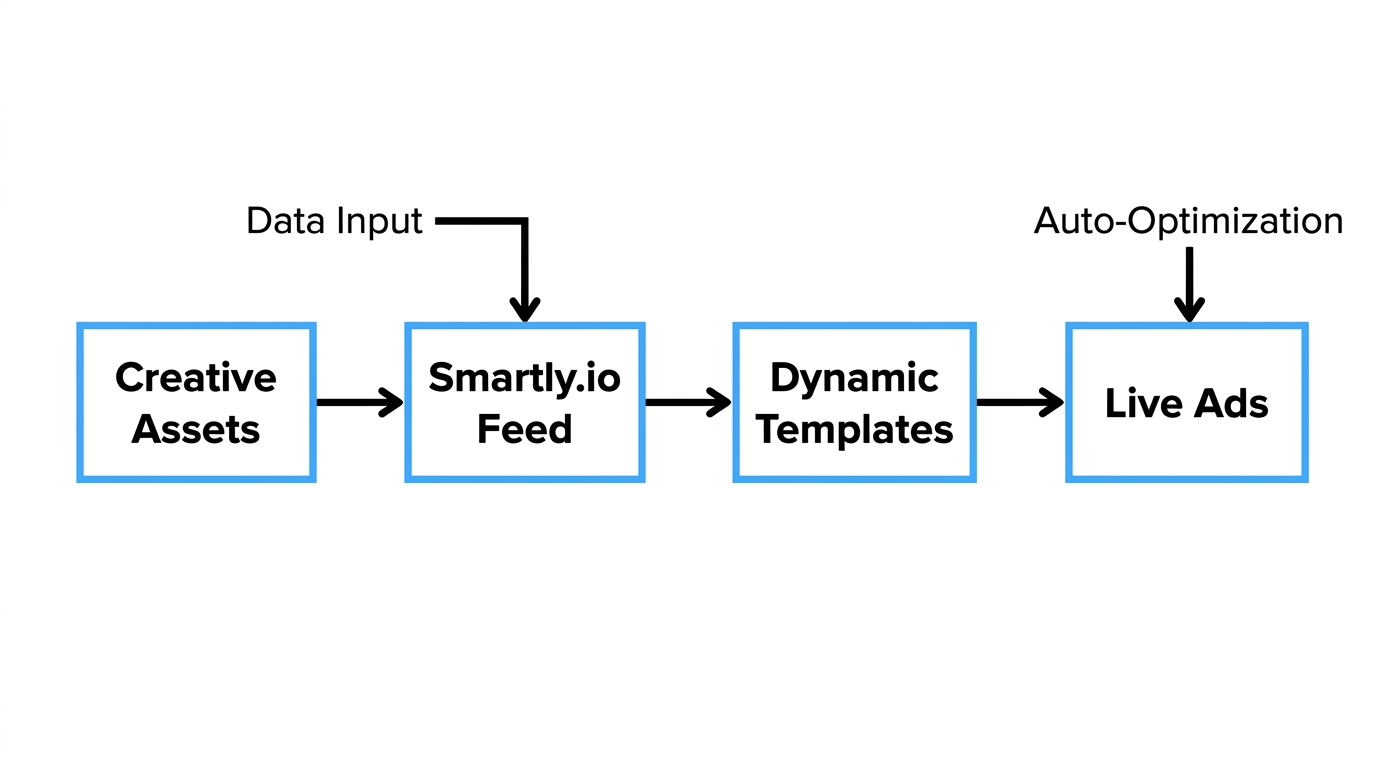
Ready to move from manual ads to a generative system? Follow these steps to build your creative engine.
Step 1: Audit Your Data Pipeline
Before launching an AI campaign, ensure your tracking is flawless. Running AI automation without a working Meta Pixel or Conversions API is a recipe for disaster. If the data is flawed, the AI will optimize for the wrong actions (Webmoghuls.com). AI requires a learning phase, typically needing at least 50 conversions per week to stabilize performance (Pipeboard.co).
Step 2: Source Raw Assets
Collect high-quality video and imagery. This is where you feed the system. Using tools like Stormy AI, you can find creators who align with your brand niche to provide the authentic, raw footage that will be modularized in the next step.
Step 3: Build Modular Templates in Marpipe
Upload your assets to Marpipe and create a multivariate test. Test 3-5 different backgrounds against 2-3 different hooks. Run this for a short period to identify which creative components are high-performers.
Step 4: Scale Winners in Smartly.io
Take the winning elements from your Marpipe tests and build them into Smartly.io DCO templates. Use these templates to automatically generate thousands of localized and personalized ads for different audience segments. You can even pair this with a tool like Revealbot to set rule-based triggers that pause ads if ROAS drops below a certain threshold.
Step 5: Continuously Refine
Generative systems are not "set and forget." Monitor the performance of your systems and replace underperforming "modules" with new creative hypotheses. The goal is a perpetual creative loop that stays ahead of ad fatigue.
Conclusion: The Future of Ad Creative
The social media automation market is projected to reach $12.8 billion by 2033 according to reports on Templated.io. As we move closer to a world of fully autonomous campaigns, the role of the marketer is shifting from "creator" to "curator." By implementing systems like Smartly.io and Marpipe, you can stop fighting ad fatigue and start leveraging it as a competitive advantage. The future of advertising belongs to those who can build systems that learn as fast as the algorithms they run on.