Most entrepreneurs treat talent acquisition like a trip to the grocery store: they wait until they are hungry, walk down the aisles of LinkedIn, and pay the market price for whatever is on the shelf. But the most successful organizations in the history of business, sports, and even nation-states don’t just buy talent—they grow it. This concept, known as a talent farm or a "farm league" approach, shifts the focus from hiring for past experience to identifying and developing elite potential early. Whether it is a multi-billion dollar hospitality empire or a state-sponsored math academy, the goal is the same: find the raw materials of greatness and refine them before the competition even knows they exist.
To build a world-class organization, you must stop looking for the finished product and start looking for the signs of future dominance. By implementing a talent acquisition strategy that prioritizes long-term workforce development for startups, you can create a competitive advantage that is impossible to replicate through headhunting alone.
The 'Produce Talent Quickly and Early' Philosophy
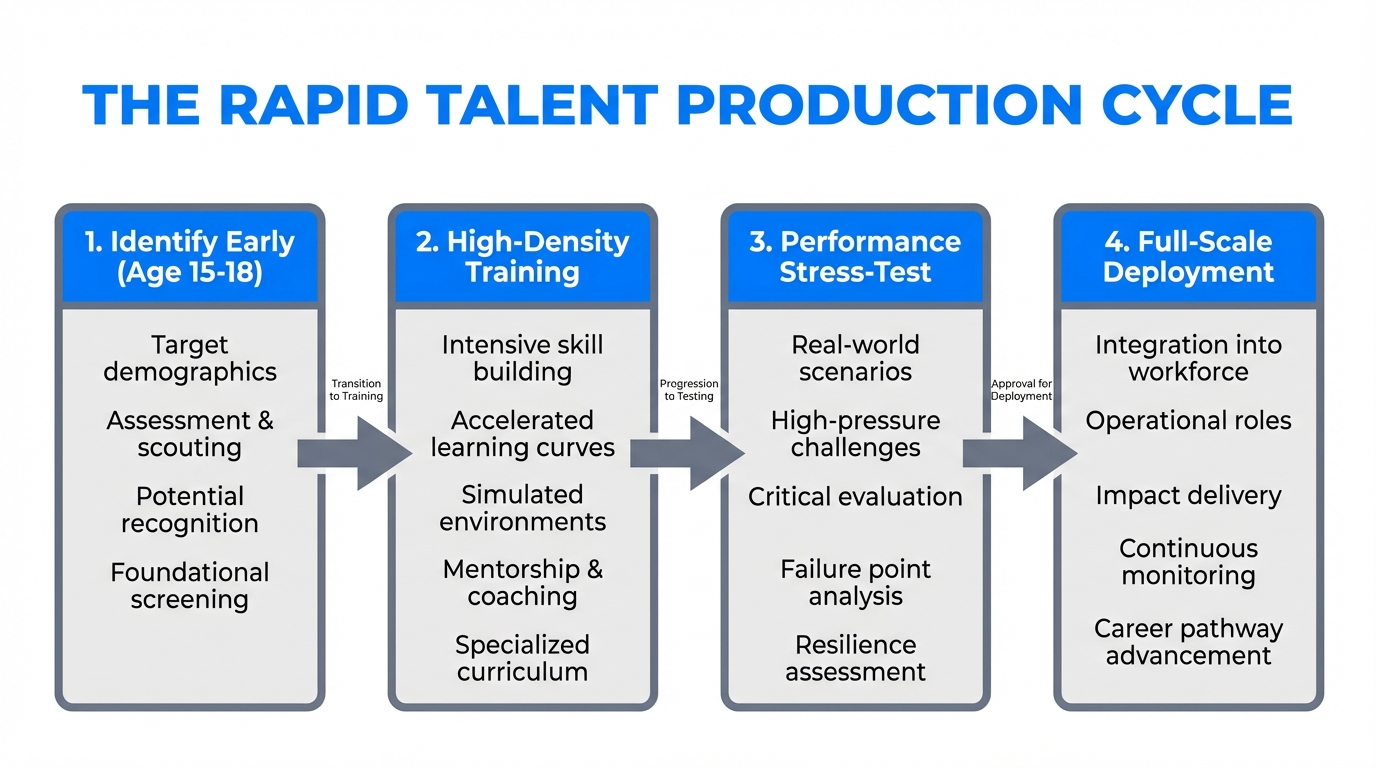
In many Western educational systems, the focus is on "No Child Left Behind"—a philosophy of inclusion and remediation. While socially noble, this approach is the exact opposite of what is required for high-performance team building. In contrast, many of the world’s most competitive environments operate under a blunt, uncompromising slogan: "Produce talent quickly and early."
Consider the "Genius Program" in China, such as the Special Class for the Gifted Young, which identifies children with exceptional aptitudes for math and science. These students are pulled out of traditional schooling and placed into intensive boot camps. They skip standard college entrance exams and dive straight into high-level research and development. The result? These "geniuses" are the engines behind global giants like TikTok and major AI breakthroughs that outpace even the most well-funded Western labs. They aren't just finding talent; they are manufacturing it at scale.
For an entrepreneur, this means moving away from the safety of the "senior hire" and toward the high-leverage "high-potential hire." While a senior executive brings a Salesforce-ready resume, a high-potential junior employee offers a blank slate and a steeper growth trajectory. When you identify someone with the right cognitive horsepower and cultural alignment at age 21, you can mold them into the perfect leader for your specific entrepreneurship leadership needs by age 25.
"The most valuable real estate and the hardest real estate to build is the one in the consumer's mind. The same is true for your team—you must build your identity in their minds before they are shaped by the mediocre habits of other companies."Case Study: Butch Stewart and the Art of the 'Un-Business' Hire
Gordon "Butch" Stewart, the founder of Sandals Resorts, built a multi-billion dollar empire by identifying talent where others saw only "odd job" workers. When Stewart started his first business, Appliance Traders Limited, he was selling air conditioning units door-to-door in Jamaica. He didn't have the budget to hire corporate sales veterans from legacy giants. Instead, he hired local "island boys"—young men with high energy and no preconceived notions about how business was "supposed" to be done.
Stewart’s talent acquisition strategy was based on two non-negotiable traits: speed and service. He realized that while big corporations had more resources, they were slow. He trained his young, hungry team to guarantee AC installation within 8 hours of a call. This wasn't a feat of engineering; it was a feat of workforce development. He took raw potential and focused it on a singular, competitive advantage. By the time he moved into the resort business, he had a "farm league" of loyal, high-performing managers who had been with him since the AC days.
This vertical integration extended even to his airline, Air Jamaica. He didn't just buy an airline; he used it as a talent pipeline to ensure the "Sandals experience" began at the airport. He understood that the first and last impression of a customer’s vacation was the flight. By controlling the talent at every touchpoint, he maintained a 50% repeat guest rate—a figure nearly unheard of in the luxury hospitality industry. Stewart’s success proves that scaling business teams isn't about finding people who have done the job before; it’s about finding people who are wired to do the job better than anyone else.
| Hiring Component | Traditional Corporate Strategy | Talent Farm Strategy |
|---|---|---|
| Primary Metric | Years of Experience | Raw Aptitude & Hunger |
| Onboarding | Compliance & Policy | Intensive Skill Immersion |
| Cost Basis | Market Premium (Expensive) | Investment in Growth (High ROI) |
| Loyalty | Low (Transactional) | High (Mentorship-Based) |
The Michelangelo Effect: Unveiling the Elite Performer
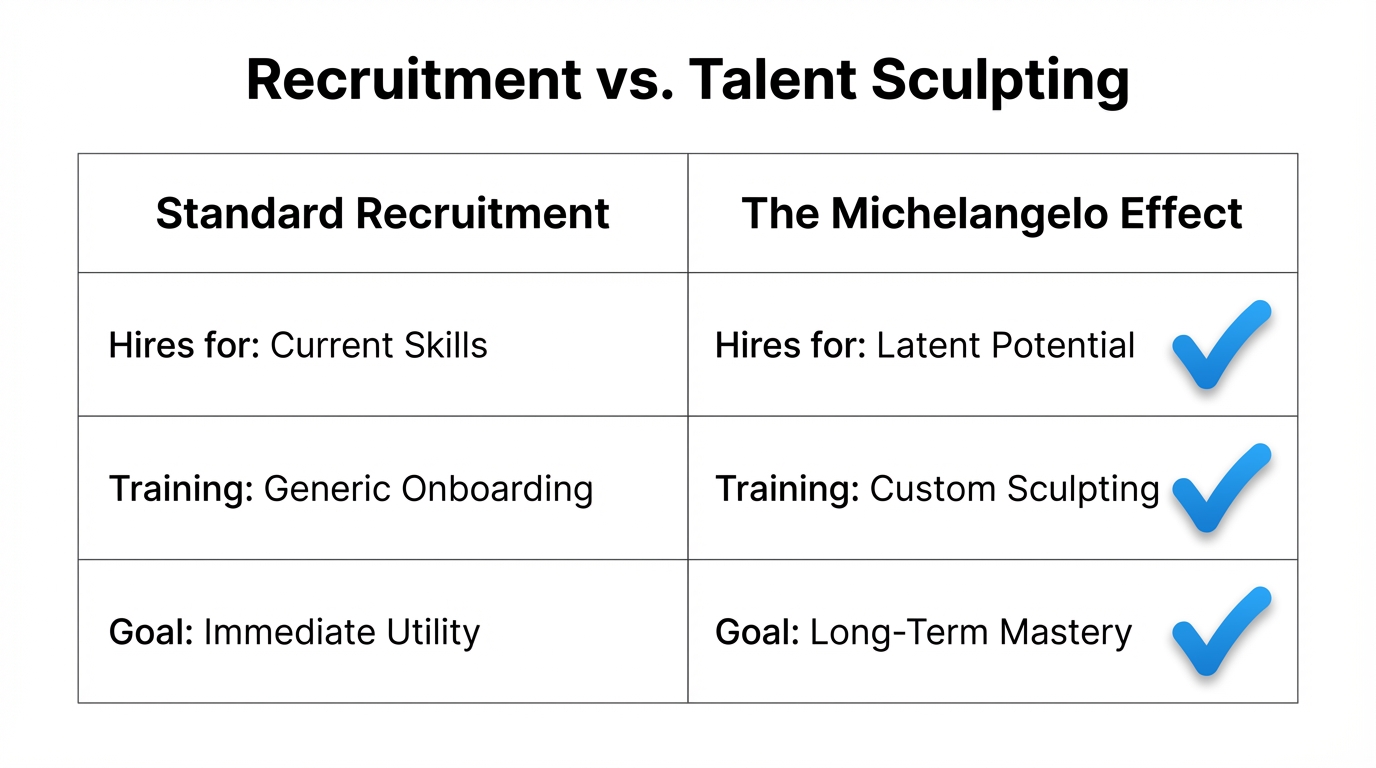
How do you actually turn a "high-potential" hire into a high-performer? Psychology points to the Michelangelo Effect. When Michelangelo was asked how he created the statue of David, he famously replied that the statue was already there—he simply chipped away the excess stone. In entrepreneurship leadership, your job is to chip away at an employee’s self-doubt and lack of skill until their inner excellence is revealed.
Research shows that when leaders affirm their team members and set extraordinarily high expectations, the employees often rise to meet them. This is a form of social sculpting. If you tell a junior developer that they have the potential to be a CTO, and you consistently treat them as if that potential is a fact, they begin to internalize that identity. They start working, thinking, and leading like a CTO. They use tools like Notion or Linear not just for tasks, but as architects of a system.
This effect is what makes programs like the Duke Talent Identification Program (TIP) so successful. By simply telling a middle-schooler that they are "talented" based on a test, you plant a seed of identity that can drive their academic and professional success for decades. For your business, this means creating internal awards, specific titles, and public affirmations that reinforce the elite status of your "farm league" members.
"The greatest gift you can give a high-potential employee is not a raise, but a belief in their own inevitable greatness."Creating Your G-League: A Playbook for Startups
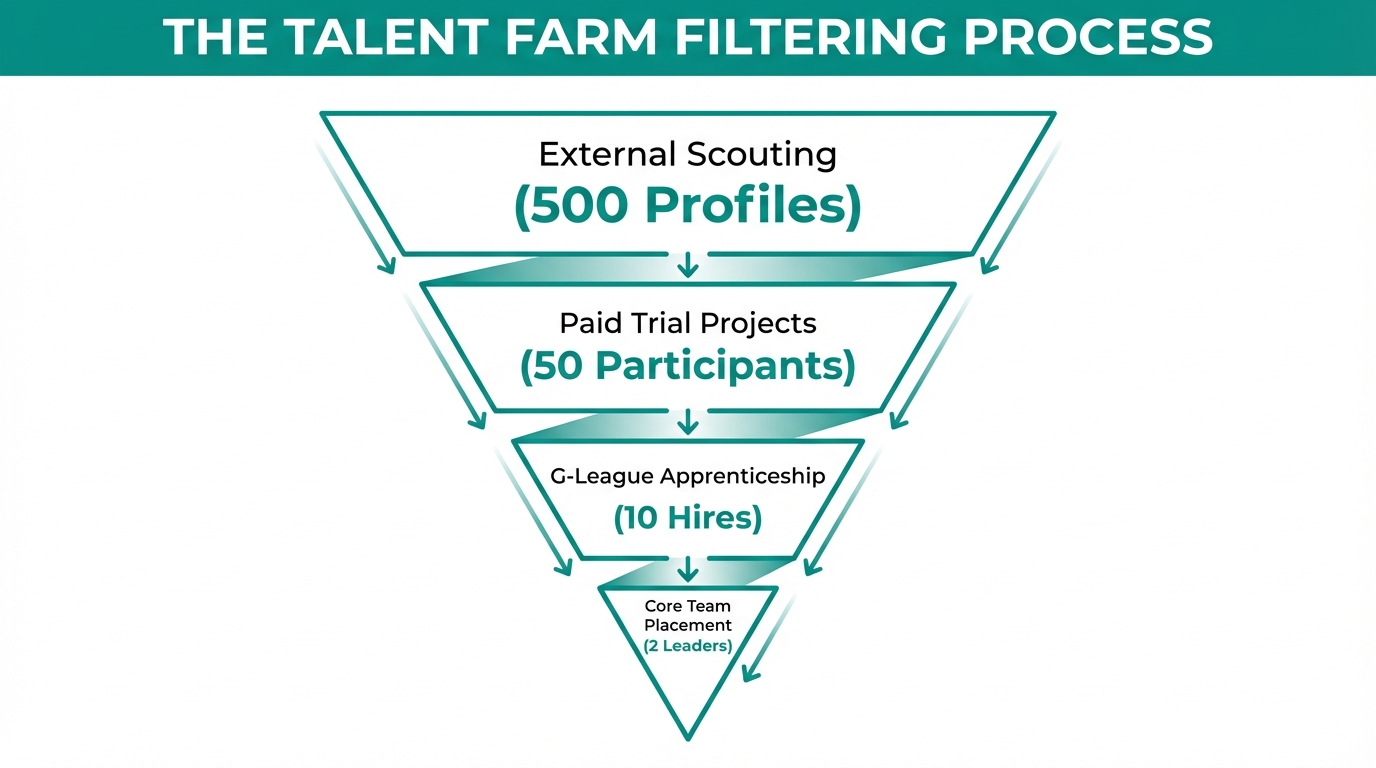
You don't need a government budget to build a talent farm. You can start by creating what many call a "G-League" (after the NBA’s developmental league) or an intensive internship program. This is a structured environment where young talent is vetted, trained, and filtered before being offered high-stakes roles. This is essential for workforce development for startups where every hire is a massive risk.
Step 1: Identify the "Genetic" Markers of Your Role
Before you hire, define the raw traits that cannot be taught. For a sales role, it might be resilience and verbal agility. For a technical role, it might be first-principles thinking. Use assessments to screen for these before you even look at a resume. Tools like Stormy AI can help you source and vet potential talent—like UGC creators or brand ambassadors—by analyzing their performance data and "brand fit" long before you sign a contract.
Step 2: Create a High-Pressure 'Vetting' Project
Instead of a standard interview, give potential talent a real-world problem to solve in 48 hours. This mimics the "Produce Talent Quickly" model. Those who thrive under pressure and show creative problem-solving are your farm league candidates. Don't worry about whether they use Canva or Figma perfectly; look at the logic behind their decisions.
Step 3: Vertical Mentorship
Pair your farm league hires with your top performers. This isn't just about learning the tech stack; it's about cultural indoctrination. They need to see how decisions are made in the trenches. This is how tech giants have successfully integrated young talent into elite AI "super intelligence" teams—by immersing them in an environment where they could learn from the best in the world daily.
Step 4: Continuous Tweak and Calibrate
Butch Stewart was famous for "tweaking" his hotels daily. He would sleep in the beds and check the champagne temperature. You must do the same with your talent pipeline. Monitor the performance of your farm league using analytics tools like Mixpanel or PostHog to see which internal projects are succeeding. If a certain type of hire isn't working out, adjust your identification markers immediately.
The Modern Talent Stack: AI and Human Potential
In today's landscape, scaling business teams requires a blend of human intuition and AI efficiency. Just as high-performance sports programs use data to optimize their athletes' performance, modern companies use data to optimize their workforce. For example, when sourcing creators for marketing campaigns, platforms like Stormy AI allow you to identify high-potential influencers by detecting fake followers and analyzing audience quality automatically. This allows you to build a "farm league" of creators who can drive real growth without the manual overhead of traditional vetting.
By automating the discovery and outreach process, you can focus on the Michelangelo Effect—mentoring your creators and employees to reach their full potential. Use TikTok Ads Manager or Meta Ads Manager to test the output of your talent farm. When you find a winner, double down. This data-driven approach ensures that your talent acquisition strategy is backed by hard evidence, not just gut feeling.
"The winner of the AI era won't be the one with the most data, but the one who best identifies and empowers the humans who can leverage it."Conclusion: Playing the Long Game in Talent
Building a talent farm is a long-term play. It requires the patience of a gardener and the ruthlessness of a scout. You must be willing to invest in young potential, create your own internal "universities," and constantly affirm the greatness of your team. The entrepreneurship leadership of the future isn't about finding the perfect person today; it's about creating a system where the perfect person is inevitable.
Whether you are building a hospitality giant or a cutting-edge tech firm, remember that talent is not a static resource. It is a crop. If you plant the right seeds, provide the right environment, and chip away at the excess, you will build a high-performance team that no competitor can buy away from you. Start your farm today, and you'll never have to worry about the talent market again.