In 2014, Justin Mares launched Kettle & Fire, a bone broth company that eventually grew into a nine-figure annual business. At the time, his "janky" validation process involved a $10 domain, a $5 logo from Fiverr, and a manual landing page built on Unbounce. It took him weeks to coordinate the pieces and months to actually see the product on shelves. Fast forward to 2025, and the landscape of automated brand building has undergone a seismic shift. What used to take a team of five and a $60,000 agency budget can now be executed by a single founder in less than 24 hours using ai business tools. By leveraging the latest frontier models, entrepreneurs can move from ideation to a revenue-generating smoke test with unprecedented speed.
The Day Zero Framework: Ideation Meets AI Market Research Tools
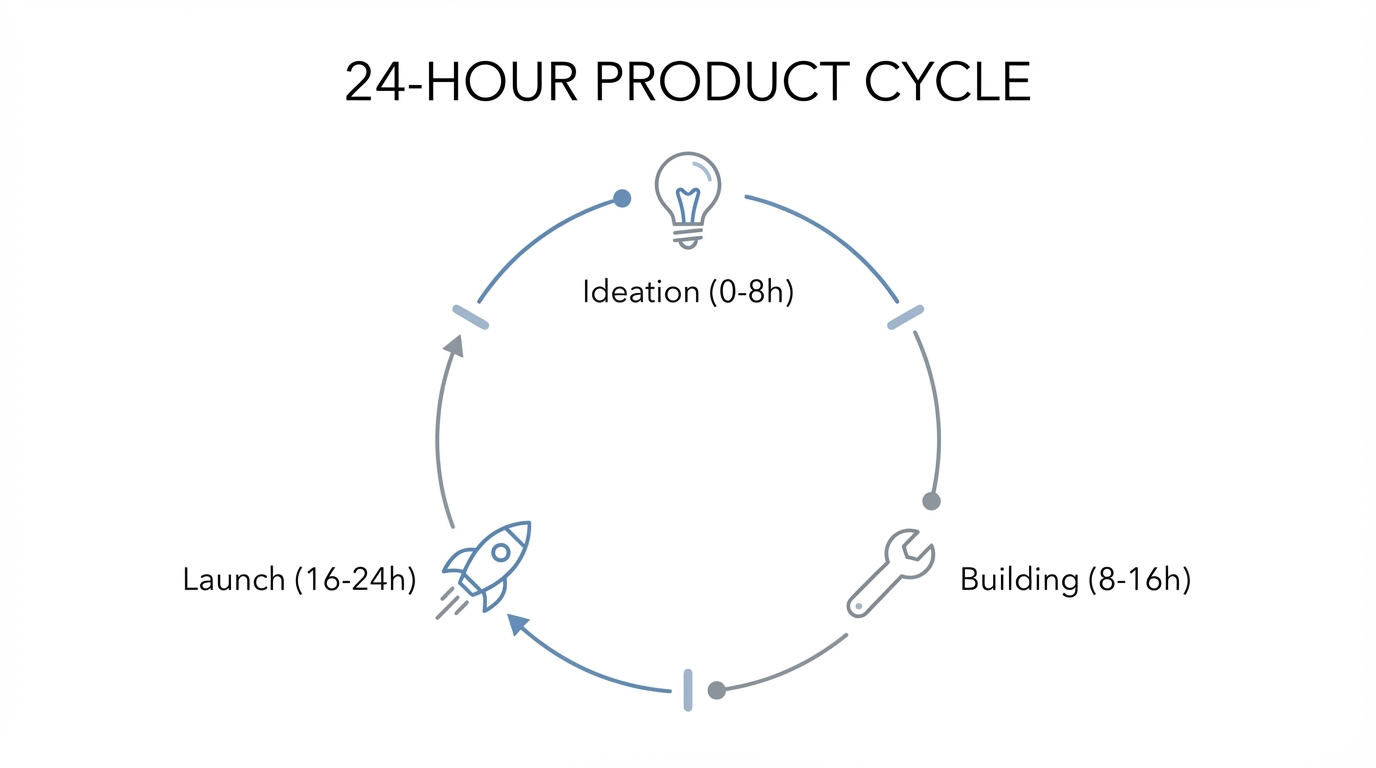
The foundation of any successful startup is solving a problem that exists on both a micro and macro level. In the original Mares framework, this meant manually scrolling through Reddit and checking Google Trends to see if anyone was actually searching for bone broth. Today, ai market research tools have turned this qualitative slog into a quantitative science. Instead of spending hours reading threads on PaleoHacks or Mark’s Daily Apple, founders can use large language models like Claude to perform instant sentiment analysis.
By scraping community discussions or feeding entire forum threads into a model, you can identify the exact pain points and vocabulary of your target audience. For instance, if you are looking into the health and wellness space, you might find that users aren't just looking for "healthier food"—they are specifically discussing "leaky gut," "collagen density," or "convenient nutrient density." AI for entrepreneurs allows you to distill thousands of comments into a list of the top three emotional triggers that drive a purchase decision. This ensures that your "Day Zero" is spent on a problem worth solving, rather than a hobby project that won't scale [source: Harvard Business Review].
Visual Identity: Moving Beyond Fiverr to High-Fidelity AI Renders
In the legacy startup playbook, creating a brand identity was a major bottleneck. You either spent thousands on a professional designer or $5 on a "god-awful" logo that made your brand look like a scam. In 2025, tools like GPT-4o and Midjourney have democratized high-end design. You can now generate high-fidelity CPG (Consumer Packaged Goods) product renders that look like they were shot in a professional studio.
Instead of waiting days for a freelancer to return a mockup, you can prompt a model with specific constraints: "Create a 3D render of a functional beverage can with a minimalist, matte finish, highlighting '10g Protein' and 'Collagen' in a modern sans-serif font, set against a fresh, lime-green background." Within seconds, you have a visual asset that can be used for your landing page and social media ads. This ability to launch a startup with ai means your brand looks like a nine-figure business before you’ve even manufactured a single unit. As Justin Mares noted, the design that once cost $60,000 can now be approximated for the cost of a $20 monthly subscription.
Instant Deployment: Building Landing Pages with Bolt.new and Rork
Once you have your data and your visuals, the next step is building the digital storefront. Traditionally, this required a subscription to a landing page builder and hours of drag-and-drop work. In 2025, the rise of ai business tools like Bolt.new and Rork has simplified this to a single prompt. These platforms can generate entire codebases and deploy them instantly, allowing you to move from a concept to a live URL in minutes.
Step 1: Define the Value Proposition
Use the sentiment analysis from your research phase to write your copy. If the Reddit community is complaining about the 48-hour cook time for bone broth, your headline should lead with "Professional Grade Bone Broth, Zero Prep Time." AI for entrepreneurs can help you generate dozens of variations of this headline to A/B test against different audience segments.
Step 2: Generate the Site Structure
Using a tool like Bolt.new, you can describe the functionality you need. For a validation test, you don't need a full Shopify backend. You need a clean, high-converting page that explains the benefits and includes a prominent "Order Now" button. Modern AI tools can handle the layout, responsive design, and even basic integration with payment processors like Stripe.
Step 3: The Smoke Test
The most critical part of the Mares framework is the "smoke test." This involves running traffic to your site and seeing if people will actually click "Order." By setting up a checkout flow that leads to a pre-order or a "back in stock soon" notification, you can gauge real market demand. If you see a 30% conversion rate on a "janky" site, you know you have a winner. In 2025, this entire process—from buying the domain to running your first $50 in Google Ads—can be finished before the sun goes down.
Scaling with AI: Managing Creator Relationships and Content

Validation is only the beginning. Once you know people want your product, you have to find a way to scale your message. In the wellness and CPG space, User-Generated Content (UGC) is the gold standard for building trust. However, finding, vetting, and managing dozens of creators is a full-time job. This is where modern platforms provide a massive advantage to the solo founder.
To keep overhead low while maximizing reach, tools like Stormy AI can help source and manage UGC creators at scale. By using an AI-powered search engine, you can find influencers who already align with your brand's niche and automate the personalized outreach process. This allows a one-person team to maintain a consistent flow of content across TikTok and Instagram, which is essential for scaling from a validated idea to a household name.
The Advantage of the One-Person Startup in 2025
One of the most profound shifts in 2025 is that coordination costs have plummeted. Historically, the more people you added to a team, the slower you moved because of the need to align everyone's vision. Now, if you have a strong opinion on what the world should look like, you can use ai business tools to execute that vision yourself. You are no longer limited by your technical skills or your design ability; you are only limited by the quality of your ideas and your ability to prompt the models effectively. For specialized needs, modern platforms like Stormy AI even provide AI agents that handle creator discovery and outreach autonomously.
Whether you are building a new CPG brand or a software-as-a-service (SaaS) product, the goal is to circle a problem until you find a solution that "lights you up." By using automated brand building techniques, you can test twelve different startup ideas in a year for the same cost and time it used to take to test one. This iterative approach increases your "surface area for luck," making it almost inevitable that you will eventually hit a product-market fit.
Conclusion: Taking the 24-Hour Challenge
Building a brand in 2025 is no longer about having a massive capital injection or a team of experts. It is about speed and validation. If you have an idea, don't spend months building it in secret. Instead, use the 24-hour framework: use ai market research tools to find the pain points, generate your visual assets with GPT-4o, deploy a landing page with Bolt.new, and spend $50 on ads to see if anyone bites. Launch a startup with AI today, and by tomorrow, you’ll have the data you need to know if you're building the next nine-figure empire or if it’s time to move on to the next big idea.