In the high-stakes environment of 2025 startup growth, the difference between a market leader and a forgotten footnote often comes down to distribution velocity. While traditional marketing teams are still clicking through endless dashboard menus, a new breed of growth engineers is moving to the terminal. The shift from bulky Graphical User Interfaces (GUIs) to high-speed command-line tools is transforming how we deploy, manage, and scale digital advertising. By integrating an AI Ad Campaign Manager CLI with autonomous frameworks like Agent Zero, startups can now achieve a level of operational efficiency that was previously reserved for enterprise-level programmatic desks.
The numbers back this shift toward automation. The global AI marketing market reached $20.4 billion in 2024 and is aggressively projected to hit $107.5 billion by 2028. For founders and marketing leaders, the question is no longer whether to use AI, but how to integrate it into a cohesive growth marketing stack that minimizes human friction and maximizes output. This guide provides the blueprint for assembling that stack, moving beyond simple automation into the era of autonomous marketing agents.
The Velocity Advantage: Why CLI Beats Traditional GUIs
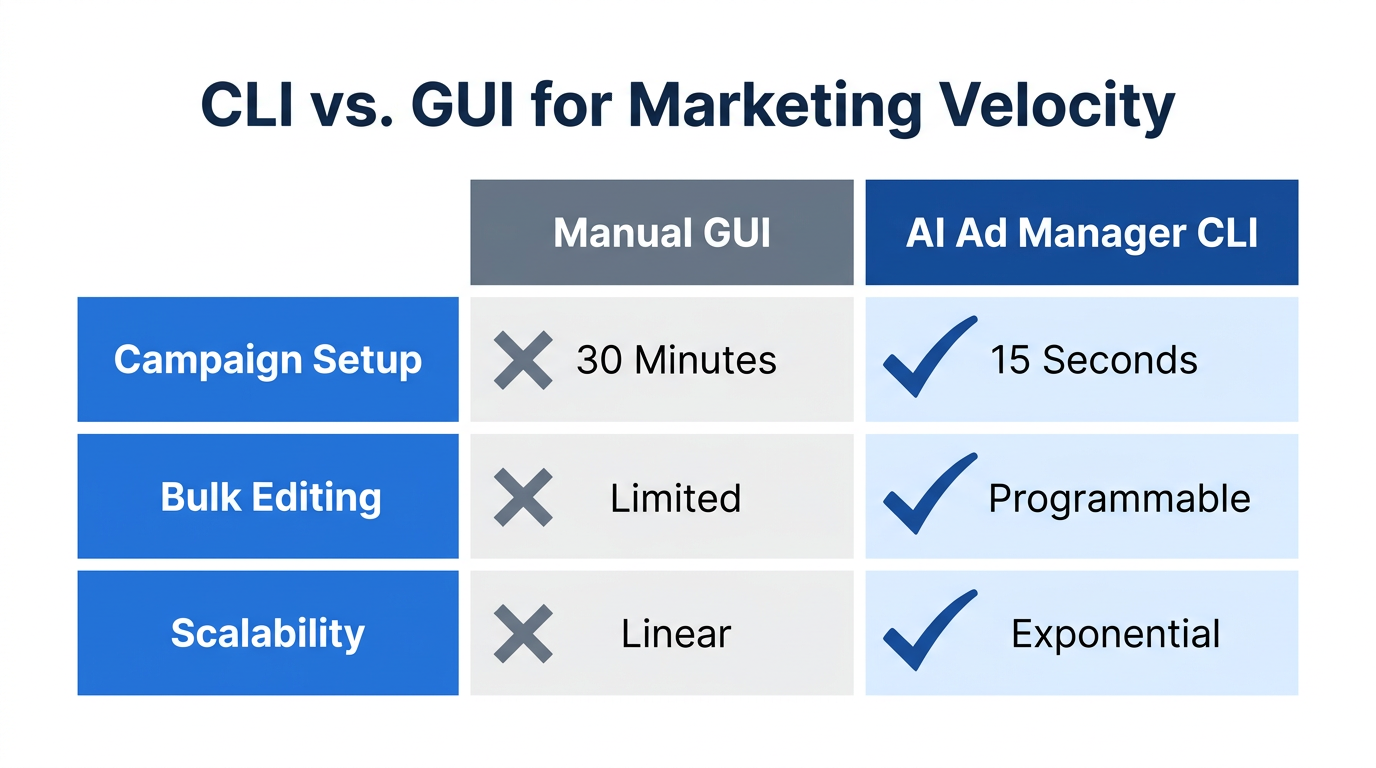
For a scaling startup, speed is a competitive moat. Traditional ad platforms like Meta Ads Manager or Google Ads are designed for the average user, resulting in interfaces cluttered with hundreds of menus. Navigating these to perform a simple account audit can take 15 to 30 minutes. In contrast, using a tool like Adscriptly CLI allows a growth engineer to execute a full account audit with a single natural-language command: adscriptly audit --account-id 123. This efficiency is why technical marketers are increasingly adopting the AI Ad Campaign Manager CLI model.
Beyond just speed, the CLI provides unrivaled scriptability. You can pipe the output of one command into another, allowing for complex workflows that a browser simply cannot handle. For example, you can write a script that identifies underperforming keywords and automatically adds them to a negative keyword list across multiple accounts simultaneously. This level of programmatic control reduces Cost Per Acquisition (CPA) by up to 30% through improved targeting accuracy.
"The CLI isn't just a tool; it's a high-speed vehicle for your marketing strategy. But remember, a fast car still needs a skilled driver to avoid burning the budget."
The 2025 Growth Stack: Core Components
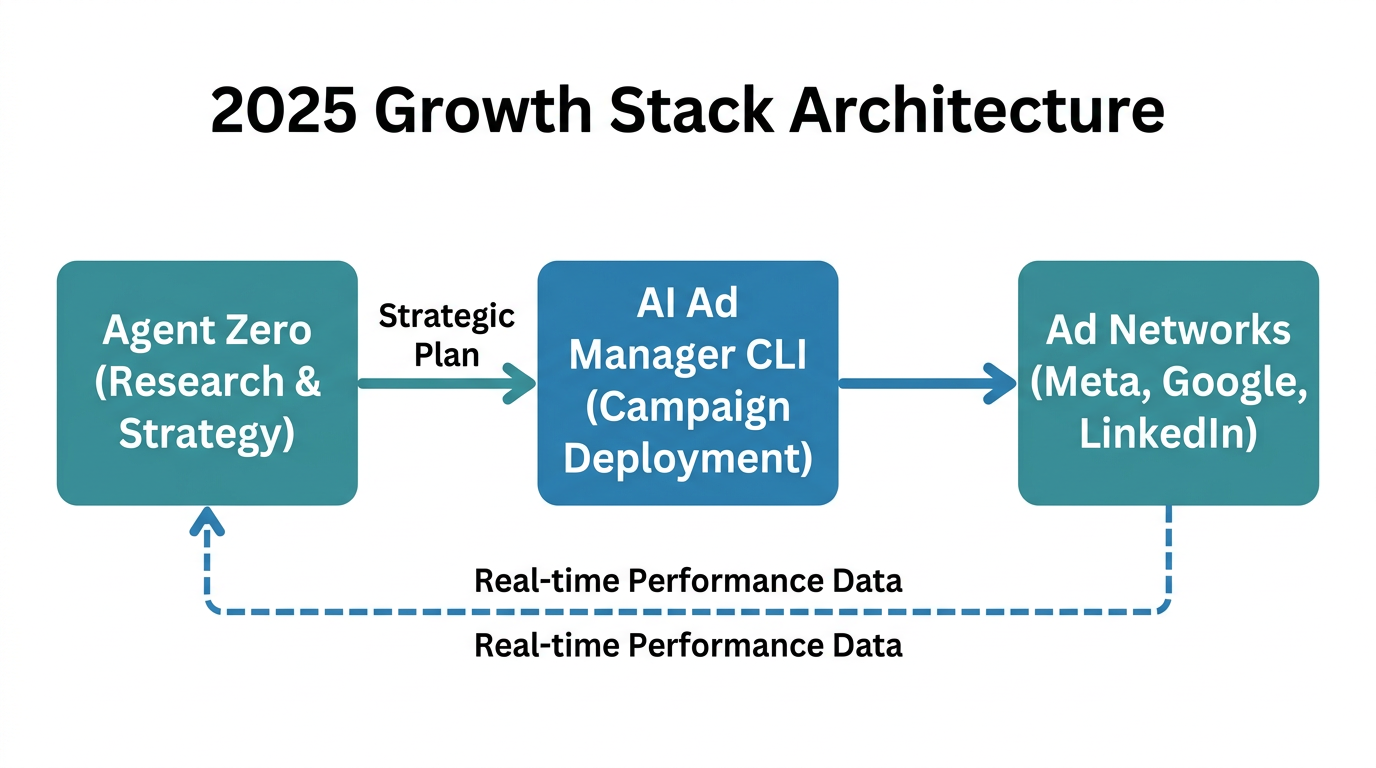
Building a modern startup distribution strategy requires three distinct layers: Creative Generation, Management/Execution, and Workflow Orchestration. Here is how to assemble the best-in-class components for 2025:
| Layer | Tool Recommendation | Primary Function |
|---|---|---|
| Creative | Jasper or AdStellar | Generating high-converting ad copy and visual variants. |
| Management | Adscriptly CLI | Natural-language terminal control for Google and Meta Ads. |
| Orchestration | Agent Zero + n8n | Autonomous decision-making and cross-platform automation. |
| Analytics | PostHog / Amplitude | Product-led growth tracking and event-based triggers. |
1. Creative Generation: Jasper and the Power of Personalization
Success in digital ads today depends on volume. Brands like Carvana have used AI-driven automation to generate over 1.3 million personalized video ads. By using tools like Jasper, your growth team can spin up hundreds of ad variations tailored to specific user segments in minutes. This allows for "micro-campaigns" that target niche behaviors rather than broad demographics, a trend cited by Digital Robots as the future of performance marketing.
2. Management: Adscriptly CLI and Developer Assistants
Once your creatives are ready, the AI Ad Campaign Manager CLI takes over the execution. Tools like the Google Ads API Developer Assistant allow developers to interact with the Google Ads API using natural language. Instead of writing complex GAQL (Google Ads Query Language) queries, you can simply ask the terminal to "show me all ad groups where CPA is 20% higher than average" and take action immediately. This bridges the gap between high-level strategy and low-level API execution.
3. Orchestration: The Rise of Agent Zero
The final piece of the puzzle is Agent Zero, a framework for building autonomous marketing agents. Unlike standard automation which follows "if-then" rules, Agent Zero can be given a high-level goal—such as "Maintain a 3.0 ROAS while scaling spend by 10% weekly"—and it will autonomously navigate between your CLI tools, CRM, and ad platforms to achieve it. This is often referred to as "Yolo Mode," where the agent has the authority to execute changes without manual confirmation for every step.
The Autonomous Distribution Playbook
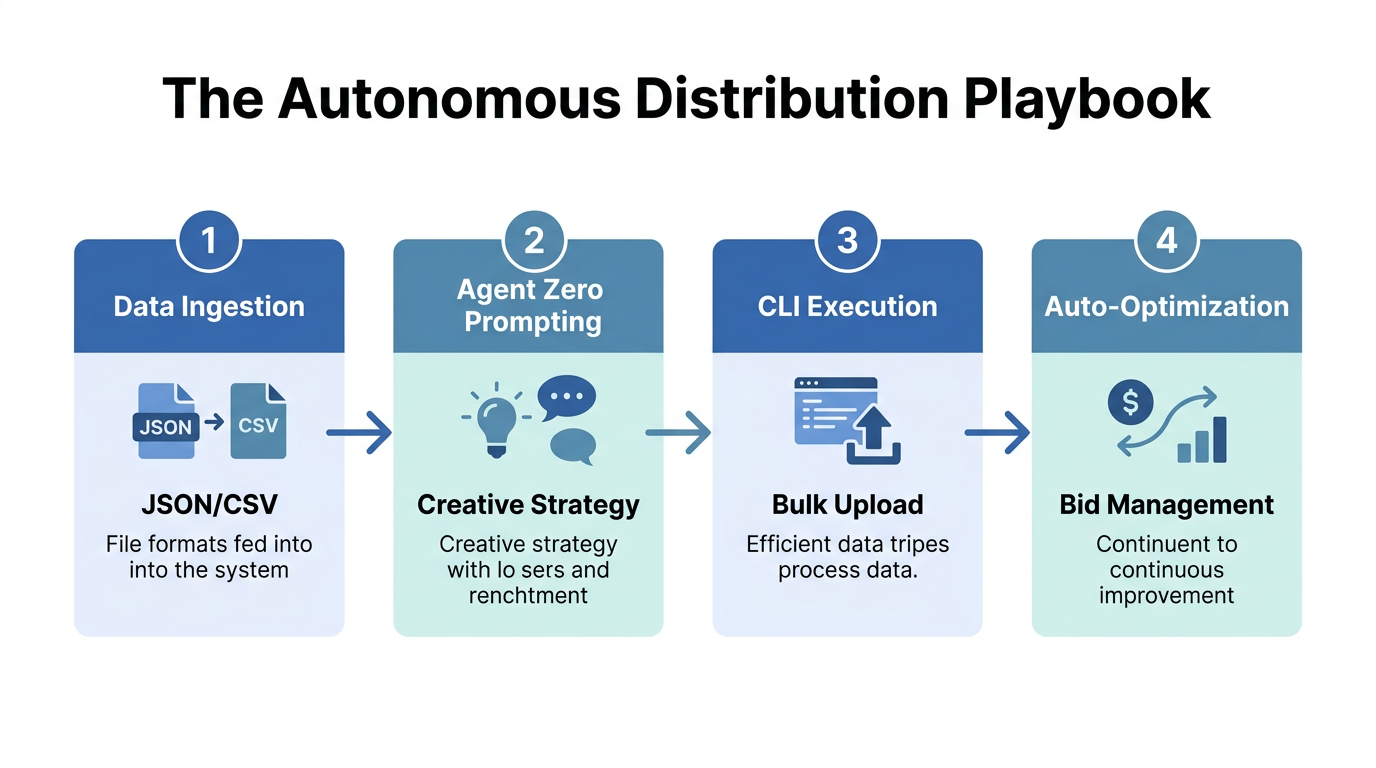
To implement this stack effectively, follow this three-step playbook designed for maximum distribution velocity:
Step 1: Set Your Guardrails and Goals
Before turning on autonomous agents, you must define the "Why." While AI handles the *how* (bidding, variants), humans must define the *why* (brand values and long-term goals). Experts at Adnimation emphasize that strategy remains a human-led endeavor. Set strict ROAS floors and daily spend limits within your CLI configuration files to prevent the AI from "spiraling" and burning budget on unproven variations.
Step 2: Connect the Loop with MCP
Utilize the Model Context Protocol (MCP) to connect your LLMs to your external marketing tools. Standards like the Model Context Protocol specification allow a single AI agent to communicate across your entire stack—from your HubSpot CRM to your ad platforms. This allows for "Offline Conversion Loops," where the CLI automatically feeds data about closed deals or qualified leads back into the ad platform's API to optimize bidding in real-time.
Step 3: Source and Manage Creator Assets
Autonomous distribution is only as good as the content being distributed. For many startups, User-Generated Content (UGC) is the highest-performing asset class. Platforms like Stormy AI can help source and manage UGC creators at scale, ensuring your Agent Zero workflows always have fresh, authentic creative to test. You can find creators based on specific niche performance and then pipe their content directly into your CLI-driven ad campaigns.
"The brands that win in 2025 won't just have better products; they will have faster feedback loops between their conversion data and their ad terminal."
Maintaining Brand Voice: The 86% Rule
Despite the power of autonomous marketing agents, the human element remains critical. Statistics show that 86% of top marketers still use human review for AI-generated copy. Generic AI output can often lead to "brand flattening," where every ad looks and feels like spam. This is a common mistake identified by Hashmeta, who warn that neglecting brand voice can alienate sophisticated audiences.
Use your AI Ad Campaign Manager CLI to handle the heavy lifting of data analysis and bidding, but keep a human in the loop for the final creative approval. A good workflow involves the AI generating 10 copy variants, a human editor selecting and refining the best three, and the CLI then deploying those three across 100 micro-targeted ad sets.
Real-World Results: Moving the Needle
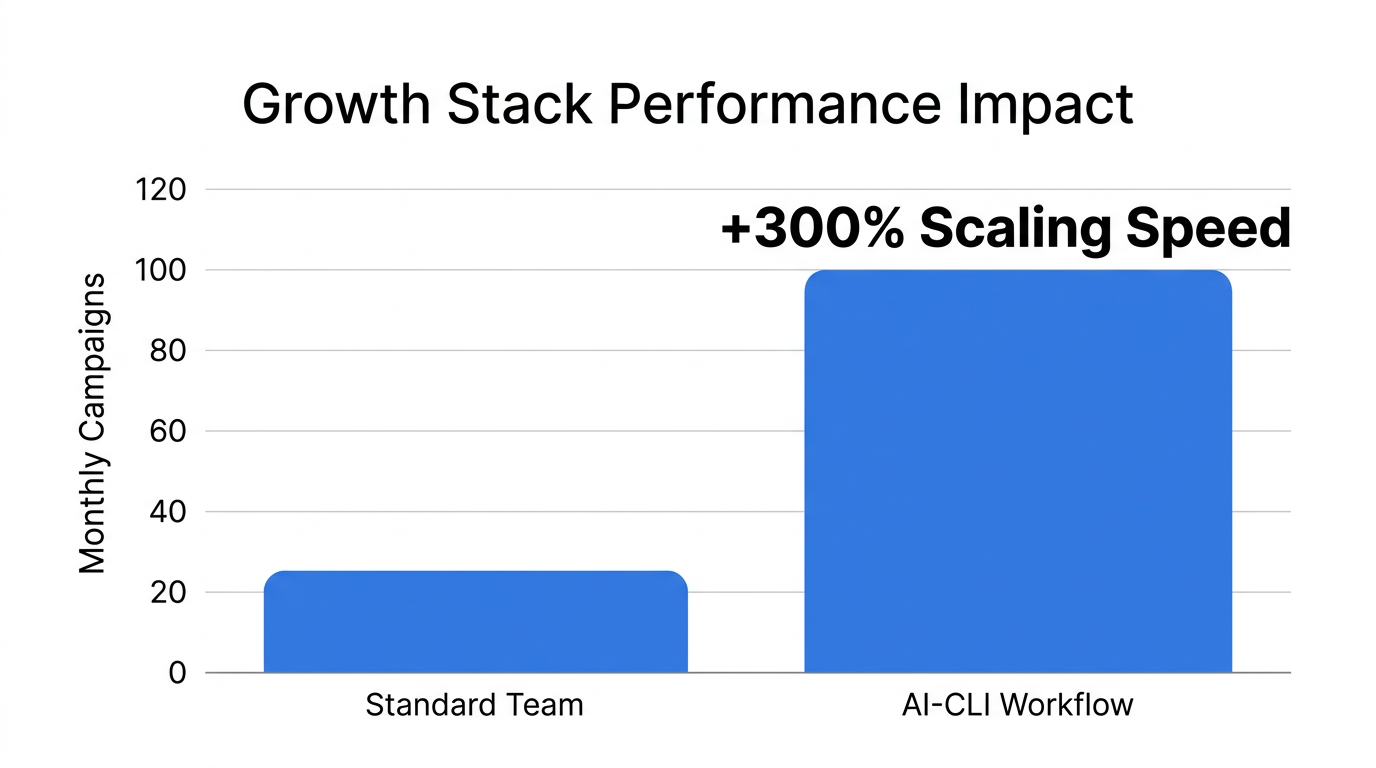
The impact of this high-velocity stack is measurable across industries. Consider these examples of AI and automation in action:
- Trendyol: This retailer implemented predictive bidding and achieved a 180% improvement in ROAS and a 27% reduction in CAC.
- H&R Block: By leveraging automated AI solutions, they saw a 144% increase in conversion rates during peak seasons.
- Carvana: Their use of automated scripts to manage millions of personalized videos demonstrates the scale possible when you move away from manual GUI management.
When you combine these execution speeds with the ability to Stormy AI streamline creator sourcing and outreach, you create a growth machine that is both data-driven and culturally relevant. This synergy is what defines a modern growth marketing stack.
Conclusion: Scaling into the $107B Market
As we move toward a $107 billion AI marketing market, the barrier to entry for high-performance distribution is lowering. You no longer need a massive internal agency to run sophisticated, global ad campaigns. By mastering the AI Ad Campaign Manager CLI and deploying frameworks like Agent Zero, a small team of growth engineers can outperform traditional marketing departments ten times their size.
The Velocity Advantage is real. Start by moving your most repetitive auditing and reporting tasks to the terminal. Integrate your creative pipeline with autonomous agents, and never lose sight of the human touch that defines your brand voice. The future of marketing isn't just about AI—it's about the speed at which you can turn data into distribution.