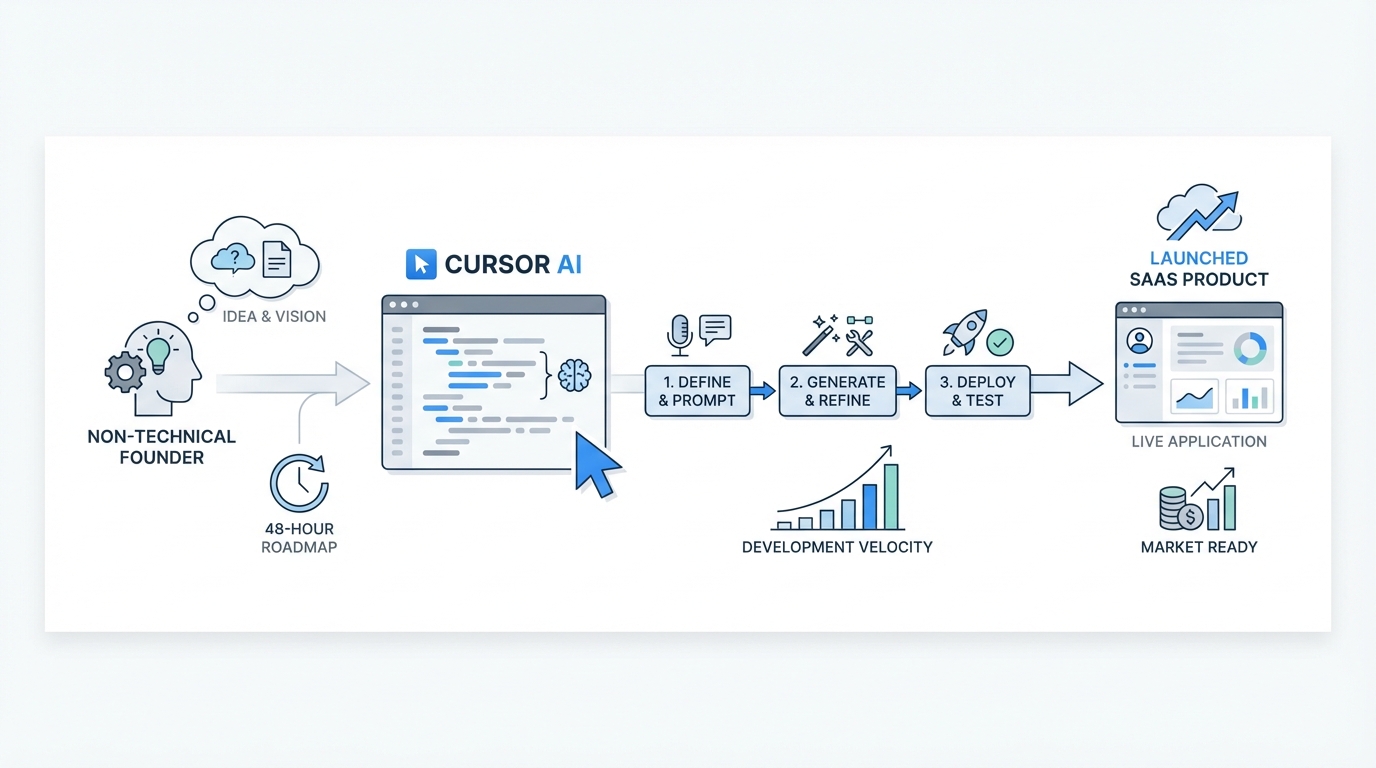
The barrier to entry for software entrepreneurship has officially collapsed. Just a few years ago, if you wanted to launch a software-as-a-service (SaaS) platform but couldn't code, you faced two expensive options: find a technical co-founder who would take half your equity, or hire a development agency for tens of thousands of dollars. Today, that dynamic has changed. By leveraging an AI-native development environment like Cursor, non-technical founders are now building, deploying, and scaling functional software products in a single weekend. In this guide, we will break down the exact playbook used by successful founders to build a saas with ai from scratch, reaching over $20,000 in monthly recurring revenue (MRR) in just 90 days.
The 'AI-First' Stack: Your Non-Technical Toolkit


Before you write your first line of code (or rather, before you ask the AI to write it for you), you need the right tools. The modern AI-first stack is designed for speed and low friction. These tools are built to talk to each other, making the "plumbing" of your application much simpler for a beginner. This cursor ai tutorial for beginners focuses on a specific set of tools that prioritize ease of deployment and scalability.
- Cursor: This is your primary engine. Unlike traditional code editors, Cursor is an AI-native IDE that understands your entire codebase. You don't need to know syntax; you just need to know how to describe the logic you want to build.
- Vercel: Once your code is ready, you need a place for it to live on the internet. Vercel allows you to host your application with zero configuration. You can deploy directly from your editor, making the transition from a local file to a live website instantaneous.
- Supabase: Every SaaS needs a way to store user data and handle logins. Supabase provides an all-in-one solution for your database, authentication, and file storage. It is often referred to as the open-source alternative to Firebase and integrates seamlessly with AI prompts.
- Resend: Your app will need to send welcome emails, password resets, and notifications. Resend is a modern email API built specifically for developers that ensures your emails actually land in the inbox.
- Apify: If your SaaS relies on data from other websites (like Amazon product prices or social media trends), Apify is essential. It simplifies web scraping and data aggregation so you can focus on building features rather than managing proxies.
By using this stack, you are building on a foundation of TypeScript and Next.js. While those names might sound intimidating to a non-technical founder, they are the most AI-friendly languages currently available. Cursor performs significantly better when writing in these modern frameworks, which means fewer bugs and faster shipping for you. To handle the marketing side of your new venture, you can use Stormy AI to find and vet influencers who can drive traffic to your app through an automated AI search engine.
The 48-Hour Build Timeline: From Concept to MVP
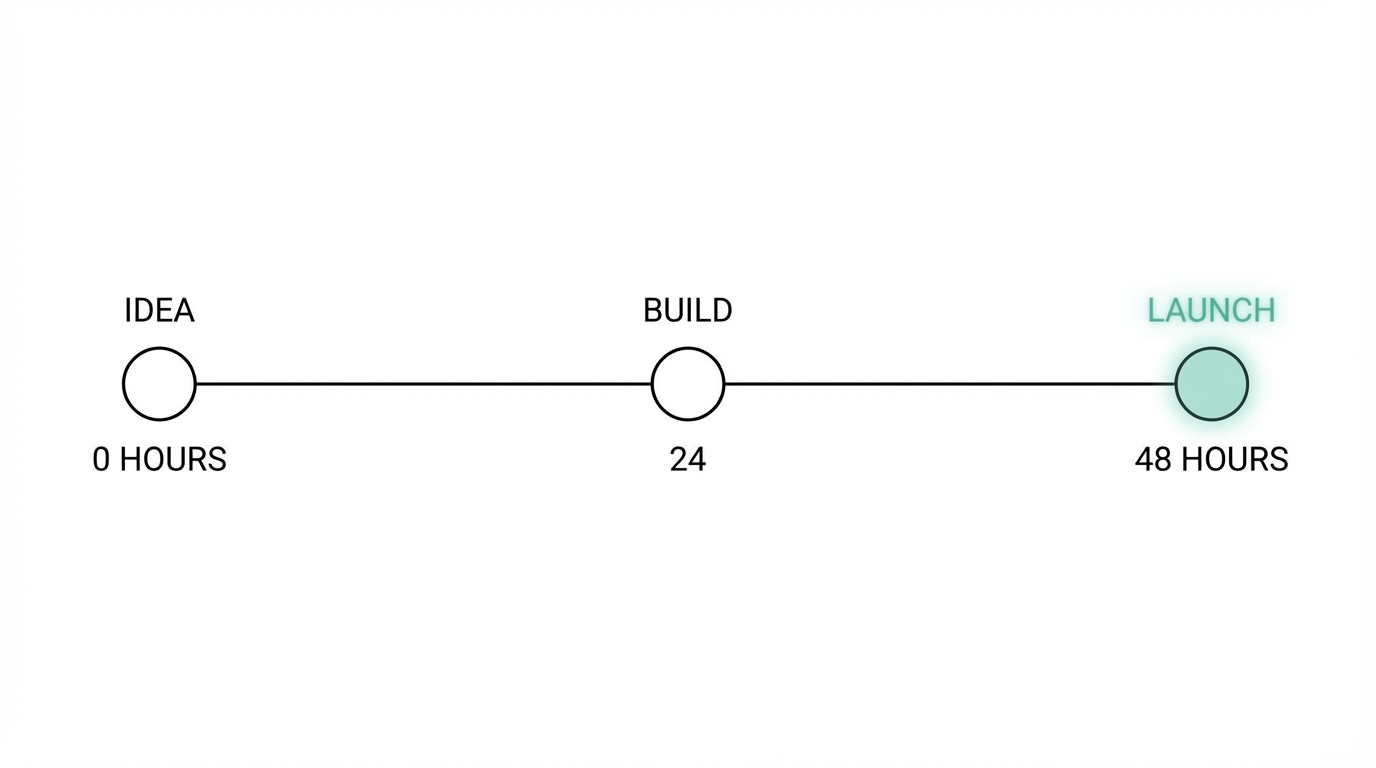
Building a product in two days requires intense focus and a structured plan. You cannot afford to get lost in the weeds of aesthetic perfection or "feature creep." Your goal is to build a Minimum Viable Product (MVP) that solves one core problem exceptionally well. This build mvp in 48 hours roadmap is a proven framework for high-speed execution.
Hours 1–4: Mapping and SOPs
Don't touch the code yet. Spend the first four hours mapping out the existing workflows you want to automate. If you are building a tool for Amazon sellers, write down exactly how a human does product research manually today. What data do they look at? What spreadsheets do they fill out? By defining these Standard Operating Procedures (SOPs), you provide the AI with a clear roadmap of the logic it needs to replicate. Use this time to sketch a rough layout of your user interface on paper.
Hours 5–12: Building Core Features
Open Cursor and start prompting. Begin with the core functionality. If your app is an AI-powered research tool, focus on getting the data to appear on the screen first. Use the "Composer" feature in Cursor to generate the initial file structure. Don't worry about the login screen or the "About Us" page yet—just make the main feature work.
Hours 13–20: Bug Testing and Iteration
This is where most beginners get stuck. You will encounter errors. Instead of panicking, copy the error message and paste it directly back into Cursor. Ask the AI to "fix this error and explain why it happened." This iterative loop is how you learn. Stormy AI is an AI-powered platform for creator discovery and vetting—helping you analyze creator profiles and detect fake followers in seconds so you can focus on partnerships that actually convert.
Hours 21–30: UI Polish and Branding
In the SaaS world, branding is everything. A tool that looks like it was built in 1995 won't command a high price point. Spend these hours using Tailwind CSS (which Cursor is excellent at writing) to make your app look professional. Ensure the buttons are consistent, the typography is clean, and the layout works on mobile devices.
Hours 31–40: Edge Cases and Final Polish
Test what happens when a user enters the wrong information. Does the app crash, or does it show a helpful error message? Fix the "edge cases" that could ruin the user experience. Prepare your demo video—this is the most important asset for your launch.
Hours 41–48: Deployment and Pitching
Connect your project to Vercel and hit deploy. Your app is now live. Spend the final hours of your weekend reaching out to potential partners or recording a walkthrough to share on social media.
Leveraging Domain Knowledge: Why Niche Matters
One of the biggest mistakes a non-technical founder can make is trying to build a generic tool, like a "general AI writing assistant." You are competing with giants like OpenAI and Google in that space. Instead, the secret to a successful no-code saas builder journey is domain knowledge. You need to solve a specific, painful problem that you have personally experienced.
Take the example of Hassam, who built Launchfast. He didn't build a generic AI tool; he built a tool specifically for Amazon private label sellers. Because he had spent years running his own Amazon brands, he knew exactly which data points were a pain to collect and which spreadsheets were the most exhausting to maintain. He didn't have to guess what his users wanted—he was his user. This niche focus allowed him to hit $10,000 MRR in just 30 days because the value proposition was crystal clear to his audience.
If you aren't sure where to start, look at your own hobbies or professional background. Are you an expert in real estate? Logistics? Gardening? There is likely a manual process in that industry that could be automated with an AI-powered tool. When you combine deep industry expertise with the speed of Cursor, you become more effective than a senior engineer who doesn't understand the business problem.
The Distribution Hack: Partnering for Growth
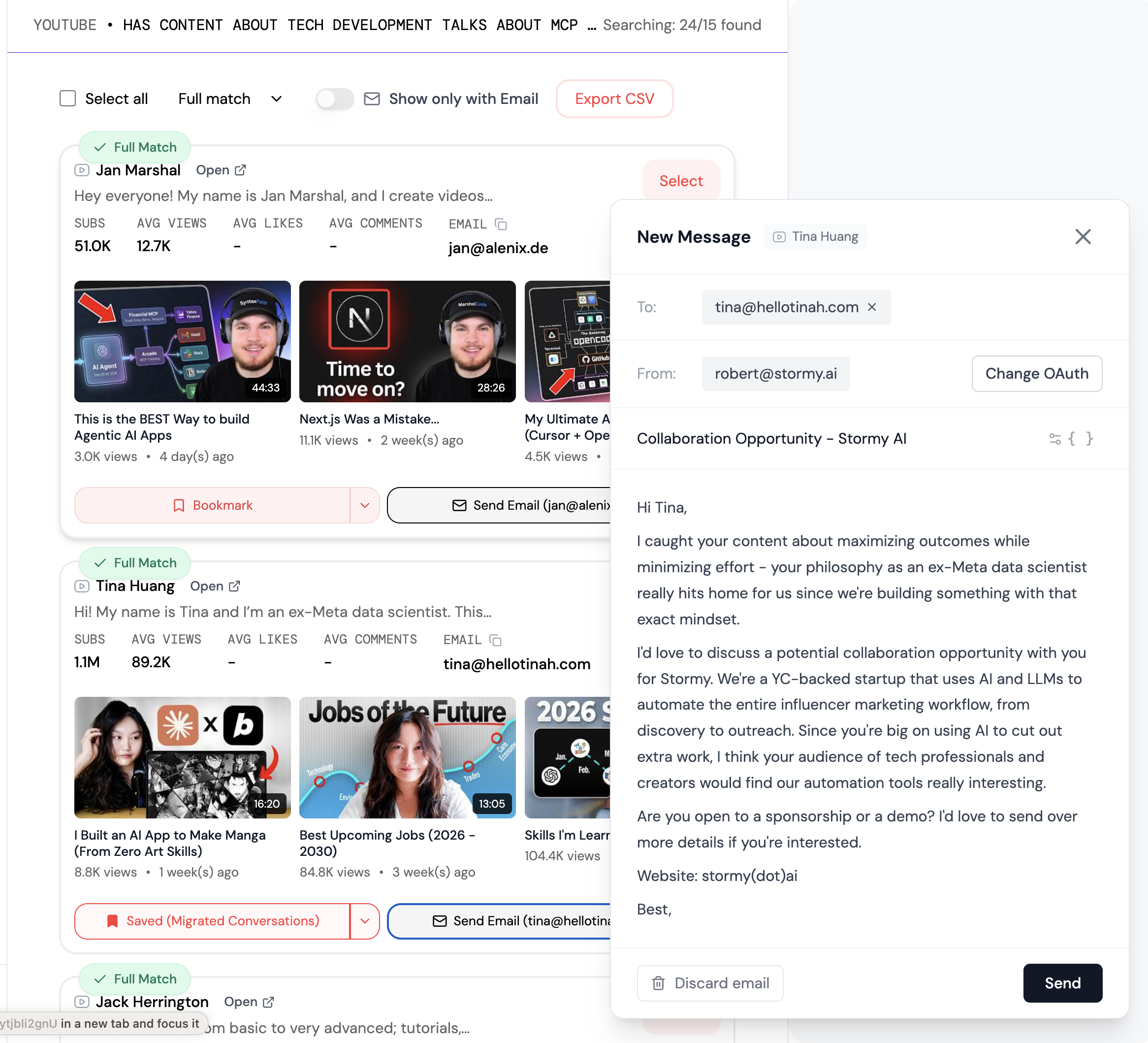
Building the app is only half the battle. The other half is getting people to use it. Many founders spend months building an audience from scratch on Twitter or LinkedIn, but there is a faster way: The Distribution Partnership. Instead of trying to find customers one by one, find someone who already has your target customers and offer them a deal.
Hassam solved his distribution problem by reaching out to a coaching company called Legacy X, which already had thousands of Amazon sellers in their program. He offered them a 50% equity stake or a revenue share in exchange for exclusive access to their members. This gave him instant validation and a built-in customer base. Within 90 days, his app was earning $21,800 per month with over 330 active users.
When you are just starting out, remember that 50% of something is a lot better than 100% of nothing. You can use Stormy AI to discover and contact UGC creators and influencers who already own the attention of your target demographic using its automated AI outreach agent. By reaching out to these distribution partners with a working MVP in hand, you transform your SaaS from a side project into a real business overnight. You can even manage all these partnerships and deal stages using the Stormy AI creator CRM.
How to Find and Validate Your SaaS Idea
You don't need a unique, never-before-seen idea to be successful. In fact, it is often safer to enter a validated market where people are already spending money. The goal is to execute better or provide a more specialized solution than the existing competitors. Here is a quick non-technical founder guide to validation:
- Identify 3-5 domains: Write down industries where you have deep knowledge.
- Check the competition: Use tools like Sensor Tower to see which apps are making money in the app stores, or use Ahrefs to find high-volume search terms related to software tools in your niche.
- Analyze user pain points: Go to Reddit, Facebook groups, and review sites. Look for people complaining about current tools. What features are missing? What is too expensive? What is too complicated?
- Verify search intent: Use Google Search Console or keyword research tools to see if people are actively looking for a solution to the problem you've identified.
By following these steps, you ensure that you are building a saas with ai for a market that actually exists. You aren't building in a vacuum; you are filling a gap in a proven ecosystem.
Iterative Shipping: The 30-Day Rule
The 48-hour build gets you to the starting line, but the next 30 days determine if you stay in the race. After you launch, you must commit to the "one improvement per day" rule. Your early users will find bugs. They will ask for features you didn't think of. They will get confused by your UI.
Take their feedback and immediately feed it back into Cursor. Shipping a small update every 24 hours does two things: it fixes the product, and it builds immense trust with your early adopters. They see that you are listening and that the product is evolving in real-time. This momentum is what carries a SaaS from a handful of users to hundreds of paying subscribers. Whether you are building mobile app tools or web platforms, the speed of your feedback loop is your greatest competitive advantage. Once your product gains traction, you can use Stormy AI for post tracking to monitor how creators are talking about your brand across different platforms.
The $200 MVP: Budgeting for Your Launch
One of the most appealing aspects of the AI-first stack is the cost. You can build a professional-grade SaaS for a fraction of what it cost just two years ago. Here is a typical cost breakdown for a 48-hour build:
- Cursor Pro: $20/month (Essential for high-limit AI access).
- Vercel Pro: $20/month (For team features and higher bandwidth).
- Supabase: $0 - $25/month (Their free tier is very generous for MVPs).
- Resend: $0 - $20/month (Free for the first 3,000 emails per month).
- Apify: $0 - $49/month (Depending on your data scraping needs).
- Domain Name: $10 - $15/year.
Total estimated cost: Under $200. This means you can afford to fail. If your first idea doesn't gain traction, you haven't lost your life savings. You've simply paid for a high-intensity coding bootcamp and can move on to the next idea with more experience. This low-risk, high-reward environment is exactly why now is the best time to build a saas with ai.
Conclusion: From Idea to Execution
The era of "I have an idea but I don't know how to build it" is over. With the combination of domain knowledge, AI-native tools like Cursor, and a smart distribution strategy, the only thing standing between you and a $20,000 MRR business is 48 hours of focused execution.
Stop planning, stop waiting for a co-founder, and stop worrying about your lack of a computer science degree. Pick a niche you understand, identify a problem that hurts, and start prompting. If you can spend 1,000 hours mastering the art of building with AI and use Stormy AI to automate your growth and influencer outreach, you will be more capable than 99% of the entrepreneurs who came before you. It’s time to get off the sidelines and start shipping. Use a no-code saas builder approach combined with AI power, and transform your knowledge into a scalable software product this weekend.