The dream of the solopreneur software business has shifted. While traditional SaaS (Software as a Service) models often require massive infrastructure and high customer acquisition costs, a new frontier has emerged: the browser extension. For those looking to build a chrome extension for profit, the barrier to entry has never been lower, especially when leveraging the power of Artificial Intelligence. By building on top of existing platforms like ChatGPT, developers are finding they can reach thousands of users and generate significant revenue in record time. Take Sayed Ezadi, for example, who transitioned from corporate life to building Superpower ChatGPT, a simple browser extension that now generates between $20,000 and $30,000 in monthly recurring revenue (MRR).
The Strategic Advantage of Browser Extensions

Why are extensions the ultimate AI tool development guide for solo founders? The answer lies in the distribution. When you build a standalone website, you are competing with the entire internet for attention. However, when you build for an existing marketplace like the Chrome Web Store, you are tapping into a pre-existing flow of users who are already looking for solutions within their current workflow.
As noted in recent solopreneur success stories, there are two primary strategies for extension growth. First, you can build for massive platforms like Gmail, YouTube, or X (formerly Twitter). If a platform has 100 million users and only 0.001% of them need your specific feature, you still have a viable 2,000-user customer base. Alternatively, you can target smaller but highly professional marketplaces like Zoom or Salesforce, where competition is lower but the user intent is high.
How to Find and Validate Your AI Idea

The most successful browser extension development projects solve a personal frustration. Sayed Ezadi didn't start with a complex business plan; he built features that he felt were missing from the native ChatGPT interface. To replicate this success, you must become an active listener in the communities where your potential users hang out. Platforms like Reddit, Discord, and Facebook Groups are gold mines for user complaints and feature requests.
If you're unsure where to start, think about niche industries that are slow to adopt AI. Professionals like lawyers or doctors often have specific workflows that could be enhanced by a targeted AI tool. Finding the right creators to help you market these niche tools is essential. Using Stormy's AI search for discovery across TikTok, YouTube, Instagram, and newsletters, you can instantly find influencers in specific professional niches—such as legal-tech or med-tech creators—to validate whether your extension idea resonates with their audience before you write a single line of code.
The Technical Stack: Simplicity over Complexity

One of the biggest misconceptions in browser extension development is that you need a complex backend or the latest JavaScript framework. In reality, you can build a $20K MRR business using nothing but pure JavaScript, HTML, and CSS. Keeping the stack light allows for faster load times and fewer bugs within the user's browser environment.
Most developers spend their time in VS Code, which remains the industry standard for writing extension manifests and background scripts. For the backend, leveraging AWS (Amazon Web Services) provides the scalability needed as your user base grows from ten to ten thousand. By using simple API calls to OpenAI or other LLM providers, your extension acts as a "wrapper" that provides a superior user experience (UX) compared to the raw AI interface.
The 72-Hour MVP Playbook
Speed is your greatest asset as a solopreneur. The goal of your Minimum Viable Product (MVP) should be to solve one specific problem exceptionally well. Here is the chrome extension business model playbook for a 72-hour launch:
Step 1: Identify the Core UI Injection Point
Decide where your AI will live. Does it add a button to the Gmail compose window? Does it create a sidebar in LinkedIn? Use standard DOM manipulation to inject your features into the existing platform's interface.
Step 2: Build the Core Logic
Connect your extension to an AI API. Focus on functional simplicity. If your tool is meant to summarize YouTube videos, the MVP should only summarize the video—don't worry about folders, history, or sharing features yet.
Step 3: Submit to the Chrome Web Store
The review process can take anywhere from 24 hours to a week. Submit early. Once it's live, you can begin the process of gathering real user data. To ensure your extension is actually performing as expected across different demographics, you can use Stormy AI for influencer vetting and fake follower detection to ensure the feedback you're getting is from high-quality, authentic users rather than bot accounts or spam profiles.
UX Fundamentals: Enhancing vs. Inventing
Good browser extension development isn't about reinventing the wheel; it's about making the wheel better. Your extension should feel like a native part of the website the user is already visiting. This is known as "UI Injection." If your AI tool feels like a disruptive popup, users will quickly uninstall it. If it feels like a "superpower" added to their favorite site, they will pay for it.
Focus on reducing friction, a core principle in UX design. Every click you save the user is a reason for them to keep the extension installed. For example, instead of making a user copy-paste text into a separate AI tab, provide a "Right-Click to Summarize" option directly in the browser. This seamless integration is what separates profitable tools from forgotten side projects.
The 'First 1,000 Users' Marketing Checklist
Growth for extensions is largely organic, but you can jumpstart the process with a tactical checklist. Sayed Ezadi reached over 260,000 downloads without spending a single dollar on traditional ads. Instead, he focused on community-led growth.
- Reddit Launch: Find a relevant subreddit (like r/ChatGPT or r/Productivity) and share your tool as a helpful resource, not a sales pitch.
- Directory Listings: Submit your tool to "Top 10 AI Tools" lists and chrome extension directories.
- Influencer Outreach: Reach out to micro-influencers who cover productivity tools. For a streamlined approach, Stormy's AI outreach can generate hyper-personalized emails to creators, managing the entire conversation in an AI-powered inbox so you can focus on coding while the AI handles follow-ups.
- User Feedback Loop: Talk to every single early adopter. Learn how a lawyer uses your tool versus how a student uses it. These insights will drive your next set of paid features.
Monetization: The Two-Pronged Approach
How do you actually make money? The most effective chrome extension business model uses a "Freemium" approach. Keep your core features free for as long as possible to build a massive user base. This builds trust and creates a barrier to entry for competitors. Superpower ChatGPT remained free for nine months before introducing paid tiers.
Once you have a large audience, you can monetize in two ways:
- Premium Features: Charge for advanced capabilities like data export, custom prompts, or higher API usage limits.
- The Newsletter Model: An extension gives you a direct line to your users. By launching a newsletter through Beehiiv, you can monetize your audience through sponsorships. Platforms like Passionfroot allow you to find sponsors who will pay to reach your specific user base, creating a secondary revenue stream that can sometimes rival the extension's subscription revenue.
Tracking Performance and Scaling Your Success

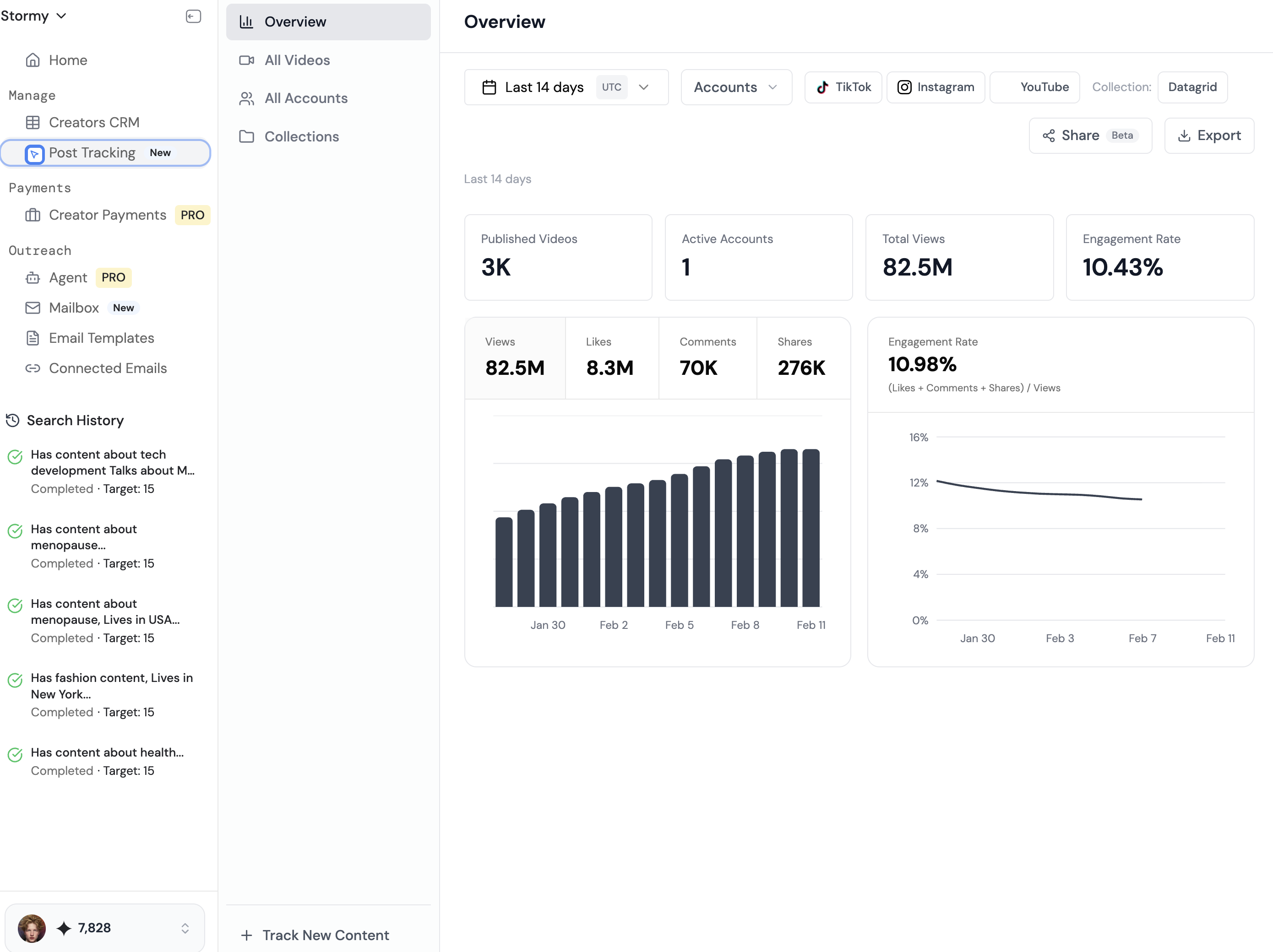
As your extension grows, you need to monitor how it is being discussed and shared across social media. Solopreneur software businesses often fail because they lose track of their brand sentiment. By using Stormy's post tracking and analytics, you can monitor every video or post where your extension is mentioned, allowing you to see which marketing channels are actually driving installs and engagement in real-time.
Scaling also means diversifying. While "platform risk" (the chance that OpenAI or Google might release a feature that kills your extension) is real, the best defense is a loyal user base. If one platform changes its rules, your reputation and your email list (via your newsletter) allow you to pivot to another platform—like LinkedIn or TikTok—with minimal friction.
The Future of AI Extensions
The window of opportunity for AI extensions is wide open. Whether you are building a tool for App Store Optimization enthusiasts or a productivity booster for corporate managers, the blueprint remains the same: find a niche, build fast using simple tools, and prioritize the user experience. By following this AI tool development guide, you can transition from a hobbyist to a founder of a $20K/month business.
Success in this space requires a combination of technical execution and smart marketing. Don't wait for the perfect idea. Build a version 1.0, launch it on the Chrome Web Store, and start listening to your users today. If you need help finding the right creators to scale your growth or tracking your campaign's performance, Stormy AI is the all-in-one platform designed to help modern software founders manage everything from discovery to creator payments with ease.