How to Build a $25/Month AI SDR: The 2026 OpenClaw Sales Playbook
Build a custom OpenClaw AI SDR for $25/month. Learn the 2026 playbook for automated lead enrichment, cold email automation, and hyper-personalized outreach.
In 2026, the traditional sales tech stack is undergoing a radical collapse. For years, founders and growth marketers have been held hostage by a fragmented ecosystem of tools—paying $150 for LinkedIn Sales Navigator automation, $200 for lead databases, and $300 for email sequencers. By the time you add enrichment and CRM costs, most startups are burning over $1,500 monthly just to keep a basic outbound motion alive. But the 'OpenClaw Moment' has changed everything. By leveraging the OpenClaw framework, savvy teams are now building autonomous AI SDRs for approximately $25 per month that don't just send templates, but actually execute the entire sales cycle from research to inbox triage.
The Rise of Agentic Sales in 2026
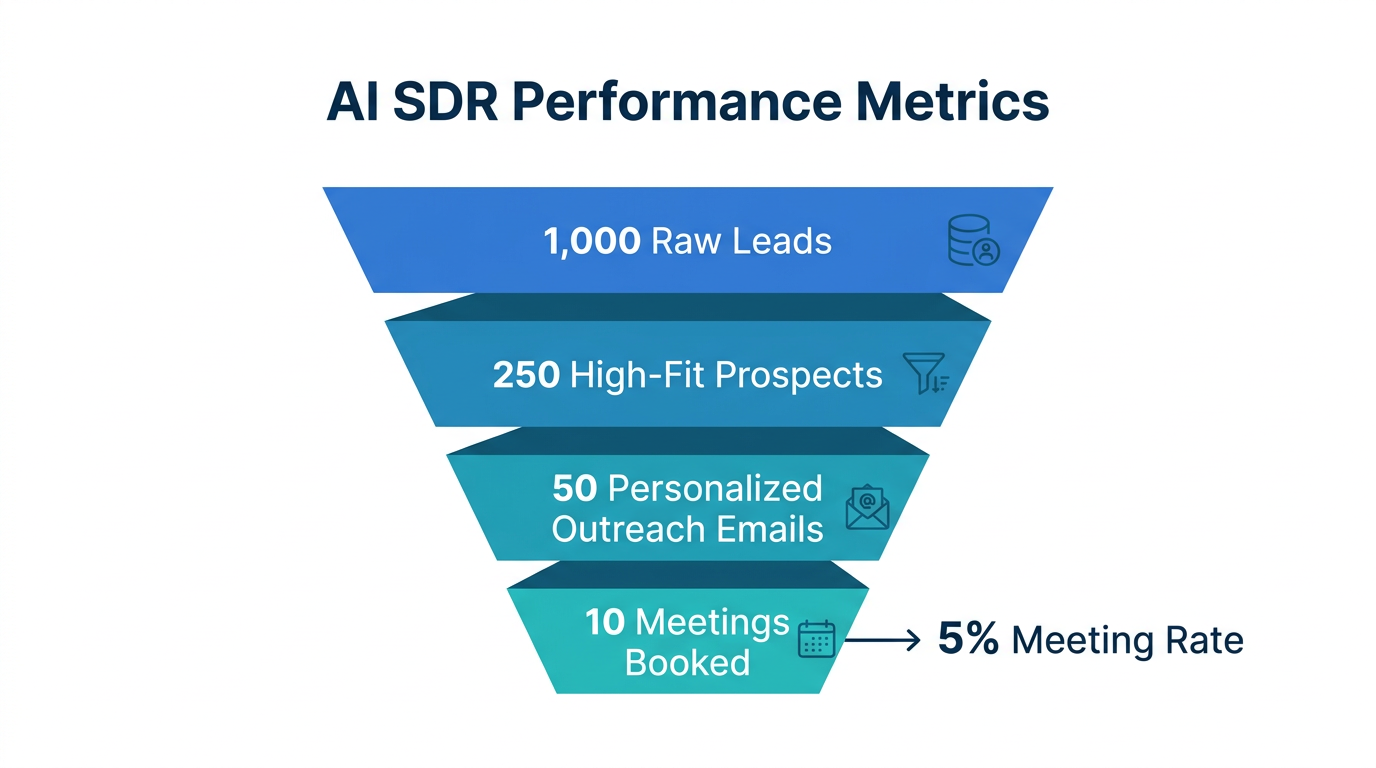
The shift from 'Chat AI' to 'Agentic AI' is the defining trend of this year. We are no longer asking LLMs to write emails; we are instructing agents to perform actions. According to Autobound, 81% of sales teams have now implemented agentic workflows, a staggering leap from the 24% adoption rate seen just three years ago. This isn't just a marginal improvement—it's a fundamental shift in unit economics.
OpenClaw, the open-source agent framework created by Peter Steinberger (who recently joined OpenAI), has become the gold standard for this movement. With over 264,000 GitHub stars, it is the primary engine behind the new 'Agentic Revenue Architecture' that allows companies to own their sales infrastructure rather than renting it from legacy SaaS providers.
"The claw is the law: the next generation of sales will be won by those whose agents can actually navigate the web, not just predict the next word in a sentence."
Cost Comparison: Legacy SaaS vs. OpenClaw SDR
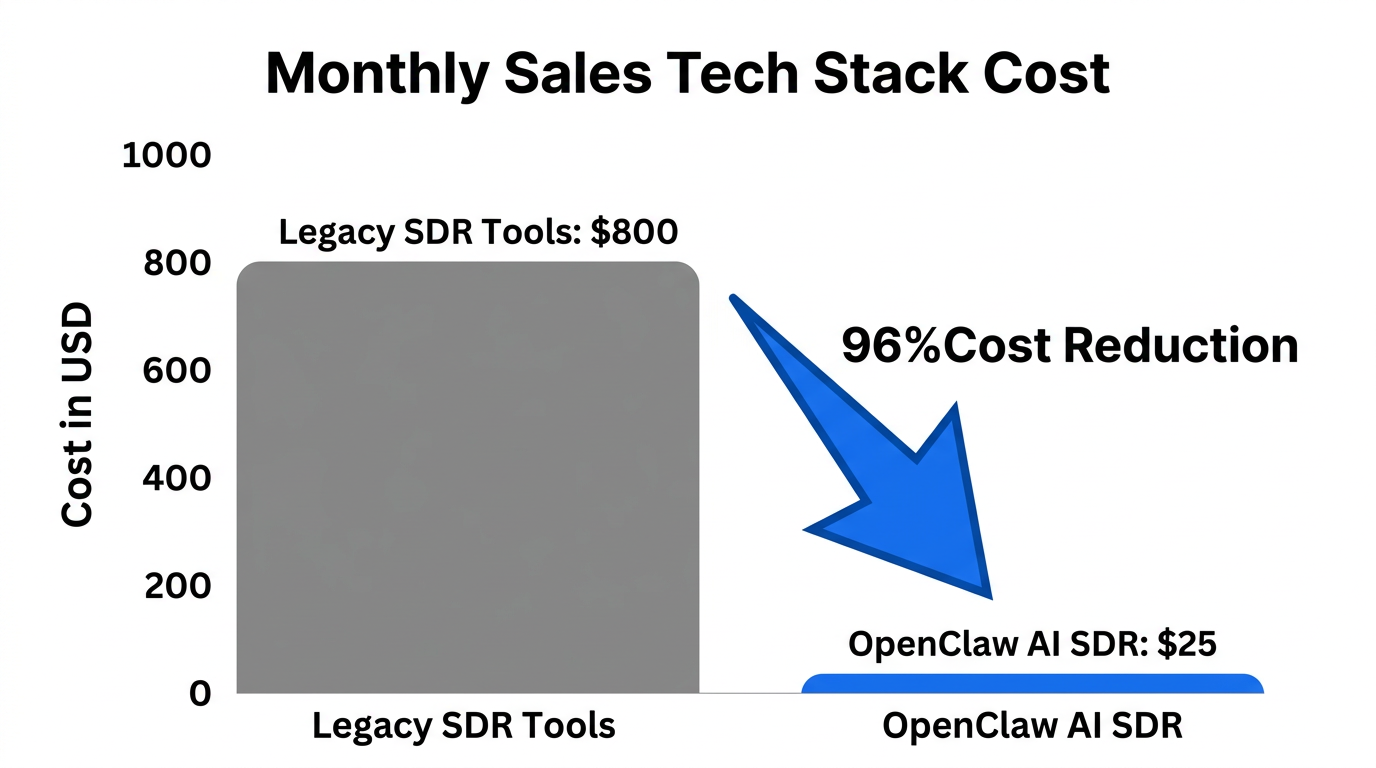
To understand why founders are flocking to OpenClaw, you only need to look at the monthly balance sheet. Legacy stacks like Apollo and Dripify often cost $1,500+ per month when scaled. A custom OpenClaw setup runs on the price of a mid-tier VPS and API tokens.
| Feature | Legacy Stack (Apollo/Dripify) | OpenClaw AI SDR (2026) |
|---|---|---|
| Monthly Cost | $1,500+ | ~$25 - $50 |
| Research Depth | Static Database (Often Outdated) | Real-time Browser Scraping |
| Personalization | Variable Tags (First Name, Co) | Deep Contextual Reasoning |
| Execution | Manual Follow-ups | Autonomous Follow-up Logic |
| Data Ownership | Locked in Vendor CRM | Full Self-Hosted Control |
Individual users on communities like Reddit/ColdEmail report that replacing these tools with a custom agent has led to response rate increases of 40%. This is because the agent can reference specific nuances—like a lead's recent podcast appearance or a specific line in their 10-K filing—that generic templates simply cannot capture.
Step-by-Step Playbook: Building Your AI SDR
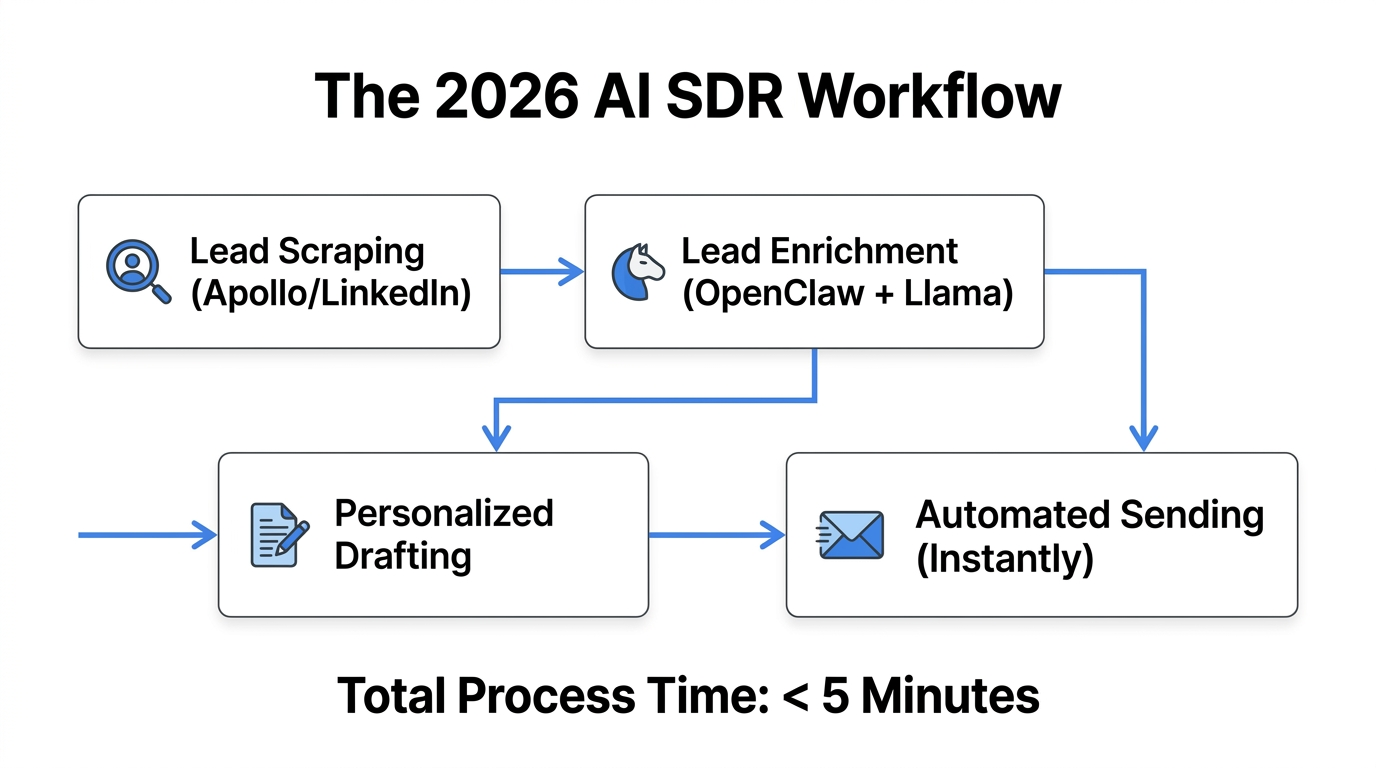
Building an OpenClaw AI SDR requires a shift from clicking buttons to 'Vibe Coding'—the 2026 paradigm where you describe behaviors in natural language and the agent interprets the execution. Follow this sequence to launch your agent in under 48 hours.
Step 1: Environment and Core Configuration
Do not attempt to run OpenClaw directly on your primary machine. For security and stability, use a sandboxed environment. Docker is recommended to ensure the agent doesn't have unrestricted access to your local file system.
- Deploy a small VPS (DigitalOcean or Linode) for $10/month.
- Install the OpenClaw core via Docker.
- Connect your API keys. Pro-tip: Use Claude 3.5 Sonnet for routine tasks. It offers the best performance-to-cost ratio, keeping your token spend under $15/month even with high volume.
Step 2: Automated Lead Enrichment & Browser Control
The 'secret sauce' of OpenClaw is its browser control module. Instead of buying a list, you give the agent a list of target companies. The agent will:
- Navigate to LinkedIn and find the relevant stakeholders.
- 'Claw' the web for recent company news, funding rounds, or product launches.
- Generate a 'Battlecard' for each lead that summarizes why your solution fits their current trajectory.
For those in the creator economy space, this is where specialized discovery tools shine. For instance, brands looking for influencers often use Stormy AI to find the right creators first, then feed those URLs into their OpenClaw agent to handle the actual outreach and negotiation sequence.
"The future of sales isn't 'low-cost,' it's 'high-relevance.' OpenClaw allows us to achieve both simultaneously by automating the research phase that humans usually skip."
Step 3: Implementing the Inbox Triage System
One of the most impressive feats of the 2026 OpenClaw framework is its ability to handle massive email volume. One user reported processing 4,000 unread emails in just 48 hours using an automated inbox triage system.
Configure your agent to monitor your sales inbox every 30 minutes. The agent should be programmed with 'Vibe Coding' logic to:
- Identify Intent: Is this a 'not interested,' a 'check back in 6 months,' or a 'let's meet'?
- Categorize: Tag high-priority leads in your CRM automatically.
- Draft Responses: Create a hyper-personalized draft based on the lead's LinkedIn and previous email history, leaving it in your 'Drafts' folder for a final 2-second human approval.
Optimization Secrets: Keeping Costs Under $30
While the OpenClaw software is free, API token costs can spiral if you aren't careful. To build a truly low cost sales automation engine, you must optimize your model selection.
Experts recommend a 'Multi-Agent Swarm' approach. Use a very small, cheap model (like Llama 3 8B) to filter out spam and irrelevant leads, and only invoke the expensive, high-reasoning models (Claude 3.5 Sonnet) when it’s time to draft the actual outreach email. This tiered architecture is how you keep your total AI outreach playbook spend under $30/month.
Vibe Coding: The 'Prompt' is the Product
In 2026, we don't 'program' agents; we 'vibe' them. Your agent's personality and follow-up logic are defined in a YAML configuration file. Here is an example of a high-converting 'Vibe Prompt' for an AI SDR:
"You are an SDR who is curious, concise, and helpful. Never use 'hope this finds you well.' If you see a lead recently posted about a product launch, congratulate them on a specific feature. If they don't reply in 3 days, send a follow-up that offers a specific piece of value relevant to their industry."
This natural language instruction, combined with OpenClaw's browser capabilities, creates a sales machine that feels human because it has access to human-level context.
Security and Best Practices for 2026
Giving an AI agent the ability to control a browser and run shell commands is powerful, but it's also a potential security risk. Peter Steinberger himself has emphasized that while "the claw is the law," the law must be enforced within a secure sandbox.
- Read-Only Permissions: Initially, give your agent read-only access to your CRM and email until you trust its logic.
- Token Limits: Set hard daily limits on your Claude/OpenAI accounts to prevent 'hallucination loops' from draining your budget.
- Human-in-the-loop: For cold email automation 2026, always start with a 'Draft Only' mode. Only move to 'Full Auto' once the agent has achieved a 95% accuracy rate in its categorizations.
The Future: Owning Your Agentic Architecture
The era of the $1,500/month 'walled garden' sales stack is ending. By building your own OpenClaw AI SDR, you aren't just saving money—you are building a proprietary asset. You own the data, you own the logic, and you own the relationship.
Whether you are a solo founder or a scaling growth team, the 2026 playbook is clear: stop renting your sales tools and start building your agentic architecture. Start small, use Stormy AI to identify your initial creator or lead targets, and let your custom OpenClaw agent handle the heavy lifting while you sleep. The efficiency gains are no longer theoretical—they are the new baseline for survival in a competitive market.