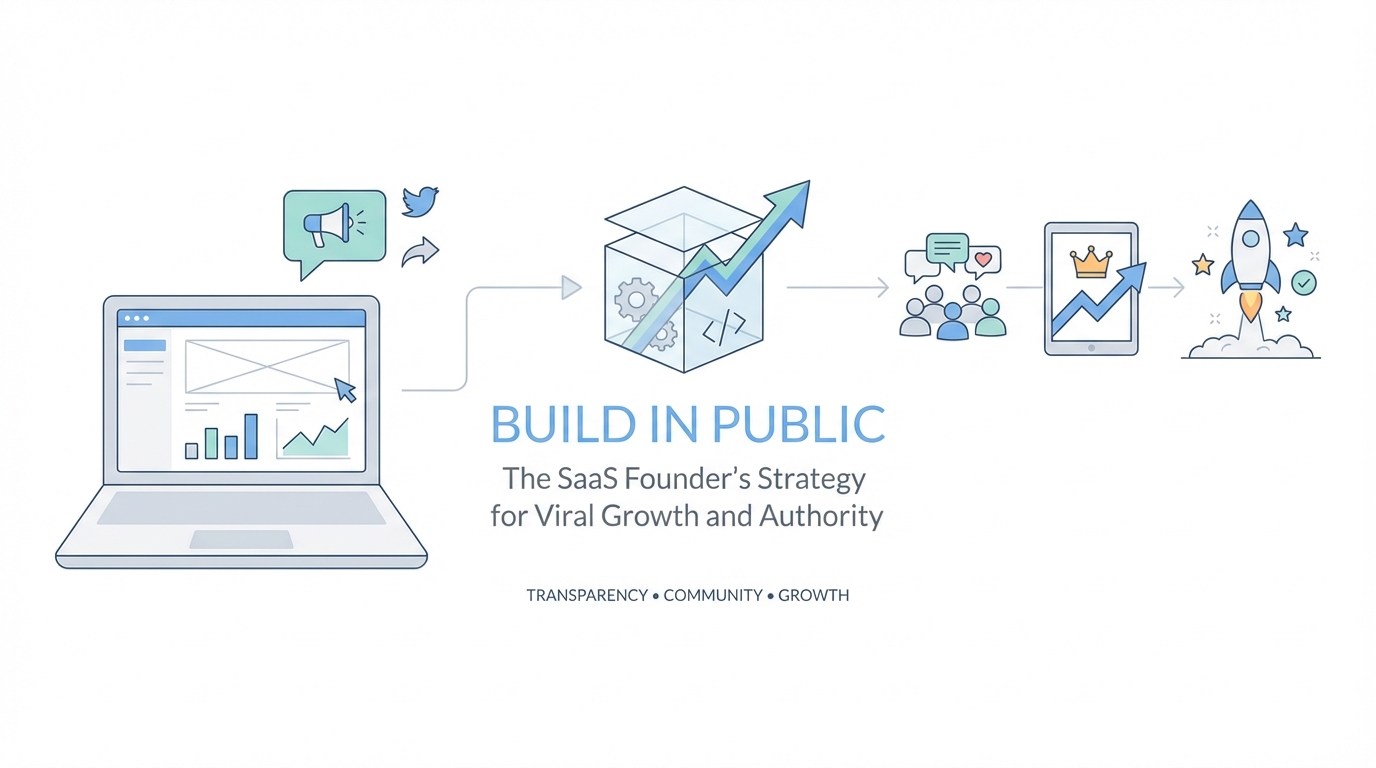
In the traditional software world, the launch of a new product was often shrouded in mystery, hidden behind non-disclosure agreements and iron-clad corporate silos. But the era of the shadowy corporate giant is fading. Today, a new generation of entrepreneurs is proving that transparency is the ultimate marketing engine. By adopting a build in public philosophy, founders are bypassing traditional ad spend and building multi-million dollar companies through raw, unpolished storytelling. This strategy doesn't just launch products; it builds a loyal community that acts as an unpaid sales force, validating features before a single line of code is written.
The Shift to Transparency: Why Unpolished Wins in the AI Era

We are living in an age of skepticism. Consumers are increasingly blind to polished saas marketing strategy tactics that feel like high-budget commercials. Instead, they crave the human element. For Dustin, the founder of Magi AI, this realization was the catalyst for a business that now generates over $100,000 in monthly revenue. Instead of hiding his lack of formal coding experience, he shared the journey of teaching himself how to build apps from scratch. This founder-led growth approach creates a level of trust that traditional brands simply cannot buy.
When you build in public, you aren't just selling a tool; you are selling a narrative. People want to root for the underdog. When Dustin launched his MVP after an 8-week build process, he didn't need a massive budget for Google Ads. He had already established authority by sharing his learning process, his failures, and his vision. This transparency acts as a powerful filter, attracting users who are invested in the product's long-term success rather than just its immediate features.
In the crowded AI space, where new tools appear daily, Stormy AI—an all-in-one AI search engine for creator discovery across TikTok, YouTube, and Instagram—helps brands navigate the noise by identifying creators who align with this authentic style. By documenting the "messy middle" of product development—the bugs, the pivots, and the sleepless nights—founders build a personal brand that serves as a moat. Anyone can clone a feature, but no one can clone your unique journey and the relationship you’ve built with your audience.
The 100,000 Subscriber Engine: Growing an Asset Over Time
One of the most striking aspects of Dustin's success is his long-term commitment to audience building. Before Magi AI even existed, he had spent a decade cultivating a personal blog. This grow email list for business strategy resulted in over 100,000 email subscribers before he ever asked for a single dollar for his software. This list wasn't just a database; it was a pre-warmed audience ready to convert on day one. In fact, Dustin saw $3,000 in revenue in his first month with zero paid advertising.
To replicate this, founders must view their content as a separate product. Use platforms like ConvertKit to manage these relationships and segment your audience based on their interests. A high-quality email list provides a level of stability that social media algorithms cannot match. If you are building a tool for mobile app developers, your email content should provide value to that specific niche long before you pitch your SaaS product.
Personal branding for founders is not about being a celebrity; it is about being a resource. By consistently sharing insights on technology and marketing, you position yourself as an authority. When you finally release a product, your email list doesn't see it as an advertisement—they see it as a recommendation from a trusted expert. This is the core of founder-led growth.
The Social Media Launchpad: Converting Followers to Users
Social media is often misused as a megaphone for announcements. In a build in public strategy, social media is a conversation. Dustin’s transition from an agency owner to a SaaS founder was documented in real-time. He leveraged his "knack for social media" to turn his personal accounts into a launchpad. Instead of relying on Meta Ads Manager to find new leads, he used his existing network to gain initial traction.
For modern founders, this often involves finding the right partners. Using Stormy AI can help you discover creators who specialize in UGC (User Generated Content) for mobile apps by using natural-language prompts, allowing you to amplify your "build in public" message. When an influencer shares the "behind the scenes" of your app development, it carries significantly more weight than a standard sponsored post. This is because it aligns with the authentic, unpolished vibe that users currently prefer.
Key tactics for a social media launchpad include:
- The Tease: Share screenshots of the UI long before it is functional.
- The Vulnerability: Post about a feature that failed or a bug that took 48 hours to fix.
- The Poll: Ask your audience to vote on the next feature or the pricing structure.
- The Celebration: Share your revenue milestones openly, just as Dustin shared his jump from $10,000 to $30,000 a month.
The Feedback Loop: Validating Before You Build
The most expensive mistake a founder can make is building something nobody wants. Building in public solves this by creating a continuous feedback loop. By the time Dustin used Bubble to build his MVP, he already knew the pain points of existing AI users. He noticed that people were tired of juggling multiple subscriptions for different models and that basic quality-of-life features—like folder organization and searchable chats—were missing from the major platforms.
By engaging with his 100,000-person audience, he could validate these hypotheses. SaaS marketing strategy in the modern era is as much about listening as it is about talking. When your audience feels like they helped design the product, their loyalty is unshakeable. They become your beta testers, your bug hunters, and eventually, your biggest advocates.
Tools like Ahrefs can help you identify what people are searching for, but your audience tells you why they are searching for it. Integrating this feedback into your development cycle ensures that your SaaS product remains relevant in a rapidly shifting market like Artificial Intelligence.
The 8-Week Build Playbook: From Idea to $100k/Month
How do you go from a revelation to a million-dollar business without a coding background? Dustin’s 8-week sprint provides a clear playbook for the modern entrepreneur. He didn't spend months in a vacuum; he used no-code tools and strategic APIs to move fast. Speed is a competitive advantage, especially when you are building in public.
Step 1: Identify the Gaps
Don't try to reinvent the wheel. Look at massive platforms (like ChatGPT) and find the "quality of life" features they are missing. For Dustin, this meant adding search, folders, and access to multiple models (GPT-5, Claude, Flux) in one dashboard.
Step 2: Leverage No-Code and AI Tools
You don't need a computer science degree to launch a SaaS. Dustin used Bubble for the front-end and tools like Rocket.new to accelerate the development process. By using OpenRouter and fal.ai, he could access the world's best AI models through unified APIs, saving months of custom integration work. Modern founders are also using Stormy AI to automate creator analysis, replacing outdated manual vetting processes with instant quality reports.
Step 3: Launch Early and Publicly
Dustin's first month saw $3,000 in revenue because he didn't wait for perfection. He launched an MVP that solved one core problem well. Building in public means being okay with an "ugly" version 1.0. If you are solving a real pain point, users will forgive the lack of polish.
Step 4: Implement a Recurring Affiliate Program
To scale from $30,000 to $100,000 a month, Dustin utilized a generous affiliate program. Instead of a one-time fee, he offered recurring commissions. This turned his users into long-term partners who were incentivized to help the product grow. This is a far more sustainable saas marketing strategy than constantly fighting rising CPAs on Apple Search Ads.
Integrating Influencer Marketing with Build in Public
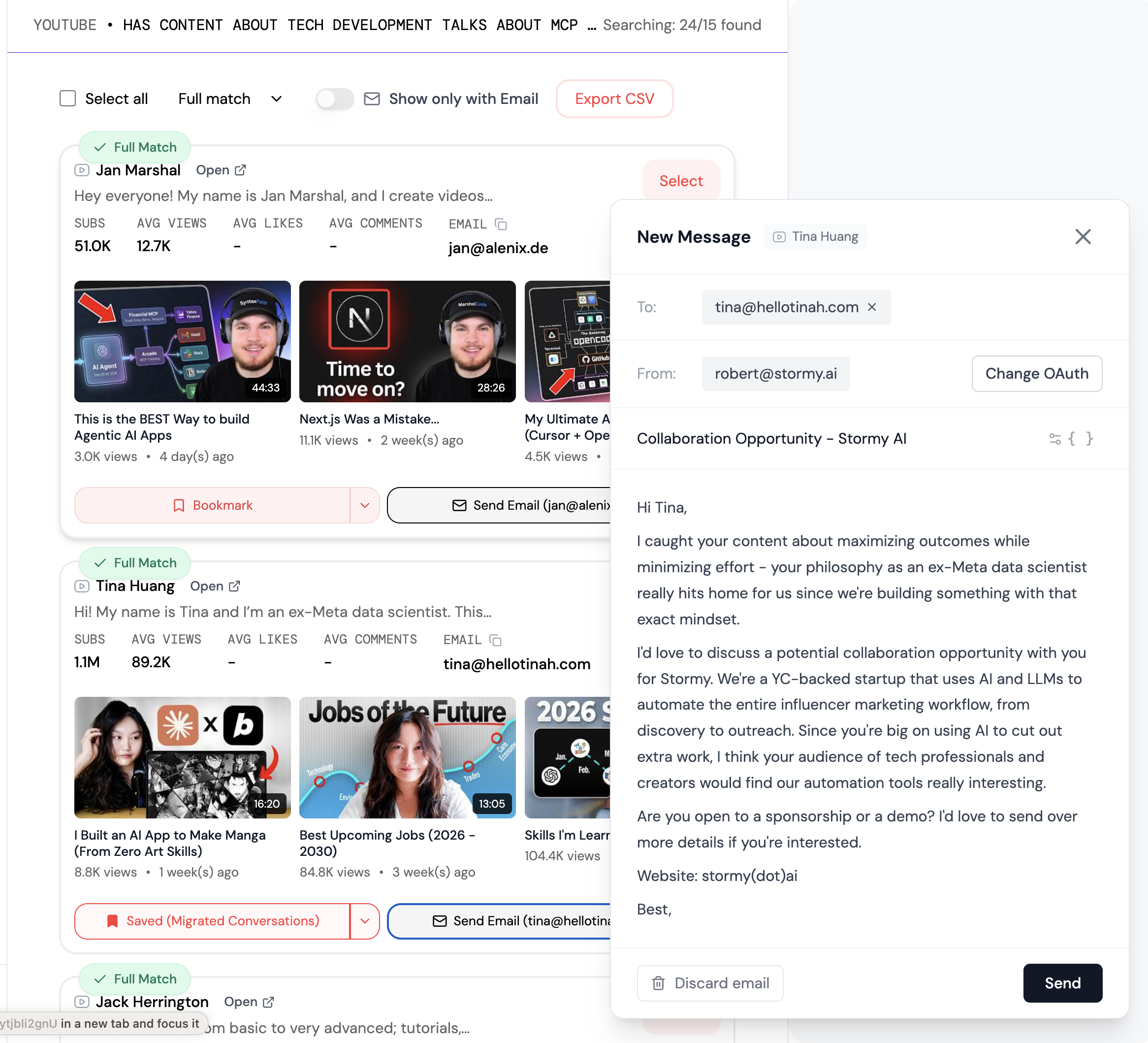
While the founder is the face of the brand, scaling requires more voices. This is where influencer marketing intersects with the "build in public" ethos. Instead of standard ads, brands are now working with UGC creators who can document their own experience using the tool. This creates a secondary layer of transparency. If a founder shows how the tool is built, and an influencer shows how the tool is used to solve a specific problem, the social proof is doubled.
For mobile app developers, this is particularly effective for app install campaigns. Seeing a real person use an app to generate an image via fal.ai models is more convincing than any static banner. Founders can use Stormy AI to find creators who specifically understand the SaaS and AI landscape. Once you identify the right partners, you can use Stormy AI to send hyper-personalized outreach emails at scale, ensuring your message reaches the right inbox every time.
Founder-led growth isn't just about one person; it’s about a network of authorities all talking about a shared journey. When you combine your personal brand with the reach of niche influencers, you create a viral loop that is difficult for competitors to disrupt.
Monetization: The Power of Simple Subscriptions
Magi AI's revenue growth is built on a straightforward, tiered subscription model. Dustin moved away from the freemium model, opting instead for a strictly paid model starting at $20 a month. This ensures that every user is a high-value customer from day one. In the AI era, where API costs can be significant, this protected his margins and allowed for rapid scaling.
By using Stripe for payment processing, he could easily manage solo plans and team plans (at $40/month), providing a clear path for enterprise growth. His transparency extended to his pricing; he openly discussed why the model was built this way and how it benefited the user by providing access to "the best of the best" AI models without five different subscriptions.
Conclusion: Your Story is Your Greatest Asset
Building in public is more than a marketing tactic; it is a commitment to authenticity and community-led growth. Dustin’s journey from a broke aspiring actor to the founder of a million-dollar SaaS proves that the barriers to entry in the software world have never been lower—provided you are willing to share your story. By focusing on personal branding for founders, growing a robust email list, and maintaining a transparent feedback loop, you can build a business that is resilient to market shifts.
If you are ready to start your journey, don't wait for a perfect product. Start documenting your process today. Use tools like Stormy AI to find your initial audience and vet potential collaborators, leverage no-code platforms to build your MVP, and remember that your failures do not define you—they are simply chapters in the story you are building in public. The transparency you offer today will be the foundation of the authority you hold tomorrow.