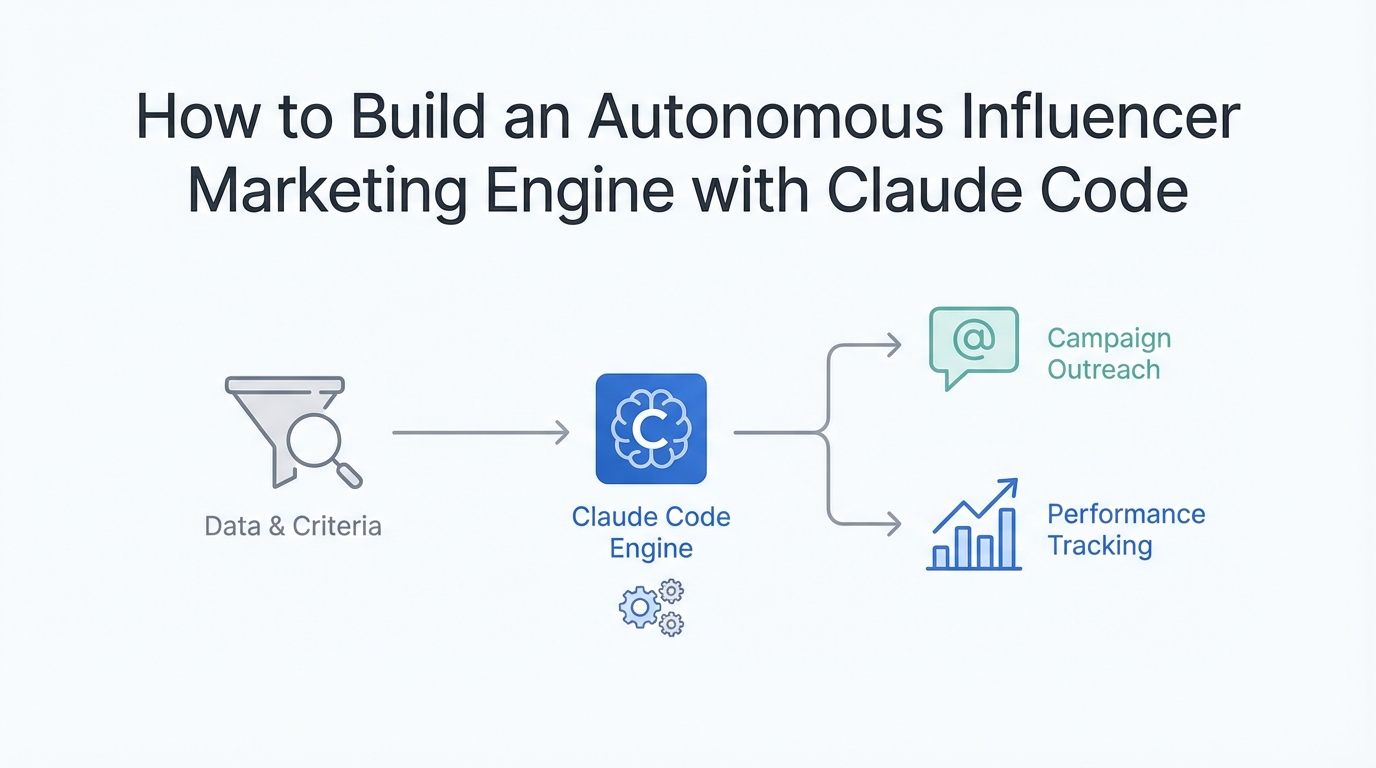
In the rapidly evolving landscape of digital growth, 2026 has officially become the year of the 'delegator.' For years, marketers have relied on 'copilots'—tools that suggest improvements or draft single emails. However, the paradigm is shifting toward agentic workflows, where AI doesn't just assist but autonomously executes entire marketing cycles. According to data from Influencer Marketing Hub, the influencer marketing industry is projected to reach $32.55 billion in 2026. To capture a slice of this market without ballooning your headcount, you need more than a dashboard; you need a terminal-based command center capable of discovering, vetting, and contacting thousands of creators while you sleep.
The Shift from Copilots to Delegators: Why Agentic Workflows Matter
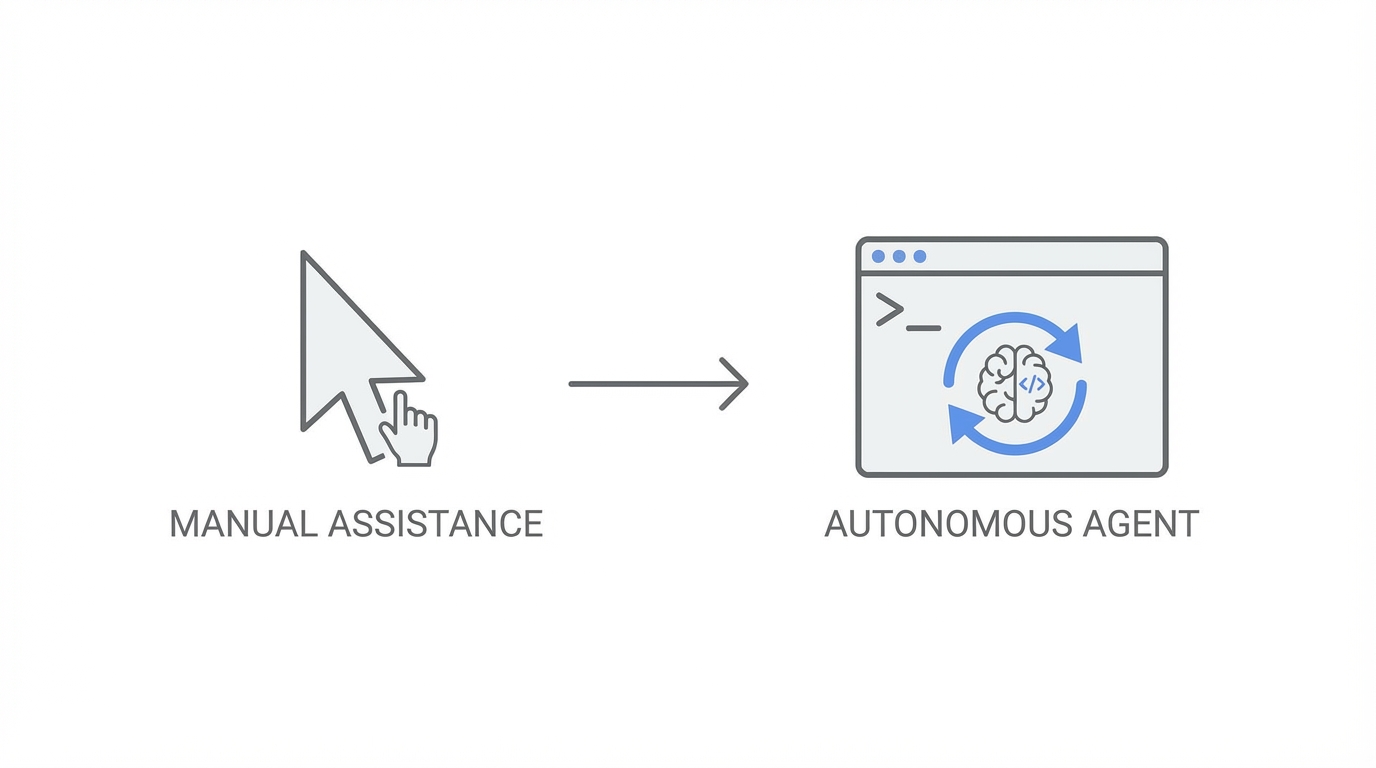
The traditional influencer marketing workflow is notoriously manual. Finding a creator, checking their engagement rate, looking for fake followers, and drafting a personalized email can take hours per person. Even with 89% of marketers currently using discovery tools, InfluenceFlow reports that 50% of marketers are now specifically planning to use AI for creator selection to eliminate these bottlenecks. We are moving toward what experts at NoimosAI call Autonomous Marketing.
As Bernard Marr recently noted in Forbes, 'Agentic Teamworking' is the next logical leap. Instead of a marketing department of 20 people, you will see a department of 2 people managing 20 specialized agents. In this new world, your role is to define the strategy and the 'vibe', while a tool like Anthropic’s Claude Code handles the execution. This strategy, often referred to as 'Vibe Marketing,' allows for unprecedented scale without sacrificing the authenticity that drives influencer ROI.
Step 1: Architecting the Claude Code Environment
To build an autonomous engine, you must first step out of the browser and into the terminal. Claude Code is Anthropic’s terminal-based AI agent that can run commands, edit files, and interact with external APIs through the Model Context Protocol (MCP). This protocol is the secret sauce that allows Claude to 'see' and 'act' within your local development environment and across the web.
Installing the CLI
Start by installing Claude Code globally on your machine. This gives the agent access to your file system, where it will store your Ideal Creator Profile (ICP) and campaign data. Once installed, you can initialize a marketing project directory. This environment will serve as the brain of your outreach engine, hosting scripts that bridge the gap between discovery and communication.
Integrating the Apify MCP Server
Claude is smart, but it doesn't have a live feed of Instagram or TikTok. To fix this, you need to install the Apify MCP server. By running a command like npx skillfish add apify/agent-skills, you grant Claude the ability to trigger 'Actors'—specialized scrapers that can extract real-time social data. This is critical because, as Archive.com notes, nano-influencers (1k–10k followers) make up 75.9% of the market and deliver 50% higher engagement rates. You need a tool that can find these needles in the haystack at scale.
Step 2: Defining the 'Vibe' in CLAUDE.md
One of the biggest mistakes in automation is being too vague. If you tell an AI to 'find influencers,' it will find garbage. To prevent this, you must define your Ideal Creator Profile (ICP) within a CLAUDE.md file in your project root. This file acts as the 'Employee Handbook' for your AI agent.
Instead of rigid keyword filters, use semantic instructions. For example, you might instruct Claude to: 'Identify creators in the Sustainable Home niche who focus on zero-waste living but avoid promoting temporary fad diets.' Tools like Kuli specialize in this type of content-level search, looking at what a creator actually says in their videos rather than just their bio keywords. By documenting these nuances in your CLAUDE.md, you ensure that every creator the agent discovers aligns with your brand's core values.
Step 3: Executing the Automated Discovery Loop
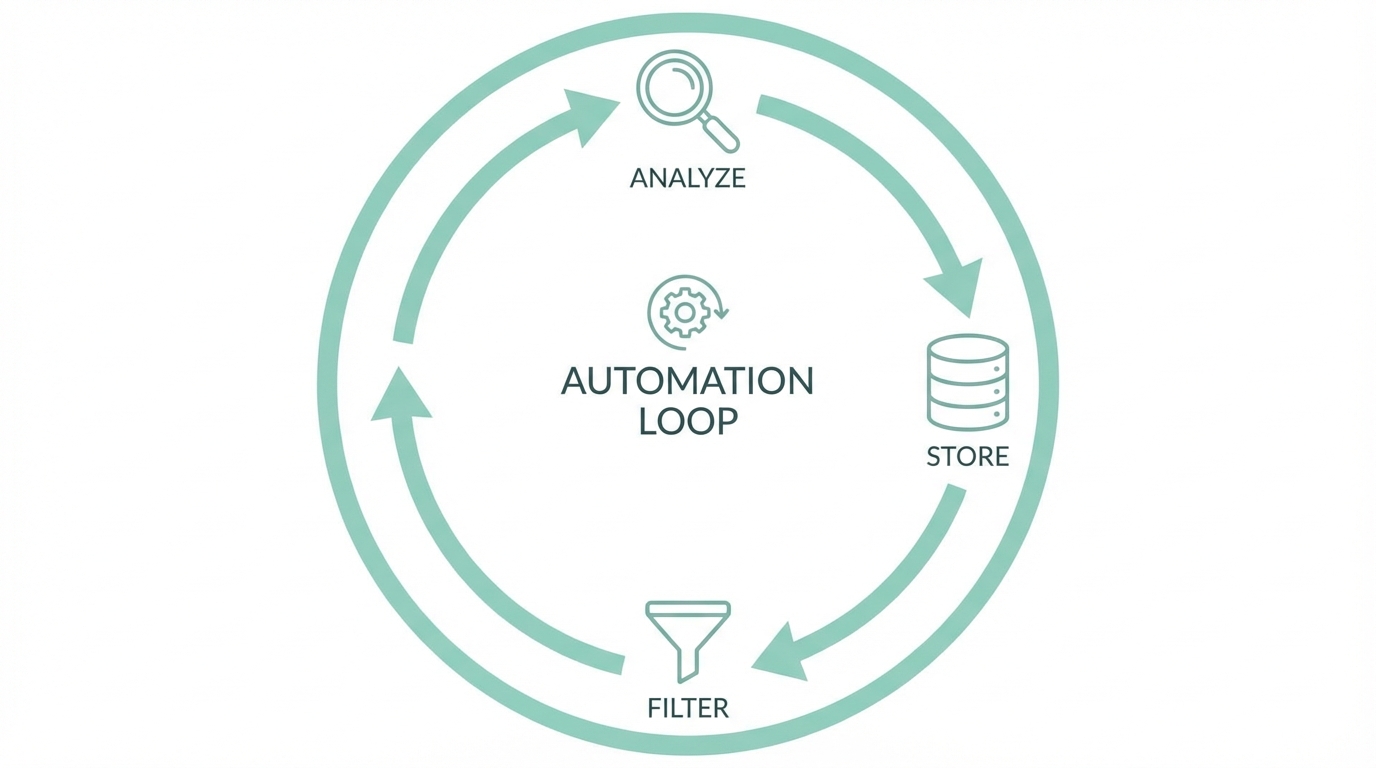
With the environment set up and the 'vibe' defined, you can now trigger the discovery loop. In 2026, the best campaigns don't just look at follower counts; they look at commercial KPIs. Research from IQFluence shows that elite AI-optimized campaigns can hit an ROI of $11–$18 for every $1 spent.
You can prompt Claude to use modern discovery platforms like Stormy AI or Influencers Club to pull a list of 100 creators who match your semantic profile. For a more direct approach, platforms like Stormy AI provide an AI search engine that understands natural language prompts, allowing you to instantly find creators across TikTok, YouTube, and Instagram. Integrating such a tool into your workflow ensures you are vetting for engagement fraud and audience quality automatically before the data ever reaches your outreach list.

Once the data is extracted via the Apify MCP, have Claude save it to a local JSON file. The agent should then perform a Content Quality Score analysis. It can use Firecrawl to scrape the creator's latest blog posts or Phyllo to pull verified performance metrics. If the engagement rate is below your threshold or the content feels 'spammy,' Claude will automatically discard the lead.
Step 4: Hyper-Personalized Outreach via Instantly.ai
The death knell of any influencer campaign is 'AI Slop'—generic emails that say 'Hey, love your feed!' According to LinkNow, influencers are increasingly savvy; generic outreach now sees less than a 1% response rate. To solve this, your autonomous engine must bridge the gap to Instantly.ai for outreach.
Using Claude Code, you can write a script that does the following for every discovered creator:
- Analyzes the last 5 Reels or TikToks the creator posted.
- Extracts a specific insight (e.g., 'I loved your tip about using beeswax wraps for sourdough storage').
- Generates a hyper-personalized first line.
- Pushes the lead into an Instantly.ai sequence via their API.
This level of personalization at scale is only possible through an agentic workflow. You aren't just sending emails; you are building the foundation for what Boksi calls 'Digital Ambassador' roles—long-term partnerships built on genuine trust and relevance rather than one-off transactional posts.
Step 5: The Verification Loop and Sentiment Analysis
An autonomous engine isn't 'set and forget.' It needs a Verification Loop to monitor performance and adjust. Boris Cherny, a key engineer behind Claude Code, emphasizes that agents should have the tools to see their own results. In a marketing context, this means giving Claude access to your email analytics and CRM.
You can instruct Claude to run a daily check: if a specific outreach template has a low open rate, the agent should propose a new subject line. If a creator replies with a specific question about rates, Claude can use the Creator CRM features found in modern tools like Stormy AI to flag the conversation for human intervention or draft a response based on your pre-set pricing guidelines. This 'sentiment analysis' ensures that the follow-up tone matches the creator's energy, further increasing the likelihood of a successful deal.
Avoiding Common Pitfalls in Influencer Automation
As you build this engine, there are three major traps to avoid. First is Over-Scripting. As Talent Resources points out, 65% of influencers prefer to lead the creative process. If your automated outreach includes a 10-page script, you will lose the best creators. Automation should handle the logistics, not the art.
Second is Vanity Metric Obsession. Never allow your agent to select creators based solely on follower count. A micro-influencer with a highly engaged, niche audience will always outperform a mega-influencer with a disconnected following. Finally, avoid Automating Broken Processes. As noted on Medium, if your manual outreach doesn't work, AI will only make it 'consistently bad at scale.' Always validate your 'vibe' and ICP manually before scaling to thousands of creators.
Conclusion: Building a Perpetual Growth Machine
Building an autonomous influencer marketing engine with Claude Code is about moving from being a 'doer' to being a 'director.' By leveraging MCP servers, real-time social data, and hyper-personalized outreach through platforms like Instantly.ai, you can create a system that scales linearly without increasing your workload. The brands that win in 2026 will be those that treat influencer marketing as a high-performance engine rather than a series of one-off experiments. Start by defining your strategy in your CLAUDE.md, empower your agent with the right tools, and let the delegator era begin.