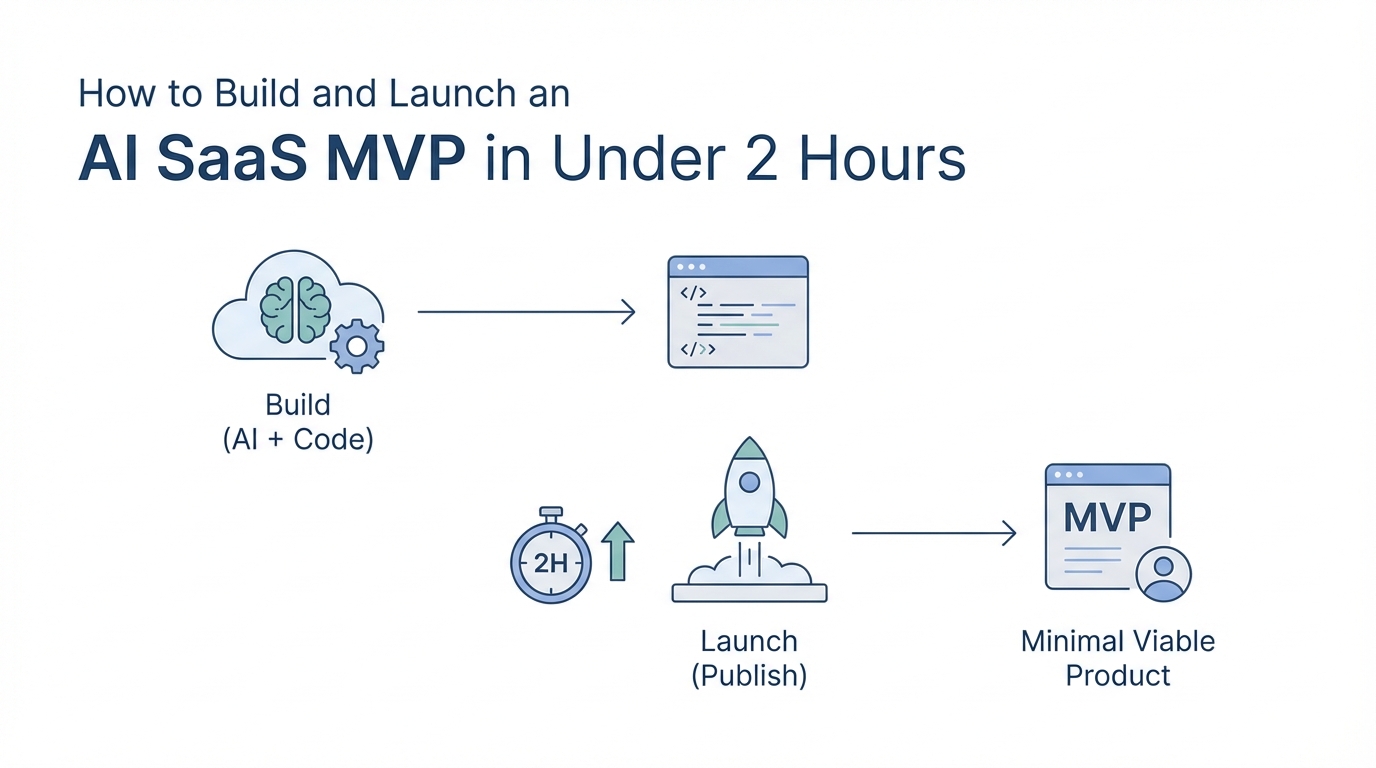
The traditional playbook for launching a software company is officially dead. In the old world, you needed to raise VC capital, hire an expensive team of engineers, and endure a two-year development cycle before your product ever saw the light of day. Today, the technical shift powered by AI has compressed that timeline into a single afternoon. According to recent McKinsey reports on AI adoption, generative technologies are fundamentally reshaping how businesses create value. If you can describe a problem and navigate a few APIs, you can build AI startup fast without writing a single line of backend code from scratch. This guide provides a battle-tested AI MVP tutorial to take you from a blank screen to a functional SaaS in under 120 minutes.
The Death of the Legacy Development Cycle
We are currently living through a massive transition in how tech products are built, marketed, and operated. Historically, product development was a sluggish process of overthinking and high overhead. However, the cultural shift toward lean operations means you can now launch a product with zero employees. As seen in the success of solopreneurs like Pieter Levels and Marc Louw, transparency and speed are the new competitive moats. You no longer need an office or a massive creative team; you need a rapid prototyping AI stack that allows you to iterate in real-time.
Marketing has also shifted from seasonal big-budget campaigns to an "always-on" storytelling model. By using AI to generate high-quality, Disney-style visuals or personalized avatars, you can engage audiences on a daily level. The goal of this playbook is to help you harness this technical shift to build a "cash-printing" machine while your competitors are still drafting their first job descriptions.
The PRD Framework: Using ChatGPT as Your Co-Founder
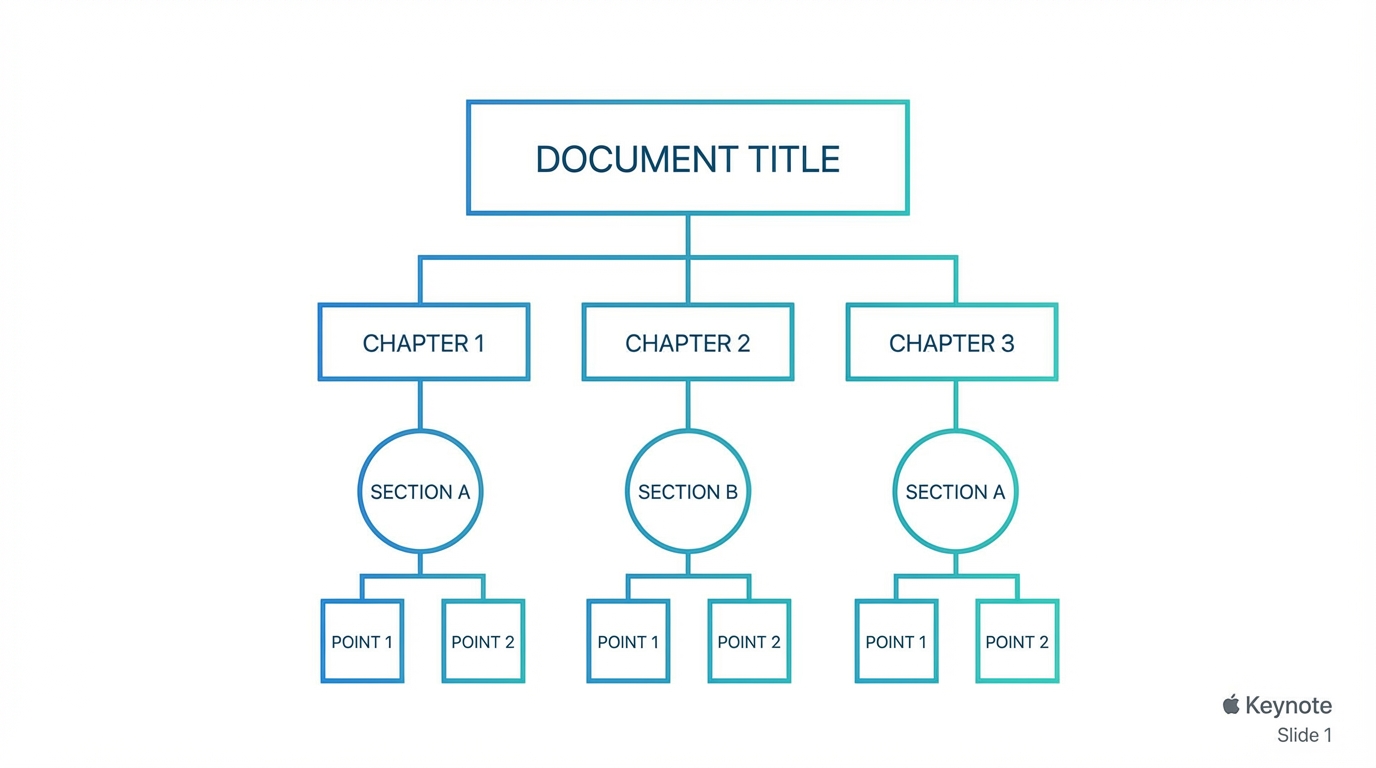
Before you touch a single tool, you need a roadmap. Most founders get stuck in the "idea maze" because they lack a Product Requirement Document (PRD). This document acts as the bridge between your vision and the technical execution. Instead of spending weeks drafting this, you can use ChatGPT as a virtual co-founder to generate it instantly.
Step 1: The Context Injection
Start by feeding ChatGPT the specific problem you want to solve. For example, if you want to build an AI-first version of Moonpig (a personalized greeting card company that does $400 million in annual revenue according to Reuters reports), tell the AI: "I want to create an AI-first version of Moonpig that uses 3D characters to tell stories. Act as my co-founder and tell me what this looks like to generate $10M a year in cash flow."
Step 2: Generate the PRD
Once the AI provides the business model, ask it to "Put this into a PRD that I can show to an engineering team." This document will outline the user flow, feature set, and technical stack. This is the exact framework used to validate no-code AI startup ideas during a single meeting. By the time you finish your coffee, you have a professional-grade blueprint ready for the next phase: prototyping.
The Rapid Prototype Stack: Building the Front-End Fast
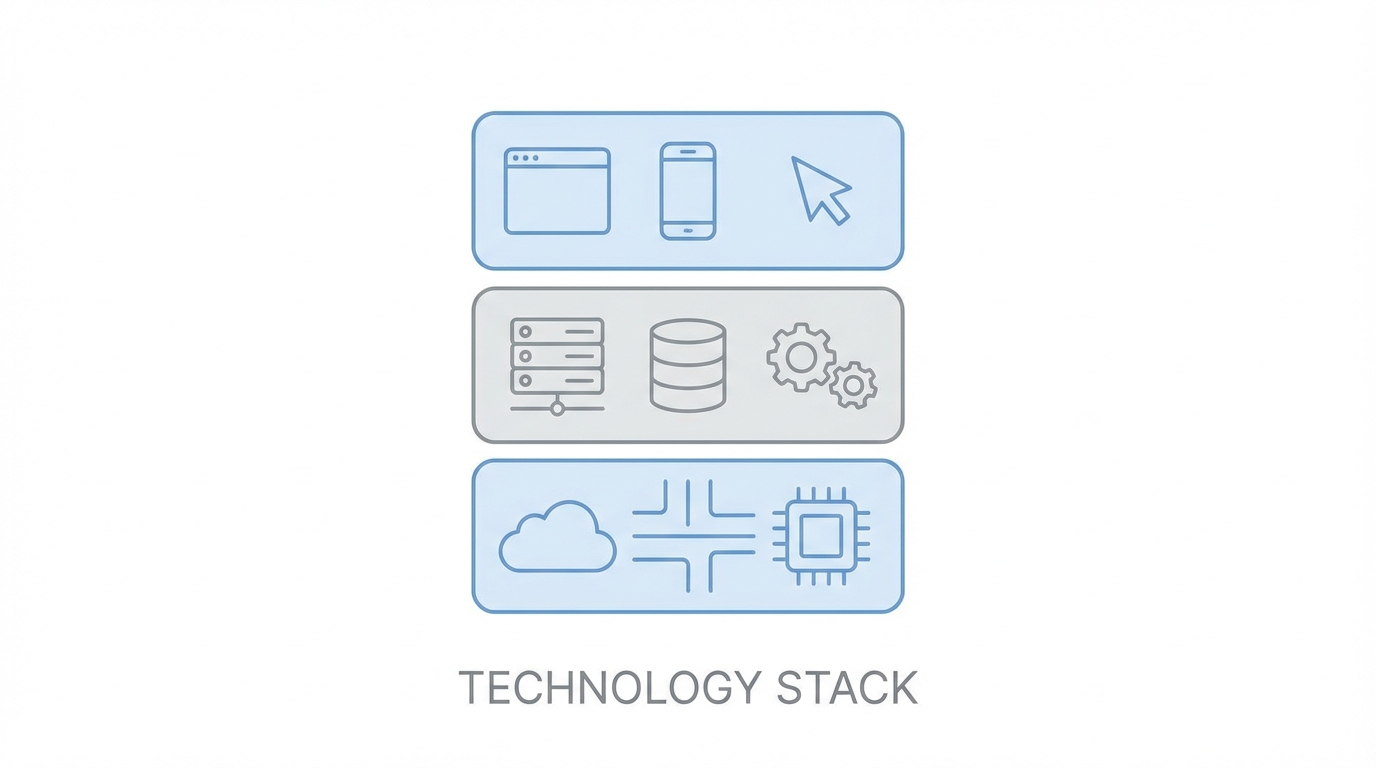
To how to build AI SaaS products effectively, you must separate the user interface (UI) from the logic. You don't need a custom React build on day one. Instead, use a Rapid Prototype Stack to create a functional interface in under 60 minutes. Tools like Replit, Bolt, or Lovable allow you to build the front-end during a single meeting.
The goal is to create a "UI layer" on top of an LLM model. For a product like "Teeny Tails"—an AI children's book generator—the UI only needs a few elements: a character name input, a photo upload button, and a theme selector. By using a builder like Shopify or Remove.bg for specific asset handling, you can create a seamless experience where users feel like they are interacting with a custom app, even if the backend is just a series of API calls.
Mastering Sequential Prompting: Connecting the Dots
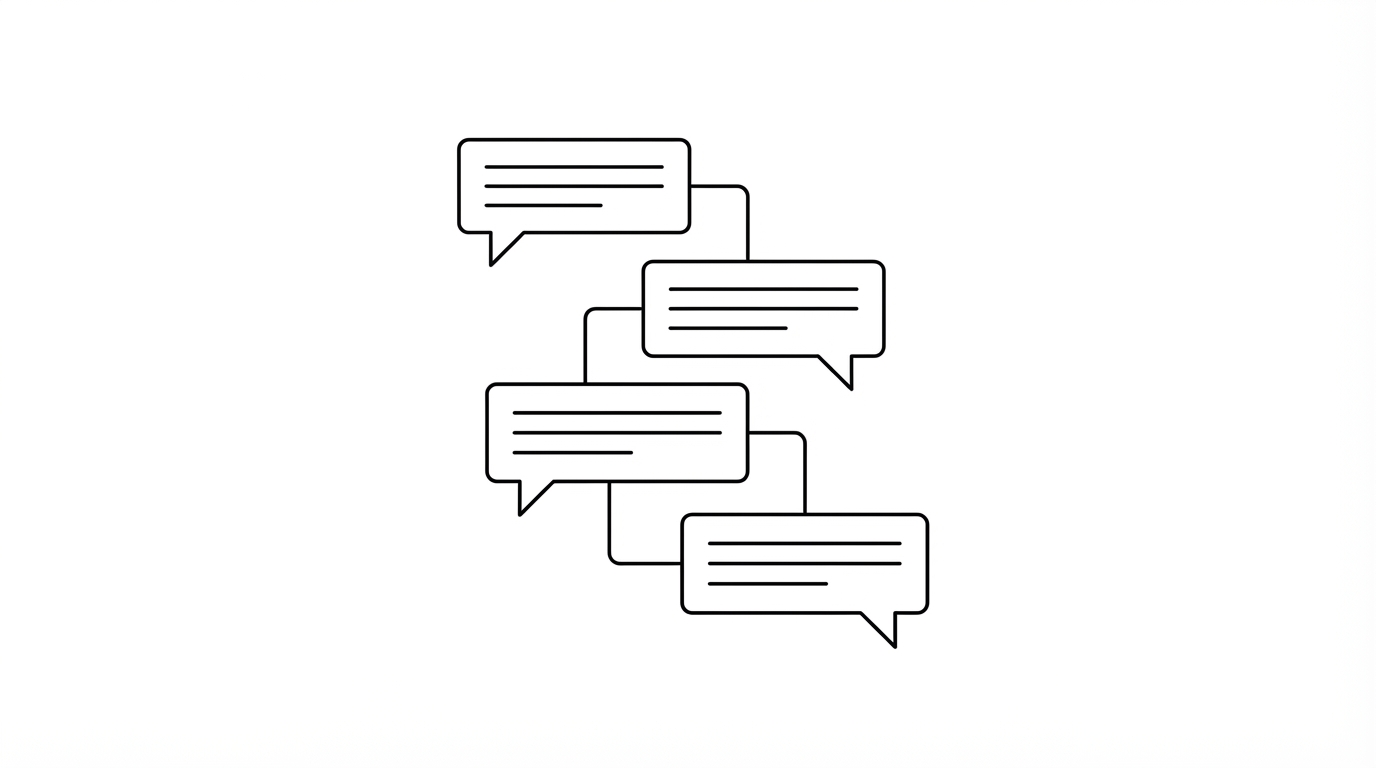
The secret sauce of modern AI SaaS is sequential prompting. This is the process of taking an output from one AI tool and using it as the input for another. This "Lego brick" approach allows you to build incredibly complex workflows with simple logic.
The Visual Pipeline: Leonardo to Kling
Let’s say you are building an avatar-based greeting card app. Your sequence would look like this:
- Character Creation: Use Leonardo.ai to generate a 3D, Pixar-style character. Leonardo is superior for this because it offers precise control over character consistency.
- Animation: Take that static image and upload it to Kling AI. Kling can turn a static photo into a 5-second video clip where the character sips a cup or waves goodbye.
- Dubbing: Use the lip-sync features in Kling or ElevenLabs to make the character speak personalized messages.
By connecting these via APIs, your SaaS can take a single user photo and, within minutes, return a high-definition animated video. This is the core engine that turns a "fun tool" into a recurring revenue product.
The Manual-First Rule: Validating the Workflow
A common mistake in how to build AI SaaS is trying to automate everything on day one. Before you hire an engineer to stitch APIs together, you must follow the Manual-First Rule. Perform the sequential prompting yourself for the first 10 customers. Talk to ChatGPT, copy the prompt into Leonardo, download the image, and put it into Kling.
Doing this manually allows you to iterate the prompt structure based on real-world outputs. For instance, you might realize that ChatGPT needs to add specific "kiss cut" instructions for your stickers to look right. Once you have a master prompt that consistently produces high-quality results, you can then use automation tools like Stormy AI to source creators who can help you scale the content side or manage the outreach for your new platform.
Guerrilla Marketing: Winning Your First 10 Customers
Once your MVP is functional, you need to prove people will pay for it. Guerrilla marketing is about high-conviction, low-cost outreach. For a sticker business targeting schools, don't buy ads. Instead, go to a school’s faculty directory, find the principal's photo, and use your AI pipeline to create a custom sheet of "Principal's Award" stickers.

Mail these physical samples to the school with a QR code. When a principal sees a high-quality, 3D avatar of themselves on a "Well Done" sticker, the wow factor does the selling for you. This "memifying" of moments is a powerful way to build awareness quickly. To scale this, tools like Stormy AI are invaluable; you can discover creators in the education or parenting niche and send hyper-personalized emails using AI to pitch your collaboration. Their search engine allows you to find influencers who fit your niche precisely, ensuring your guerrilla samples reach the right audience.
Scaling Revenue: From MVP to 10M/Year

As your no-code AI startup gains traction, the focus shifts to fulfillment and retention. For physical products like cards or stickers, connect your front-end to a drop-shipping API like Printful. This ensures that every time a user hits "Generate" and "Order," the product is printed and shipped without you touching a box.
The business plan for a $10M/year AI Moonpig clone assumes a $7 card price with a 20-30% markup for AI personalization. With 200,000 users purchasing an average of five cards annually, you hit $7 million in base revenue, with the remaining $3 million coming from AI-enhanced add-ons like flowers or chocolates. This isn't just a theory; it’s a mathematical path to scaling a lean, AI-driven business according to Harvard Business Review's SaaS growth principles.
Conclusion: The Era of the Single-Founder Unicorn
Building a SaaS in under 2 hours is no longer a gimmick—it is a viable strategy for the rapid prototyping AI era. By following the PRD framework, mastering sequential prompting, and applying guerrilla marketing tactics, you can launch a product that generates real cash flow before the day is over. The barriers to entry have never been lower, but the value of storytelling and brand has never been higher. Stop planning and start building; your first 100 customers are just one sequence of prompts away.