
The era of the 'chatbot assistant' is officially over. In 2026, the competitive landscape of digital marketing has split into two camps: legacy firms struggling with rising labor costs and the new breed of the agentic marketing agency. These agencies aren't just using AI to write copy; they are using Claude Code to build autonomous operational engines. With Anthropic's agentic CLI tool reaching a $2.5 billion annualized run rate by mid-2026, the technology has matured into the primary engineering core for modern marketing teams. This guide explores how to transition your firm to this high-scale model, leveraging technical marketing capacity to handle 10x the client volume with the same headcount.
Defining the Agentic Marketing Agency vs. Traditional Firms
In 2026, the distinction between a 'digital agency' and an 'agentic agency' comes down to the shift from Vibe Coding to Agentic Engineering. Traditional firms use AI as a better version of Google Search—asking for ideas or draft outlines. An agentic marketing agency, however, treats tools like Claude Code as senior partners capable of executing 'frontier tasks' without constant hand-holding. This shift is reflected in the market data, with the global AI marketing sector hitting $26.99 billion this year, according to market research projections.
"Claude Code is the worst branding maybe in history... because it's not just for coding. It's for any marketer who needs to build an engine." — Kamil Rextin, Founder of 42 Agency.While legacy agencies are bogged down by manual reporting and fragmented data entry, agentic firms use the Model Context Protocol (MCP) to bridge live marketing data directly into their AI agents. This allows for real-time optimization of Google Ads and social campaigns without human intervention. In fact, research from Stormy AI shows that agencies utilizing these agentic layers report a 300% average increase in ROI for performance marketing clients.
The 12-Person Agency: Handling 80+ Clients with Claude Code
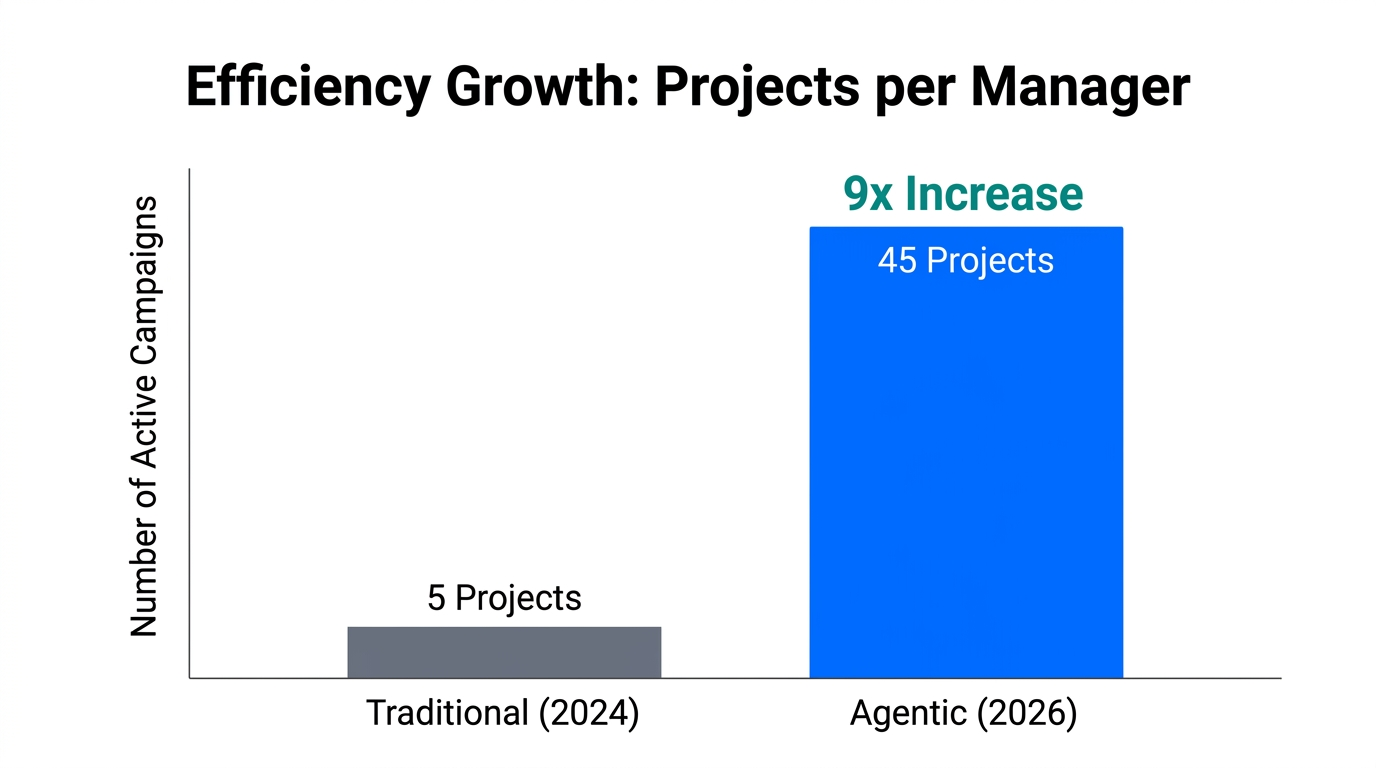
The most shocking transformation in 2026 is the collapse of the traditional 'headcount-to-revenue' ratio. Case studies from AdVenture Media Group demonstrate that a 12-person team can now manage over 80 high-ticket clients by automating the most labor-intensive parts of the agency lifecycle: reporting and technical SEO audits.
Previously, a monthly reporting cycle might take two full days per client. By building a custom pipeline via Claude Code, that same task is now completed in 40 minutes for the entire client roster. This is not just about speed; it is about independence. As Hiba Fathima from Firecrawl notes, marketers can now ship landing pages and tracking scripts without waiting in a developer queue.
| Task Type | Manual Time (2024) | Agentic Time (2026) | Efficiency Gain |
|---|---|---|---|
| Full SEO Technical Audit | 6 Hours | 12 Minutes | 96.7% |
| Custom Dashboard Build | 10 Hours | 45 Minutes | 92.5% |
| Competitor Scraping & Analysis | 4 Hours | 8 Minutes | 96.6% |
| Creator Outreach (80+ leads) | 8 Hours | 15 Minutes | 96.8% |
For agencies focused on influencer marketing and UGC, platforms like Stormy AI provide the critical discovery and vetting data that Claude Code agents use to automate hyper-personalized outreach. By connecting Stormy AI's API to a Claude-powered agentic loop, agencies can discover creators on TikTok and Instagram and send 500 personalized emails while the team focuses on strategy.
The Skill-Based Workflow: Setting Up Your Agency Operating System

To build an agentic marketing agency, you must move beyond simple prompts. You need a Skills-Based Workflow. This involves treating Claude Code as a resident engineer that lives in your project repository. The core of this system is the CLAUDE.md memory file, which prevents the AI from becoming 'senile' or losing track of brand guidelines.
Step 1: Initialize Your Environment
Install the CLI tool using npm install -g @anthropic-ai/claude-code. This gives your agency access to the terminal interface where the real automation happens. While some prefer Cursor for its visual IDE, Claude Code's terminal-first approach is superior for parallel mode—where you describe an outcome and let multiple agents work simultaneously.
Step 2: Create the CLAUDE.md Memory File
This file acts as the 'source of truth' for the agent. It should contain your agency’s naming conventions, preferred tech stacks (e.g., Framer for landing pages, Beehiiv for newsletters), and core brand voices. This ensures that every sub-agent Claude spawns remains consistent with the client's identity.
Step 3: Define Your 'Marketing Skills'
Don't ask Claude to 'do SEO.' Instead, create a market-audit.md skill file. This markdown file contains a structured sequence: use Firecrawl to scrape the competitor, use Composio to pull CRM data, and then generate a PDF report. By standardizing these 'Skills,' your agency can scale technical marketing capacity without hiring more engineers.
"The win isn't speed—it's independence. I can ship landing pages without waiting on a developer queue." — Hiba Fathima, Firecrawl.Financial Milestones: Reaching the $1B Scale in the Agentic Economy

The financial incentives for adopting the Claude Code agency model are staggering. As of early 2026, organizations report a 45% increase in productivity for technical SEO and Generative Engine Optimization (GEO). The goal for many top-tier agencies is to reach the $1 billion annualized run rate milestone—a feat once reserved for SaaS companies but now achievable for high-efficiency service firms.
| Platform | Philosophy | Interface | Best For |
|---|---|---|---|
| Claude Code | Autonomous Agent | Terminal / CLI | Multi-file refactors & automations |
| Cursor | AI-Native IDE | IDE Hybrid | Website design & editing |
| GitHub Copilot | Inline Assistant | IDE Sidebar | Rapid boilerplate & snippets |
Pricing for these tools has stabilized in 2026, with Claude Max tiers costing between $100–$200/mo. This provides 'Priority Parallel Capacity,' allowing an agency to run 20+ agents simultaneously. For enterprise-level work, Enterprise plans and Team Premium models are becoming the industry standard, offering early access to collaboration features that allow multiple human strategists to 'co-pilot' a single agentic swarm.
Managing the Terminal Barrier and Security Compliance
Despite the efficiency, two major hurdles remain for the agentic marketing agency in 2026: the Terminal Barrier and Security Compliance. Many creative-heavy agencies struggle with the CLI-only interface of Claude Code. Founders must decide whether to hire 'Marketing Engineers' who are comfortable in the terminal or provide extensive training to traditional account managers.
Furthermore, granting a CLI agent access to local files and GitHub repositories is a major security concern for enterprise clients. About 40% of enterprises still cite security as their primary barrier to full agentic adoption. To solve this, agencies are implementing strict SOC2 auditing for their agentic workflows and ensuring a 'human-in-the-loop' mandate for all final creative outputs. This is critical to avoid the 'Uncanny Valley' backlash seen in late 2025, where brands faced criticism for purely AI-generated content that felt 'soulless.'
"Claude Code is designed for 'frontier tasks' where the AI acts as a senior partner rather than just an autocomplete tool." — Dario Amodei, CEO of Anthropic.The Future: Search Everywhere Optimization (GEO)

In 2026, SEO has evolved into Generative Engine Optimization (GEO). With recent studies showing a massive shift in search behavior, the win is no longer just ranking #1 on Google. The goal is to be the primary cited source inside AI Overviews and Research Responses from Claude, ChatGPT, and Perplexity. Agentic agencies are building AI Visibility Trackers using Claude Code to scrape these AI responses and identify why a competitor is being cited more often, allowing for rapid-fire semantic content adjustments.
By integrating tools like Stormy AI for creator sourcing, Firecrawl for data indexing, and Claude Code for orchestration, your agency can move from manual execution to high-margin strategy. The transition to an agentic marketing agency isn't just an upgrade—it's a total survival requirement for the next decade of digital growth.