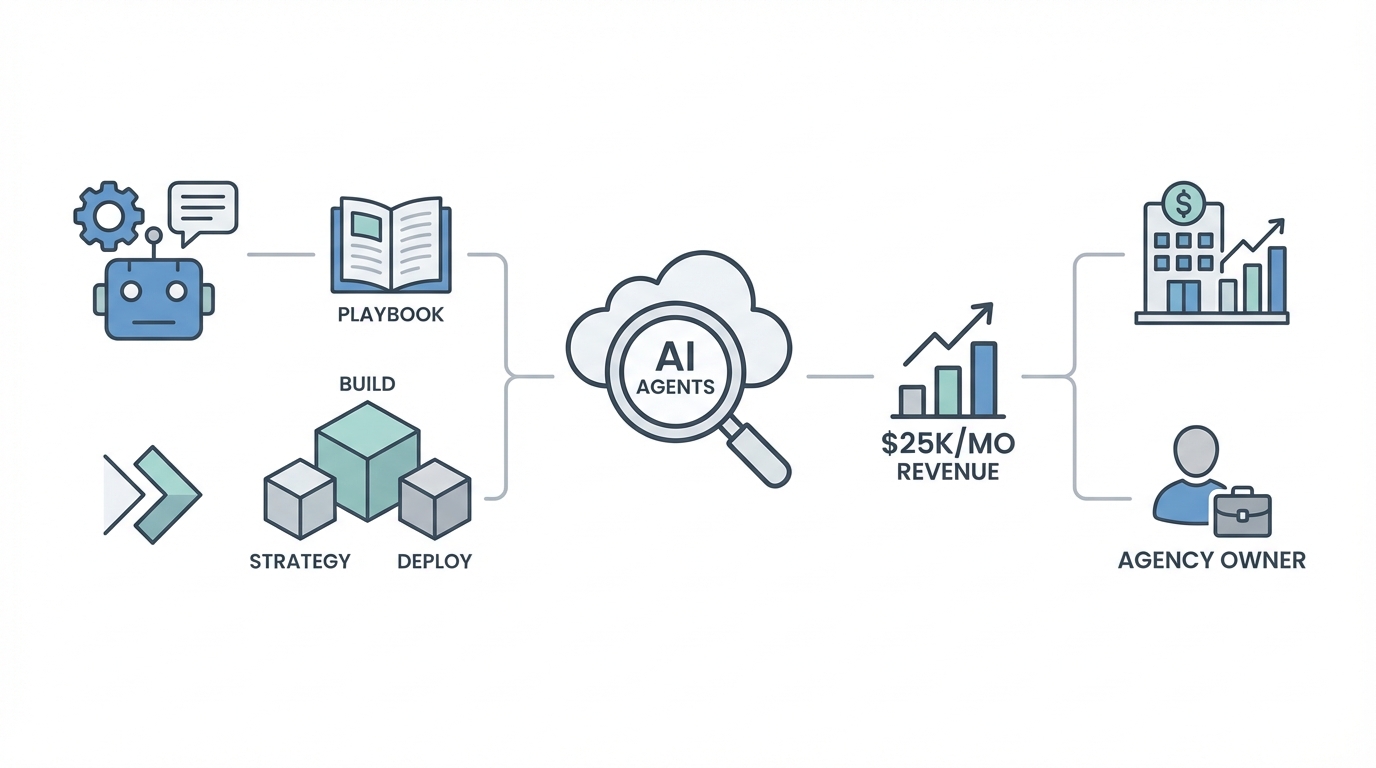
The dream of the "one-person unicorn" is no longer science fiction. We are entering a transition where the traditional service-based agency model is being cannibalized by autonomous systems. If you want to build a profitable AI business, you don't need to be a Stanford computer science graduate or a venture-backed rocket scientist. You need a boring problem, a repeatable process, and the discipline to wire agents into your workflow. This is the Leveraged Agency model: a three-phase playbook to transition from $1,000 in manual monthly revenue to a $5M ARR AI startup.
The Leveraged Agency Philosophy

Most entrepreneurs fail because they try to build the "Uber for X" before they even understand "X." The leveraged agency flips the script. Instead of burning hundreds of thousands of dollars in venture capital to find product-market fit, you start with manual labor. By selling a service first, you are paid to do market research. You identify the soul-crushing, repetitive tasks that businesses hate doing and find the edge cases that a generic AI prompt would miss. This approach ensures you are profitable from month one, retain 100% of your equity, and build true enterprise value by replacing human hours with agentic workflows.
Phase 1: Starting with Manual Labor
The first step in starting an AI agent business is finding a "boring pain." These are tasks that are necessary but miserable—think insurance form processing, invoice reconciliation, PDF-to-Salesforce data entry, or responding to thousands of local business reviews. You can find these opportunities by monitoring "community signals" on platforms like Reddit or using tools like IdeaBrowser to see what users are complaining about.
During the first three to six months, you should perform these tasks manually or with the help of a few freelancers. Your goal is not to stay a manual agency; it is to document every single SOP (Standard Operating Procedure). You need to learn the "if-this-then-that" logic of the task. For example, if you are processing customs paperwork, what happens when a field is missing? What happens if the currency is in Yen instead of Dollars? These are the edge cases. Documenting these is what allows you to build a robust AI automation agency later.
At this stage, you are likely operating at 40% margins with 1-5 clients paying a few thousand dollars a month. While it feels like "just an agency," you are actually building the blueprints for a high-scale software company.
Phase 2: Transitioning to 80% Margins
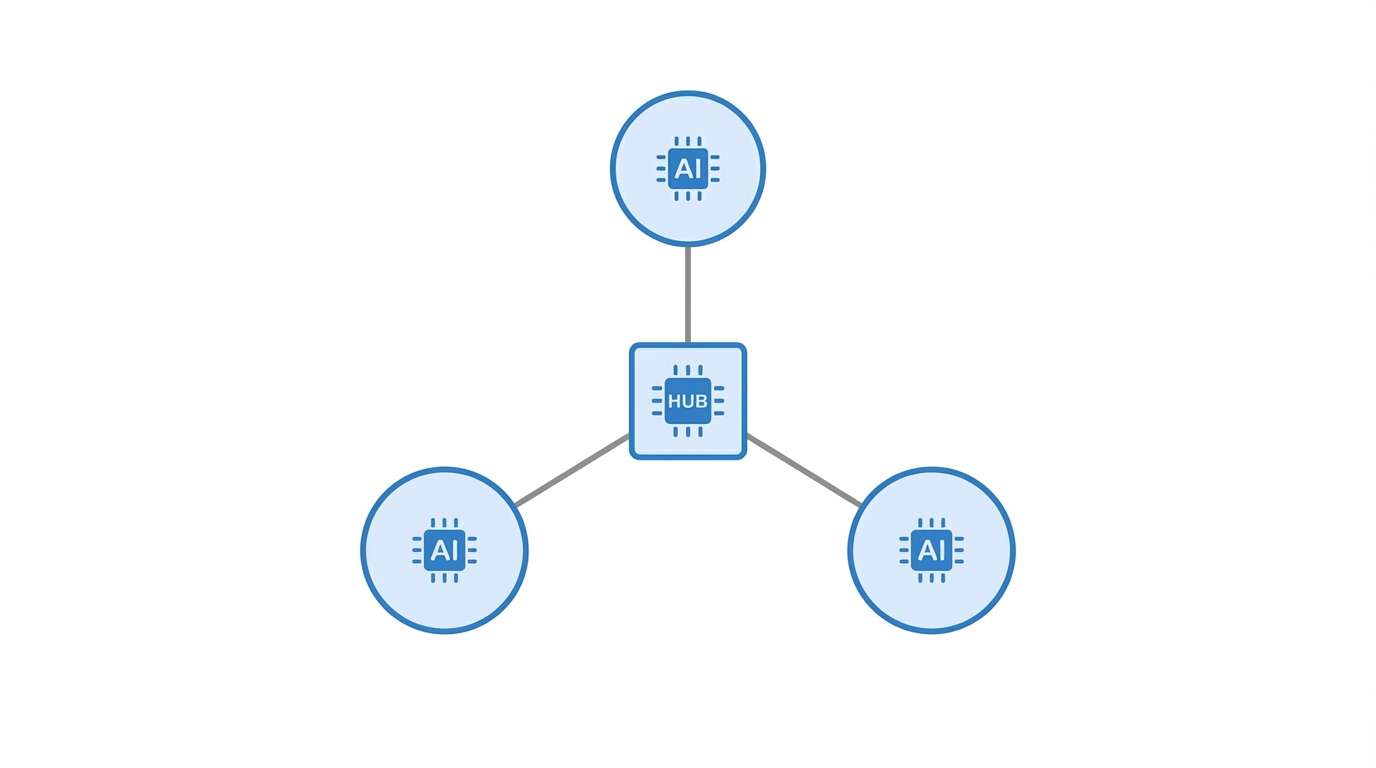

Once you have a library of SOPs and a deep understanding of the edge cases, it is time to "wire the agents." In Phase 2, you stop hiring humans and start building workflows that mirror your manual processes. This is where you leverage tools like Gumloop or Lindy AI to create autonomous agents that handle the heavy lifting. You can also use Claude or Cursor to build custom Python scripts for more complex logic.
The critical shift here is Outcome-Based Pricing. You should keep your service pricing exactly the same as when you were doing it manually. If a client was paying $3,000/mo for manual Instagram management, they should still pay $3,000/mo when the AI does it. The client is paying for the outcome—the posts, the engagement, the growth—not the hours you spend behind a keyboard. By automating the fulfillment, your margins jump from 40% to 80% or higher. You can now handle 10x the client load without increasing your headcount.
Phase 3: Scaling to $5M ARR with Multi-Tier Offers
By the time you hit $25,000 in monthly recurring revenue (MRR), you have moved beyond the agency model and into the AI startup territory. To scale toward $5M ARR, you must diversify how clients access your system. This involves creating a "barbell" of product offerings:
- Enterprise Tier: A "white-glove" service targeting Fortune 500 or Fortune 2000 companies. This is where you charge premium prices for high-security, custom integrations of your agent workflows.
- Self-Serve Tier: A classic SaaS model where users can log in to a dashboard and run the AI agents themselves for a lower monthly fee.
- API Tier: Giving other developers access to your data or processing logic, allowing them to build their own products on top of your engine.
A great example of this evolution is the company Bank Statement Converter, which started as a simple micro-SaaS to turn PDFs into Excel files and grew into a trusted tool making over $40,000 per month by solving a hyper-specific, boring pain point.
Distribution and the Content Flywheel

To reach hundreds of clients, you need a distribution engine that works while you sleep. The leveraged agency relies on "Building in Public." Start accounts on X (formerly Twitter) or Instagram and share your process. Don't just post "buy my service"; show the exact workflows you are building. When people see you solving a problem with a 90% success rate, they naturally want to hire you.
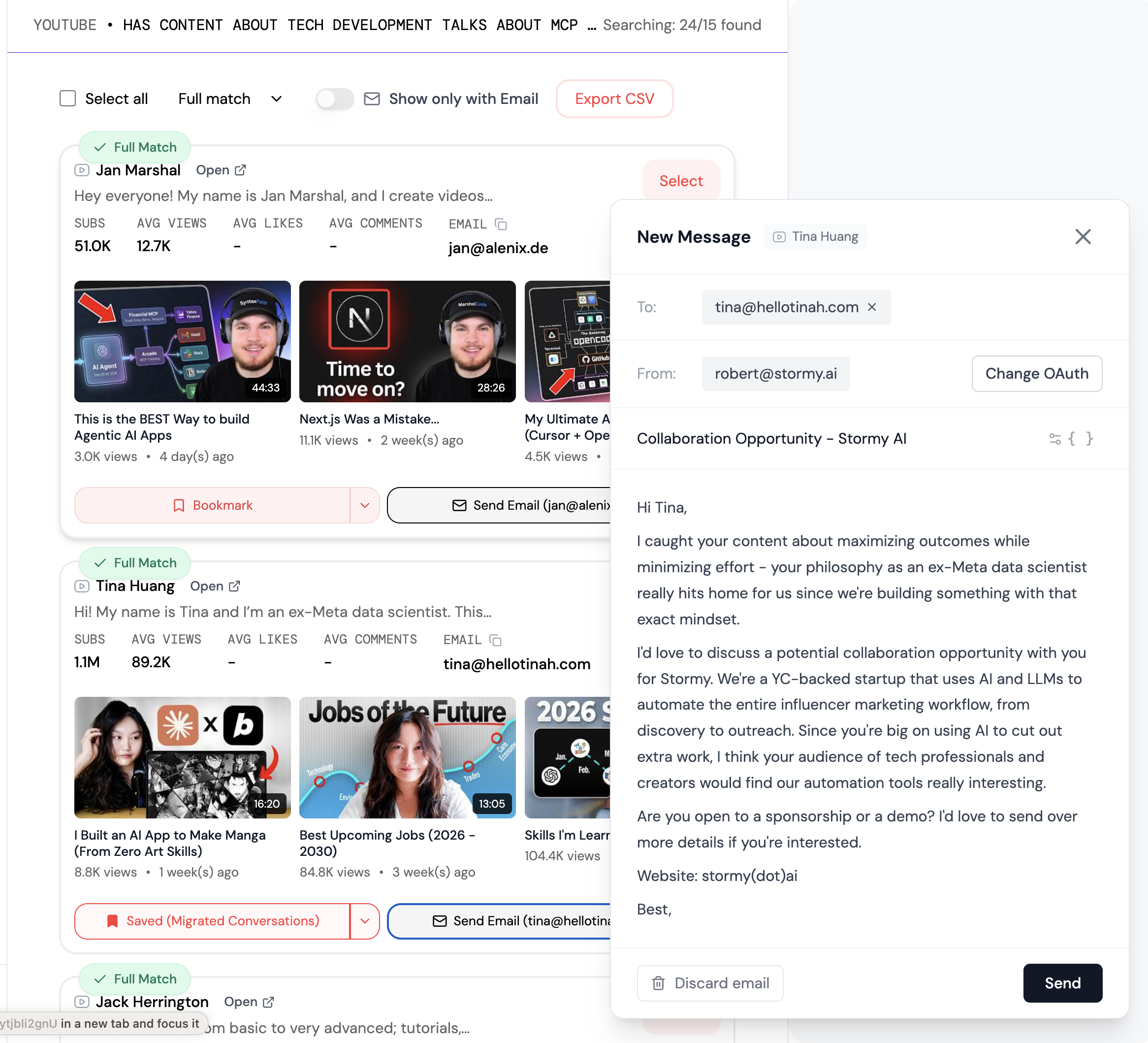
When scaling your distribution, manual outreach is often the bottleneck. Tools like Stormy AI can help you source and manage UGC creators or influencers to talk about your product, allowing you to automate the "discovery and outreach" phase of your marketing just as you automated the "fulfillment" phase of your service. By connecting an AI agent to your distribution, you create a flywheel where content drives customers, and those customers provide data to make your agents even better.
Why Boring is Better than Sci-Fi

The tech world is currently "frothy" with futuristic AI ideas that have zero revenue. While others are trying to build the next sentient robot, you should focus on "un-sexy" automation. Solving a problem like "we process insurance claims in 24 hours" is much easier to sell than "we are building the future of work." Business owners will happily hand over their credit cards for anything that saves them time or removes a soul-crushing task from their plate.
You don't need to be a "Big Idea" person; you need to be a "Boring Marketer." If you can find a repeatable task on Zapier or through Google search trends and build an agentic system around it, you have the foundation of a profitable AI business idea. Reinvest the "agency dividends"—the high profits from your 80% margins—into further agent development and 10x distribution. This is how you build a multipreneur portfolio that isn't just a job, but a high-value asset.
Conclusion: Take the First Step
The era of the "Idea Guy" is here, but only for those who can execute. Start by picking one boring pain point this week. Don't worry about the software yet—just find someone who will pay you to solve it manually. Once you've documented the edge cases and proved the value, use tools like Stormy AI for creator discovery or Gumloop for workflow automation to scale your reach. The path to $25K/mo isn't about working harder; it's about building systems that have more leverage than you do. Have a creative day, and start building.