Imagine being fired twice, laid off once, and feeling completely directionless in your late 20s. That was the reality for Colin McIntosh before he founded Sheets & Giggles, an eco-friendly bedding company that famously hit $1.2 million in sales in a single month just two years after shipping its first box. While many entrepreneurs obsess over product features or supply chains, McIntosh attributes a massive portion of his success to a disciplined brand naming strategy. In a crowded marketplace like bedding, a name isn't just a label; it is your most potent organic marketing tool.
Building a million-dollar ecommerce brand requires more than just a good product. It requires a brand identity map that guides every decision from the URL you buy to the creators you hire for UGC campaigns. This article dives deep into the four non-negotiable naming rules McIntosh used to build his empire, providing a masterclass in how to name a business for SEO and viral growth.
Phase 0: The Brand Identity Map
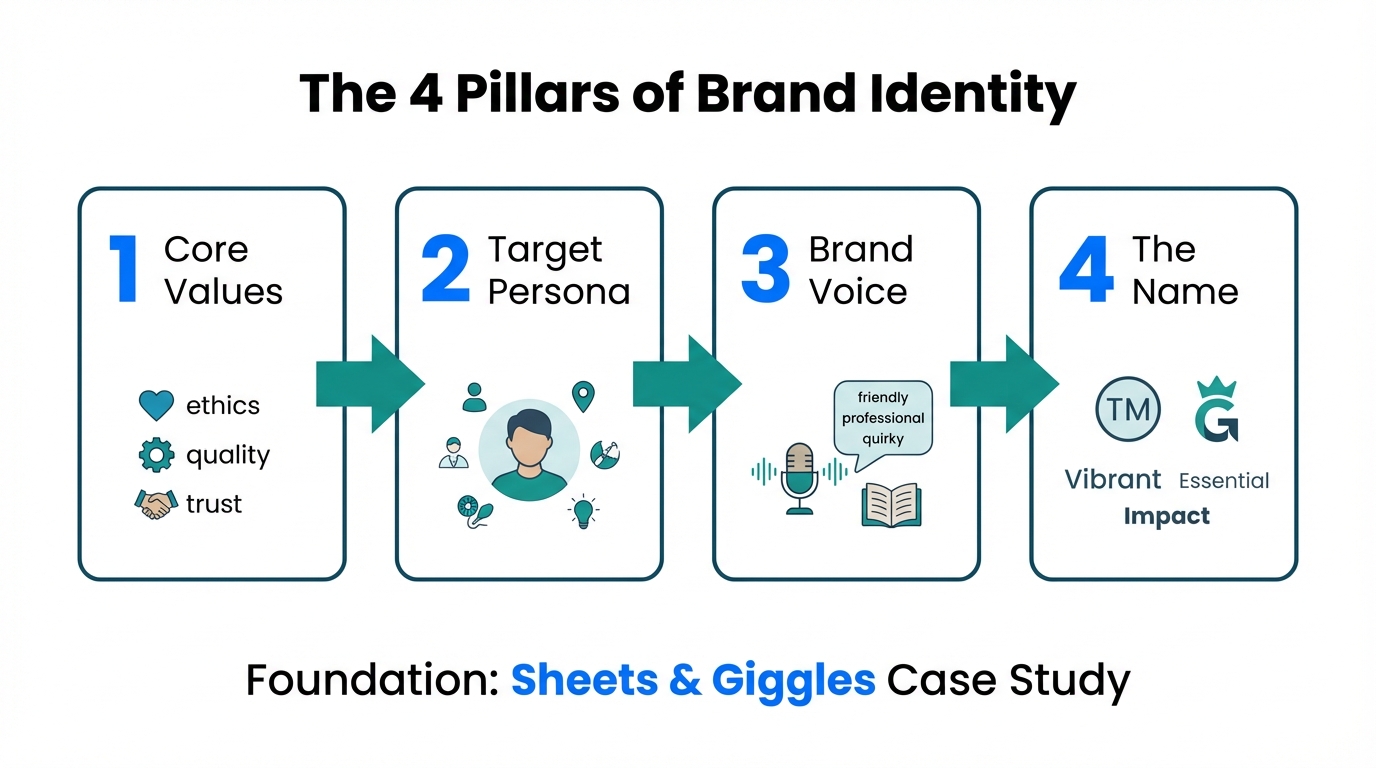
Before you even brainstorm a name, you must build a brand identity map. According to McIntosh, this should be the first step for any founder. It allows you to visualize and understand the company you are building before you spend a dime on manufacturing or web design. This map acts as a foundation for your financial model and your overall business model.
McIntosh emphasizes that you should sell before you build. By capturing 11,000 emails before launch with a 46% conversion rate on his signup forms, he validated that people weren't just interested in his "eucalyptus sheets"—they were interested in the brand he was building. This emotional investment from customers is what leads to a 4% email conversion rate, far higher than the industry average of 2%.
Rule 1: The "Spell-Sharable-Memorable" Framework
The first rule of a million-dollar brand naming strategy is that the name must be easy to spell, easy to share, and impossible to forget. In the world of word-of-mouth marketing, friction is the enemy of growth. If a customer tells a friend about your "disruptive sleep-tech solution" but the friend can't remember the name five minutes later, you've lost a sale.
"Sheets & Giggles" works because it uses a familiar linguistic pattern (a play on "sh*ts and giggles"). It’s memorable because it’s funny, sharable because people like telling jokes, and spellable because it uses common English words. If you have to spell your brand name out for someone over the phone, you’ve already failed Rule #1.
"If you're not pissing at least 20% of people off, you're probably not doing it right. Your brand needs a personality that bleeds off the screen."
When you use tools like TikTok Ads Manager or Meta Ads Manager, a memorable name reduces your Customer Acquisition Cost (CAC). People who see your ad once might not click, but if the name sticks, they’ll search for you later on Google or Amazon.
Rule 2: Connotation vs. Denotation
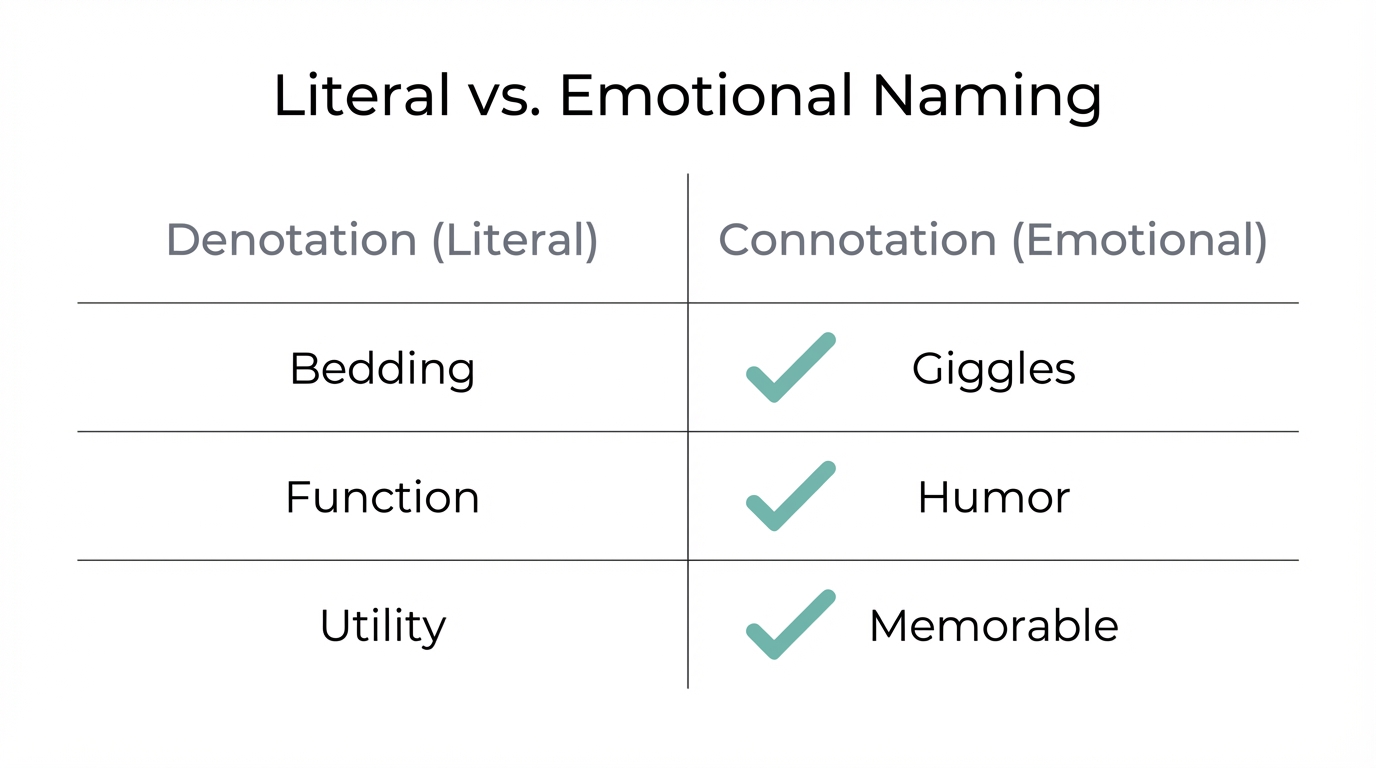
Your brand name must either connote or denote what you do. This is a critical rule for ecommerce brand building because it reduces the cognitive load on the consumer. If your name is completely abstract (like "Xobni" or "Quibi"), you have to spend millions of dollars in venture capital just to explain to people what you sell.
McIntosh chose a name that denotes the product category: Sheets. The moment a consumer hears the name, they know exactly what the product is. If you choose a name that connotes the feeling (e.g., "Slumber" or "Cloud"), it still works because it signals the category. If your name does neither, you are fighting an uphill battle from day one.
| Naming Strategy | Definition | Example | Marketing Effort Required |
|---|---|---|---|
| Denotative | Explicitly names the product | Sheets & Giggles | Low — Category is clear |
| Connotative | Hints at the feeling/use case | Everlane | Medium — Requires brand story |
| Abstract | Made-up words | Ro | High — Requires massive ad spend |
Rule 3: How to Name a Business for SEO
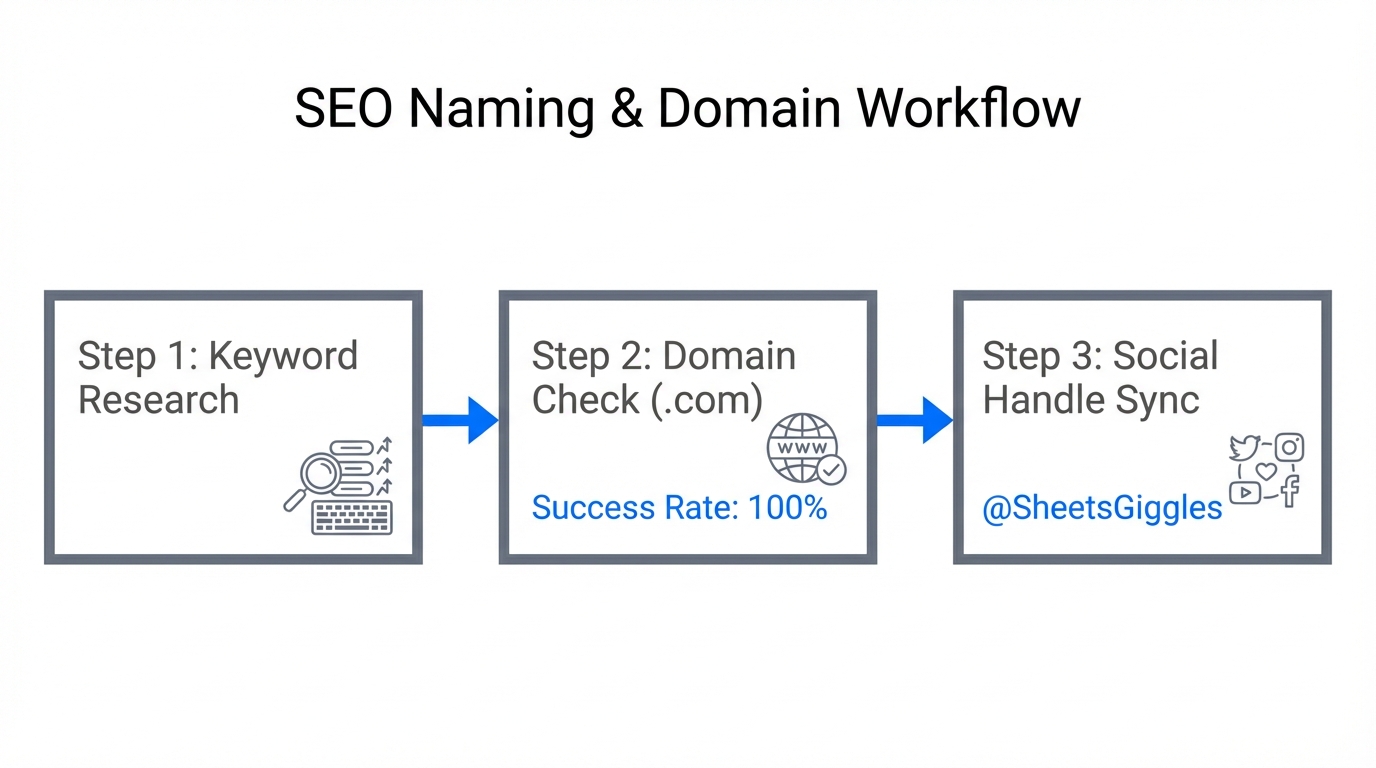
One of the most common mistakes founders make is picking a name that is impossible to rank for. If you name your company "Apple," you’d better have a billion dollars to fight for that keyword. When learning how to name a business for SEO, you must look for "White Space" in the search results.
McIntosh warns against picking words where a competitor or a generic term already dominates the first page of Google. By combining a high-intent keyword ("Sheets") with a unique identifier ("Giggles"), he created a brand name that was easy to own. Within months, searching for "Sheets & Giggles" led directly to his Shopify store, not a Wikipedia page about laughter.
When you are building your brand identity map, run your potential names through keyword research tools or the Google Ads Keyword Planner. If the top results are massive incumbents with high domain authority, keep brainstorming. You want a name that allows you to dominate your own branded search traffic immediately.
Rule 4: The .com Constraint
In the US market, trust is synonymous with .com. While tech startups love .io, .ai, or .co, the average American consumer still views these with a hint of skepticism. McIntosh is adamant: if you are selling a physical product to a mass audience, you need the .com Top-Level Domain (TLD).
"Americans don't buy from anything that's not a .com," McIntosh says. This constraint actually helps your brand naming strategy by forcing you to be creative. If the .com for your primary name is taken by a squatter for $50,000, and you don't have that budget, it’s a sign to pivot the name. A brand like Sheets & Giggles was able to secure its domain early, which instantly lent it the credibility needed to compete with legacy bedding brands.
"A .com is a signal of permanence. It tells the customer you aren't a fly-by-night operation and that their credit card info is safe with you."
Scaling the Brand: Beyond the Name
Once you have the name, the work of ecommerce brand building begins. For Sheets & Giggles, this meant leaning into a distinct brand voice. They don't iron their sheets for photoshoots because they want to look real. They use friends as models because "you can't fake friendship and chemistry." This authentic approach makes their content perfect for platforms like TikTok and Instagram.
To scale to $1.2 million a month, McIntosh also utilized a modern tech stack, including Okendo for reviews and Rebuy for smart upsells. But perhaps most importantly, he focused on building a community through personalized outreach. In the early days, he answered every social media comment and customer care email himself.
As brands grow, maintaining that personal touch becomes harder. Modern growth teams now use AI-powered platforms to maintain that "founder-led" feel at scale. For instance, platforms like Stormy AI streamline creator sourcing and outreach, helping brands discover and vet UGC creators who actually resonate with the brand's unique "punny" or "authentic" voice, ensuring that the outreach stays hyper-personalized even as the creator roster grows into the hundreds.
The Million-Dollar Blueprint: A Summary
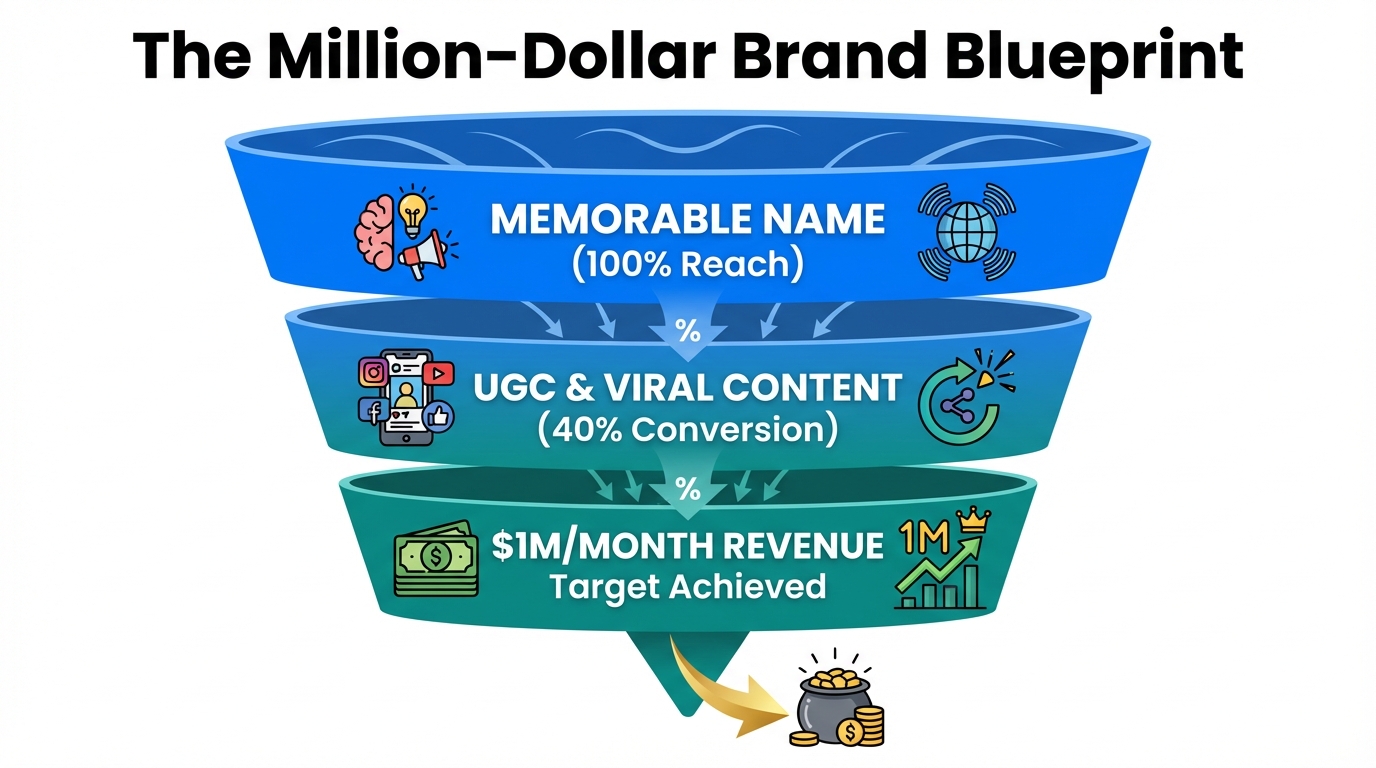
Building a brand that makes $1 million a month while you work from bed (as McIntosh often does) isn't a result of luck. It is the result of a rigorous framework applied to the very first decision you make: the name. By following the spell-sharable-memorable rule, ensuring denotation, optimizing for SEO, and securing a .com, you remove the barriers between your product and your customer.
If you're currently in the "blank page" phase, use tools like ChatGPT or Claude to brainstorm within these four constraints. Once you have a name that sticks, validate it through an email capture campaign, and then use Stormy AI to source the creators who will bring that name to life across social media.
The journey from being laid off to running a multi-million dollar business is paved with smart, early decisions. Start with a name that works as hard as you do.