In the rapidly evolving landscape of 2026 performance marketing, the difference between a profitable campaign and a wasted budget often comes down to the speed of execution. By early 2026, 92% of businesses reported plans to invest heavily in generative AI for marketing, according to the Salesforce State of Marketing report, with the industry growing at a staggering CAGR of 26.7%. For performance marketers, the most significant shift isn't just better copy—it is the move toward autonomous ad management. Using tools like Claude Code, startups are now achieving 20–30% higher ROI than those relying on traditional, manual optimization methods.
The Rise of Agentic Ad Ops: Why Claude Code Changes Everything
Traditional automation in 2024 was largely "if-then" logic. If ROAS drops below 2.0, pause the campaign. If a click-through rate is high, increase the budget. While functional, these rules lack the reasoning required to understand why a campaign is underperforming. Enter Agentic AI. In 2026, research from the Capgemini Research Institute shows that 79% of companies are deploying AI agents that can reason and make nuanced decisions based on multi-dimensional data.
"The shift from simple automation to agentic orchestration means your AI doesn't just follow a trigger; it navigates your entire marketing stack to solve problems before you even notice them."
Claude Code is Anthropic’s command-line interface (CLI) tool that allows marketers and developers to build complex, autonomous workflows. Unlike a standard chatbot, Claude Code can interact directly with your local files, codebases, and—most importantly—APIs. This capability allows for ROAS optimization at a scale that was previously impossible for small teams.
Connecting Claude to the Ad Stack via MCP Servers
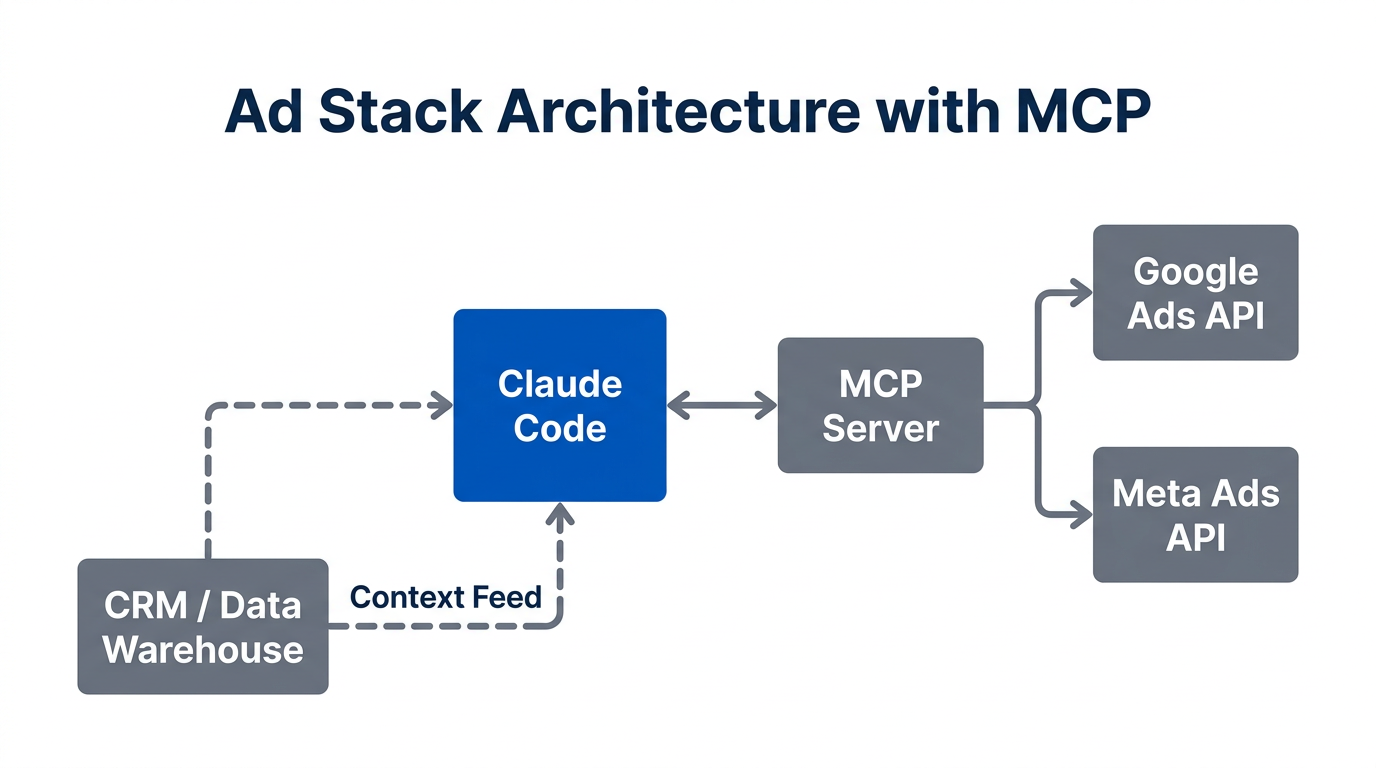
The backbone of autonomous ad management is the Model Context Protocol (MCP). This breakthrough allows Claude to connect directly to external data sources like Meta Ads Manager and Google Ads without the need for cumbersome middleware or manual data exports. By using an MCP server, Claude can fetch real-time performance metrics, analyze them, and execute changes immediately.
How to Set Up Your Real-Time Data Pipeline
- Install the Claude Code CLI: Follow the Claude Code documentation to initialize the environment.
- Integrate MCP Servers: Use pre-built servers for Meta or Google Ads available on GitHub. This gives Claude the "hands" to adjust your campaigns.
- Define Your North Star: Tell Claude your target ROAS and budget constraints. Example: "Maintain a minimum 3.5x ROAS while scaling the daily budget by 10% every 48 hours for top performers."
| Feature | Traditional Automation | Claude Code (Agentic) |
|---|---|---|
| Data Access | Batch exports/API polling | Real-time via MCP |
| Logic | Static If-Then rules | Dynamic reasoning & context |
| Creative Handling | Manual upload | Autonomous script/asset generation |
| Budget Management | Threshold-based | Predictive reallocation |
Playbook: Automating Performance-Driven Budget Reallocation
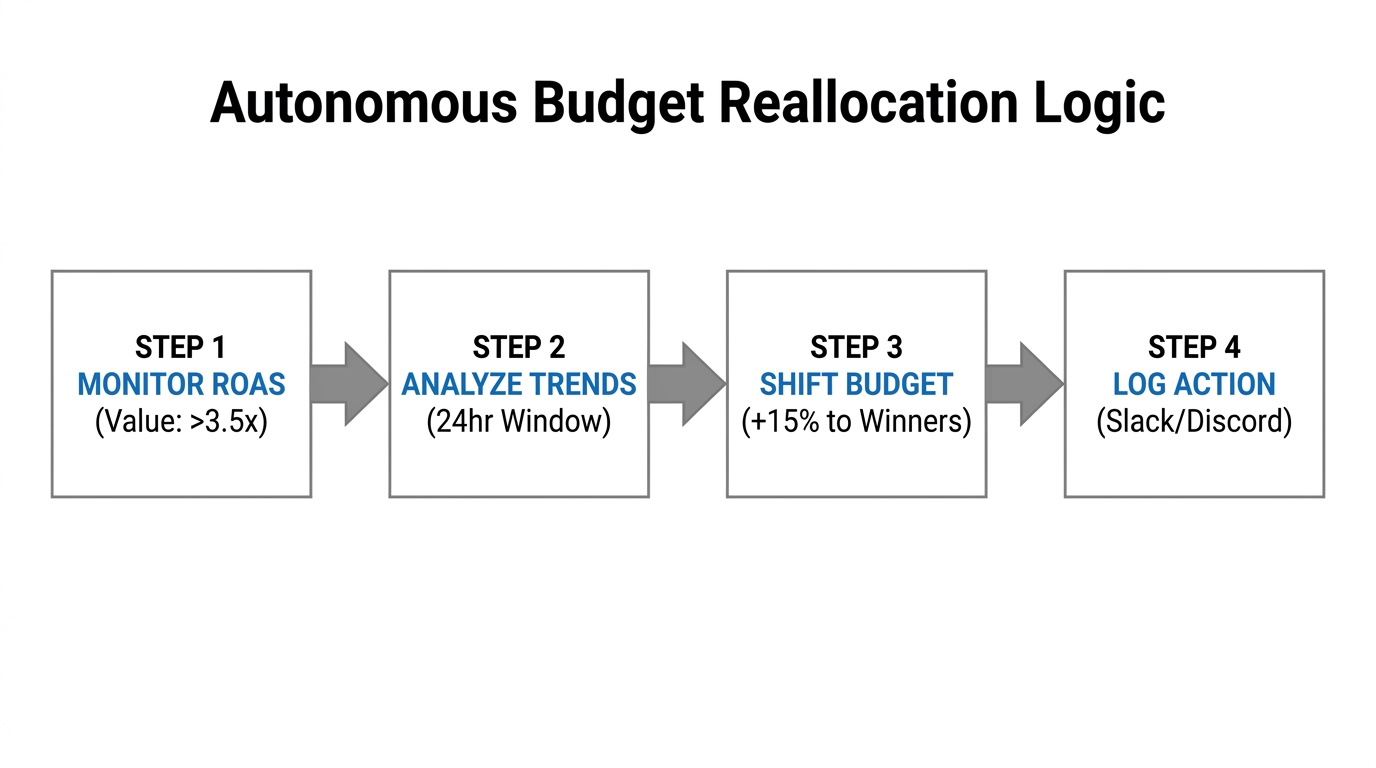
One of the most immediate ways to see a boost in ad spend optimization is through autonomous budget shifting. In a manual setup, a media buyer might check accounts every morning. With Claude Code, the check happens every hour, or even every minute. Data from Taboola shows that the average return for marketing automation is now $5.44 for every $1 spent.
"The goal is to stop 'bleeding' budget on low-performing creative and funnel those dollars into winners in real-time."
Using the Claude CLI, you can run a script that identifies the bottom 20% of campaigns by ROAS and automatically reallocates that capital to the top 2 campaigns. This isn't just a simple shift; Claude can analyze attribution models to ensure that the "low-performing" campaign isn't actually a vital top-of-funnel touchpoint. This level of reasoning prevents the common mistake of killing "assist" campaigns that drive final conversions elsewhere.
Real-World Impact: The Advolve Success Story
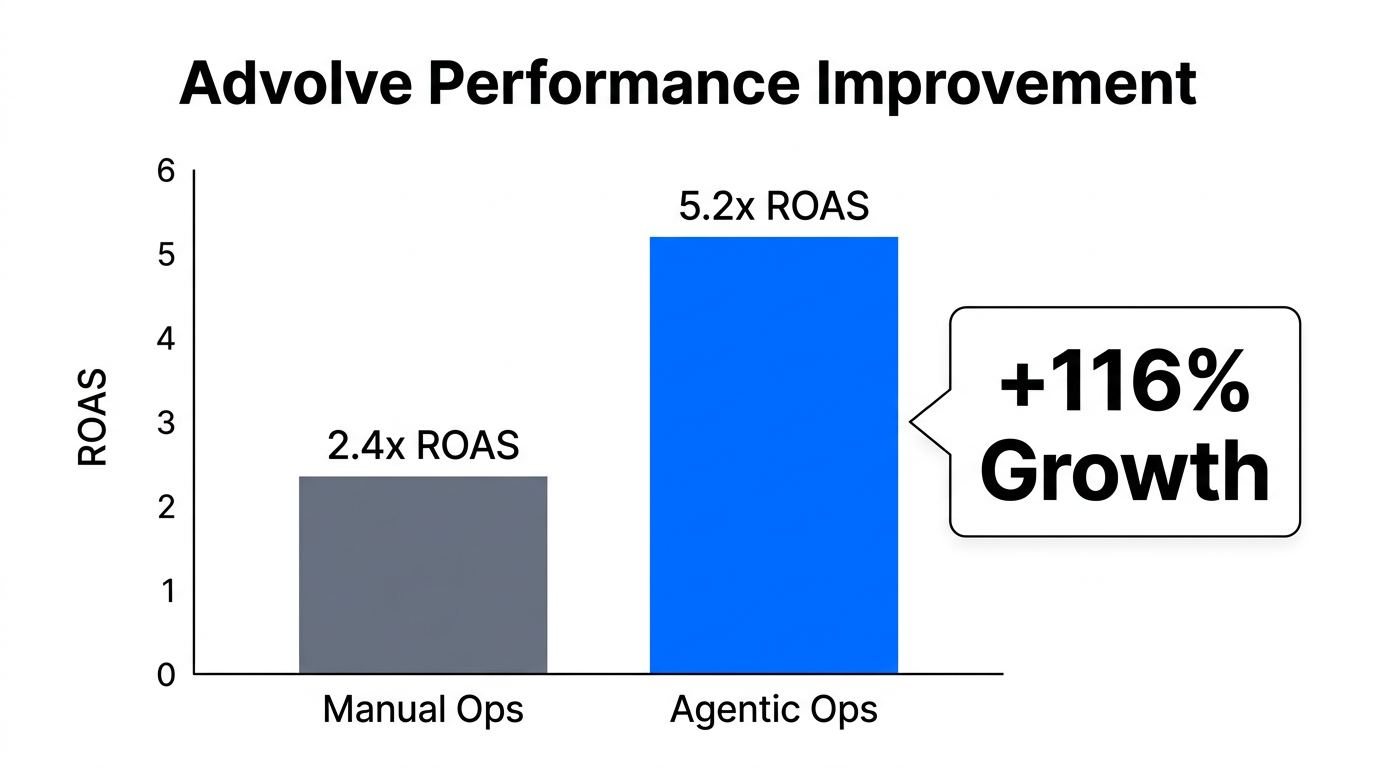
The B2B startup Advolve provides a masterclass in this approach. By using Claude to orchestrate millions of ad variations simultaneously, they achieved a 90% reduction in operational load. Instead of having dozens of account managers manually tweaking bids, Advolve used Claude as a "central brain" to maintain process integrity across massive datasets.
Their implementation went beyond simple bidding. They used Claude for agentic decision making in their creative workflows. Claude would analyze which visual elements were driving the highest engagement and then instruct models like Kling AI or ElevenLabs to generate new variations of the winning creative. This closed-loop system resulted in a 15% increase in ROAS for their clients, proving that AI budget management is most effective when paired with AI-native creative generation.
Process Integrity: Feeding the Machine High-Quality Data
An AI agent is only as effective as the data it consumes. A common mistake in performance marketing automation is using fragmented or outdated CRM data. Poor data hygiene leads to "off-target" creative that can alienate your core audience.
To avoid this, marketers must ensure their first-party data is clean before feeding it into Claude. This involves:
- Real-time CRM Sync: Connect your HubSpot or Pipedrive data directly to your AI workflows.
- Feedback Loops: If a lead is marked as "junk" in your CRM, Claude should automatically deprioritize the audience segments or creative that generated that lead.
- Human-in-the-Loop (HITL): While Claude can automate 90% of the work, high-performing teams still keep a human for final QA on brand-sensitive creative, as noted in recent Nielsen marketing effectiveness studies.
"Data hygiene isn't just about cleaning lists; it's about providing the AI with the semantic context it needs to understand your customer's true intent."
When scaling these autonomous loops, the creative volume required can be immense. This is where platforms like Stormy AI become essential. While Claude manages the budgets and technical shifts, Stormy allows you to discover creators who can provide the authentic, user-generated content (UGC) that high-performance algorithms crave. By feeding human-led UGC into an AI-managed ad machine, you get the best of both worlds: authenticity and efficiency.
Best Practices for Claude-Powered Ad Management
Implementing AI budget management requires a shift in mindset. You are no longer a "button-pusher" but an architect of systems. Follow these best practices to ensure your transition is successful:
Step 1: Start with Validation
Don't let the AI spend your entire budget on day one. Use Claude to write validation scripts first. For example, have Claude check your Google RSA (Responsive Search Ad) copy to ensure every headline meets character limits and brand voice guidelines before exporting a CSV for upload. This reduces errors and saves hours of manual checking, as seen in Anthropic’s internal tests where production time for complex tasks dropped from 30 minutes to 30 seconds.
Step 2: Use Goal-Based Conversational Prompts
Treat Claude as a senior partner. Instead of saying "Optimize ads," use detailed, goal-oriented prompts: "Analyze the performance of our last 14 days of TikTok Ads. Compare the engagement rates of video assets with and without captions. If the 'with captions' group has a 20% higher conversion rate, generate a prompt for our creative team to update all pending assets."
Step 3: Monitor for AI Hallucinations
While Claude is excellent at reasoning, always double-check the final data outputs before making massive budget shifts. Set up automated Slack alerts to notify you whenever the AI makes a budget change exceeding 20% of the account total.
Conclusion: The Future of ROAS is Autonomous
The transition to Claude Code and autonomous ad management is not just a trend; it is a fundamental shift in how performance marketing operates. By leveraging MCP servers for real-time data and using agentic reasoning for budget reallocation, brands can achieve a level of ROAS optimization that was previously reserved for enterprise companies with massive data science teams. Start small by automating your integrity checks, then scale into full autonomous management. The future of your ROAS depends on how quickly you can move from manual workflows to intelligent, agentic systems.